Immune Thrombocytopenia (ITP)
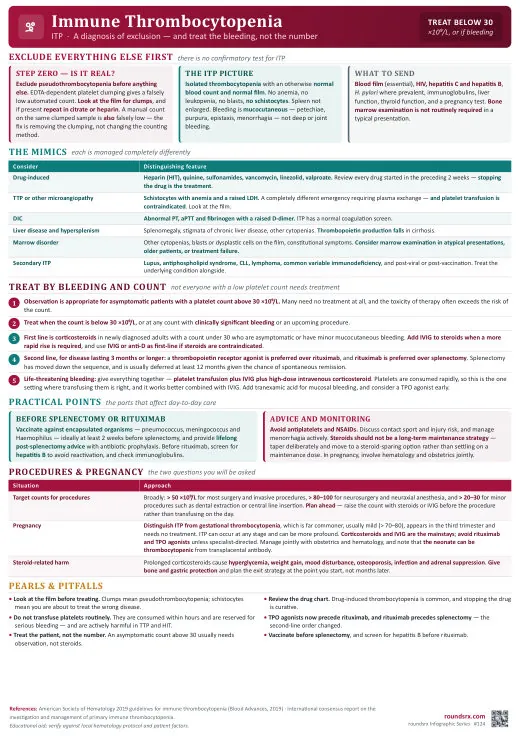
ITP is an autoimmune condition where IgG autoantibodies target platelet surface glycoproteins (GPIIb/IIIa, GPIb/IX), leading to splenic phagocytosis and accelerated platelet destruction. It is a diagnosis of exclusion -there is no confirmatory test. Incidence: ~3-4/100,000 adults/year. Primary ITP (80%) has no identifiable cause. Secondary ITP (20%) is associated with SLE, HIV, HCV, H. pylori, CLL, or medications (heparin → HIT, not ITP). Key principle: treat the patient, not the number. Many patients tolerate platelets of 20-30K without significant bleeding.
- CBC with peripheral smear -isolated thrombocytopenia with large platelets (young, reactive). All other cell lines normal. If pancytopenia → think MDS, aplastic anemia, infiltrative process.
- Peripheral smear -must review. Rules out pseudothrombocytopenia (platelet clumping from EDTA -redraw in citrate tube), schistocytes (TTP/HUS), blasts (leukemia), leukoerythroblastic picture (marrow infiltration).
- HIV, HCV -required in all new ITP (secondary causes that change management)
- H. pylori testing -stool antigen or breath test. Eradication can improve platelet count.
- Direct Coombs (DAT) -Evans syndrome = autoimmune hemolytic anemia + ITP. If DAT positive → treat as Evans.
- Immunoglobulins (quantitative Ig) -CVID can present with ITP
- ANA -if SLE suspected (young woman with ITP)
- Coags (PT/INR, aPTT) -should be normal. If abnormal → think DIC, liver disease, factor deficiency.
- Bone marrow biopsy -NOT routine for typical ITP. Indicated if: age > 60 (rule out MDS), atypical features (other cytopenias, splenomegaly, lymphadenopathy), or refractory to first-line therapy.
- Confirm on the peripheral smear (the diagnostic manual step), platelet clumps, classically at the feathered edge. Seeing clumps tells you the automated count is spurious.
- Can you just do a manual count? Only on a non-clumped specimen. A manual hemocytometer count run on the same clumped EDTA tube is also falsely low, because aggregated platelets cannot be counted as singles by any method, automated or manual. The clumps have to be prevented first.
- Get an accurate count by removing the clumping: redraw in sodium citrate (blue top) and multiply the result by 1.1 to correct for the citrate dilution; or use heparin (green top); and/or warm the sample to 37°C and run promptly (some cases are cold-dependent). Then either automated or manual counting is reliable.
- Why it matters: mistaking pseudothrombocytopenia for true thrombocytopenia leads to unnecessary platelet transfusions, steroids, marrow biopsies, and held anticoagulation. The fix is changing the tube, not treating the patient.
- Observation only if platelets ≥ 30K and no bleeding and no upcoming procedures -most patients don't need treatment. ASH Guidelines, 2019
- First-line -Corticosteroids:
- Dexamethasone 40 mg PO daily × 4 days -preferred by many experts. Faster response, shorter course. Can repeat q2-4 weeks × 3-4 cycles. Wei, 2016
- Prednisone 1 mg/kg daily × 2-4 weeks → taper. Classic approach. Response in 70-80% but relapse rate ~60-80% after taper.
- First-line adjunct -IVIG 1g/kg × 1-2 days: for active bleeding or platelets < 10K or pre-procedure. Fastest response (24-48h) but transient (2-4 weeks). Fc receptor blockade → reduced splenic phagocytosis.
- Anti-D (WinRho) 50-75 mcg/kg IV: only for Rh-positive, non-splenectomized patients. Causes mild extravascular hemolysis that "distracts" the spleen. FDA black box: rare fatal intravascular hemolysis.
- Second-line -TPO receptor agonists: Eltrombopag 50 mg PO daily or Romiplostim 1-10 mcg/kg SQ weekly. Stimulate megakaryopoiesis. ~80% response. Maintenance therapy -platelets drop when stopped. RAISE, 2011; EXTEND
- Second-line -Rituximab 375 mg/m² weekly × 4: ~60% initial response but only ~20-30% sustained at 5 years. Best in younger patients with short disease duration.
- Second-line -Fostamatinib (SYK inhibitor): 100-150 mg BID PO. For refractory ITP. FIT, 2018
- Third-line -Splenectomy: ~65% long-term remission. Defer at least 12-24 months (spontaneous remission possible). Requires pre-op vaccines (pneumococcal, meningococcal, Hib) ≥ 2 weeks before surgery.
- Emergency bleeding: Platelets + IVIG + methylprednisolone 1g IV + aminocaproic acid (antifibrinolytic). Consider emergent splenectomy if refractory.
| Drug | Dose | Route | Notes |
|---|---|---|---|
| Dexamethasone | 40 mg daily × 4 days | PO | Preferred first-line. Can repeat q2-4 wk. Wei, 2016 |
| Prednisone | 1 mg/kg × 2-4 wk → taper | PO | Alternative first-line. 70-80% response. High relapse on taper. |
| IVIG | 1 g/kg × 1-2 days | IV | Fastest response (24-48h). For bleeding or plt < 10K. Transient. Monitor for infusion reactions, aseptic meningitis. |
| Eltrombopag | 50 mg daily (titrate 25-75) | PO | TPO-RA. Response in 1-2 wk. Monitor LFTs. Take on empty stomach (no dairy/Ca). RAISE, 2011 |
| Romiplostim | 1-10 mcg/kg weekly | SQ | TPO-RA. Titrate by platelet response. Risk of marrow reticulin fibrosis (reversible). |
| Rituximab | 375 mg/m² weekly × 4 | IV | Anti-CD20. 60% initial response, ~25% durable at 5y. Check HBV before. Arnold, 2007 |
| Fostamatinib | 100-150 mg BID | PO | SYK inhibitor for refractory ITP. SE: diarrhea, HTN, LFT elevation. FIT, 2018 |
| Aminocaproic acid | 4-5g load → 1g/hr | IV/PO | Antifibrinolytic for emergency bleeding. Adjunct to platelets. |
Mrs. Patel is a 34-year-old woman presenting with 3 days of spontaneous bruising and petechiae on bilateral lower extremities. No mucosal bleeding, no epistaxis, no hemoptysis, no melena. No recent illness or new medications. No joint pains or rash. VS stable. Exam: scattered petechiae on shins, no splenomegaly, no lymphadenopathy. Labs: platelets 8K (previously normal 6 months ago), Hgb 13.2, WBC 6.8, peripheral smear shows large platelets with no schistocytes/blasts. PT/INR normal. HIV negative, HCV negative, H. pylori stool antigen negative. DAT negative.
Patient: 28F with petechiae on legs, gum bleeding, and menorrhagia × 1 week. Platelets 8K. WBC and Hgb normal. Smear: large platelets, no schistocytes. No splenomegaly. No meds.
Key findings: Isolated thrombocytopenia in a young woman with no other cytopenias and normal smear = classic ITP. Large platelets = increased marrow production (compensatory). No schistocytes rules out TTP/HUS.
Management:
- Dexamethasone 40 mg daily × 4 days (preferred over prednisone taper, faster response, shorter course)
- IVIG 1 g/kg × 1-2 days if wet purpura or active mucosal bleeding (raises platelets within 24-48h)
- Avoid platelet transfusion unless life-threatening bleeding (transfused platelets destroyed immediately)
- Hold anticoagulants, avoid NSAIDs, IM injections, contact sports
- Check HIV, HCV, H. pylori (treatable causes of secondary ITP)
Teaching point: ITP is a diagnosis of exclusion, there is no confirmatory test. The goal is NOT a normal platelet count; it's a safe count (≥ 30K in most patients). Overtreating asymptomatic mild ITP causes more harm than the disease.
Patient: 52F with ITP × 3 years. Failed steroids (relapsed after taper × 3), failed rituximab. Currently on romiplostim 5 mcg/kg weekly, platelets fluctuate 15-40K. Now needs hip replacement. Surgeon wants platelets > 50K.
Key findings: Chronic refractory ITP requiring pre-surgical platelet optimization. Bone marrow biopsy showed megakaryocytic hyperplasia (appropriate for ITP). No MDS features.
Management:
- Increase romiplostim to 8-10 mcg/kg weekly (titrate to target > 50K for surgery)
- Add IVIG 1 g/kg 1-2 days pre-op for rapid temporary boost
- Platelet transfusion available in OR (transfuse only for active surgical bleeding)
- Consider eltrombopag 50-75 mg daily as add-on or alternative TPO-RA
- TXA 1g IV pre-op + 1g q8h × 3 days post-op (antifibrinolytic, reduces surgical bleeding)
Teaching point: TPO receptor agonists (romiplostim, eltrombopag) are the backbone of chronic ITP management. They work in ~80% of patients but require ongoing therapy, platelets drop when stopped. For surgery, combine TPO-RA dose escalation + IVIG for reliable platelet elevation.
Patient: 65M with known ITP (non-compliant with eltrombopag). Presents with sudden severe headache, vomiting, right hemiplegia. CT head: left basal ganglia hemorrhage with midline shift. Platelets 3K.
Key findings: ICH in the setting of severe thrombocytopenia, life-threatening emergency. Mortality of ICH with plt < 10K approaches 50%. This is one of the few situations where platelet transfusion is indicated in ITP.
Management:
- Platelet transfusion: 2-3 adult doses STAT (even though destroyed rapidly, provides temporary hemostasis)
- IVIG 1 g/kg IV STAT (raises endogenous platelets within 24-48h by blocking Fc receptors on splenic macrophages)
- Methylprednisolone 1g IV daily × 3 days
- TXA 1g IV (antifibrinolytic, stabilizes existing clot)
- Emergent neurosurgery consult for possible decompressive craniotomy
Teaching point: ICH is the most feared complication of ITP (< 1% but devastating). In this scenario, transfuse platelets despite ITP, the immediate hemostatic need outweighs the short platelet lifespan. Combine with IVIG and steroids for sustained response.
- Platelet count -q1-2 days during active treatment; weekly during titration; monthly once stable. Goal: ≥ 30K (not "normal").
- Bleeding assessment -skin (petechiae, purpura, ecchymoses), mucosal (oral blood blisters = "wet purpura" = higher bleed risk), menorrhagia, epistaxis, GI, intracranial
- Blood glucose -while on steroids (dexamethasone/prednisone)
- LFTs -q2-4 weeks on eltrombopag (hepatotoxicity risk)
- CBC with differential -monitor for new cytopenias (would suggest secondary cause or MDS)
- Reticulin fibrosis -consider bone marrow biopsy if on TPO-RA > 1 year (rare reversible marrow fibrosis)
- Infection screening -on immunosuppression (rituximab, chronic steroids). HBV reactivation monitoring with rituximab.