Legionnaires' Disease (Legionella)
| Source | Detail | Why it matters to you |
|---|---|---|
| Aerosolized potable water showers, faucets, humidifiers | Legionella colonizes building plumbing, especially where water sits warm and stagnant. Inhalation of aerosol, or aspiration of colonized water, delivers the organism to the lower airway. | Ask where the patient has been sleeping. Hotels, cruise ships, long-term care facilities and recently reopened buildings are the recurring histories. |
| Cooling towers | Large air-conditioning cooling towers aerosolize water over a wide area and are the classic driver of community outbreaks clustered around a single building. | A second case from the same postcode within weeks is an outbreak until public health says otherwise. |
| Hot tubs and decorative fountains | Warm, agitated, heavily aerosolized water is close to ideal growth conditions. | Specifically ask about hot tub use, including on a cruise or at a hotel. Patients do not volunteer it. |
| Hospital water systems | Causes genuinely hospital-acquired Legionella. Onset ≥ 48 hours after admission with no other exposure implicates the building. | A nosocomial case is a mandatory, urgent report -it means other inpatients are being exposed right now. |
| Potting soil and compost not water | The route for L. longbeachae, which is soil-adapted rather than water-adapted and is a major cause in Australia and New Zealand. | The urine antigen misses this species entirely. Gardening exposure plus a negative urine antigen is exactly when you need culture or PCR. |
- Age over 50 and male sex -consistently the largest demographic signal.
- Current or former smoking and chronic lung disease -impaired mucociliary clearance and macrophage function.
- ⚠ Immunosuppression, especially TNF-alpha inhibitors and systemic glucocorticoids -cell-mediated immunity is what contains an intracellular pathogen, so drugs that blunt it convert exposure into severe disease. Solid organ and stem cell transplant recipients are the highest-risk group and are also the group in whom you should extend treatment duration.
- Malignancy, diabetes, chronic kidney or liver disease, alcohol use disorder, iron overload.
| Feature | What you see | Why it happens / how to use it |
|---|---|---|
| High fever with rigors | Often > 39°C, with prominent malaise, headache and myalgia that can precede any respiratory complaint. | Patients are frequently labelled "viral illness" at first contact because the cough is mild and dry early on. |
| Diarrhea, nausea, vomiting | Watery diarrhea in roughly a quarter to half of cases. | GI symptoms dominating a pneumonia presentation should raise Legionella, and they are a common reason the chest is not examined early. |
| Confusion, headache, lethargy | Encephalopathy out of proportion to hypoxemia; occasionally ataxia. | Easily attributed to age or sepsis. In a febrile patient with an infiltrate, it should prompt the urine antigen rather than a head CT alone. |
| Hyponatremia | Often the most reproducible laboratory clue, and more frequent than in other causes of CAP. | Driven by SIADH. Still not specific enough to act on alone, but a low sodium plus severe CAP is a good reason to send the antigen. See Hyponatremia →. |
| Transaminitis, hypophosphatemia | Mild AST and ALT elevation, commonly around twice normal. Low phosphate is described as a supportive clue. | Part of the systemic picture. Recheck rather than chase, since both usually resolve with treatment. |
| Elevated CK, myoglobinuria, AKI | Rhabdomyolysis is a recognized complication and can be the reason for the renal failure. | Send a CK in severe Legionella -missing rhabdomyolysis means missing a treatable driver of AKI. See Rhabdomyolysis →. |
| Relative bradycardia Faget sign | A pulse lower than the fever predicts. Expect the heart rate to rise roughly 10 bpm for every 1°F of fever (Liebermeister's rule), which gives the expected pulse at each temperature below. A pulse under the figure for that temperature is relative bradycardia. 102°F (38.9°C) → 110 · 103°F (39.4°C) → 120 · 104°F (40.0°C) → 130 · 105°F (40.6°C) → 140 · 106°F (41.1°C) → 150 | ⚠ The number only means anything if Cunha's conditions hold: age ≥ 13, temperature 102 to 106°F, pulse and temperature taken at the same moment, normal sinus rhythm, and no beta-blocker, pacemaker, or second/third-degree block. Ignore those and you are simply describing a rate-controlled patient. Even when they hold it is overemphasized -its absence does not reassure, and its presence never substitutes for a test. |
| Legionnaires' disease | Pontiac fever | |
|---|---|---|
| What it is | Pneumonia, with an infiltrate on imaging. | Self-limited influenza-like illness with NO pneumonia. |
| Incubation | 2 to 14 days, usually 5 to 6. | Hours to about 3 days -much shorter. |
| Course | Can be fatal. Requires antibiotics. | Resolves on its own in days. |
| Treatment | Fluoroquinolone or azithromycin. | None. Supportive care only -antibiotics have no established role in a self-limited illness with no pneumonia. |
| Reporting | Notifiable. | Also notifiable -it flags the same contaminated water source, and often the same outbreak. |
- Severe CAP, particularly anyone requiring ICU admission -this is the group where a missed diagnosis is lethal and where the pretest probability is highest. See Severe CAP criteria →.
- ⚠ Failure to improve on a beta-lactam -because a beta-lactam was never treating it, apparent "antibiotic failure" is one of the strongest clues you will get.
- Epidemiological exposure: recent travel or hotel stay, cruise ship, hot tub, known outbreak, or a recent stay in a building with a suspect water system.
- Onset ≥ 48 hours after hospital admission, which raises the question of the hospital water supply.
- Immunocompromised hosts, especially on TNF-alpha inhibitors, glucocorticoids, or post-transplant.
| Test | Performance | What it is good for, and where it fails |
|---|---|---|
| Urinary antigen first-line, order it now | Sensitivity ~70 to 80% Specificity > 99% | Fast, cheap, and positive as early as 1 day after symptom onset, so it is the test that changes management today. Crucially, it stays positive for weeks (sometimes far longer) and is NOT blunted by antibiotics -so unlike blood cultures, you have not lost anything by having started treatment first. That same persistence is its other limitation: a positive result can reflect an infection from weeks or months ago, so interpret it against the current illness. Detects serogroup 1 only. |
| Lower respiratory culture BCYE agar | Variable sensitivity; reference standard | Requires buffered charcoal yeast extract (BCYE) agar with L-cysteine -Legionella will not grow on routine media, so the laboratory must be told you suspect it or the right plate is never set up. This is the only test that yields an isolate, and the isolate is what lets public health match the patient's strain to a specific cooling tower or building. Ordering it is what turns one case into a prevented outbreak. |
| PCR / NAAT lower respiratory specimen | Sensitivity exceeds culture Specificity > 99% | Detects species and serogroups the urine antigen cannot, with results in hours rather than days. This is the test that rescues the serogroup-1 blind spot, so it is the right next step when suspicion stays high after a negative antigen. Availability varies by institution, which is worth knowing before you need it at 2am. |
| Serology paired titers | Requires a 4-fold rise over weeks | Retrospective and epidemiological only. A single acute titer is uninterpretable, and by the time convalescent serology returns the patient has been discharged or died. Do not order it to make a treatment decision. |
| Gram stain | Supportive, never confirmatory | Abundant neutrophils with no visible organisms is the classic and genuinely useful pattern, because Legionella stains poorly. It is a nudge toward an atypical or intracellular pathogen, not a diagnosis. |
- ⚠ Radiographic worsening during the first days of correct treatment is expected and is not treatment failure. The film characteristically lags the patient. Judge response by fever curve, oxygen requirement and mental status, not by a repeat chest film, or you will abandon a working antibiotic.
- Resolution is slow, often taking weeks to a couple of months. Warn the patient at discharge so a persistent shadow does not trigger an unnecessary cancer workup, and so they are not alarmed by ongoing fatigue.
| Drug | Dose | Notes and cautions |
|---|---|---|
| Levofloxacin most commonly used | 750 mg IV or PO daily (500 mg daily is an accepted alternative, usually with a longer course) | Excellent oral bioavailability, so IV to PO switch needs no dose change once the patient is stable and absorbing. Watch QT prolongation, tendinopathy, aortic events and CNS effects; check for interacting agents and avoid co-administration with divalent cations, which block absorption. |
| Moxifloxacin | 400 mg IV or PO daily | Equivalent option. Not renally dosed (hepatic conjugation), which makes it convenient in AKI, but it achieves poor urinary concentrations so it is a bad choice if a urinary source is also in play. See how the fluoroquinolones differ → |
| Azithromycin | 500 mg IV or PO daily | The agent already present in most empiric CAP regimens, so the patient may effectively be on treatment before the diagnosis is made. Long half-life allows a shorter course. Preferred over a fluoroquinolone in pregnancy and in patients where fluoroquinolone toxicity is a real concern. |
| Doxycycline | 100 mg PO BID | Alternative for mild, outpatient-managed disease only. Weaker supporting evidence than the fluoroquinolones and macrolides; do not use it in severe or immunocompromised disease. |
| Evidence | Finding | Interpretation |
|---|---|---|
| Meta-analysis favoring fluoroquinolones Kato meta-analysis, 2021 | 5 RCTs plus 12 retrospective studies. Mortality OR 0.59 (95% CI 0.35 to 0.98) favoring fluoroquinolones, with shorter length of stay. But in the levofloxacin-specific subgroup, only length of stay improved -mortality did not differ. | The mortality signal is borderline (upper confidence limit 0.98) and does not survive intact in the subgroup that matters most, since levofloxacin is the fluoroquinolone actually used. |
| Meta-analysis finding no difference Jasper meta-analysis, 2021 | 21 publications, 3,525 patients. Mortality 6.9% with fluoroquinolones vs 7.4% with macrolides, OR 0.94 (95% CI 0.71 to 1.25), p = 0.66. No significant difference. | Larger, more recent, and the confidence interval is tight around no effect. This is the more reassuring dataset if you are choosing azithromycin. |
| Situation | Duration | Why |
|---|---|---|
| Immunocompetent, mild to moderate, responding well | 5 to 10 days (azithromycin at the shorter end) | Azithromycin's long intracellular half-life means drug persists at the site of infection after the last dose, so a 5 to 7 day course delivers longer effective exposure than the calendar suggests. |
| Severe disease, ICU admission | 7 to 10 days, extend if slow to respond | Higher organism burden and slower clearance. Start IV in severe disease rather than relying on oral absorption in a shocked or vomiting patient, then switch once stable. |
| ⚠ Immunocompromised transplant, TNF-alpha inhibitor, high-dose steroids | 14 to 21 days | Relapse after a short course is the specific failure mode here, because clearing an intracellular pathogen depends on the cell-mediated immunity these patients lack. This is the single most important duration adjustment on the page. |
| Cavitation, lung abscess, empyema, or extrapulmonary disease | At least 21 days | Poor drug penetration into necrotic or walled-off tissue, and a correspondingly high relapse rate with standard courses. |
"Mr. R is a 61-year-old smoker with COPD, admitted three days ago with community-acquired pneumonia and started on ceftriaxone and azithromycin. Overnight the azithromycin was held for a QTc of 480, and this morning he is more confused, febrile to 39.2, and his oxygen requirement has gone from 2 to 6 liters. His sodium is 128, AST and ALT are roughly twice normal, and he has had watery diarrhea since admission. He also spent five nights in a hotel the week before he became unwell.
My concern is Legionella. The picture fits, but more importantly he has effectively been on beta-lactam monotherapy since the azithromycin was stopped, and a beta-lactam has no activity against Legionella at all, so what looks like clinical deterioration on treatment may simply be untreated infection. I have sent a urine antigen and a sputum specimen for Legionella culture on BCYE and PCR, and I have specifically flagged Legionella to the lab so the right medium is used. I am starting levofloxacin 750 mg IV daily rather than restarting azithromycin, which handles the QT problem and treats Legionella at the same time. I have sent a CK given the risk of rhabdomyolysis with his rising creatinine. If the urine antigen is negative I will not stop the levofloxacin, because the antigen only detects serogroup 1. If it is confirmed, this is notifiable, so I will report it and give public health the hotel dates, since the isolate may let them match it to a source."
- ⚠ Exposure history taken with dates -hotels, cruises, hot tubs, recent building works, gardening and potting soil, covering the 2 to 14 days before onset.
- Urine antigen sent in severe CAP, ICU admission, beta-lactam failure, or any epidemiological risk factor.
- ⚠ Lower respiratory specimen sent for culture and PCR as well, with Legionella flagged explicitly to the laboratory so BCYE agar is used.
- An agent with real activity is actually running -fluoroquinolone or macrolide, confirmed on the current MAR, not just written in the plan.
- ⚠ Check nobody has "narrowed" to a beta-lactam alone, and specifically check whether the macrolide was quietly held for QT.
- Sodium, LFTs, phosphate, creatinine and CK sent, with CK repeated if creatinine is climbing.
- Duration set deliberately, extended to 14 to 21 days if immunocompromised and documented with the reason.
- Team warned not to react to the day-3 film, since early radiographic worsening is expected.
- ⚠ Case reported to public health, and infection prevention notified if onset was ≥ 48 hours after admission.
- Patient counselled at discharge that fatigue and residual radiographic changes take weeks to months to clear, so neither prompts alarm.
| Point | Detail |
|---|---|
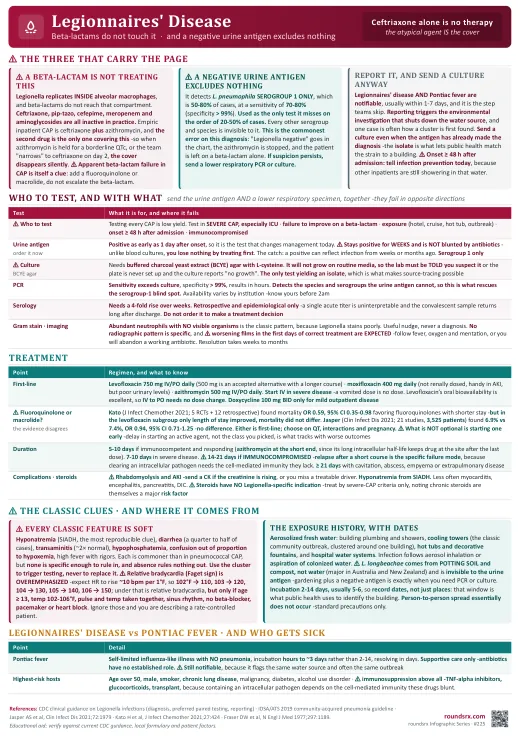
| ⚠ Beta-lactams do not work | Legionella lives inside alveolar macrophages, which beta-lactams and aminoglycosides do not penetrate. Ceftriaxone monotherapy is no therapy. Apparent beta-lactam failure in CAP is itself a clue. |
| The exposure | Aerosolized water: cooling towers, hotel and hospital plumbing, hot tubs, decorative fountains. Incubation 2 to 14 days, usually 5 to 6. L. longbeachae comes from potting soil instead. No person-to-person spread, so no isolation needed. |
| Highest-risk hosts | Age over 50, male, smoker, chronic lung disease, and above all immunosuppression -TNF-alpha inhibitors, glucocorticoids, transplant. |
| ⚠ The classic clues are soft | Hyponatremia (SIADH), diarrhea, transaminitis, confusion, high fever. More common than in other CAP but individually non-specific, and absence excludes nothing. Relative bradycardia is overemphasized. Use them to trigger testing, not to replace it. |
| ⚠ Negative urine antigen excludes nothing | Detects serogroup 1 only (50 to 80% of cases), sensitivity 70 to 80%, specificity > 99%. Sole use misses 20 to 50% of cases. |
| Antigen timing is forgiving | Positive as early as 1 day after symptom onset, stays positive for weeks, and is not blunted by antibiotics -so treat first, test after. The same persistence means a positive can reflect an older infection. |
| ⚠ Send culture too | BCYE agar with L-cysteine, and tell the lab or the plate is never set up. Culture and PCR catch the species the antigen misses, and the isolate is what lets public health find the water source. |
| Serology is useless acutely | Needs a 4-fold rise over weeks. Epidemiological tool only, never a treatment decision. |
| Treatment | Levofloxacin 750 mg daily, moxifloxacin 400 mg daily, or azithromycin 500 mg daily. Doxycycline only for mild outpatient disease. IV first in severe disease, then switch. |
| FQ vs macrolide: unsettled | Kato, 2021 found OR 0.59 (0.35 to 0.98) favoring fluoroquinolones, but the levofloxacin subgroup showed only a length-of-stay benefit. Jasper, 2021, larger at 3,525 patients, found no mortality difference (6.9% vs 7.4%, OR 0.94). Either is first-line; starting early matters more than choosing. |
| ⚠ Duration | 5 to 10 days immunocompetent and responding. 14 to 21 days if immunocompromised. ≥ 21 days with cavitation, abscess, empyema or extrapulmonary disease. Relapse is the short-course failure mode. |
| Do not chase the film | Radiographic worsening early in correct treatment is expected. Follow fever, oxygen and mentation. Resolution takes weeks to months, so warn the patient. |
| Complications | Rhabdomyolysis and AKI (send a CK), hyponatremia, and less often myocarditis, encephalitis, pancreatitis, DIC. Steroids have no Legionella-specific role -treat per severe CAP criteria only. |
| ⚠ It is notifiable | Report Legionnaires' disease and Pontiac fever to public health, usually within 1 to 7 days. Reporting is what shuts down the water source. Nosocomial onset (≥ 48 hours) means telling infection prevention today. |
| Pontiac fever | Self-limited flu-like illness with NO pneumonia, incubation hours to 3 days. Supportive care, no antibiotics -but still report it. |
- The beta-lactam is not treating this. If a CAP patient is deteriorating on ceftriaxone, do not escalate the beta-lactam. Add a fluoroquinolone or macrolide and check whether someone quietly stopped the azithromycin.
- A negative urine antigen is not a negative result. It sees serogroup 1 and nothing else. If suspicion is real, send a lower respiratory culture on BCYE and a PCR, and tell the lab what you are looking for.
- Report it, and send the culture anyway. The patient is a sentinel for a water system that is still running, and the isolate is what lets public health find it.