Acute Leukemia (AML / ALL)
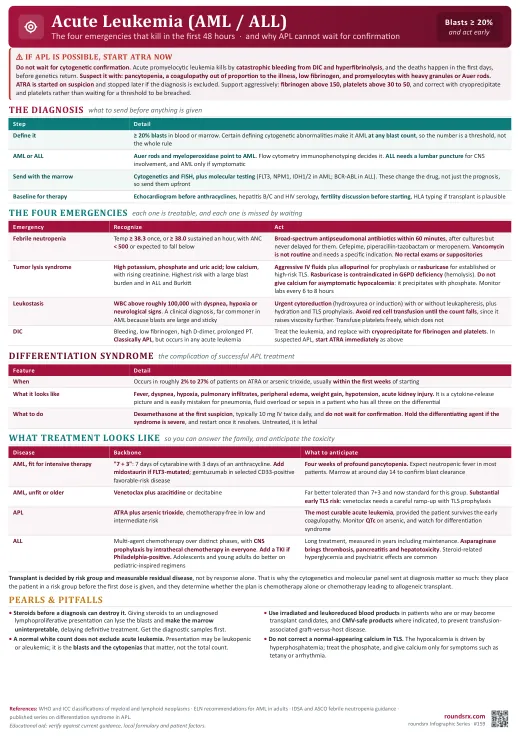
Acute leukemia = rapid clonal expansion of immature hematopoietic cells (blasts) in the bone marrow, spilling into blood. AML (acute myeloid): median age 68, most common adult acute leukemia. ALL (acute lymphoblastic): bimodal -peak in children 2-5y + second peak > 60y. Diagnosis: ≥ 20% blasts in marrow or blood (WHO). Exception: AML with recurrent genetic abnormalities (e.g. t(8;21), inv(16)) can be diagnosed at any blast %. APL (acute promyelocytic leukemia, M3): medical emergency -presents with severe DIC. Treat with ATRA immediately on suspicion, before confirmation. The intern's role: you will not choose chemo regimens -you WILL manage TLS prevention, febrile neutropenia, DIC, transfusion, electrolytes, and pain.
- CBC with differential + peripheral smear -blasts (≥ 20%), may see Auer rods (AML, especially APL). WBC can be markedly elevated (leukostasis risk if > 100K) or low (aleukemic leukemia).
- Bone marrow biopsy + aspirate -definitive. Send: morphology, flow cytometry (lineage: myeloid vs lymphoid), cytogenetics (karyotype), FISH (specific translocations), molecular testing (FLT3, NPM1, IDH1/2, TP53 for AML; BCR-ABL for ALL).
- Coags + fibrinogen -DIC screen (especially APL). If DIC + blasts → start ATRA immediately.
- BMP + uric acid + LDH + phosphate -TLS risk assessment
- G6PD -before rasburicase
- Type & screen -will need multiple transfusions
- HLA typing -early if transplant candidate (start sibling/unrelated donor search)
- Lumbar puncture -ALL requires CNS staging (LP with intrathecal chemotherapy). AML: LP only if CNS symptoms.
- Echo -baseline EF before anthracycline-containing induction
- Infectious workup -blood/urine cultures, CXR, consider fungal markers if prolonged neutropenia expected
- APL (M3 AML) -EMERGENCY: Start ATRA (all-trans retinoic acid) immediately if APL suspected (Auer rods, DIC, promyelocytic morphology). Do NOT wait for FISH confirmation. ATRA + arsenic trioxide (ATO) cures > 90% of APL. Lo-Coco, 2013
- AML induction: "7+3" -cytarabine 7 days + daunorubicin 3 days. Targeted: add midostaurin if FLT3+ RATIFY, 2017, gemtuzumab ozogamicin if CD33+ favorable risk. Unfit elderly: azacitidine + venetoclax VIALE-A, 2020.
- ALL induction: Multi-agent (vincristine, prednisone, daunorubicin, asparaginase ± cyclophosphamide). Ph+ ALL: add dasatinib or ponatinib (TKI) [GRAAPH-2005]. CNS prophylaxis with intrathecal methotrexate.
- Consolidation → Transplant: Intermediate/high-risk AML and high-risk ALL → allogeneic stem cell transplant in CR1.
- Intern-managed complications:
- TLS prevention: Aggressive IVF + allopurinol (prophylaxis) or rasburicase (treatment/high-risk). Check TLS labs q6-8h.
- Leukostasis (WBC > 100K): Emergent leukapheresis + hydroxyurea 50-100 mg/kg. Symptoms: dyspnea, confusion, visual changes (WBC plugging microvasculature).
- DIC: Aggressive blood product support (cryoprecipitate for fibrinogen < 100-150, platelets for < 50K with bleeding). Treat the leukemia (definitive DIC treatment).
- Febrile neutropenia: Cefepime or meropenem within 1 hour. See neutropenic fever protocol.
- Transfusion: pRBC for Hgb < 7-8. Platelets for < 10K (prophylactic) or < 50K with bleeding. Irradiated + leukoreduced products.
| Drug | Dose | Route | Notes |
|---|---|---|---|
| ATRA (tretinoin) | 45 mg/m²/day divided BID | PO | APL -start immediately on suspicion. Differentiates promyelocytes. Risk: differentiation syndrome (fever, dyspnea, edema, pleural effusion) → dexamethasone 10 mg BID. Lo-Coco, 2013 |
| Arsenic trioxide | 0.15 mg/kg IV daily | IV | APL (with ATRA). Cure rate > 90%. QTc monitoring (arrhythmia risk). Hepatotoxicity. |
| Cytarabine (Ara-C) | 100-200 mg/m²/day × 7d (induction) | IV | Backbone of AML "7+3." High-dose for consolidation. Cerebellar toxicity at high dose (check cerebellar function daily). |
| Venetoclax | 400 mg daily (after ramp-up) | PO | BCL-2 inhibitor. With azacitidine for unfit AML. High TLS risk -ramp-up dosing + rasburicase. VIALE-A, 2020 |
| Midostaurin | 50 mg BID days 8-21 | PO | FLT3 inhibitor added to 7+3 for FLT3-mutated AML. RATIFY, 2017 |
| Hydroxyurea | 50-100 mg/kg/day | PO | Cytoreduction for leukostasis (WBC > 100K). Bridge until definitive chemo. Also for SCD maintenance. |
Patient: 32F with 10 days of fatigue, bruising, and epistaxis. WBC 3.2K with 45% blasts, Hgb 7.1, platelets 18K. PT 19, fibrinogen 82. Smear: bilobed blasts with heavy granulation and Auer rods.
Key findings: APL [t(15;17) PML-RARA] with DIC, the hematologic emergency. APL is the most curable leukemia but the most dangerous at presentation due to DIC-related hemorrhage.
Management:
- Start ATRA (all-trans retinoic acid) 45 mg/m²/day IMMEDIATELY, do not wait for FISH confirmation
- Aggressive product support: cryoprecipitate to keep fibrinogen > 150 mg/dL, platelets > 30-50K (higher thresholds for APL)
- Arsenic trioxide (ATO) + ATRA for low-risk APL (WBC < 10K) Lo-Coco, 2013
- Watch for differentiation syndrome (fever, dyspnea, weight gain, pulmonary infiltrates), treat with dexamethasone 10 mg IV BID
- FISH for PML-RARA t(15;17) to confirm
Teaching point: APL is a clinical diagnosis, start ATRA on morphologic suspicion alone (Auer rods + DIC). Waiting for FISH costs lives. ATO+ATRA cures > 95% of low-risk APL without traditional chemotherapy.
Patient: 65M with 1 week of confusion and dyspnea. WBC 142K with 88% blasts, Hgb 8.2, platelets 34K. SpO₂ 88% on room air. CXR: bilateral interstitial infiltrates. CT head: no bleed.
Key findings: Leukostasis, WBC > 100K with symptomatic microvascular plugging (pulmonary: hypoxia; CNS: confusion). AML blasts are large and sticky, leukostasis occurs at lower WBC than ALL.
Management:
- Emergent leukapheresis to rapidly reduce WBC (temporizing, effect lasts hours)
- Hydroxyurea 50-100 mg/kg/day to cytoreduction (start immediately, even before pheresis)
- DO NOT transfuse pRBCs until WBC is reduced (increases viscosity → worsens leukostasis)
- TLS prophylaxis: aggressive IVF + rasburicase (tumor lysis is imminent with cytoreduction)
- Expedite bone marrow biopsy, cytogenetics, and molecular markers for definitive therapy
Teaching point: Leukostasis is a clinical diagnosis, there is no specific WBC threshold. Do not wait for confirmatory tests. The immediate goal is cytoreduction, not diagnosis. Avoid pRBC transfusion until WBC is lowered.
Patient: 22M with 3 weeks of fatigue, bone pain, and fever. WBC 48K with 72% lymphoblasts, Hgb 9.4, platelets 28K. Mediastinal mass on CXR. Flow cytometry: TdT+, CD10+, CD19+, CD22+.
Key findings: B-cell ALL. Young adult with mediastinal mass (T-cell features possible). Must check for Philadelphia chromosome [t(9;22) BCR-ABL], present in 25% of adult ALL and changes therapy entirely.
Management:
- FISH for BCR-ABL (Philadelphia chromosome), if positive, add dasatinib or ponatinib to chemotherapy
- Pediatric-inspired regimen (hyper-CVAD or DFCI protocol), AYA patients (< 40) have better outcomes with pediatric protocols CALGB 10403, 2019
- LP with intrathecal methotrexate (CNS prophylaxis, ALL has high CNS tropism)
- TLS prophylaxis: IVF + allopurinol (or rasburicase if high risk)
- HLA typing for siblings early, allogeneic transplant may be indicated in CR1 for high-risk features
Teaching point: Always check for Philadelphia chromosome in adult ALL, it's present in 25% of cases and is the single most important prognostic and therapeutic marker. Ph+ ALL gets TKI + chemo, not chemo alone.
Ms. Chen is a 58-year-old woman presenting with 2 weeks of fatigue, easy bruising, and gum bleeding. Exam: pallor, petechiae, gingival hyperplasia. Labs: WBC 68K with 78% blasts, Hgb 6.8, platelets 12K, LDH 1200, uric acid 9.2. Smear: large blasts with Auer rods. PT 18, fibrinogen 95.
- CBC daily during induction -track nadir (typically days 10-21 for AML). Expect 2-4 weeks of pancytopenia.
- TLS labs q6-8h -K⁺, PO₄, Ca²⁺, uric acid, Cr, LDH during first 72h of treatment
- Coags + fibrinogen daily -especially APL. Keep fibrinogen > 100-150 with cryoprecipitate.
- Daily assessment: fever curve, exam (skin for leukemia cutis, gums for infiltration, fundoscopy for leukostasis, neuro for CNS leukemia)
- Day 14 bone marrow (AML) -assess for residual disease. If persistent blasts → may need re-induction.
- QTc -on arsenic trioxide. Hold if QTc > 500 ms. Correct K⁺ and Mg²⁺ aggressively.
- Cerebellar function -on high-dose cytarabine. Dysarthria, ataxia, nystagmus → stop immediately (irreversible).
- MRD (measurable residual disease) -flow cytometry or molecular testing post-induction. Guides consolidation/transplant decision.