Lower GI Bleed
| Cause | % of LGIB | Key Features |
|---|---|---|
| Diverticular bleed | ~30-40% | Most common cause in adults > 60. Painless, large-volume, bright red blood. Usually self-limited (80% stop spontaneously). Right-sided diverticula bleed more often than left. Recurrence ~20-35% at 1 year Niikura, 2015. |
| Hemorrhoids | ~20% | Bright red blood on toilet paper or coating stool. Most common cause of LGIB overall when including outpatient. Usually minor. |
| Angiodysplasia / AVM | ~10% | Vascular ectasias, usually right colon. Chronic, intermittent bleeding. Associated with aortic stenosis (Heyde syndrome) and CKD. |
| Colitis (ischemic, IBD, infectious) | ~10–15% | Bloody diarrhea + abdominal pain. Ischemic colitis: elderly + hypotension → "watershed" (splenic flexure). IBD: younger, chronic. |
| Colorectal cancer/polyps | ~5–10% | Occult or slow chronic bleeding → iron deficiency anemia. Mass on colonoscopy. |
| Post-polypectomy bleed | Variable | 1–7 days after colonoscopy with polypectomy. Usually self-limited. |
- Clues to upper source: hemodynamic instability, BUN/Cr ratio > 30, melanotic stool mixed with red blood, history of liver disease/varices/NSAID use
- BUN/Cr ratio > 30 suggests upper GI bleed (absorbed blood products increase BUN)
| Test | When | Notes |
|---|---|---|
| CT angiography | Active bleeding (requires > 0.3-0.5 mL/min) | Fast, widely available. Localizes active extravasation Defined, 2019. Can guide IR embolization. Get BEFORE colonoscopy if hemodynamically unstable. |
| Tagged RBC scan (nuclear medicine) | Intermittent or slow bleeding (> 0.1 mL/min) | More sensitive than CTA for slow bleeds. Localizes to a region (not exact vessel). Takes hours. Less useful in acute management. |
| Angiography + embolization (IR) | Active hemorrhage not controlled by endoscopy | Requires active bleeding (> 0.5 mL/min). Can embolize the bleeding vessel. Risk: bowel ischemia (~5%). |
| Surgery | Massive, life-threatening, refractory bleed | Last resort. Segmental colectomy if source localized. Subtotal colectomy if source unknown (high morbidity). Always try to localize before surgery. |
- Hold anticoagulation during active bleed + resuscitation
- Restart early -within 7 days for most patients (if indication is strong: Afib, mechanical valve, recent VTE). Longer delay → increased thromboembolic events without mortality benefit from reduced rebleeding.
- Aspirin for secondary cardiovascular prevention: do NOT stop (increased cardiac events outweigh GI bleed risk). Hold only if life-threatening hemorrhage.
- CBC -Hgb/Hct (may lag in acute hemorrhage), platelets
- BMP -BUN/Cr ratio > 20:1 suggests upper GI source (digested blood raises BUN)
- Coags -PT/INR, PTT (especially if on anticoagulants or liver disease)
- Type & Screen -always. Type & Cross if actively bleeding or Hgb dropping
- Lactate -marker of hypoperfusion from hemorrhagic shock
- LFTs -if upper source suspected (cirrhosis, varices)
- Digital rectal exam -stool color (bright red, maroon, melena), hemorrhoids, masses
- Colonoscopy within 24h -diagnostic AND therapeutic. Requires bowel prep (GoLYTELY 4L over 3–4h). Identifies source in 70–80%.
- CT angiography -if hemodynamically unstable or too unstable for prep. Detects active bleeding > 0.3 mL/min.
- EGD first -if BUN/Cr > 20, hemodynamic instability with hematochezia, or high suspicion for upper source (~15% of hematochezia is upper GI)
- Tagged RBC scan -for intermittent or slow bleeds (> 0.1 mL/min). More sensitive but less specific than CTA. Takes hours.
- Capsule endoscopy -for obscure GI bleeding when EGD and colonoscopy are negative
| Drug | Dose | Route | Notes |
|---|---|---|---|
| pRBCs | Transfuse if Hgb < 7 (or < 9 if CAD/active hemorrhage) | IV | Restrictive strategy preferred. 1 unit raises Hgb ~1 g/dL. |
| Pantoprazole (Protonix) | 40 mg IV BID | IV | If upper source not yet excluded. Switch to PO once upper ruled out. |
| 4F-PCC (KCentra) | 25–50 units/kg IV | IV | Warfarin reversal for life-threatening bleed. Effect within 15 min. |
| Idarucizumab (Praxbind) | 5 g IV | IV | Reversal of dabigatran. Complete reversal within minutes. |
| Andexanet alfa (Andexxa) | Fixed low or high dose, NOT weight-based: low 400 mg bolus then 4 mg/min × 2h; high 800 mg then 8 mg/min × 2h | IV | Reversal of rivaroxaban/apixaban only (not edoxaban). High dose only if last dose was apixaban > 5 mg or rivaroxaban > 10 mg within 8h. Use for life-threatening bleed only (expensive, and raises thrombotic risk). |
| GoLYTELY (PEG) | 4L over 3–4h | PO/NGT | Bowel prep before colonoscopy. Can give via NGT if patient unable to drink. |
Presentation: 72M with PMH of HTN, diverticulosis presents with 3 episodes of painless maroon stools over 6 hours. Denies abdominal pain, NSAID use, or anticoagulation.
Vitals: HR 92, BP 128/74, afebrile. Abdomen soft, non-tender. Rectal: maroon stool, no hemorrhoids.
Labs: Hgb 8.0 (baseline 12.0), BUN/Cr ratio 14, INR 1.0, platelets 210K.
Management: Two large-bore IVs, resuscitate with lactated Ringer's (LR). Type & screen, crossmatch 2 units pRBC. Transfuse for Hgb < 7 (restrictive strategy). Hold aspirin if on it. GI consult → colonoscopy within 24 hours after bowel prep. If active diverticulum found → endoscopic hemostasis with clip placement or epinephrine injection. Hgb q6h during active monitoring.
Presentation: 65F on apixaban (Eliquis) for AFib presents with massive bright red blood per rectum, lightheadedness, and near-syncope.
Vitals: HR 120, BP 85/50, RR 22, pale and diaphoretic. Abdomen soft. Rectal: large-volume bright red blood.
Labs: Hgb 6.2, lactate 3.8, BUN/Cr ratio 22 (consider upper source).
Management: Activate massive transfusion protocol (MTP). Two large-bore IVs, lactated Ringer's (LR) wide open. Reverse anticoagulation with andexanet alfa (Andexxa) or 4-factor PCC (Kcentra) if unavailable. CTA abdomen/pelvis to localize active extravasation. If source identified → IR angiographic embolization. If no source on CTA or ongoing instability → surgery consult for possible subtotal colectomy. Elevated BUN/Cr → consider EGD to rule out upper source first.
Presentation: 80F POD#3 from CABG presents with acute LLQ cramping pain and bloody diarrhea (6 episodes). History of PVD and CHF.
Vitals: HR 98, BP 108/62, T 37.8°C. Abdomen tender in LLQ, no peritoneal signs. Rectal: bloody stool.
Labs: Hgb 10.2, WBC 14K, lactate 2.1. CT abdomen shows colonic wall thickening at splenic flexure (watershed area) with pericolonic fat stranding, no pneumatosis or free air.
Management: Supportive care - bowel rest (NPO), IV lactated Ringer's (LR) for hydration, optimize cardiac output. Avoid vasopressors if possible (worsen ischemia). Broad-spectrum antibiotics (piperacillin-tazobactam (Zosyn)) if concern for transmural ischemia or sepsis. Serial abdominal exams q4-6h. Repeat imaging if worsening pain, rising lactate, or peritoneal signs. Surgery consult for perforation, gangrene, or clinical deterioration. Most cases resolve in 48-72h with supportive care.
- Hgb q6-8h during active bleed
- Hemodynamics
- Stool output
- Repeat Hgb after transfusion
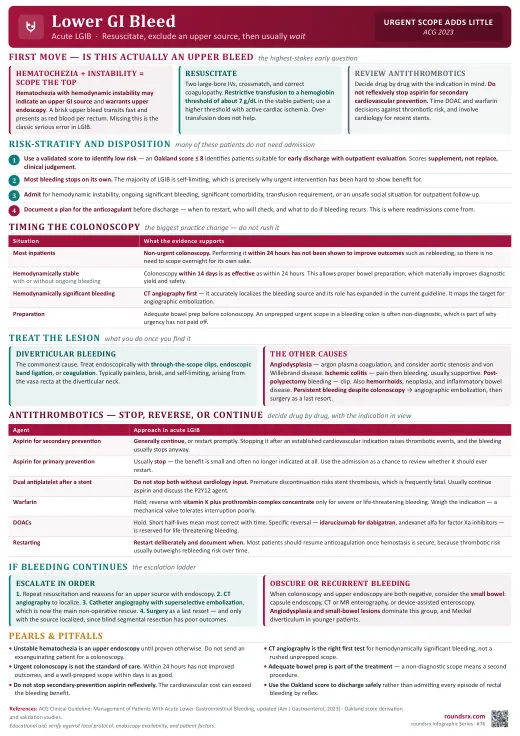
Text version
- Assuming hematochezia = lower source (15% are upper)
- Not holding anticoagulation
- Over-transfusion (Hgb > 7 threshold for most)
- Not doing colonoscopy within 24h