SLE Flare
| Organ | Manifestation | Severity |
|---|---|---|
| Skin / joints | Malar rash, discoid rash, photosensitivity, oral ulcers, arthralgia/arthritis (non-erosive) | Mild -treat with hydroxychloroquine ± NSAIDs |
| Serositis | Pleuritis, pericarditis | Moderate -steroids, NSAIDs, colchicine |
| Hematologic | Autoimmune hemolytic anemia (Coombs+), leukopenia, lymphopenia, thrombocytopenia | Moderate to severe -steroids, IVIG if severe thrombocytopenia |
| Renal (lupus nephritis) | Proteinuria, hematuria, rising Cr, nephrotic/nephritic syndrome. Class IV (diffuse proliferative) is most common and most severe. | Severe -renal biopsy, pulse steroids + mycophenolate or cyclophosphamide |
| CNS (cerebral lupus) | Seizures, psychosis, stroke, transverse myelitis, cognitive dysfunction | Severe -pulse steroids + cyclophosphamide. Rule out other causes (infection, TTP, APS). |
| Pulmonary | Diffuse alveolar hemorrhage (DAH), shrinking lung syndrome, ILD, pulmonary HTN | DAH = life-threatening -pulse steroids + cyclophosphamide + possible plasmapheresis |
- ↓ C3 / C4 (complement consumed by immune complexes) -most sensitive marker of active disease
- ↑ Anti-dsDNA -correlates with lupus nephritis activity. Rising titers = impending flare.
- ↑ ESR with normal CRP -classic lupus pattern (CRP usually only rises in serositis or infection, not lupus flares). If CRP is high → think infection.
- Worsening cytopenias -active disease. But also consider medication side effects.
| Severity | Treatment |
|---|---|
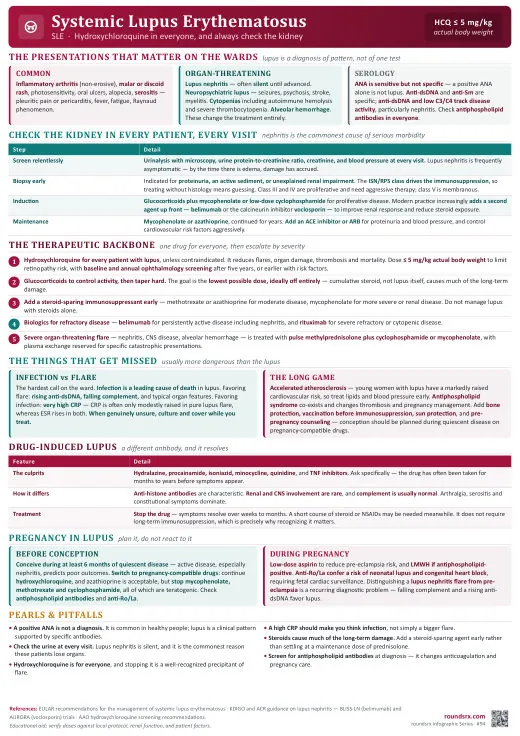
| All patients (baseline) | Hydroxychloroquine (Plaquenil) 200–400 mg daily CORNERSTONE -reduces flares, organ damage, thrombosis, and mortality. Never stop. Annual eye exam for retinal toxicity. |
| Mild flare (skin, joints) | NSAIDs (short course) + topical steroids. Low-dose prednisone (≤ 7.5 mg/day). |
| Moderate flare (serositis, cytopenias) | Prednisone 0.5–1 mg/kg/day → taper. Add steroid-sparing: mycophenolate, azathioprine, or methotrexate. |
| Severe flare (nephritis Class III/IV, CNS, DAH) | Pulse methylprednisolone 1g IV daily × 3 days → prednisone 1 mg/kg. Then: mycophenolate (preferred for nephritis induction -ALMS, 2009) or cyclophosphamide (Euro-Lupus low-dose protocol for severe nephritis). Belimumab (anti-BAFF) for add-on in active lupus nephritis BLISS-LN, 2020. Voclosporin (calcineurin inhibitor) added to MMF for nephritis AURORA, 2021. |
- Patient: 28F with known SLE, presents with fatigue, joint pain, malar rash, oral ulcers, Cr rising from 0.8 → 1.6 over 2 weeks.
- Flare workup:
- Labs: CBC (cytopenias?), BMP (renal), UA with microscopy (RBC casts = lupus nephritis), protein/creatinine ratio, complement C3/C4 (low = active disease), anti-dsDNA (rising titer = flare), ESR/CRP.
- UA: 2+ protein, 25 RBCs, RBC casts → active lupus nephritis. Protein/Cr ratio 2.8 (>0.5 = significant proteinuria).
- C3: 45 (low), C4: 8 (low), anti-dsDNA: 1:640 (elevated) → serologically active.
- Diagnosis: Class III/IV lupus nephritis until biopsy proves otherwise. Renal biopsy is MANDATORY -treatment depends on ISN/RPS class.
- Treatment:
- Mild flare (skin/joints only): Hydroxychloroquine (Plaquenil) 200mg BID (NEVER stop -reduces flares, thrombosis, and mortality). Low-dose prednisone (Deltasone) ≤10mg/day.
- Moderate flare (serositis, cytopenias): Prednisone 0.5-1mg/kg/day, taper over weeks.
- Severe flare (nephritis Class III/IV): Pulse methylprednisolone (Solu-Medrol) 500-1000mg IV × 3 days → prednisone 1mg/kg → taper. Induction: mycophenolate (CellCept) 2-3g/day OR cyclophosphamide (ALMS, 2009 -myco = cyclo for induction). Add belimumab (Benlysta) per BLISS-LN.
- Maintenance: Mycophenolate (CellCept) 1-2g/day + hydroxychloroquine indefinitely.
- Key: Hydroxychloroquine is the ONE drug every SLE patient should be on. Reduces flares, organ damage, and mortality.
Patient: 24-year-old woman with known SLE presenting with bilateral LE edema, foamy urine × 2 weeks, and fatigue. BP 148/92.
Key findings: UPCR 3.8 (nephrotic range), UA: 25 RBCs/hpf with RBC casts. C3 42 (low), C4 6 (low). Anti-dsDNA 1:640 (rising). CRP 1.8 (low). Renal biopsy: Class IV with crescents.
Management:
- Induction: mycophenolate 3g/day + prednisone 0.5-1 mg/kg ALMS, 2009
- Alternative: IV cyclophosphamide Euro-Lupus, 2004
- Continue HCQ (never stop). Consider belimumab BLISS-LN, 2020
- ACEi/ARB for proteinuria and BP
Teaching point: Cannot predict nephritis class clinically, biopsy is mandatory. Class IV is most common and aggressive. Low CRP + low complements = classic SLE flare pattern.
Patient: 32-year-old woman with SLE on mycophenolate and prednisone 10 mg, presenting with fever 39.1°C, fatigue, worsening joint pain × 3 days.
Key findings: CRP 42 (elevated). C3/C4 normal. Anti-dsDNA stable. Procalcitonin 2.4. Urine culture: E. coli.
Management:
- Infection, not flare, high CRP, normal complements, stable dsDNA, elevated procalcitonin
- Treat UTI per sensitivities. Hold mycophenolate during infection.
- Do NOT increase steroids. Resume MMF once cleared.
Teaching point: CRP low + C3/C4 low + dsDNA rising = flare. CRP high + C3/C4 normal + procalcitonin elevated = infection. When uncertain, cover both.
Patient: 29-year-old woman with SLE (class III nephritis in remission × 18 months) on HCQ and azathioprine, now 8 weeks pregnant. Anti-Ro/SSA positive.
Key findings: Stable disease. UPCR 0.15. C3/C4 normal. aPL negative.
Management:
- Continue HCQ, safe, reduces neonatal lupus and flares
- Continue azathioprine, safe (unlike mycophenolate, which is teratogenic)
- Anti-Ro/SSA+ → fetal echo at 16 weeks for congenital heart block
- ASA 81 mg at 12 weeks (preeclampsia prophylaxis)
Teaching point: Safe: HCQ, azathioprine, low-dose prednisone. Teratogenic: mycophenolate, cyclophosphamide, MTX. Anti-Ro requires fetal cardiac monitoring.
| Parameter | Frequency | Target / Action |
|---|---|---|
| Vitals | q4h floor, q1–2h ICU | HR, BP, RR, SpO₂, Temp -notify for significant deviations |
| Labs (BMP, CBC) | Daily AM or as indicated | Trend Cr, K⁺, WBC, Hgb -adjust treatment based on trajectory |
| Disease-specific markers | Per clinical context | See Overview and Management tabs for condition-specific targets |
| I&Os | Strict if volume-sensitive | UOP ≥ 0.5 mL/kg/hr. Net fluid balance guides diuresis or resuscitation. |
| Telemetry | Continuous if indicated | Arrhythmia detection. Discontinue when no longer indicated (reduces alarm fatigue). |
| Clinical response | Each assessment | Symptom improvement, functional status, appetite, mental status -the exam matters more than labs |
| Test | What it tells you |
|---|---|
| ANA | Screening test. Positive in nearly all SLE, but also in healthy people, other autoimmune disease, and with age. Report the titre and pattern. |
| Anti-dsDNA | Specific for SLE and tracks disease activity, particularly lupus nephritis. Useful to follow serially once the diagnosis is made. |
| Anti-Smith | The most specific antibody for SLE, but present in only a minority. A positive result largely settles the diagnosis; a negative one excludes nothing. |
| C3 and C4 | Fall during active disease as complement is consumed. A falling complement with a rising dsDNA is the classic serologic signature of a flare, especially renal. |
| Urinalysis with sediment, plus urine protein:creatinine | The single most important test at every visit. Lupus nephritis is often silent until it is advanced, so proteinuria, hematuria and cellular casts are actively looked for rather than waited for. |
| CBC, creatinine, LFTs | Cytopenias are diagnostic criteria in their own right: hemolytic anemia, leukopenia, lymphopenia and thrombocytopenia. Creatinine tracks renal involvement. |
| Antiphospholipid antibodies | Lupus anticoagulant, anticardiolipin and anti-beta-2-glycoprotein I. Check at diagnosis, because they change thrombotic and pregnancy risk and therefore management. |
| Anti-Ro and anti-La | Relevant in pregnancy: they cross the placenta and cause neonatal lupus and congenital heart block, which changes fetal monitoring. |
| Renal biopsy | Indicated for significant proteinuria or an active sediment. The ISN/RPS class dictates whether the patient needs induction immunosuppression, so the biopsy drives treatment rather than confirming a hunch. |
| Drug | Dose | Role | Watch for |
|---|---|---|---|
| Hydroxychloroquine EVERYONE | 5 mg/kg actual body weight per day, usually 200 to 400 mg | Background therapy for essentially every patient with SLE. Reduces flares, organ damage and mortality, and improves pregnancy outcomes. | Retinal toxicity is the dose-limiting harm, hence the weight-based cap and annual screening from year five. Do not stop it in pregnancy. |
| Glucocorticoids | Dose to severity; pulse methylprednisolone for organ-threatening disease | Fast control while a slower agent takes effect. | The goal is always to get off them. Cumulative steroid exposure, not lupus itself, causes much of the long-term damage. Taper deliberately and add a steroid-sparing agent early. |
| Mycophenolate mofetil | 2 to 3 g daily for induction | Lupus nephritis induction and maintenance, and useful in non-renal disease. | Teratogenic. Requires reliable contraception and a switch to azathioprine before a planned pregnancy. |
| Cyclophosphamide | Low-dose Euro-Lupus or NIH regimens | Severe organ-threatening disease: proliferative nephritis, CNS lupus, alveolar hemorrhage. | Gonadal toxicity, infection, hemorrhagic cystitis and later malignancy. Discuss fertility preservation before starting. |
| Belimumab | IV or subcutaneous | Active SLE and lupus nephritis, added to standard therapy. Anti-BLyS monoclonal. | Infection risk. Slow onset, so it is an add-on for persistent activity rather than a rescue drug. |
| Anifrolumab | IV every 4 weeks | Type I interferon receptor blocker for moderate to severe SLE, particularly skin and joint disease. | Not approved for lupus nephritis or CNS lupus, which is the distinction most often got wrong. Increased herpes zoster risk. |
| Voclosporin | Oral, with background therapy | Calcineurin inhibitor approved specifically for active lupus nephritis in combination with mycophenolate and steroids. | Monitor blood pressure and eGFR; calcineurin inhibitors are nephrotoxic, which is a particular consideration in a nephritis population. |