Lyme Disease
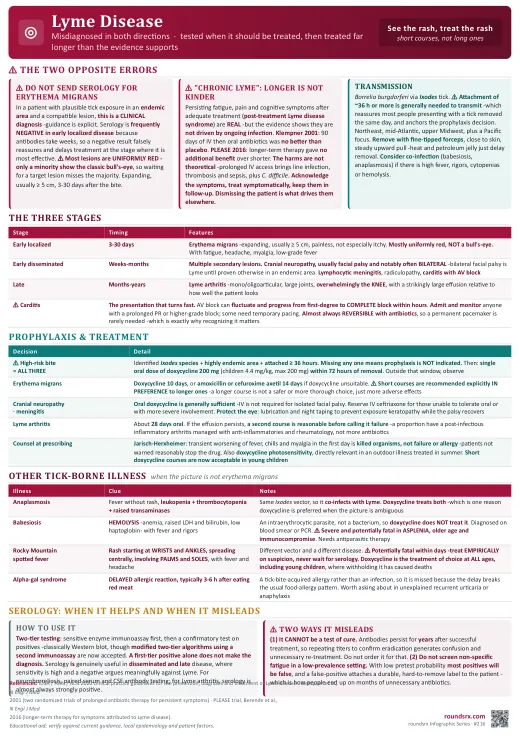
- Borrelia burgdorferi transmitted by Ixodes ticks (the blacklegged or deer tick), concentrated in the Northeast, mid-Atlantic and upper Midwest, with a separate focus on the Pacific coast. Geography is part of the diagnosis.
- ⚠ The tick generally must be attached for about 36 hours or more to transmit infection. That single fact reassures most people who present with a tick they removed the same day, and it is the anchor of the prophylaxis decision below.
- Remove ticks promptly with fine-tipped forceps, grasping close to the skin and pulling steadily upward. Heat, petroleum jelly and other folk methods delay removal, which is exactly what increases risk.
- Consider co-infection with babesiosis and anaplasmosis, which share the same vector. Suspect it when there is high fever, rigors, cytopenias or hemolysis rather than the usual picture.
| Stage | Timing | Features |
|---|---|---|
| Early localized | 3 to 30 days after the bite | Erythema migrans: an expanding erythematous lesion, usually at least 5 cm, typically painless and not especially itchy. ⚠ Most are uniformly red -only a minority show the classic "bull's-eye" central clearing, so waiting for a target lesion means missing the majority. Often with fatigue, headache, myalgia and low-grade fever. |
| Early disseminated | Weeks to months | Multiple secondary erythema migrans lesions. Cranial neuropathy, most often facial nerve palsy, which is notably often BILATERAL -bilateral facial palsy is Lyme until proven otherwise in an endemic area. Lymphocytic meningitis, radiculopathy, and carditis presenting as AV block that can progress rapidly. |
| Late | Months to years | Lyme arthritis: a mono- or oligoarticular arthritis of large joints, overwhelmingly the knee, with a strikingly large effusion relative to how well the patient feels. Rarely a late neurologic syndrome. |
- Standard two-tier testing: a sensitive enzyme immunoassay first, followed by a confirmatory test on positives -classically a Western blot, though modified two-tier algorithms using a second immunoassay are now also accepted. A first-tier positive alone does not make the diagnosis.
- Serology is genuinely useful for later disease -disseminated and late presentations, where sensitivity is high and a negative result argues meaningfully against Lyme.
- ⚠ Antibodies persist for years after successful treatment, so serology CANNOT be used as a test of cure. Repeating titers to confirm eradication generates confusion and unnecessary re-treatment. Do not order them for that purpose.
- ⚠ Do not screen non-specific fatigue with Lyme serology in a low-prevalence setting. With a low pretest probability, most positives will be false, and a false-positive result attaches a durable and difficult-to-remove label to the patient.
- For suspected neuroborreliosis, lumbar puncture with paired serum and CSF antibody testing helps. For Lyme arthritis, synovial fluid PCR can support the diagnosis, but serology is almost always strongly positive by then.
- ⚠ A bite counts as high-risk only when ALL THREE conditions are met: the tick was an identified Ixodes species, the bite occurred in a highly endemic area, and it was attached for 36 hours or more. Missing any one of them means prophylaxis is not indicated.
- For a high-risk bite: a single oral dose of doxycycline 200 mg in adults (4.4 mg/kg up to a 200 mg maximum in children), given within 72 hours of tick removal. Outside that window, observation is the recommended approach.
- Otherwise, observe and advise. Tell the patient exactly what to watch for -an expanding rash at the site, fever, or a flu-like illness over the following month- and that they should return rather than wait it out.
| Presentation | Regimen and duration |
|---|---|
| Erythema migrans | Doxycycline for 10 days, or amoxicillin or cefuroxime axetil for 14 days where doxycycline is unsuitable. These short courses are the recommendation, explicitly in preference to longer ones -a longer course is not a safer or more thorough choice, it is simply more adverse effects. |
| Cranial neuropathy | Oral doxycycline is generally sufficient; intravenous therapy is not required for isolated facial palsy. Eye protection matters -lubrication and taping at night to prevent exposure keratopathy while the palsy recovers. |
| Meningitis or radiculopathy | Oral doxycycline is effective for most patients; intravenous ceftriaxone is reserved for those unable to take or tolerate oral therapy, or with more severe involvement. |
| Carditis | Hospitalize and monitor if there is high-grade block or symptoms. Intravenous therapy initially in that setting, switching to oral once the block improves. Usually fully reversible. |
| Lyme arthritis | An oral course of about 28 days first. If the effusion persists, a second course is reasonable before concluding treatment has failed, since a proportion have a post-infectious inflammatory arthritis that is then managed with anti-inflammatory therapy and rheumatology input rather than further antibiotics. |
| Doxycycline in children | Short courses are now considered acceptable in young children, where the historical concern about dental staining applied to prolonged and repeated exposure rather than a single short course. |
"Ms. C is a 41-year-old woman who hikes in an endemic area, presenting with a 9 cm expanding erythematous lesion on her thigh that appeared about ten days ago, with fatigue and myalgia. The lesion is uniformly red without central clearing, which is the usual appearance rather than the exception, so the absence of a bull's-eye does not argue against erythema migrans. Given plausible exposure in an endemic area and a compatible lesion, this is a clinical diagnosis and I have not sent serology, which would likely be negative at this stage and would only delay treatment. I have examined for secondary lesions and found none, cranial nerves are intact with no facial weakness, and I specifically checked an ECG given that carditis presents as AV block, with a normal PR interval. I have started doxycycline for 10 days rather than a longer course, since short courses are the recommendation. I warned her about a possible Jarisch-Herxheimer reaction in the first day so she does not stop the drug, and about photosensitivity given the season. She asked about testing to confirm cure afterwards, and I explained that antibodies persist for years so serology cannot answer that question."
- Compatible rash plus endemic exposure? Treat clinically -do not send serology and do not wait.
- Examine for secondary lesions, cranial nerves and an ECG where disseminated disease is plausible.
- Tick bite without disease: apply all three high-risk criteria before offering prophylaxis, and stay inside the 72-hour window.
- Counsel on Jarisch-Herxheimer and photosensitivity at the time of prescribing.
- Consider co-infection with babesiosis or anaplasmosis if the illness is more severe than expected or there are cytopenias.
- Persisting symptoms after treatment: acknowledge them, treat symptomatically, keep the patient in follow-up, and do not extend antibiotics.
| Point | Detail |
|---|---|
| Transmission | Ixodes tick, attachment of about 36 hours or more generally needed. Northeast, mid-Atlantic, upper Midwest, plus a Pacific focus. Remove ticks promptly with fine forceps -folk methods delay removal and raise risk. |
| ⚠ Erythema migrans | CLINICAL diagnosis -do NOT send serology. It is often negative early and testing only delays treatment. Most lesions are uniformly red; the bull's-eye is the minority. Expanding, usually ≥ 5 cm, 3-30 days after the bite. |
| Disseminated | Multiple lesions, facial palsy that is often BILATERAL (Lyme until proven otherwise in an endemic area), lymphocytic meningitis, radiculopathy, and carditis with AV block. |
| ⚠ Carditis | Block can progress to complete within hours -admit and monitor for a prolonged PR or higher-grade block; some need temporary pacing. Almost always reversible, so a permanent pacemaker is rarely needed. |
| Late | Lyme arthritis -mono- or oligoarticular, large joints, overwhelmingly the knee, with a large effusion relative to how well the patient looks. |
| Serology | Two-tier (EIA then confirmatory test). Useful in later disease, not early. ⚠ Antibodies persist for years -it CANNOT be a test of cure, and screening non-specific fatigue in low-prevalence settings mostly generates false positives. |
| ⚠ Prophylaxis | High-risk requires ALL THREE: Ixodes species + highly endemic area + attached ≥ 36 h. Then single-dose doxycycline 200 mg (4.4 mg/kg, max 200 mg, in children) within 72 hours. |
| Treatment | Erythema migrans: doxycycline 10 days, or amoxicillin/cefuroxime 14 days. Short courses are preferred over longer ones. Oral therapy suffices for most cranial neuropathy and meningitis. Lyme arthritis ~28 days oral. Warn about Jarisch-Herxheimer and photosensitivity. |
| ⚠ "Chronic Lyme" | Post-treatment symptoms are real but not ongoing infection. Klempner 2001 (90 days of antibiotics, no better than placebo) and PLEASE 2016 (longer no better than shorter) settle it. Prolonged IV therapy causes line infections, thrombosis, sepsis and C. difficile. Acknowledge, treat symptomatically, keep them in follow-up -dismissing the patient drives them elsewhere. |
- See the rash, treat the rash. Serology is the wrong move in early disease and delays the easiest cure you will get.
- Check an ECG when you think Lyme. Carditis is the thing that turns quickly.
- Longer antibiotics are not a kinder answer. The trials are unambiguous, and the line is what harms the patient.