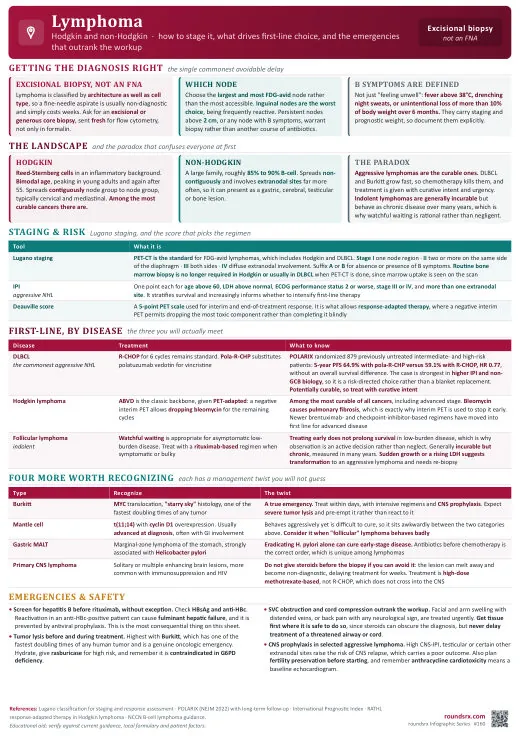
Lymphoma
Lymphoma = malignancy of lymphocytes. Two major categories: Hodgkin lymphoma (HL) -bimodal peak (20s and 60s), Reed-Sternberg cells, excellent prognosis (cure rate > 80%), contiguous nodal spread. Non-Hodgkin lymphoma (NHL) -much more common (90% of lymphomas), heterogeneous group from indolent (follicular) to aggressive (DLBCL, Burkitt). Key teaching point for interns: you are not expected to manage the chemo -you are expected to recognize lymphoma, complete the staging workup, manage inpatient complications (tumor lysis, febrile neutropenia, cord compression, SVC syndrome), and ensure tissue gets to pathology properly.
- Excisional lymph node biopsy -gold standard. NOT fine needle aspiration (FNA). FNA disrupts architecture needed for subtyping. Core needle biopsy acceptable if excisional not feasible.
- Pathology: hematoxylin/eosin, immunohistochemistry (CD20, CD3, CD15, CD30, Ki-67), flow cytometry, cytogenetics/FISH
- PET/CT -staging (Ann Arbor). PET-avid = aggressive. PET-negative nodes in follicular lymphoma may still be involved.
- CT chest/abdomen/pelvis -if PET not available
- Bone marrow biopsy -required for NHL staging. Optional for HL with PET/CT (PET replaced BMBx in many centers).
- Labs: CBC, CMP, LDH (prognostic, correlates with tumor burden), uric acid (TLS risk), hepatitis B (reactivation risk with rituximab), HIV (lymphoma association), ESR (HL prognostic factor), β2-microglobulin (NHL prognostic)
- Echocardiography -baseline EF before anthracycline-containing regimens
- Fertility counseling -before starting chemo (especially alkylating agents). Sperm banking / oocyte cryopreservation.
- Hodgkin Lymphoma:
- Early stage (I-II) favorable: ABVD × 2-4 cycles ± involved-site radiation. Cure rate > 90%.
- Advanced stage (III-IV): ABVD × 6 cycles or BV-AVD (brentuximab-AVD). [ECHELON-1, 2018]
- PET-adapted: interim PET after 2 cycles guides therapy intensity.
- DLBCL (most common aggressive NHL): R-CHOP × 6 cycles (rituximab + cyclophosphamide/doxorubicin/vincristine/prednisone). Cure rate 60-70%. CNS prophylaxis with intrathecal methotrexate for high-risk (testicular, breast, kidney, adrenal involvement). GELA, 2002
- Follicular lymphoma (indolent): Watch-and-wait for asymptomatic low tumor burden. Treat when symptomatic: rituximab ± bendamustine or CHOP. Not curable with standard therapy -median survival > 15 years with serial treatments.
- Burkitt lymphoma: Medical emergency -fastest growing human tumor. Hyper-CVAD or similar intensive regimen. TLS prophylaxis critical (aggressive IVF + rasburicase).
- Intern responsibilities: TLS prevention, infection prophylaxis, transfusion support, recognize treatment complications, ensure adequate IV access (port placement), fertility counseling documentation.
| Regimen | Components | Used For | Key Toxicities / Pearls |
|---|---|---|---|
| ABVD | Doxorubicin (Adriamycin), Bleomycin, Vinblastine, Dacarbazine | Hodgkin lymphoma (standard first-line) | Bleomycin pulmonary toxicity, monitor PFTs, stop if DLCO drops > 20%. Doxorubicin → cardiomyopathy. q28-day cycles. |
| BV-AVD | Brentuximab vedotin + Doxorubicin, Vinblastine, Dacarbazine | Advanced HL (replacing ABVD in some centers) | No bleomycin = no pulmonary toxicity. Higher neuropathy risk. Requires G-CSF prophylaxis. ECHELON-1, 2018 |
| R-CHOP | Rituximab + Cyclophosphamide, Doxorubicin (Hydroxydaunorubicin), Vincristine (Oncovin), Prednisone | DLBCL (standard first-line) | q21-day cycles × 6. Rituximab added ~15% survival benefit. GELA, 2002 Vincristine → peripheral neuropathy (cap at 2 mg). |
| R-EPOCH | Rituximab + Etoposide, Prednisone, Vincristine, Cyclophosphamide, Doxorubicin (dose-adjusted, continuous infusion) | Double-hit/triple-hit DLBCL, primary mediastinal B-cell lymphoma, Burkitt | 96-hour continuous infusion, requires central access. More toxic than R-CHOP but better outcomes for high-risk NHL. Dunleavy, 2013 |
| BR | Bendamustine + Rituximab | Indolent NHL (follicular, marginal zone) | Well-tolerated. Less alopecia and neuropathy than R-CHOP. BRIGHT, 2014 |
| Drug | Dose/Regimen | Route | Notes |
|---|---|---|---|
| R-CHOP | Rituximab + Cyclo/Doxo/Vincristine/Pred | IV | Standard for DLBCL. q21 days × 6 cycles. GELA, 2002 |
| ABVD | Doxorubicin/Bleomycin/Vinblastine/Dacarbazine | IV | Standard for Hodgkin. q28 days. Monitor PFTs (bleomycin). |
| Rituximab | 375 mg/m² | IV | Anti-CD20. Infusion reactions common (premedicate). Screen HBV (reactivation risk -give entecavir prophylaxis if HBsAg+ or anti-HBc+). |
| Brentuximab vedotin | 1.2 mg/kg q2wk | IV | Anti-CD30 ADC. HL + some NHL. Peripheral neuropathy. ECHELON-1, 2018 |
| TMP-SMX | 1 DS tab Mon/Wed/Fri | PO | PCP prophylaxis during and 6 months after R-CHOP/ABVD. |
| Acyclovir | 400 mg BID | PO | VZV prophylaxis during chemo. |
| Entecavir | 0.5 mg daily | PO | HBV prophylaxis if anti-HBc positive + receiving rituximab. |
Patient: 24F presents with 2 months of dry cough, dyspnea on exertion, and a 15 lb weight loss. She also reports drenching night sweats requiring changing her sheets nightly. No fevers.
Exam: Non-tender left supraclavicular lymphadenopathy (2.5 cm, rubbery). No hepatosplenomegaly.
Labs: WBC 11K, Hgb 10.8, ESR 55, LDH 280 (mildly elevated). HIV negative.
Imaging: CXR: large anterior mediastinal mass. CT chest: 12 cm mediastinal mass with bilateral hilar lymphadenopathy. PET/CT: intensely FDG-avid mediastinal, bilateral hilar, and left supraclavicular nodes. No disease below diaphragm.
Biopsy: Excisional biopsy of supraclavicular node: Reed-Sternberg cells in background of mixed inflammatory infiltrate. IHC: CD15+, CD30+, CD20−. Consistent with nodular sclerosis classical Hodgkin lymphoma.
Staging: Stage IIB (bilateral hilar = still same side of diaphragm, B symptoms present). Despite being stage II, B symptoms → treated as advanced stage.
Management:
- Pre-chemo: Echo (EF 62%), PFTs (baseline DLCO normal), HBV screen negative, fertility counseling → oocyte cryopreservation.
- ABVD × 6 cycles. Interim PET after cycle 2: Deauville 2 (complete metabolic response).
- Bleomycin dropped after cycle 2 per PET-adapted approach. RATHL, 2016
- End-of-treatment PET: Deauville 1. Complete remission.
Teaching Point: Nodular sclerosis is the most common HL subtype, classically presenting in young women with a mediastinal mass. B symptoms upstage IIA to advanced-stage treatment protocols. PET-adapted therapy allows de-escalation to reduce bleomycin toxicity.
Patient: 67M presents with 3 weeks of rapidly enlarging right neck mass, fatigue, and unintentional 12 lb weight loss. No night sweats or fevers.
Exam: 5 cm firm, non-tender right cervical mass. Left axillary lymphadenopathy (3 cm). Spleen palpable 2 cm below costal margin.
Labs: WBC 6K, Hgb 11.2, LDH 580 (elevated, correlates with tumor burden), uric acid 9.2. HBsAg negative, anti-HBc positive.
Imaging: PET/CT: FDG-avid bilateral cervical, axillary, retroperitoneal nodes + splenic involvement. No bone marrow uptake on PET.
Biopsy: Core needle biopsy: diffuse proliferation of large CD20+ B cells, Ki-67 > 80%. BCL2+ by IHC. FISH: no MYC rearrangement (rules out double-hit). Diagnosis: DLBCL, GCB subtype.
Staging: Stage IIIA (nodes both sides of diaphragm + spleen, no B symptoms).
Management:
- Anti-HBc positive → start entecavir prophylaxis before rituximab (HBV reactivation risk).
- Echo baseline (EF 58%). TLS risk: intermediate → allopurinol + aggressive hydration.
- R-CHOP × 6 cycles (q21 days). GELA, 2002
- IPI score calculated (age > 60, elevated LDH, stage III = IPI 3, high-intermediate risk).
- End-of-treatment PET: Deauville 2. Complete remission. Surveillance CT q6 months × 2 years.
Teaching Point: DLBCL is the most common aggressive NHL. R-CHOP is curative in 60-70%. Always check anti-HBc before rituximab, even resolved HBV can reactivate fatally. LDH correlates with tumor burden and is prognostic (part of IPI score).
Patient: 55F found to have bilateral inguinal lymphadenopathy on routine physical exam. Completely asymptomatic. No B symptoms, no fatigue, no cytopenias.
Exam: Bilateral inguinal nodes (2-3 cm), rubbery, non-tender. No other palpable lymphadenopathy. No hepatosplenomegaly.
Labs: CBC normal. LDH normal. β2-microglobulin mildly elevated (3.1).
Imaging: PET/CT: mildly FDG-avid bilateral inguinal and external iliac nodes (SUVmax 4). Small mesenteric nodes. No bulky disease.
Biopsy: Excisional inguinal node biopsy: follicular architecture with small cleaved cells. CD20+, CD10+, BCL2+. Ki-67 15%. Grade 1-2. Diagnosis: follicular lymphoma, grade 1-2.
Staging: Stage IIIA (nodes both sides of diaphragm, no symptoms).
Management:
- Low tumor burden (GELF criteria not met: no node > 7 cm, no B symptoms, no cytopenias, no organ compression).
- Watch and wait, no treatment initiated. Active surveillance with exam + labs q3 months, CT q6 months.
- Patient counseled: follicular lymphoma is not curable with standard therapy, but median survival is > 15-20 years with serial treatments. Early treatment does NOT improve overall survival.
- Criteria to initiate treatment: development of B symptoms, cytopenias, bulky disease (> 7 cm), rapid growth, organ compression, or patient preference.
- When treatment needed: options include rituximab monotherapy, BR (bendamustine-rituximab), or R-CHOP.
Teaching Point: Follicular lymphoma is the classic "watch and wait" lymphoma. Asymptomatic patients with low tumor burden should NOT be treated. This is one of the hardest conversations in oncology, telling a patient they have cancer but you are not going to treat it. Treatment does not improve OS in asymptomatic disease, and each line of therapy has toxicity.
- CBC before each cycle -delay if ANC < 1000 or platelets < 100K
- Interim PET/CT -after 2 cycles (HL) or 3-4 cycles (NHL). Complete metabolic response = Deauville 1-3.
- Echo q3 months during anthracycline therapy (doxorubicin cardiotoxicity)
- PFTs during bleomycin therapy -stop if DLCO drops > 20% from baseline
- HBV DNA monthly if on rituximab with HBV risk (reactivation can be fatal)
- LDH + uric acid before each cycle -rising LDH suggests progression; high uric acid = TLS risk
- Post-treatment surveillance: CT q6 months × 2 years, then annually × 5 years. PET only if suspected relapse (not for routine surveillance).
Mr. Rodriguez is a 28-year-old man presenting with 6 weeks of painless left cervical lymphadenopathy (3 cm), night sweats, 10 lb weight loss, and pruritus. No fevers. No cough. Exam: firm, rubbery, non-tender left cervical and left supraclavicular nodes. No hepatosplenomegaly. Labs: WBC 9K, Hgb 11.8, LDH 320 (elevated), ESR 45. CXR: mediastinal widening.