Malaria
| Species | Timing and behavior | What it means for you |
|---|---|---|
| P. falciparum the one that kills | Usually presents within 1 month of return, and the large majority within 3 months. No dormant liver stage. Capable of very high parasitemia because it infects red cells of all ages and sequesters in the microvasculature. | This is the medical emergency. Cerebral malaria, acidosis, AKI and ARDS all come from this species. A short interval since travel does not reassure -it is the expected pattern. |
| P. vivax and P. ovale the relapsers | Form dormant liver hypnozoites, so they can present months to years after exposure and can relapse repeatedly after apparently successful treatment. Vivax can still cause severe disease, so "benign tertian" is a misleading label. | Blood-stage treatment alone is not enough. These require radical cure with an 8-aminoquinoline to clear hypnozoites, which is why a G6PD level is part of the workup rather than an afterthought. |
| P. malariae | Long incubation and can persist at low levels for years. Rarely severe. | No hypnozoites, so no radical cure needed. Blood-stage treatment suffices. |
| P. knowlesi | Zoonotic, Southeast Asia (especially Borneo). Short 24-hour replication cycle, so parasitemia can rise very fast. | Can cause severe disease and is easily misread on the smear as P. malariae, which is dangerous because malariae is treated as benign. Consider it with Southeast Asian travel. |
- Fever is the constant, but the classic periodic pattern is usually absent in non-immune travelers, so waiting for tertian or quartan fevers to declare themselves is a way of losing days. Fever may be continuous or irregular.
- Non-specific by design: headache, myalgia, malaise, rigors, sweats, cough, abdominal pain, diarrhea and vomiting. This is routinely diagnosed as influenza, gastroenteritis or a viral syndrome, which is exactly how a treatable death happens.
- Examination findings are unreliable. Splenomegaly, jaundice and pallor may be present or entirely absent. A normal examination does not lower the probability enough to stop the workup.
- Laboratory clues that should raise suspicion: thrombocytopenia (common and one of the more useful pointers), anemia, an unremarkable or low white count, elevated LDH and bilirubin from hemolysis, and mildly raised transaminases.
- ⚠ Taking prophylaxis does not exclude malaria. No regimen is fully protective, adherence is often imperfect, and a partially suppressed infection can present late and atypically. Treat a patient on prophylaxis with the same suspicion as one who took none.
| Test | What it does, and its limits |
|---|---|
| Thick smear | The sensitivity test. A larger volume of blood is examined after lysing red cells, so it detects low-level parasitemia that a thin film would miss. It is the screening film, and it is poor at species identification because the cells are destroyed. |
| Thin smear | The species and quantification test. Red cell morphology is preserved, so it allows speciation and calculation of percent parasitemia. Both films are needed, and asking only for "a malaria smear" risks getting only one. |
| ⚠ Percent parasitemia | Report it explicitly and repeat it, because it is both a severity criterion and the measure of treatment response. Parasitemia of 5% or more meets the CDC definition of severe malaria on its own, regardless of how well the patient looks, and falling below 1% is the threshold for switching from IV to oral therapy. |
| Rapid diagnostic test | Antigen detection, fast, and useful when expert microscopy is not immediately available. Two important limitations. HRP2-based tests can be falsely negative where hrp2/hrp3 gene deletions circulate, so a negative RDT does not overturn a strong clinical suspicion. And they can stay positive for weeks after cure, so an RDT cannot be used to follow response or to diagnose a second episode. |
| PCR | Most sensitive and best for confirming species (particularly knowlesi, and mixed infections). Turnaround is too slow to guide initial treatment, so it confirms rather than decides. |
- Glucose -hypoglycemia is common and easily missed, arising both from parasite consumption and, where quinine is used, from quinine-induced hyperinsulinemia. Check it repeatedly rather than once.
- Lactate and a blood gas -acidosis is one of the strongest predictors of death and can be present before the blood pressure falls.
- CBC (thrombocytopenia, anemia), creatinine (AKI is a severity criterion), LFTs and bilirubin (jaundice is a severity criterion), coagulation studies (DIC).
- ⚠ Quantitative G6PD in any vivax or ovale infection, because radical cure with primaquine or tafenoquine can cause severe hemolysis in G6PD deficiency. Send it early so the result is back when you need it rather than delaying discharge.
- Blood cultures -concurrent bacteremia is well described in severe malaria, and finding parasites does not mean you have found the only problem.
| Step | Detail and rationale |
|---|---|
| The drug | Artesunate intravenously, 2.4 mg/kg at 0, 12 and 24 hours. It replaced quinine on mortality grounds, not convenience. In SEAQUAMAT, 2005 mortality fell from 22% to 15% in adults, a 34.7% relative reduction, and the trial was stopped early. AQUAMAT, 2010 reproduced it in 5,425 African children, 8.5% versus 10.9%. Artesunate also clears parasites faster and causes less hypoglycemia and cardiotoxicity than quinine. |
| ⚠ Do not delay for the drug | Artesunate is stocked by many but not all hospitals. Find out where yours keeps it before you need it, and if there is any delay, give an interim oral or alternative parenteral agent rather than waiting -in severe malaria, time to first effective dose is what determines outcome. |
| When to switch to oral | Once the patient is tolerating oral therapy and parasitemia has fallen to 1% or below. ⚠ Artesunate must always be followed by a full oral course of a different, longer-acting antimalarial. Artemisinins have a very short half-life, so artesunate alone leaves a high rate of recrudescence -the patient improves, goes home, and relapses weeks later. |
| ⚠ Post-artesunate delayed hemolysis | A recognized and easily missed complication. Parasitized red cells cleared by the spleen can lyse days to weeks later, producing falling hemoglobin, rising LDH and jaundice one to three weeks after apparently successful treatment. Check a hemoglobin weekly for about 4 weeks after discharge and warn the patient, or the anemia is worked up from scratch as something else. |
| Supportive care | Treat hypoglycemia aggressively and recheck often. Careful fluid management -these patients tolerate fluid overload badly and pulmonary edema is a recognized cause of death, so resuscitate for shock but do not run them wet. Manage seizures, AKI and acidosis on their merits. Exchange transfusion is no longer recommended, since it never showed a survival benefit and carries real procedural risk. |
| Regimen | Notes |
|---|---|
| Artemether-lumefantrine first-line | Artemether-lumefantrine (Coartem), twice daily, now for 5 days. ⚠ Must be taken with fatty food or a milky drink -lumefantrine absorption is poor without fat, and a patient who is nauseated and eating nothing may be effectively undertreated. Say this explicitly rather than leaving it on the label. |
| Atovaquone-proguanil | Atovaquone-proguanil (Malarone) daily for 3 days. Well tolerated. Avoid using it for treatment in someone who developed malaria while taking it as prophylaxis, since that suggests it will not work. |
| Quinine plus doxycycline | An alternative where artemisinins are unavailable. Poorly tolerated -cinchonism (tinnitus, deafness, nausea), hypoglycemia from hyperinsulinemia, and QT prolongation. Doxycycline (or clindamycin in pregnancy and young children) must accompany it. |
| Chloroquine | Only for confirmed chloroquine-sensitive infections, which now means a narrow set of regions. Assume falciparum is chloroquine-resistant unless you have specific reason not to, because resistance is widespread and getting this wrong wastes the window in which treatment works. |
- Pregnancy -malaria is more severe and carries fetal risk, so treat urgently. IV artesunate is used for severe malaria in all trimesters, because the risk of untreated severe malaria to mother and fetus exceeds the theoretical drug risk. Avoid primaquine, tafenoquine and doxycycline.
- Asplenia and immunosuppression -a higher risk of severe disease and of rapid deterioration, so lower the threshold for admission and for intravenous therapy.
- Prophylaxis for travelers -Atovaquone-proguanil, Doxycycline, Mefloquine or Tafenoquine, chosen by destination resistance pattern, trip length and tolerability. Each has a different start and stop schedule, and the terminal doses after leaving the area are the ones travelers abandon, so state the stop date explicitly.
- Bite avoidance still matters -insecticide-treated nets, repellent and covering up in the evening and overnight, when the Anopheles vector bites. No chemoprophylaxis is completely protective, which is the honest framing to give.
- Visiting friends and relatives is the highest-risk travel category, because such travelers often do not seek pre-travel advice, believe childhood immunity persists (it wanes within a few years of leaving an endemic area), and stay longer in rural settings. Ask about this pattern specifically rather than asking whether someone was "a tourist".
"Mr. K is a 34-year-old man who returned ten days ago from a three-week visit to family in Nigeria, presenting with four days of fever, rigors, headache and myalgia. He was seen two days ago and diagnosed with a viral illness, which is the usual pattern and the reason I want to move quickly. He took atovaquone-proguanil but missed several doses, and I want to be explicit that this does not lower my suspicion at all, since no prophylaxis is fully protective. He is febrile to 39.2, tachycardic at 112, blood pressure 104 over 62, and he is fully alert. His platelets are 68,000, hemoglobin 11.4, bilirubin mildly elevated with a raised LDH, creatinine normal and glucose 74. Thick and thin smears are being read urgently and I have told the laboratory this is an urgent malaria smear rather than a routine specimen. My working diagnosis is falciparum malaria until proven otherwise, and if the first smear is negative I will repeat thick and thin films every 12 to 24 hours rather than treating a single negative as an exclusion. The number I most want from the thin smear is the percent parasitemia, because 5% or more makes this severe malaria and mandates intravenous artesunate regardless of how well he looks. I have already confirmed where our pharmacy stocks artesunate so there is no delay if he meets criteria. If he is uncomplicated, the plan is artemether-lumefantrine, and I want to flag that CDC extended this to a 5-day, 10-dose course in 2026, so I will not write the 3-day regimen. I will also tell him it must be taken with fatty food, because lumefantrine is poorly absorbed without it. Blood cultures are sent, since bacteremia coexists with severe malaria, and I am checking glucose repeatedly given the risk of hypoglycemia."
- ⚠ Travel history taken in every febrile patient, including where, when and for how long.
- Thick AND thin smears requested, flagged urgent to the laboratory, with percent parasitemia reported explicitly.
- Serial smears arranged every 12 to 24 hours if the first is negative and suspicion persists.
- Severity criteria checked one by one, including the parasitemia threshold in a patient who looks well.
- Location of IV artesunate confirmed before it is needed, with no waiting for the drug in a severe case.
- Glucose, lactate, creatinine, bilirubin, coagulation and blood cultures sent, with glucose rechecked repeatedly.
- ⚠ Full oral follow-on course prescribed after artesunate, never artesunate alone.
- Quantitative G6PD sent early in vivax or ovale so radical cure is not delayed.
- Patient warned about delayed hemolysis with a hemoglobin check weekly for about 4 weeks.
- Fatty-food instruction given verbally for artemether-lumefantrine, and the 5-day duration confirmed on the prescription.
- Case reported to public health as a notifiable disease.
| Point | Detail |
|---|---|
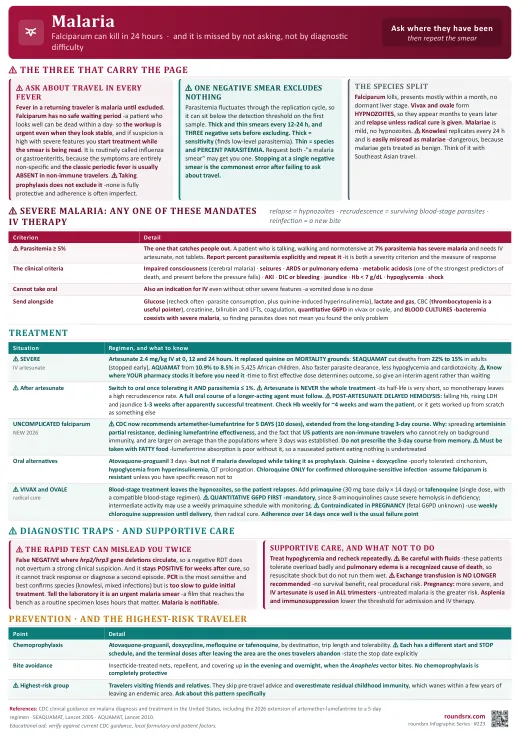
| ⚠ Ask about travel | Fever in a returning traveler is malaria until excluded. It is missed by not thinking of it, not by diagnostic difficulty. Falciparum can kill within 24 hours, so the workup is urgent even in a well-looking patient. |
| The species split | Falciparum kills, usually presents within a month, no hypnozoites. Vivax and ovale form hypnozoites, so they present months to years later and relapse without radical cure. Malariae is mild with no hypnozoites. Knowlesi replicates every 24 hours and is misread as malariae, which is dangerous. |
| ⚠ One negative smear is not enough | Parasitemia fluctuates. Thick and thin smears every 12 to 24 hours, three negative sets before excluding. Thick = sensitivity, thin = species and percent parasitemia. |
| RDT limits | False negatives with hrp2/hrp3 deletions, and stays positive for weeks after cure so it cannot track response. PCR confirms species but is too slow to guide first treatment. |
| ⚠ Severe malaria | Any ONE of: parasitemia ≥ 5%, impaired consciousness, seizures, ARDS, acidosis, AKI, DIC, jaundice, Hb < 7, hypoglycemia, shock. A well-looking patient at 7% parasitemia has severe malaria. Inability to take oral therapy also mandates IV. |
| Severe: IV artesunate | 2.4 mg/kg at 0, 12 and 24 hours. SEAQUAMAT cut mortality 22% to 15% in adults; AQUAMAT 10.9% to 8.5% in African children. Switch to oral when tolerating it with parasitemia ≤ 1%. |
| ⚠ Never artesunate alone | Short half-life means high recrudescence as monotherapy. A full oral course of a longer-acting agent must follow. |
| ⚠ Delayed hemolysis | Post-artesunate delayed hemolysis -falling hemoglobin, rising LDH and jaundice 1 to 3 weeks after successful treatment. Check hemoglobin weekly for about 4 weeks and warn the patient, or it gets worked up as something else. |
| NEW 2026 5 days, not 3 | CDC extended artemether-lumefantrine to 5 days (10 doses) for uncomplicated falciparum, driven by artemisinin partial resistance, declining lumefantrine effectiveness, and the non-immune status and body size of US travelers. ⚠ Take with fatty food -absorption is poor without it. |
| Other oral options | Atovaquone-proguanil (avoid if malaria developed on it as prophylaxis). Quinine plus doxycycline -cinchonism, hypoglycemia from hyperinsulinemia, QT prolongation. Chloroquine only for confirmed sensitive infections; assume falciparum is resistant. |
| ⚠ Vivax and ovale | Radical cure with primaquine or tafenoquine to clear hypnozoites. Quantitative G6PD first -mandatory. Contraindicated in pregnancy (fetal G6PD unknown): use weekly chloroquine until delivery. Adherence over 14 days is the usual failure point. |
| Supportive care | Treat hypoglycemia and recheck often. Careful with fluids -pulmonary edema is a recognized cause of death. Send blood cultures, since bacteremia coexists. Exchange transfusion is no longer recommended. |
| Prevention | Atovaquone-proguanil, doxycycline, mefloquine or tafenoquine by destination and trip length, plus bite avoidance. State the stop date -terminal doses are what travelers abandon. Prophylaxis does not exclude malaria. Highest-risk group: those visiting friends and relatives. |
- Ask where they have been. Every febrile patient, every time. That question is the whole diagnosis.
- One negative smear excludes nothing. Three negative sets, 12 to 24 hours apart, and get the percent parasitemia every time.
- Five days, not three. The 2026 CDC change to artemether-lumefantrine is exactly the kind of number that gets prescribed from memory, and the memorized answer is now wrong.