Male Hypogonadism
Hypogonadism is a clinical syndrome, not a laboratory value. It requires consistent symptoms or signs of androgen deficiency together with unequivocally and repeatedly low testosterone. Diagnosing it from one borderline level in a tired man is how patients end up on indefinite therapy that suppresses their own production and their fertility, for a number that would have been normal on a repeat draw.
The opposite error is just as real. Genuinely low testosterone with a low or inappropriately normal LH points at the pituitary and hypothalamus, and the answer can be a prolactinoma, hemochromatosis, or a mass lesion. Treating the testosterone without asking why it is low means treating the symptom of a tumor.
- More specific (these are the ones that should prompt testing): reduced morning erections, low libido, erectile dysfunction, reduced spontaneous erections, small or shrinking testes, gynecomastia, loss of body and facial hair, hot flushes, infertility, and loss of height or fragility fracture.
- Less specific (common in the general population and a poor basis for a diagnosis on their own): fatigue, depressed mood, poor concentration, reduced muscle bulk, increased body fat, sleep disturbance.
- The distinction is practical. A man presenting with fatigue alone who happens to have a mildly low level probably has something else, plus a level that needs repeating. A man with gynecomastia, small testes and low libido is a different proposition entirely.
| Type | Pattern | Causes and implications |
|---|---|---|
| Primary testicular failure | Low testosterone with HIGH LH and FSH -the pituitary is working and shouting at a testis that cannot respond | Klinefelter syndrome (47,XXY) is the commonest congenital cause and is substantially underdiagnosed: suspect it with small firm testes, tall stature, gynecomastia and infertility, and send a karyotype. Also mumps orchitis, testicular trauma or torsion, cryptorchidism, chemotherapy or radiation, and cytotoxic drugs. Fertility is usually not recoverable, so raise sperm banking before gonadotoxic treatment. |
| Secondary pituitary or hypothalamic | Low testosterone with LOW or INAPPROPRIATELY NORMAL LH and FSH -a normal LH against a low testosterone is not reassuring, it is the abnormality | This is the one that needs a cause found. Hyperprolactinemia (including drug-induced), pituitary adenoma or other mass, hemochromatosis, infiltrative disease, head trauma, congenital causes such as Kallmann syndrome (with anosmia), and the functional causes below. Fertility is often recoverable with gonadotropin therapy, which is why the distinction matters for a man who wants children. |
- Total testosterone measures both bound and unbound hormone, and most of it is bound to sex hormone-binding globulin. When SHBG is abnormal, the total misrepresents what is biologically available, which is why the same number means different things in different men.
- SHBG is LOWERED by obesity, insulin resistance and type 2 diabetes, nephrotic syndrome, hypothyroidism, glucocorticoids and androgen use. Lower SHBG drags the total testosterone down, so an obese diabetic man can have a low total testosterone with a normal free testosterone and no true deficiency. This is the single commonest reason to mislabel a man as hypogonadal.
- SHBG is RAISED by aging, hyperthyroidism, liver disease, HIV, anticonvulsants and estrogens. Higher SHBG lifts the total, so an older man can have a reassuring total testosterone while his free testosterone is genuinely low.
- Measure free or bioavailable testosterone when the total is borderline, or whenever a condition altering SHBG is present. Use equilibrium dialysis or a calculated free testosterone from total testosterone, SHBG and albumin; direct analog free testosterone immunoassays are unreliable and should not be used to make this decision.
- Once low testosterone is confirmed on two morning samples, measure LH and FSH to separate primary from secondary. This single step determines the entire subsequent workup.
- For secondary hypogonadism, look for the cause: prolactin (and review the medication list for antipsychotics, metoclopramide and others), iron studies including transferrin saturation and ferritin for hemochromatosis, and assessment of the other pituitary axes (thyroid, cortisol, growth hormone) where indicated.
- Obtain pituitary MRI when testosterone is severely low, when prolactin is elevated, when other pituitary hormones are abnormal, or when there are mass-effect features such as headache or visual field loss. Do not skip this in a young man with markedly low testosterone and low gonadotropins.
- For primary hypogonadism with small firm testes, send a karyotype for Klinefelter syndrome, which frequently goes undiagnosed into adulthood and carries implications beyond testosterone, including cardiometabolic and malignancy risk.
- If fertility is a concern, obtain semen analysis before starting any therapy, because treatment choice changes completely.
- Assess bone density in men with confirmed, longstanding hypogonadism, which is an established secondary cause of osteoporosis (see Osteoporosis).
- Where a functional cause is present, address it first. Weight loss, tapering opioids or glucocorticoids where possible, treating sleep apnea, reducing alcohol and improving glycemic control can all raise testosterone without committing the patient to therapy.
- Where a specific cause is found, treat that. A prolactinoma responds to a dopamine agonist, and testosterone may normalize without replacement.
- Reserve testosterone for men with confirmed, symptomatic hypogonadism in whom the underlying cause is either irreversible or already addressed.
- Absolute or near-absolute: known or suspected prostate or breast cancer, a man actively seeking fertility, and an unevaluated prostate nodule or elevated PSA.
- ⚠ Baseline hematocrit above 50% is a relative contraindication, because a meaningful proportion of these men will exceed 54% on treatment.
- Caution in untreated severe obstructive sleep apnea, severe lower urinary tract symptoms, uncontrolled heart failure, and thrombophilia or prior venous thromboembolism.
- Transdermal gels give steady levels but carry a genuine and often forgotten risk: skin-to-skin transfer to female partners and children, which can cause virilization. Counsel on washing hands, covering the site and avoiding contact until absorbed.
- Intramuscular injections are inexpensive and effective. Shorter-acting esters produce peak-and-trough swings that some men feel as fluctuating energy and mood; longer-acting preparations give steadier levels.
- Other options include subcutaneous pellets, buccal and nasal preparations, and newer oral formulations. Choice is driven largely by patient preference, cost and how well they tolerate fluctuation.
| What | When, and why |
|---|---|
| Symptom response | Reassess at 3 to 6 months. If there is no symptomatic benefit, stop the therapy rather than continuing it indefinitely -a normalized number in a man who feels no different is not a treatment success. |
| Testosterone level | Check at 3 to 6 months after starting, aiming for the mid-normal range. Timing of the sample depends on formulation, so interpret it against the preparation used. |
| ⚠ Hematocrit | Baseline, at 3 to 6 months, then annually. Testosterone stimulates erythropoiesis, and erythrocytosis is the commonest adverse effect. If hematocrit exceeds 54%, stop therapy until it falls, evaluate for hypoxia and sleep apnea, and restart at a reduced dose. The concern is hyperviscosity and thromboembolic risk. |
| Prostate | PSA and prostate assessment before starting in men at appropriate age and risk, with follow-up assessment in the first year and periodically thereafter. Evaluate a confirmed substantial PSA rise or a new nodule before continuing. |
| Bone density | Repeat after 1 to 2 years in men who had osteoporosis or low bone mass at baseline, to confirm the expected response. |
"Mr. D is a 38-year-old man referred for a testosterone of 240 ng/dL drawn at a mid-afternoon visit, with fatigue and low libido. Before accepting the diagnosis I would repeat it fasting in the morning, because the diurnal peak is early and an afternoon sample understates it, and a single low value is not sufficient. He has a BMI of 36 and type 2 diabetes, both of which lower SHBG, so his total may understate his free testosterone; I have requested SHBG with a calculated free testosterone rather than a direct analog assay. He also takes long-term opioids for back pain, which is a dose-dependent and frequently missed cause of secondary hypogonadism. If repeat testing confirms genuinely low testosterone, the next step is LH and FSH, and given his age and the likelihood of a low gonadotropin pattern I would send prolactin and iron studies and consider pituitary imaging rather than assuming this is functional. He and his partner are considering a pregnancy, so I would specifically not start testosterone: it suppresses spermatogenesis, often to azoospermia, with slow and uncertain recovery. The initial plan is weight management, opioid taper where feasible, and screening for sleep apnea, since those may correct the level without any hormone at all."
- Was the level morning, fasting, and repeated? If not, the diagnosis is not yet made.
- Is a condition altering SHBG present? If so, interpret the total with a free or bioavailable measurement.
- LH and FSH sent to distinguish primary from secondary, and for secondary, has a cause actually been sought?
- Fertility intentions asked and documented before any prescription.
- Reversible contributors addressed -weight, opioids, glucocorticoids, sleep apnea, alcohol, glycemic control.
- On therapy: hematocrit at baseline, 3 to 6 months and annually; symptom response reviewed at 3 to 6 months with a willingness to stop if there is none.
| Step | Approach and why |
|---|---|
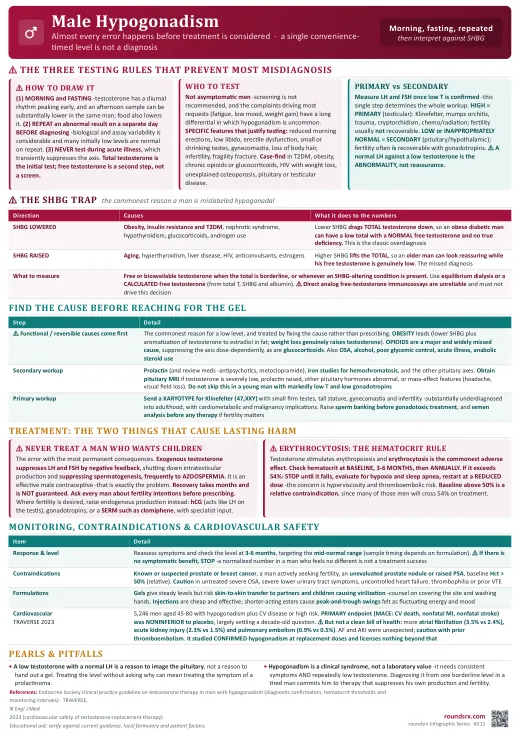
| Who to test | Not asymptomatic men. Test on specific features (reduced morning erections, low libido, small testes, gynecomastia, infertility, fragility fracture) or raised-risk conditions (type 2 diabetes, obesity, chronic opioids or glucocorticoids, HIV, pituitary or testicular disease). Fatigue alone is a weak indication. |
| ⚠ How to test | Total testosterone, MORNING and FASTING, REPEATED on a separate day. Never during acute illness. A single convenience-timed level is not a diagnosis. |
| ⚠ The SHBG trap | Obesity, diabetes, nephrotic syndrome, hypothyroidism and glucocorticoids LOWER SHBG -total reads low, free may be normal (the commonest cause of overdiagnosis). Aging, hyperthyroidism, liver disease, HIV and anticonvulsants RAISE SHBG -total reads normal while free is low. Use equilibrium dialysis or calculated free testosterone, never a direct analog immunoassay. |
| Localize | LH and FSH. HIGH = primary (testicular; Klinefelter, mumps, trauma, chemotherapy or radiation -send a karyotype for small firm testes). LOW or inappropriately normal = secondary (pituitary or hypothalamic). A normal LH against a low testosterone is the abnormality, not reassurance. |
| Secondary workup | Prolactin, iron studies for hemochromatosis, other pituitary axes, and MRI if testosterone is very low, prolactin raised, other hormones abnormal, or mass-effect features are present. |
| Fix the cause first | Obesity (lower SHBG plus aromatization; weight loss genuinely raises testosterone), opioids and glucocorticoids, sleep apnea, alcohol, poor glycemic control, acute illness, anabolic steroid use. Many need no hormone at all. |
| ⚠ Fertility | Never give testosterone to a man wanting children. It suppresses LH and FSH and therefore spermatogenesis, often to azoospermia, with slow and uncertain recovery. Use hCG, gonadotropins or a SERM instead. Ask before prescribing. |
| ⚠ Monitor | Hematocrit at baseline, 3-6 months, then annually. Stop if > 54%, evaluate for hypoxia and sleep apnea, restart at reduced dose; baseline > 50% is a relative contraindication. Testosterone level at 3-6 months targeting mid-normal. No symptomatic benefit means stop. |
| Cardiovascular | TRAVERSE 2023: noninferior to placebo for MACE, but with more atrial fibrillation (3.5% vs 2.4%), acute kidney injury (2.3% vs 1.5%) and pulmonary embolism (0.9% vs 0.5%). Caution with prior thromboembolism. It studied confirmed hypogonadism at replacement doses and licenses nothing beyond that. |
- One afternoon level is not a diagnosis. Morning, fasting, repeated, and interpreted against SHBG.
- Ask about fertility before you prescribe. Testosterone is a contraceptive, and the damage can outlast the prescription.
- A low testosterone with a normal LH is a reason to image the pituitary, not a reason to hand out a gel.