Massive Transfusion Protocol
- Vitals q5–15 min
- Ionized Ca²⁺ q30 min -replace aggressively
- Temperature -warm all products, forced air warming blanket
- Urine output -Foley, target ≥ 0.5 mL/kg/hr
- ABG/lactate q30–60 min (trend as resuscitation marker)
- CBC, coags, fibrinogen q30–60 min
- K⁺ -hyperkalemia from stored blood lysis
| Scoring System | Criteria | Threshold |
|---|---|---|
| ABC Score | Penetrating mechanism (+1), SBP ≤ 90 (+1), HR ≥ 120 (+1), positive FAST (+1) | ≥ 2 activates MTP |
| Shock Index | HR / SBP | > 1.0 predicts need for MTP |
| Clinical Triggers | Obvious massive hemorrhage, hemodynamic instability unresponsive to 2L crystalloid | Clinical judgment |
| Quantitative | ≥ 4 units pRBC in 1 hour with ongoing bleeding, OR anticipated need for ≥ 10 units pRBC in 24h | Volume-based |
| Component | Mechanism | Prevention/Treatment |
|---|---|---|
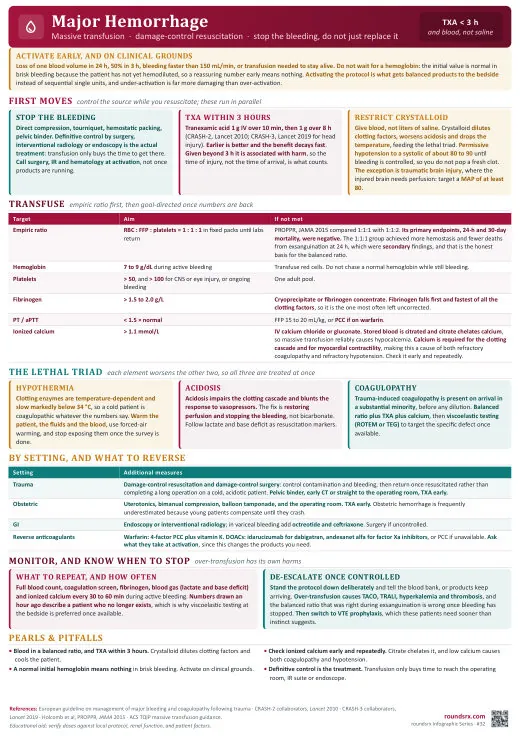
| Hypothermia | Core temp < 35°C impairs coagulation enzyme kinetics, platelet function, and fibrinolysis | Warm all products via rapid infuser, forced-air warming blanket, warm OR/room, warm IV fluids. Target temp > 36°C |
| Acidosis | Hemorrhagic shock → tissue hypoperfusion → lactic acidosis. pH < 7.2 severely impairs clotting factor function | Restore perfusion with blood products (not crystalloid). Limit NS (hyperchloremic acidosis). Bicarbonate is not routine here: the acidosis is a perfusion problem, and bicarb generates CO₂ that worsens intracellular acidosis unless minute ventilation can rise to blow it off. Reserve it for pH < 7.1 with shock refractory to blood and pressors, purely to buy time until surgical or IR source control |
| Coagulopathy | Dilutional (crystalloid), consumptive (ongoing hemorrhage), and dysfunction (hypothermia + acidosis impair cascade) | 1:1:1 balanced resuscitation, cryo for fibrinogen < 150, TXA, avoid excess crystalloid |
- Surgical/interventional hemostasis achieved (source of bleeding controlled)
- Hemodynamically stable without vasopressors or ongoing blood product requirement
- Labs normalizing: lactate trending down, pH > 7.25, fibrinogen > 150, INR < 1.5
- No active hemorrhage on reassessment
- Communicate with blood bank to deactivate MTP and return unused products
| Product | Ratio | Key Notes |
|---|---|---|
| pRBCs | 1 | O-neg until type & screen available (O-pos acceptable for males) |
| FFP | 1 | Replaces clotting factors. Thaw takes 20–30 min -keep thawed plasma available |
| Platelets | 1 | 1 apheresis unit per 6-pack pRBC |
| Cryoprecipitate | Give when fibrinogen < 150 | 10 units = ↑ fibrinogen ~70 mg/dL |
- Tranexamic Acid (TXA) 1g IV over 10 min → 1g over 8h -give within 3 hours of injury (CRASH-2, 2010)
- Calcium: Replace aggressively -citrate in blood products chelates calcium → hypocalcemia → cardiac arrest. Give Calcium Chloride 1g IV per 4 units pRBC
- Permissive hypotension: Target SBP 80–90 until surgical hemostasis (except TBI -MAP ≥ 80)
- Damage control resuscitation: Limit crystalloid. Avoid hypothermia, acidosis, coagulopathy ("lethal triad")
| TEG Parameter | ROTEM Equivalent | What It Measures | Abnormal → Treatment |
|---|---|---|---|
| R time | CT (clotting time) | Time to initial fibrin formation (factor activity) | Prolonged → FFP |
| K time / Alpha angle | CFT / Alpha angle | Speed of clot strengthening (fibrinogen) | Prolonged K / low alpha → Cryoprecipitate |
| MA (max amplitude) | MCF (max clot firmness) | Clot strength (platelet + fibrinogen) | Low MA → Platelets (if fibrinogen adequate) |
| LY30 | ML (max lysis) | Fibrinolysis at 30 min | LY30 > 3% → TXA (hyperfibrinolysis) |
| Product | Dose | Route | Notes |
|---|---|---|---|
| Calcium Chloride | 1g (10 mL of 10%) per 4 units pRBC | Central line preferred | 3x more elemental Ca than gluconate. Extravasation causes tissue necrosis |
| Calcium Gluconate | 3g IV per 4 units pRBC | Peripheral or central | Safer peripherally. Requires hepatic metabolism to release ionized Ca |
- Advantages: single product = balanced resuscitation, faster delivery (no thaw delay), reduced donor exposure (one donor instead of three), fewer bags/lines.
- Practical use: first 4–6 units in massive hemorrhage, then transition to component therapy if more is needed (LTOWB inventory is limited).
- Limitations: not universally available, "low-titer" anti-A and anti-B titers required to give safely to non-O recipients, shorter shelf life (~21 days vs 42 for pRBC).
- Evidence: retrospective and observational studies show mortality benefit; large RCTs ongoing. Reduced 24h and 30-day mortality vs component therapy in trauma cohorts.
- Target MAP ≥ 80 (or SBP ≥ 110 for adults). NO permissive hypotension. Why: cerebral perfusion pressure (CPP = MAP − ICP) drops with hypotension; even brief SBP < 90 doubles TBI mortality.
- INR target < 1.4 (vs < 1.5 standard). Why: lower threshold for bleeding tolerance in a closed cranium.
- Platelets > 100K (vs > 50K standard).
- Hypertonic saline (3% bolus 250 mL or 23.4% bolus 30 mL) for ICP control. Why: NS volume contributes to brain edema; hypertonic saline shifts free water out of cells and buys time before definitive surgical decompression.
- Reverse antiplatelets in surgical TBI with platelet transfusion + DDAVP, despite the PATCH 2016 caveat (which was for spontaneous ICH not requiring surgery, not for surgical TBI).
- Reverse anticoagulants emergently, see Anticoagulation Reversal table below.
- Pediatric patients (small distribution volume)
- Renal failure / ESRD (no excretion route)
- Rapid large-volume transfusion (overwhelms cellular K⁺ re-uptake)
- Hypothermic patients (impaired Na/K-ATPase)
- Monitor: K⁺ q30–60 min during active MTP. Continuous ECG (peaked T-waves, wide QRS, sinusoidal pattern, AV block).
- Membrane stabilization: calcium gluconate 1 g IV or calcium chloride 1 g IV. Dual purpose, also treats citrate-induced hypocalcemia.
- Intracellular shift: insulin 10 units IV + D50 (25 g) IV. Albuterol 10–20 mg nebulized.
- Request fresher units from blood bank (< 14 days old) when feasible, especially for pediatrics and renal failure patients.
- Washed RBCs remove most extracellular K⁺. Consider if hyperkalemia is severe and refractory and source control allows time for washing (~30–45 min).
- Dialysis (CRRT or HD) if refractory. More typical post-resuscitation than during active MTP.
| TRALI | TACO | |
|---|---|---|
| Mechanism | Donor anti-HLA / anti-HNA antibodies activate recipient neutrophils → non-cardiogenic pulmonary edema (capillary leak) | Volume overload from rapid or large-volume transfusion in patient with limited cardiac reserve |
| Onset | Within 6 hours of transfusion (typically < 2h) | Within 6 hours of transfusion, often during or just after |
| Risk factors | Multiparous female donors (anti-HLA in donor), critically ill recipient, sepsis, recent surgery | Elderly, CHF, renal failure, rapid transfusion rate, pediatrics, > 6 units pRBC |
| Vital signs | Hypotension, fever, tachycardia, hypoxemia | Hypertension, tachycardia, hypoxemia, JVD |
| BNP / NT-proBNP | Normal or low (not cardiac in origin) | Elevated (volume-mediated) |
| CXR | Bilateral infiltrates, looks like ARDS, no cardiomegaly | Bilateral infiltrates with cardiomegaly, Kerley B lines, pleural effusions |
| Echo | Preserved EF, no chamber enlargement | Systolic or diastolic dysfunction, dilated chambers |
| Treatment | Stop transfusion. Supportive ARDS care: lung-protective ventilation, conservative fluids. Diuretics not helpful (and harmful if hypotensive). Corticosteroids unproven. | Stop transfusion. Diuretics (furosemide 20–40 mg IV). Sit patient up. Slow transfusion rate; smaller aliquots (250 mL increments). |
| Mortality | ~5–10% in MTP setting; some studies up to 20% | Lower (~1–2%), more amenable to volume removal |
| Anticoagulant | Reversal Agent | Dose | Notes |
|---|---|---|---|
| Apixaban (Eliquis), rivaroxaban (Xarelto) | Andexanet alfa (Andexxa) | Low-dose: 400 mg bolus + 4 mg/min × 120 min. High-dose: 800 mg bolus + 8 mg/min × 120 min (if last dose > 5 mg apixaban or > 10 mg rivaroxaban within 8h) | Specific factor Xa decoy. Expensive (~$50,000/dose). Increased thromboembolism post-reversal, balance against benefit. ANNEXA-4 / ANNEXA-I |
| Dabigatran (Pradaxa) | Idarucizumab (Praxbind) | 5 g IV (two 2.5 g vials) over 5–10 min | Specific Fab fragment. Rapid (< 5 min onset). Re-elevation of dabigatran possible at 12–24h, can re-dose. REVERSE-AD, 2017 |
| Warfarin (Coumadin) | 4-factor PCC (Kcentra) + vitamin K | 4F-PCC: 25–50 units/kg IV (INR-based; max 5000 units). Vitamin K: 10 mg IV over 30 min | 4F-PCC for emergent reversal (faster than FFP, lower volume, better outcomes). Vitamin K for sustained reversal (4F-PCC is short-acting, INR rebounds without K). Sarode, 2013 |
| UFH (heparin) | Protamine sulfate | 1 mg IV per 100 units of heparin given in last 2–3h (max 50 mg). Slow IV push over 10 min. | Watch for anaphylaxis (especially fish allergy, prior protamine, NPH insulin users), hypotension, paradoxical anticoagulant effect at high doses. |
| LMWH (enoxaparin) | Protamine sulfate (partial reversal only) | 1 mg per 1 mg enoxaparin if given within 8h (~60% efficacy). 0.5 mg per 1 mg enoxaparin if 8–12h. | Only ~60% reversal at best (protamine binds anti-IIa activity but only partially anti-Xa). Andexanet has been studied but is NOT FDA approved for LMWH. |
| Antiplatelets (ASA, clopidogrel, ticagrelor, prasugrel) | Platelet transfusion + desmopressin (DDAVP) | Platelets: 1 apheresis unit (or 6-pack random donor). DDAVP: 0.3 mcg/kg IV (max 20 mcg). | Controversial in spontaneous ICH (PATCH, 2016 showed harm in non-surgical ICH), but standard practice in MTP and emergent neurosurgery. DDAVP releases vWF and improves platelet adhesion. |
| Fondaparinux | No specific reversal | 4F-PCC 50 units/kg or rFVIIa 90 mcg/kg as last resort | Off-label, mixed evidence. No FDA-approved specific reversal exists. Half-life 17–21h; supportive care often required. |
- CBC q30–60 min
- PT/INR, PTT, fibrinogen q30–60 min
- BMP (Ca²⁺, K⁺ -hyperkalemia from stored blood)
- ABG/VBG (pH, lactate, base deficit)
- TEG/ROTEM if available (point-of-care coagulation)
- Type & screen / crossmatch
| Drug | Dose | Indication |
|---|---|---|
| Tranexamic Acid (TXA) | 1g IV bolus → 1g over 8h | Antifibrinolytic -give within 3h of injury |
| Calcium Chloride | 1g IV per 4 units pRBC | Prevent/treat citrate-induced hypocalcemia |
| Calcium Gluconate | 3g IV (equivalent to 1g CaCl) | Alternative if no central line (less tissue necrosis) |
| Cryoprecipitate | 10 units IV | Fibrinogen < 150 mg/dL |
| Vitamin K (Phytonadione) | 10 mg IV | If on warfarin or INR > 1.5 |
Patient: 28M restrained driver, high-speed MVC. GCS 14, HR 132, BP 78/50, RR 24. FAST positive. Pelvis unstable.
Assessment: ABC Score = 3 (SBP ≤ 90, HR ≥ 120, FAST+). Shock Index 1.7. Activate MTP.
Management:
- MTP activated: O-pos pRBC (male), thawed plasma, platelets 1:1:1
- TXA 1g IV over 10 min (within 30 min of injury)
- Pelvic binder. Permissive hypotension: target SBP 80–90
- CaCl 1g IV after 4 units pRBC. Warm all products via rapid infuser
- After 8 units: TEG low MA (42), fibrinogen 120 → cryo 10u + platelet apheresis
- IR pelvic angioembolization. Lactate 8→4, pH 7.18→7.30
- MTP deactivated after 14u pRBC, 12 FFP, 2 plt, 20u cryo
Key lesson: Activate MTP early on clinical criteria. Use TEG to guide products once initial resuscitation underway.
Patient: 62M, cirrhosis (MELD 24), large-volume hematemesis. HR 128, BP 82/48, lactate 7.2. INR 2.8, plt 52, fibrinogen 88.
Assessment: Massive upper GI bleed with baseline coagulopathy. Shock Index 1.6.
Management:
- MTP activated. Two large-bore IVs. O-neg pRBC started
- 1:1:1 ratio. Cryo 10u immediately (fibrinogen 88)
- CaCl 1g after 4 units. iCa monitored q30 min
- Octreotide 50mcg bolus then 50mcg/hr + pantoprazole 80mg then 8mg/hr
- Ceftriaxone 1g IV (SBP prophylaxis in cirrhosis + GI bleed)
- Emergent EGD: Variceal bleed → band ligation, hemostasis achieved
- MTP deactivated after 6u pRBC. Lactate trending down
Key lesson: Cirrhotic patients need aggressive fibrinogen replacement. Transfuse to Hgb 7–8 (overtransfusion ↑ portal pressure). Early endoscopy is critical.
Patient: 32F, G3P3, vaginal delivery 45 min ago. EBL 2L, ongoing. HR 138, BP 74/42, AMS. Boggy uterus.
Assessment: PPH from uterine atony. Hemorrhagic shock. Shock Index 1.9.
Management:
- MTP activated. O-neg pRBC (female of childbearing age)
- TXA 1g IV immediately (WOMAN, 2017)
- Uterotonics: oxytocin 40u/1L LR, methylergonovine 0.2mg IM, carboprost 0.25mg IM q15min, misoprostol 800mcg PR
- Bimanual uterine massage
- CaCl 1g after 4u. iCa 0.82 → repeat CaCl
- 6 pRBC, 6 FFP, 1 plt, 10u cryo (fibrinogen 102)
- Uterotonics + Bakri balloon → hemostasis. If refractory: IR embolization or hysterectomy
- Stable at 2h. MTP deactivated
Key lesson: PPH is #1 cause of maternal death. Uterotonics first (atony is #1 cause). TXA early (WOMAN trial). Young patients compensate until sudden collapse.
- Vitals q5–15 min
- Ionized Ca²⁺ q30 min -replace aggressively
- Temperature -warm all products, forced air warming blanket
- Urine output -Foley, target ≥ 0.5 mL/kg/hr
- ABG/lactate q30–60 min (trend as resuscitation marker)
- CBC, coags, fibrinogen q30–60 min
- K⁺ -hyperkalemia from stored blood lysis