Airway & Ventilator Management
- Airway protection -GCS ≤ 8, inability to handle secretions, impending obstruction
- Hypoxemic respiratory failure -SpO₂ < 90% despite high-flow O₂, P/F < 200
- Hypercapnic respiratory failure -rising PaCO₂ with acidosis (pH < 7.25), fatigue
- Impending respiratory failure -accessory muscle use, paradoxical breathing, rising work of breathing
Pressure Control (PC): You set the pressure -the volume varies depending on lung compliance. Preferred when you want to limit pressures.
- Tidal volume (Vt) -actual delivered TV in mL/kg PBW
- Rate (RR) -set respiratory rate
- FiO₂ -fraction of inspired oxygen (0.21–1.0)
- PEEP -positive end-expiratory pressure in cmH₂O
- Peak pressure (Ppeak) -total pressure to deliver breath (airway resistance + alveolar)
- Plateau pressure (Pplat) -alveolar distension pressure (inspiratory hold). Target ≤ 30.
- Driving pressure = Pplat − PEEP. Target ≤ 15. Strong predictor of ARDS mortality.
- P/F ratio = PaO₂ ÷ FiO₂ -oxygenation index
- SpO₂ target -88–95% in ARDS; 94–98% otherwise
| Device | Flow Rate | FiO₂ Delivered | Best For | ⚠️ Limitations |
|---|---|---|---|---|
| Nasal Cannula (NC) | 1–6 L/min | 24–44% | Mild hypoxemia. Stable patients. Most common starting point. | ⚠️ Uncomfortable > 6L (dries mucosa). Unreliable FiO₂ -depends on patient's minute ventilation and mouth breathing. |
| Simple Face Mask | 5–10 L/min | 35–55% | Moderate hypoxemia. Short-term use (ED, post-op). | ⚠️ Must run ≥ 5 L/min to prevent CO₂ rebreathing. Claustrophobic. Can't eat/talk well. |
| Venturi Mask | 4–12 L/min | Precise: 24%, 28%, 31%, 35%, 40%, 50% | COPD patients -need precise low FiO₂ (24–28%) to avoid suppressing hypoxic drive. Color-coded adapters. | ⚠️ Max 50% FiO₂. Bulky. Used mainly for COPD. |
| Non-Rebreather (NRB) | 10–15 L/min | 60–90% | Severe hypoxemia. Pre-oxygenation before intubation. CO poisoning. Trauma. | ⚠️ Reservoir bag must stay inflated. Not truly 100% -room air mixes around mask. If patient needs NRB → consider escalation. |
| High-Flow Nasal Cannula (HFNC) | 20–60 L/min | 21–100% (titratable) | Hypoxemic respiratory failure, post-extubation, immunocompromised (avoid intubation), pre-oxygenation. Delivers heated humidified O₂. | ⚠️ Generates ~1 cmH₂O PEEP per 10 L/min (so 60L ≈ 6 cmH₂O). Patient must breathe spontaneously. If still desatting on HFNC 60L/100% → intubate. |
| CPAP | BiPAP | |
|---|---|---|
| What it does | Single continuous pressure (like PEEP) | Two pressures: IPAP (inhale) + EPAP (exhale) |
| Helps with | Oxygenation only -splints airways open, recruits alveoli | Both oxygenation AND ventilation -IPAP augments tidal volume (blows off CO₂), EPAP = PEEP |
| Best for | Cardiogenic pulmonary edema, OSA | COPD exacerbation (hypercapnic failure), obesity hypoventilation, neuromuscular weakness |
| Typical settings | CPAP 5–10 cmH₂O | IPAP 10–20 / EPAP 5–8 cmH₂O. Start IPAP 10, EPAP 5. Titrate IPAP up by 2 q15–30 min for CO₂. |
| Pressure support | None (single pressure) | PS = IPAP − EPAP. Higher PS = more ventilatory support. PS of 10 cmH₂O is moderate support. |
- COPD exacerbation with respiratory acidosis (pH < 7.35, PaCO₂ > 45) -strongest evidence, reduces intubation by 65% Brochard, 1995
- Cardiogenic pulmonary edema -CPAP or BiPAP both work. Reduces preload + afterload + recruits flooded alveoli. 3CPO, 2008
- Post-extubation -prophylactic NIV in high-risk patients reduces reintubation
- Immunocompromised with respiratory failure -try NIV/HFNC first to avoid vent-associated infections
- Palliative / DNI patients -ceiling of care when intubation is not desired
▶ How to Pick BiPAP Settings, Step by Step (tap to expand)
| Setting | What It Controls | How to Titrate | Think of It As |
|---|---|---|---|
| EPAP | Oxygenation (splints alveoli open, recruits collapsed lung) | Start 5 cmH₂O. ↑ by 2 if SpO₂ < 90% despite FiO₂. Max ~10-12. | = PEEP. Treats the O₂ problem. |
| IPAP | Ventilation (how much air is pushed in per breath) | Start 10 cmH₂O. ↑ by 2 q15-30 min if CO₂ still high. Max ~20-25. | = Tidal volume driver. Treats the CO₂ problem. |
| PS (= IPAP − EPAP) | Tidal volume per breath | Higher PS → bigger breaths → more CO₂ blown off. Target PS 5-15 cmH₂O for most patients. | PS is essentially your tidal volume knob. PS of 10 ≈ TV of ~400-500 mL in most adults. |
| FiO₂ | Oxygen concentration | Start 100%, wean to target SpO₂ 88-92% (COPD) or 92-96%. Always wean FiO₂ before weaning pressures. | Supplemental O₂. Independent of IPAP/EPAP. |
| Rate (backup) | Minimum breaths/min if patient doesn't trigger | Set 12-16. Usually not needed, patient triggers their own breaths. | Safety net for apnea. |
| Problem | Which Knob to Turn | What to Do |
|---|---|---|
| SpO₂ low (oxygenation failure) | ↑ EPAP (or ↑ FiO₂) | EPAP recruits alveoli and improves V/Q matching. Think of it like adding PEEP on a vent. |
| CO₂ high (ventilation failure) | ↑ IPAP (keeping EPAP the same) | This increases PS, which increases tidal volume, which blows off more CO₂. ↑ IPAP by 2 cmH₂O every 15-30 min until pH improves. |
| Both | ↑ EPAP for O₂, ↑ IPAP for CO₂ | Always increase IPAP at least as much as EPAP to maintain the PS gap. If you raise EPAP by 2, raise IPAP by 2 also. |
Example: IPAP 12 / EPAP 5 = PS 7. If you raise EPAP to 8 but keep IPAP at 12 → PS drops to 4 → patient gets smaller breaths → CO₂ rises. Fix: raise IPAP to 15 / EPAP 8 = PS 7 maintained.
- IPAP 10 / EPAP 5 (PS = 5) -safe starting point for most patients
- FiO₂ 100% (wean later based on SpO₂)
- Backup rate 12-16
- Fit mask snugly. Coach patient: "Breathe with the machine, let it push air in."
- CO₂ still elevated / pH still acidotic? → ↑ IPAP by 2 (e.g., IPAP 12 → 14 → 16). Recheck in 1h.
- SpO₂ still low? → ↑ EPAP by 2 (and raise IPAP by 2 to maintain PS). Or ↑ FiO₂.
- Both improving? → Hold current settings. Wean FiO₂ first.
- pH improving and patient comfortable? → BiPAP is working. Continue. Recheck ABG q4-6h.
- No improvement or worsening? → NIV failure. Prepare for intubation. Do NOT delay.
Presentation: Brought in by EMS, severe respiratory distress, accessory muscle use, speaking in 1-2 word sentences. RR 32, SpO₂ 84% on 6L NC, HR 115, BP 155/90.
ABG on arrival: pH 7.22, PaCO₂ 78, PaO₂ 52, HCO₃ 30 (acute-on-chronic hypercapnic respiratory failure).
→ After 15 min: RR 28, SpO₂ 89%. Still distressed. CO₂ not moving.
Step 2 (Time 15 min): ↑ IPAP to 14 / EPAP 5 (PS = 9). Keep FiO₂ 50%.
→ After 30 min: RR 24, SpO₂ 91%. Patient visibly more comfortable. Able to speak in short sentences.
Step 3 (Time 1 hour): Repeat ABG: pH 7.28, PaCO₂ 62, PaO₂ 68. pH improving, CO₂ coming down. ↑ IPAP to 16 / EPAP 5 (PS = 11).
Step 4 (Time 2 hours): ABG: pH 7.32, PaCO₂ 55, PaO₂ 72. RR 20, SpO₂ 93%. BiPAP is working. Intubation avoided.
Overnight: Continue BiPAP. Wean FiO₂ to 35%. Give Ipratropium/Albuterol (DuoNeb) nebs q4h, Methylprednisolone (Solu-Medrol) 60 mg IV daily (= prednisone 40 mg PO; switch to PO when tolerating), Azithromycin (Zithromax) 500 mg IV. Next AM: ABG 7.38 / 48 / 78. Trial off BiPAP → tolerates nasal cannula. Extubation avoided.
| Scenario | Starting IPAP / EPAP | PS | Goal | Titration Target |
|---|---|---|---|---|
| COPD exacerbation | 10-12 / 5 | 5-7 | ↓ CO₂, ↑ pH | ↑ IPAP q15-30 min → max 20-25. Target pH > 7.30. |
| Cardiogenic pulmonary edema | 10-12 / 8-10 | 2-4 | ↑ O₂, ↓ preload | Higher EPAP for recruitment. CPAP 10-12 is often enough. |
| Obesity hypoventilation | 14-18 / 8-10 | 6-10 | ↓ CO₂ | Need higher pressures due to chest wall compliance. ↑ IPAP aggressively. |
| Neuromuscular weakness | 10-14 / 5 | 5-9 | Augment weak inspiratory muscles | ↑ IPAP if NIF declining. Low threshold for intubation (GBS, MG crisis). |
| Post-extubation (prophylactic) | 8-10 / 5 | 3-5 | Prevent reintubation | Low support. Alternate with HFNC. Wean over 24-48h. |
| DNI / comfort care | 10-15 / 5-8 | 5-7 | Symptom relief | Titrate to comfort + dyspnea relief. No ABG targets. |
| Challenge | Why It Happens | What to Do |
|---|---|---|
| Higher IPAP needed | Chest wall is stiff → needs more pressure to generate the same tidal volume | Start IPAP 14-18 (not 10). May need IPAP 20-25 in BMI > 50. Don't be afraid to go higher. |
| Higher EPAP needed | Abdominal mass compresses diaphragm → atelectasis → V/Q mismatch → hypoxemia | Start EPAP 8-10 (not 5). Acts like higher PEEP to recruit collapsed bases. |
| Positioning matters hugely | Supine = diaphragm splinted by abdomen. Functional residual capacity drops. | Sit patient upright at 30-45° or reverse Trendelenburg. This alone can improve oxygenation dramatically. |
| Chronic CO₂ retention | Obesity hypoventilation syndrome (OHS), chronic hypercapnia with elevated bicarb | Don't normalize CO₂. Target their baseline PaCO₂ (often 50-60). Check HCO₃, if elevated, it's chronic. Over-ventilating → alkalosis → arrhythmias. |
| Mask leak | Facial fat makes mask seal harder | Use a full-face mask (oronasal). May need a larger size. Check for beard. Tighten straps but avoid skin breakdown. |
Patient arrives with pH 7.18, PaCO₂ 95, HCO₃ 34 (chronic + acute). SpO₂ 82%.
• Start: IPAP 18 / EPAP 10 (PS = 8), FiO₂ 40%, upright positioning
• 15 min: SpO₂ 88%, still tachypneic → ↑ IPAP to 22 (PS = 12)
• 1 hour ABG: pH 7.25, PaCO₂ 75. Improving. Hold settings.
• Target: pH > 7.30 and PaCO₂ toward their baseline (~55-60). Do NOT target PaCO₂ 40, that's over-ventilation for this patient.
• No improvement in pH or PaCO₂ after 1–2h of BiPAP
• Worsening tachypnea (RR > 30 despite NIV)
• SpO₂ < 90% despite FiO₂ escalation
• Declining mental status (somnolence, confusion)
• Hemodynamic instability
• Patient intolerance / non-compliance with mask
Do NOT delay intubation if NIV is failing. Late intubation = worse outcomes.
Equipment: ETT (7.0–7.5 women, 7.5–8.0 men), laryngoscope (video preferred), bougie, BVM, suction, end-tidal CO₂, backup airway (LMA). Two IV lines. Monitors on. Confirm code status.
3–5 minutes of 100% O₂ via NRB or HFNC 60L/min (builds O₂ reserve in FRC). Goal: SpO₂ 100%. In obese or critically ill → apneic oxygenation: leave NC at 15L under the NRB or continue HFNC during intubation attempt.
Fentanyl 1–3 mcg/kg IV (blunts sympathetic surge -useful in elevated ICP, aortic dissection). Lidocaine 1.5 mg/kg IV (for elevated ICP -controversial). Most patients skip this step.
See drug table below. Induction agent → wait 20–30 seconds → paralytic.
Sniffing position: neck flexed, head extended (aligns oral-pharyngeal-laryngeal axes). Elevate head of bed 20–30° in obese. Apply cricoid pressure (Sellick maneuver -controversial but still used).
Direct or video laryngoscopy → visualize cords → pass tube through cords → inflate cuff → confirm placement: (1) End-tidal CO₂ waveform (gold standard), (2) bilateral breath sounds, (3) misting in tube, (4) CXR for depth (2–4 cm above carina).
Start sedation (propofol or midazolam + fentanyl). Set initial vent settings. Secure tube (tape or holder). NG/OG tube. Arterial line if not already placed. ABG in 30 min. CXR to confirm ETT position.
| Drug | MOA | Dose | Onset | Duration | Best For | ⚠️ Avoid If |
|---|---|---|---|---|---|---|
| INDUCTION AGENTS | ||||||
| Etomidate | GABA-A agonist | 0.3 mg/kg IV push | 15–30 sec | 5–15 min | Hemodynamically unstable -most neutral on BP. Most common RSI induction agent. | ⚠️ Adrenal suppression (single dose is clinically insignificant). Avoid in septic shock? -debated. |
| Ketamine (Ketalar) | NMDA antagonist | 1–2 mg/kg IV push | 30–60 sec | 10–20 min | Asthma/bronchospasm (bronchodilator), hypotension (preserves BP via sympathetic stimulation), elevated ICP (old teaching said avoid -now considered safe). | ⚠️ Psychosis/schizophrenia (emergence reactions). Increases secretions -give glycopyrrolate. |
| Propofol (Diprivan) | GABA-A agonist | 1.5–2.5 mg/kg IV push | 15–30 sec | 5–10 min | Status epilepticus (anticonvulsant), elevated ICP (lowers ICP). | ⚠️ Causes significant hypotension -avoid in shock, hypovolemia. Egg/soy allergy (controversial). |
| Midazolam (Versed) | GABA-A agonist (benzo) | 0.1–0.3 mg/kg IV push | 1–2 min | 15–30 min | Rarely used for RSI (slower onset). Backup option. Provides amnesia. | ⚠️ Hypotension. Slower onset than etomidate/ketamine. Can reverse with flumazenil. |
| PARALYTICS (NEUROMUSCULAR BLOCKERS) | ||||||
| Succinylcholine (Anectine) | Depolarizing NMB -mimics ACh, sustained depolarization → paralysis | 1–1.5 mg/kg IV push | 30–45 sec | 6–10 min | Fastest onset + shortest duration. Good when you need to quickly reassess neuro status (e.g., stroke). | ⚠️ Hyperkalemia (burns > 48h, crush injury, denervation, renal failure with K⁺ > 5.5). Malignant hyperthermia (personal/family history). Myasthenia gravis. |
| Rocuronium (Zemuron) | Non-depolarizing NMB -competitive ACh blocker at nicotinic receptor | 1.2 mg/kg IV push (RSI dose) | 45–60 sec | 45–70 min | When succinylcholine is contraindicated. Reversible with sugammadex (16 mg/kg for immediate reversal). Becoming first-line at many centers. | ⚠️ Long duration -if can't intubate AND can't ventilate, patient is paralyzed for 45+ min (unless sugammadex available). |
If 2 intubation attempts fail AND cannot bag-mask ventilate AND LMA fails → cricothyrotomy. Palpate cricothyroid membrane (between thyroid and cricoid cartilage) → vertical skin incision → horizontal stab through membrane → insert bougie → railroad 6.0 ETT or cric tube. This is the final rescue. Do not delay.
L ook externally (short neck, obesity, facial trauma, beard)
E valuate 3-3-2 (3 fingers mouth opening, 3 fingers hyoid-to-chin, 2 fingers thyroid notch-to-floor of mouth)
M allampati score (III/IV = harder)
O bstruction (epiglottitis, angioedema, tumor, hematoma)
N eck mobility (c-spine collar, ankylosing spondylitis, rheumatoid arthritis)
▶ Ventilator Modes Explained, AC, PC, SIMV, PSV, APRV (tap to expand)
| Mode | How It Works | You Set | What Varies | Best For | ⚠️ Watch For |
|---|---|---|---|---|---|
| AC/VC Assist Control / Volume Control | Every breath (patient-triggered or machine-triggered) delivers a set tidal volume. | TV, RR, FiO₂, PEEP, flow rate | Pressure (Ppeak varies with compliance/resistance) | Most common mode. Default for most intubations. ARDS (guarantees 6 mL/kg TV). | ⚠️ If compliance drops → pressures rise → barotrauma. Watch Pplat. |
| AC/PC Assist Control / Pressure Control | Every breath delivers a set pressure for a set inspiratory time. | Pressure, I-time, RR, FiO₂, PEEP | Tidal volume (varies with compliance) | When you want to limit pressures strictly. Neonatal/pediatric. Some ARDS protocols. | ⚠️ If compliance worsens → TV drops → hypoventilation. Must monitor TV closely. |
| SIMV Synchronized Intermittent Mandatory Ventilation | Delivers set number of mandatory breaths. Patient can take extra breaths on their own (unsupported or with PS). | TV, RR, FiO₂, PEEP, PS level | Patient's spontaneous breaths are variable | Weaning mode -gradually reduce mandatory rate as patient takes over. | ⚠️ Increases work of breathing if PS too low on spontaneous breaths. Largely fallen out of favor -SBT preferred for weaning. |
| PSV Pressure Support Ventilation | Patient triggers every breath. Vent augments each breath with set pressure support. | PS level, FiO₂, PEEP | TV and RR (entirely patient-driven) | SBT (PS 5–8 cmH₂O), weaning assessment, awake cooperative patients. | ⚠️ No backup rate -if patient becomes apneic, no breaths are delivered. Need apnea backup alarm. |
| APRV Airway Pressure Release Ventilation | Sustained high pressure (P-high) with brief releases to low pressure (P-low) for CO₂ clearance. Essentially inverse-ratio CPAP. | P-high, T-high, P-low, T-low | TV during releases | Refractory ARDS -keeps alveoli open with sustained high pressure. Allows spontaneous breathing. | ⚠️ Complex to manage. Requires experience. Not proven superior to standard lung-protective ventilation. Hemodynamic effects from sustained high intrathoracic pressure. |
| Scenario | Mode | Why |
|---|---|---|
| Fresh intubation (default) | AC/VC | Guarantees tidal volume. Simple. Predictable. |
| ARDS | AC/VC (6 mL/kg PBW) | Must control TV tightly for lung protection. |
| COPD / asthma | AC/VC (low rate, long I:E) | Need guaranteed TV with long expiratory time to avoid air trapping. |
| High peak pressures | Switch AC/VC → AC/PC | Limits pressure delivery. But monitor TV -may drop. |
| Ready to wean / SBT | PSV 5–8 / PEEP 5 | Minimal support. Tests if patient can breathe independently. |
| Refractory ARDS | APRV (by experienced team) | Last resort before ECMO. Keeps alveoli recruited. |
| 🔵 Oxygenation (O₂) | 🔴 Ventilation (CO₂) | |
|---|---|---|
| What is it? | Getting oxygen INTO the blood | Getting CO₂ OUT of the blood |
| Measured by | PaO₂ (ABG) or SpO₂ (pulse ox) | PaCO₂ (ABG) or EtCO₂ (capnography) |
| Normal values | PaO₂ 80–100 mmHg, SpO₂ 94–98% | PaCO₂ 35–45 mmHg |
| Problem | Hypoxemia -O₂ too low | Hypercapnia -CO₂ too high Hypocapnia -CO₂ too low |
| Vent settings that fix it | FiO₂ (↑ = more O₂ delivered) PEEP (↑ = recruits collapsed alveoli, improves gas exchange surface area) | Respiratory Rate (↑ RR = blow off more CO₂) Tidal Volume (↑ TV = each breath removes more CO₂) Together = Minute Ventilation (MV = RR × TV) |
| Think of it as | How much oxygen you're putting IN the lungs | How much air you're moving THROUGH the lungs |
Step 2: ↑ PEEP (recruit alveoli -increases surface area for gas exchange)
Step 3: Prone positioning -flip patient face-down ≥ 16h/day. Redistributes ventilation to dorsal lung (where perfusion is greatest) → improves V/Q matching. Mortality benefit in severe ARDS (P/F < 150) PROSEVA, 2013
Step 4: Inhaled nitric oxide (iNO) 5–40 ppm or inhaled epoprostenol -selective pulmonary vasodilators. Dilate vessels ONLY in ventilated alveoli → redirects blood flow to functioning lung units → improves V/Q matching + oxygenation. ⚠️ No proven mortality benefit -used as rescue/bridge therapy.
Step 5: ECMO (VV-ECMO) -when all above fail. Blood is oxygenated externally. Consider if P/F < 80 despite optimal vent + prone + iNO.
⚠️ Do NOT increase RR or TV -these do not fix oxygenation. Breathing faster doesn't put more O₂ in the blood if the alveoli can't exchange gas.
Step 2: ↑ Tidal Volume (each breath removes more CO₂)
Minute Ventilation = RR × TV → this is what determines CO₂ clearance
Step 3 (if bronchospasm): Heliox (70–80% helium / 20–30% O₂) -helium is less dense than nitrogen → reduces turbulent airflow resistance → gas flows past the obstruction more easily → improves ventilation in severe bronchospasm/upper airway obstruction refractory to bronchodilators. ⚠️ Limitation: Max FiO₂ is 30% (rest is helium), so don't use if patient needs high FiO₂.
⚠️ Do NOT increase FiO₂ or PEEP -these do not remove CO₂. Giving more oxygen doesn't help ventilation.
⚠️ Watch for auto-PEEP: If RR too high (especially in COPD), patient may not fully exhale → air trapping → hemodynamic collapse.
| ABG Shows | Problem | Adjust | ⚠️ Watch For |
|---|---|---|---|
| PaO₂ 55, SpO₂ 88% | Hypoxemia | ↑ FiO₂ and/or ↑ PEEP | FiO₂ > 0.6 for > 24h → O₂ toxicity. Wean FiO₂ first, then PEEP. |
| PaCO₂ 65, pH 7.22 | Respiratory acidosis (hypoventilating) | ↑ RR or ↑ TV (↑ minute ventilation) | Auto-PEEP in COPD. Pplat > 30 if TV too high. Max RR ~35 before ineffective. |
| PaCO₂ 25, pH 7.55 | Respiratory alkalosis (overventilating) | ↓ RR or ↓ TV (↓ minute ventilation) | Patient may be anxious/in pain → treat the cause. Don't just sedate to fix CO₂. |
| PaO₂ 55 AND PaCO₂ 60 | Both hypoxemic + hypercapnic | ↑ FiO₂/PEEP (for O₂) AND ↑ RR/TV (for CO₂). If refractory → prone + iNO + ECMO. | Suggests severe disease (ARDS + dead space). Consider prone, paralytics, iNO, ECMO. |
| PaO₂ 120, FiO₂ 1.0 | Over-oxygenating | ↓ FiO₂ (wean to target SpO₂ 92–96%) | Hyperoxia harms: ↑ mortality in cardiac arrest, stroke, MI. Wean FiO₂ aggressively. |
| PaO₂ (mmHg) | SpO₂ (%) | What it means |
|---|---|---|
| 40 | 70 | Mixed venous blood. Severe hypoxemia if arterial. |
| 50 | 80 | Critically low. On the steepest part of the cliff. |
| 60 | 90 | The "knee." Above this you're on the safe plateau; below, on a cliff. |
| ~95-100 | 97-100 | Normal arterial. Far up the plateau. |
- Above the knee (PaO₂ > 60, SpO₂ > 90): flat plateau. Big PaO₂ changes produce only small SpO₂ changes. PaO₂ 100 vs PaO₂ 80 both look like 96-97% on the pulse ox.
- Below the knee (PaO₂ < 60, SpO₂ < 90): steep cliff. Small PaO₂ drops produce massive SpO₂ drops. Crashes look sudden because the curve falls off fast here.
- Why this matters for targets: aim for SpO₂ ≥ 92% (general) or 88-92% (COPD CO₂ retainers, permissive hypoxemia in ARDS). Sitting at 92% is at the edge, small drops can plummet quickly.
| Direction | Effect | Caused by |
|---|---|---|
| RIGHT shift | Hgb releases O₂ more easily (higher P50). Good for tissues, bad for lungs at low PaO₂. | CADET, face Right: ↑ CO₂, Acidosis, 2,3-DPG (BPG), Exercise, Temperature. |
| LEFT shift | Hgb holds O₂ tighter (lower P50). Hgb saturates well in the lungs but unloads poorly to tissues. | Hypothermia, alkalosis, ↓ CO₂, ↓ 2,3-BPG (stored blood), CO poisoning, methemoglobin, fetal hemoglobin. |
- CO poisoning: SpO₂ reads ~100% even though tissues are profoundly hypoxic. The pulse ox can't distinguish HbCO from HbO₂. Use co-oximetry (carboxyhemoglobin level) on a venous or arterial sample. Treat with 100% O₂ via NRB; hyperbaric for severe cases.
- Methemoglobinemia: SpO₂ stuck around 85% regardless of true saturation. Suspect with cyanosis unresponsive to O₂, "chocolate brown" blood, history of dapsone, benzocaine, nitrites, or aniline dyes. Treat with methylene blue 1-2 mg/kg IV (avoid in G6PD deficiency).
> 300: Normal
200–300: Mild ARDS
100–200: Moderate ARDS
< 100: Severe ARDS → consider prone, paralytics, ECMO
| Type | Name | Mechanism | ABG Pattern | Common Causes | Treatment Focus |
|---|---|---|---|---|---|
| Type 1 | Hypoxemic | Failure of gas exchange -O₂ can't cross alveolar membrane into blood. V/Q mismatch, shunt, diffusion impairment. | PaO₂ < 60 PaCO₂ normal or low | Pneumonia, ARDS, pulmonary edema, PE, pulmonary fibrosis, atelectasis | 🔵 FiO₂ + PEEP → prone → iNO → ECMO |
| Type 2 | Hypercapnic | Failure of ventilation -can't move enough air to clear CO₂. Pump failure (muscles, drive, mechanics). | PaCO₂ > 50 pH < 7.35 PaO₂ may be low too | COPD, asthma, obesity hypoventilation, neuromuscular disease (GBS, MG, ALS), drug overdose (opioids), chest wall deformity | 🔴 RR × TV (↑ minute ventilation). BiPAP first if possible. |
| Type 3 | Perioperative | Atelectasis from anesthesia, supine positioning, diaphragm splinting (pain, abdominal distension). | PaO₂ low PaCO₂ usually normal | Post-surgical (especially abdominal/thoracic), obesity, poor pain control limiting deep breathing | Incentive spirometry, early mobilization, pain control, CPAP if needed |
| Type 4 | Shock | Hypoperfusion → insufficient O₂ delivery to tissues despite adequate lung function. Respiratory muscles fatigue from hypoperfusion. | Lactic acidosis Mixed picture | Cardiogenic shock, septic shock, hypovolemic shock, Category E PE | Treat the shock first (fluids, vasopressors, inotropes). Intubate to reduce O₂ consumption by respiratory muscles. |
| Parameter | Standard | ARDS | COPD/Obstructive |
|---|---|---|---|
| Mode | AC/VC or AC/PC | AC/VC | AC/VC or SIMV |
| Tidal Volume | 8 mL/kg PBW | 6 mL/kg PBW | 6–8 mL/kg PBW |
| Rate | 14–16 /min | 18–22 /min | 10–14 /min (avoid stacking) |
| FiO₂ | Start 1.0, wean | Wean to keep SpO₂ 88–95% | Target SpO₂ 88–92% |
| PEEP | 5 cmH₂O | 8–16 (ARDSnet table) | Auto-PEEP concern -keep low |
| I:E Ratio | 1:2 | 1:2 to 1:3 | 1:3 to 1:4 (more time to exhale) |
- ETT displaced (too deep → right mainstem, or dislodged)
- Check: confirm with laryngoscope, CXR, ETCO₂, auscultation
- Fix: reposition or replace tube
- Mucus plug, biting tube, kinked circuit
- Check: suction catheter passes easily? Pass suction first
- Fix: suction, reposition head, bite block
- Tension pneumothorax: absent breath sounds + tracheal deviation + hypotension
- Fix: needle decompression NOW (2nd ICS, MCL or 4th ICS, anterior axillary line) then chest tube. Do NOT wait for CXR if hemodynamically unstable.
- Vent malfunction, circuit disconnect, O₂ supply failure
- Fix: disconnect from vent → manually bag the patient → troubleshoot equipment
- ABG pre/post intubation
- CXR -ETT 2-4cm above carina
- Plateau pressure -goal <30
- Driving pressure -Pplat−PEEP, goal <15
- Auto-PEEP -expiratory hold
- Peak vs Plateau -high peak + normal plat = airway resistance; both high = compliance problem
- Lung-protective: TV 6–8 mL/kg PBW, Pplat < 30, driving pressure < 15
- ARDS: TV 6 mL/kg PBW ARDSNet, 2000, PEEP per ARDSNet table, prone if P/F < 150 PROSEVA, 2013
- Daily SBT: FiO₂ ≤ 40%, PEEP ≤ 8, following commands → PSV 5/5 × 30 min
- Sedation: RASS 0 to −2. Daily SAT before SBT.
| Drug | Dose | Route | Notes |
|---|---|---|---|
| Propofol (Diprivan) | 5–50 mcg/kg/min | IV | First-line sedation. ⚠️ Propofol infusion syndrome (PRIS) risk if > 48h or > 80 mcg/kg/min (check CK, triglycerides, lactate). |
| Fentanyl (Sublimaze) | 25–200 mcg/hr | IV | Analgesia-first approach. Preferred analgesic in ICU. Lipophilic -accumulates > 72h. |
| Cisatracurium | 1–3 mcg/kg/min | IV | Neuromuscular blockade for severe ARDS × 48h. Must have adequate sedation first -paralyzed + aware = torture. ACURASYS, 2010 |
| Dexmedetomidine | 0.2–1.5 mcg/kg/hr | IV | Less delirium than benzos MENDS, 2007. SEDCOM, 2009. DEXCOM, 2016: reduced delirium and shorter time to extubation vs midazolam. ⚠️ Bradycardia, hypotension. No respiratory depression -can use during SBT. |
- Stop sedation infusions daily (unless contraindicated: active seizures, alcohol withdrawal, paralytics, elevated ICP)
- Assess: Is patient following commands? Opening eyes? Breathing comfortably?
- Restart sedation at half dose if patient fails (agitation, RR > 35, SpO₂ < 88%, distress)
- RR < 30, SpO₂ > 90%, TV > 5 mL/kg PBW
- RSBI (Rapid Shallow Breathing Index) = RR ÷ Vt (in L) < 105 -most validated weaning predictor
- No distress, paradoxical breathing, or diaphoresis
- HR and BP within 20% of baseline
- Passed SBT ✓
- Airway reflexes intact -strong cough, follows commands
- Cuff leak test: deflate cuff → listen for air leak around tube. No leak suggests laryngeal edema → post-extubation stridor risk → give dexamethasone and delay extubation
- Secretion burden manageable (not suctioning > q2h)
- Consider dexamethasone 8 mg IV q8h × 4 doses starting 12h before extubation if intubated > 7 days or failed cuff leak
- Anesthesia or airway team notified if anticipated difficult reintubation
| Indication | Why it works |
|---|---|
| Restore voice / phonation | Exhaled air is forced through the larynx instead of out the trach, giving audible speech. The primary reason it is placed and the biggest quality-of-life and delirium-reducing win. |
| Improve swallowing, reduce aspiration | Closing on exhalation restores subglottic pressure and normal aerodigestive pressures, improving laryngeal sensation, cough strength, and airway protection. |
| Better secretion clearance & cough | Restored subglottic pressure produces a more effective, productive cough so secretions clear through the mouth rather than needing trach suction. |
| Restore smell & taste | Re-establishing nasal and oral airflow returns olfaction, and with it taste and appetite. |
| Facilitate weaning & decannulation | Reintroduces upper-airway airflow and reconditions a more physiologic breathing pattern, a step toward capping and tube removal. |
| Restore physiologic PEEP | The closed exhalation phase recreates the native end-expiratory pressure that is lost when the upper airway is bypassed. |
| Type | Contraindication | Why |
|---|---|---|
| ABSOLUTE | Inflated cuff | Blocks the only exhalation route → air stacking → barotrauma / fatal arrest. Must be fully deflated first. |
| ABSOLUTE | Foam-filled cuff (e.g., Bivona Fome-Cuf) | Self-inflates and cannot be reliably kept deflated, so the exhalation path can re-occlude. Same trapping risk. |
| ABSOLUTE | Total laryngectomy | No patent connection from trachea to upper airway -exhaled air has nowhere to go. |
| ABSOLUTE | Unconscious / comatose / unstable | Cannot protect the airway or signal distress, so the valve cannot be safely trialed. |
| CAUTION | Severe upper-airway obstruction (tracheal/subglottic stenosis, bilateral vocal-fold paralysis, large granulation, or trach tube too big for the airway) | Not enough room to exhale around the tube. Always do the leak check first; no leak means do not place. |
| CAUTION | Severe aspiration risk | Redirecting airflow does not fix a grossly unsafe swallow; assess before trialing. |
| CAUTION | Thick, copious, unmanageable secretions | Secretions can occlude the valve membrane. |
| CAUTION | Severely reduced lung elasticity (end-stage obstructive disease) | Exhaling through the upper airway adds work of breathing the patient may not tolerate. |
Presentation: 45M admitted with severe bilateral pneumonia and hypoxemic respiratory failure. SpO₂ 82% on 15L NRB, intubated emergently. ABG post-intubation: pH 7.34, PaO₂ 70 on FiO₂ 0.8 → P/F ratio 88 (severe ARDS, <100).
Vent Strategy (ARDSNet): Mode AC/VC. PBW ~63 kg → TV 6 mL/kg PBW = 378 mL (set 380 mL). RR 18, PEEP 12, FiO₂ 0.8. Confirm Pplat after first breath: target <30 cmH₂O. Driving pressure (Pplat − PEEP) target <15 cmH₂O. ARMA, 2000
Escalation: P/F ratio persists <150 after 12–16h on optimized settings → initiate prone positioning for 16h/day. Consider neuromuscular blockade (Cisatracurium (Nimbex)) if severe patient-ventilator dyssynchrony. Repeat ABG 30 min after every vent change.
Teaching point: Always use PBW (predicted body weight, from height and sex), not actual body weight, for TV calculation. Over-ventilating causes ventilator-induced lung injury (VILI) and increases mortality, even a few extra mL/kg matters.
Presentation: 68F with severe AECOPD, on BiPAP for 4h with worsening hypercapnia (pH 7.18, pCO₂ 92). BiPAP failure → intubated with RSI using Ketamine (Ketalar) + Succinylcholine (Anectine).
Vent Strategy: Mode AC/VC. TV 6–8 mL/kg PBW. RR 12–14/min (low rate = more time to exhale). High inspiratory flow rate (60–80 L/min) to shorten inspiratory time. Target I:E ratio 1:4 (vs. normal 1:2) to maximize expiratory time and prevent breath stacking. Start PEEP 5.
Auto-PEEP check: Perform end-expiratory hold maneuver, press hold, read auto-PEEP off the ventilator display. Auto-PEEP >5 cmH₂O = air trapping. Treatment: decrease RR, increase expiratory time, aggressive bronchodilators (Albuterol + Ipratropium); if critical, briefly disconnect ETT and allow full passive exhalation.
Permissive hypercapnia: Target pH 7.25–7.35, not a normal pCO₂. Do not raise RR to normalize CO₂, this worsens air trapping. Hemodynamic stability is the goal, not a normal ABG.
Presentation: 55M intubated day 5 for Category E PE with hemodynamic instability, now improving. On AC/VC, RR 14, TV 450 mL, PEEP 5, FiO₂ 0.35. SpO₂ 96%, hemodynamically stable, off vasopressors. RASS −1, follows commands, intact cough.
Step 1, SAT (Sedation Vacation): Hold Propofol and Fentanyl infusions every morning. Assess within 30 min: opens eyes to voice, follows commands, breathing comfortably? Fail criteria: agitation, RR >35, SpO₂ <88%, hemodynamic instability → restart sedation at half dose. Girard, 2008
Step 2, SBT (Spontaneous Breathing Trial): SAT passes → switch to PS 5 / PEEP 5 for 30–120 min. Readiness: FiO₂ ≤40%, PEEP ≤8, hemodynamically stable. Pass criteria: RR <35, SpO₂ >90%, no significant accessory muscle use, RSBI (f/VT in L) <105. Example: RR 18, TV 0.45L → RSBI = 40 → pass.
Decision: Passes both SAT + SBT → proceed to extubation. Fails repeatedly (≥3 attempts over multiple days) → discuss tracheostomy to facilitate long-term weaning, reduce dead space, and improve patient comfort.
| Parameter | Frequency | Target / Action |
|---|---|---|
| ABG | 30 min after any vent change, then q4–6h | pH, PaCO2, PaO2, P/F ratio. Guides FiO2/PEEP (oxygenation) and RR/TV (ventilation) adjustments. |
| Daily SBT assessment | Every morning | Assess readiness: FiO2 ≤ 40%, PEEP ≤ 8, hemodynamically stable, no high-dose vasopressors, adequate mental status. RSBI < 105 (RR/TV in liters) predicts successful extubation. Girard, 2008: paired SAT + SBT improves outcomes. |
| Plateau pressure | q4–6h or with vent changes | Pplat < 30 cmH2O (lung protective). If exceeding → reduce TV, check for pneumothorax, bronchospasm, or mucus plugging. |
| Driving pressure | q4–6h | Driving pressure < 15 cmH2O (Pplat - PEEP). Strongest predictor of ARDS mortality Amato, 2015. Optimize by adjusting TV and PEEP. |
| SpO2 / FiO2 trending | Continuous SpO2, track P/F ratio | SpO2 target 88–95% in ARDS, 94–98% otherwise. Worsening P/F may indicate disease progression, fluid overload, or new complication. |
| Auto-PEEP check | q shift and with clinical concern | Expiratory hold maneuver. Auto-PEEP > 5 = air trapping → increase expiratory time (decrease RR, decrease I:E ratio). Common in COPD/asthma. |
| Sedation level (RASS) | q4h | Target RASS -2 to 0 (light sedation). Deeper sedation only if specific indication (prone, paralysis, severe agitation). Daily sedation awakening trial (SAT). |
| Daily SAT + SBT | Every morning | Girard, 2008: paired protocol -SAT first (hold sedation, assess arousal) → if passes → SBT (PS 5–8/PEEP 5 for 30–120 min). Reduces vent days and mortality. |
| VAE surveillance | Daily | Ventilator-associated events: new/worsening infiltrate, rising FiO2/PEEP after period of stability, fever, purulent secretions. Prevent with: HOB 30-45°, oral care, DVT/PUD prophylaxis, daily SBT. |
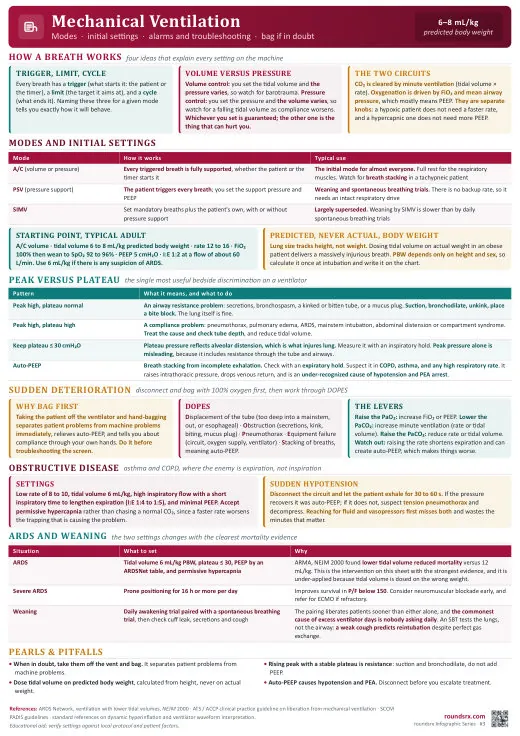
Text version
- D -Displacement (ETT too deep/dislodged)
- O -Obstruction (mucus plug, biting)
- P -Pneumothorax → needle decompress
- E -Equipment failure → bag the patient
- High Peak, Normal Plat: Airway resistance → suction, bronchodilator
- High Peak + High Plat: Compliance problem → PTX, ARDS, edema
- Driving pressure = Pplat − PEEP. Target ≤ 15.
- Stop sedation daily (SAT)
- SBT on CPAP 5 / PS 5–8 for 30–120 min
- RSBI < 105 = ready to extubate
- Pass both → extubate