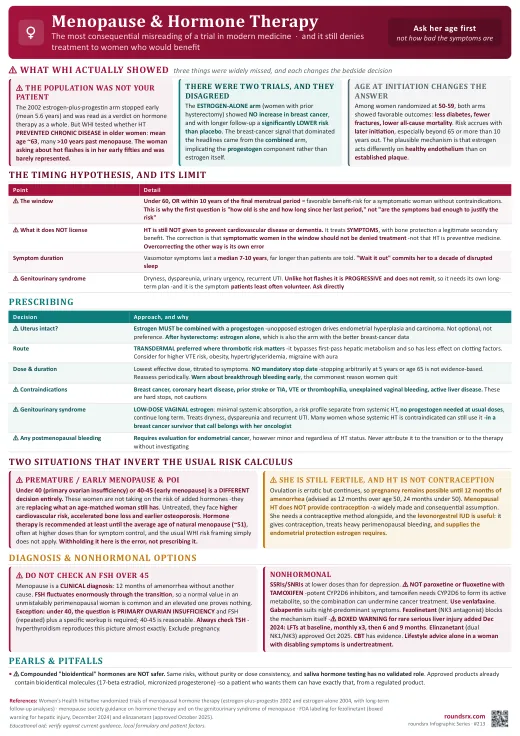
Menopause & Hormone Therapy
In 2002 the estrogen-plus-progestin arm of the Women's Health Initiative was stopped early (WHI E+P, 2002), after a mean of 5.6 years, because overall health risks were judged to exceed benefits, with an excess of breast cancer among the findings. The result was reported as a verdict on hormone therapy as a whole. Use collapsed, and a generation of clinicians was trained to refuse it.
Three things about that trial were widely missed, and each one matters at the bedside.
- The population was not the patient in front of you. WHI was designed to test whether hormone therapy prevented chronic disease in older women, so the mean age at enrollment was about 63 and many participants were more than a decade past menopause. The typical woman seeking treatment is in her early fifties with disabling vasomotor symptoms, and she was barely represented.
- There were two trials, not one, and they disagreed. The estrogen-alone arm, for women with prior hysterectomy, showed no increase in breast cancer, and longer follow-up found a significantly LOWER breast cancer risk than placebo. The breast cancer signal that dominated the headlines came from the combined arm, implicating the progestogen component rather than estrogen itself.
- Age at initiation changes the answer. Among women randomized at 50 to 59, both arms showed favorable outcomes including reduced diabetes, fewer fractures, and lower all-cause mortality. Risk accrues with later initiation, particularly beyond 65 or more than 10 years out.
- Vasomotor symptoms (hot flashes, night sweats) affect most women and are the main reason they seek help. The median duration is far longer than patients are usually told, on the order of 7 to 10 years, and telling someone to "wait it out" commits them to a decade of disrupted sleep.
- Genitourinary syndrome of menopause -vaginal dryness, dyspareunia, urinary urgency and recurrent urinary tract infection. Unlike hot flashes, this is progressive and does not remit, which is why it needs its own long-term treatment plan and why it is the symptom patients are least likely to volunteer. Ask directly.
- Sleep disruption, mood changes and cognitive complaints, often driven substantially by the night sweats themselves.
- Accelerated bone loss begins around the final menstrual period, which is why menopause and osteoporosis are linked topics (see Osteoporosis).
- Thyroid disease -check TSH, because hyperthyroidism reproduces the heat intolerance, palpitations, sweating, sleep disruption and mood change almost exactly.
- Pregnancy -still possible during the transition, and still the first test in anyone with amenorrhea.
- Hyperprolactinemia and medication effects, and in the right context pheochromocytoma or carcinoid for flushing, though these are rare and should not drive routine testing.
- ⚠ Any postmenopausal bleeding requires evaluation for endometrial cancer, regardless of how minor and regardless of hormone therapy status. This is not a symptom to attribute to the transition.
- Establish where she is in the window: age, and years since the final menstrual period. This single determination drives the risk conversation more than anything else.
- Cardiovascular risk assessment, plus blood pressure, lipids and glucose, since these shift adversely across the transition anyway and are worth addressing regardless of the hormone decision.
- Breast cancer risk, including family history, and confirm mammography is current.
- Venous thromboembolism history, personal and family, and migraine with aura, both of which push toward the transdermal route or away from systemic therapy entirely.
- Uterus present or absent -this determines whether a progestogen is required and is the single most consequential prescribing detail on this page.
| Decision | Approach, and why |
|---|---|
| Who it is for | Moderate to severe vasomotor symptoms in a woman under 60 or within 10 years of menopause, without contraindications. It remains the most effective treatment available for these symptoms, and nothing else matches it. |
| ⚠ Uterus intact | Estrogen must be combined with a progestogen. Unopposed estrogen drives endometrial hyperplasia and carcinoma, so this is not optional and not a matter of preference. After hysterectomy, estrogen alone is used -which matters because that is the arm with the more favorable breast-cancer data. |
| Route | Transdermal estrogen is preferred where thrombotic risk is a concern, because it bypasses first-pass hepatic metabolism and therefore has less effect on clotting factors than the oral route. Consider it for higher VTE risk, obesity, hypertriglyceridemia and migraine with aura. |
| Dose and duration | Lowest effective dose, titrated to symptoms. There is no mandatory stop date, and arbitrarily discontinuing at five years or at age 65 is not evidence-based. Reassess periodically, weighing ongoing symptom burden against accruing risk; some women reasonably continue longer with informed discussion. |
| ⚠ Contraindications | History of breast cancer, coronary heart disease, prior stroke or TIA, venous thromboembolism or known thrombophilia, unexplained vaginal bleeding, and active liver disease. These are not soft cautions. |
| Also expect | Fewer fractures (a genuine benefit, though not on its own an indication in most patients), and a small increase in gallbladder disease with oral therapy. Counsel about breakthrough bleeding early on, since it is the commonest reason women stop. |
| Option | Detail |
|---|---|
| SSRIs and SNRIs | Reduce vasomotor symptoms at generally lower doses than for depression, and useful when hormone therapy is contraindicated or declined. ⚠ Avoid paroxetine and fluoxetine in women taking tamoxifen: they are potent CYP2D6 inhibitors, and tamoxifen requires CYP2D6 to be converted to its active metabolite, so the combination can undermine breast cancer treatment. Venlafaxine is the usual choice in that setting. |
| Gabapentin | Useful particularly for night-time symptoms given its sedating effect, so it suits the woman whose main complaint is night sweats waking her. |
| Fezolinetant (Veozah) NK3 antagonist | A nonhormonal agent targeting the mechanism itself -blocking neurokinin B signaling at the hypothalamic thermoregulatory center, which is disinhibited when estrogen falls. ⚠ Carries a BOXED WARNING for rare but serious liver injury, added in December 2024 after approval. Check liver function before starting, then monthly for the first 3 months, and again at 6 and 9 months, and counsel the patient to report jaundice, dark urine, pale stools, nausea or unusual fatigue immediately. |
| Elinzanetant (Lynkuet) dual NK1/NK3 antagonist | Approved in October 2025, the first dual neurokinin-targeted therapy for vasomotor symptoms. A newer option in the same mechanistic family; prescribe with attention to current labeling given how recently it entered practice. |
| Nonpharmacologic | Cognitive behavioral therapy has evidence for reducing the bother of symptoms. Layered clothing, cool environments, and limiting alcohol and spicy triggers help some women. Be honest that these are adjuncts -offering only lifestyle advice to a woman with disabling symptoms is undertreatment. |
"Ms. A is a 53-year-old woman whose last menstrual period was 18 months ago, with about ten hot flashes a day and night sweats waking her three or four times nightly, now affecting her work. She has no history of breast cancer, cardiovascular disease or venous thromboembolism, no migraine with aura, her mammogram is current, and she has an intact uterus. I did not check an FSH, because at her age with this history menopause is a clinical diagnosis and the level fluctuates too much to be useful. I did check a TSH, since hyperthyroidism reproduces this picture almost exactly, and it was normal. She is 53 and 18 months out, so she is squarely inside the therapeutic window where the benefit-risk profile is favorable, and the WHI concerns that get quoted at patients her age were largely generated in women a decade older. I am recommending systemic estrogen with a progestogen, which she needs for endometrial protection given her intact uterus, at the lowest effective dose, and I have counseled that breakthrough bleeding early on is common and is the usual reason women stop. I also asked directly about vaginal dryness, which she had not raised, and she has it -that needs vaginal estrogen in its own right, because it is progressive rather than self-limiting and systemic dosing alone often does not fully treat it."
- Where is she in the window? Age and years since the final menstrual period, documented, because the entire risk conversation turns on it.
- Uterus present? If yes, a progestogen is mandatory, not optional.
- Contraindications actively screened -breast cancer, coronary disease, stroke or TIA, VTE, unexplained bleeding, liver disease.
- Genitourinary symptoms asked about directly, since patients rarely volunteer them and the treatment is different.
- TSH checked and pregnancy excluded where relevant.
- If on fezolinetant: liver testing scheduled at baseline, monthly for 3 months, then 6 and 9 months.
- Any postmenopausal bleeding investigated, never attributed to therapy without evaluation.
| Point | Detail |
|---|---|
| The WHI correction | The 2002 combined arm stopped early and was generalized to everyone. But the mean age was ~63, many were >10 years postmenopausal, and the estrogen-alone arm showed NO breast cancer increase and later a LOWER risk. Women randomized at 50-59 had favorable outcomes including lower all-cause mortality. |
| ⚠ Timing hypothesis | Under 60, or within 10 years of the final period = favorable benefit-risk. Later initiation, especially past 65, is where coronary and stroke risk appears. Ask "how old and how long since?" before "how bad are the symptoms?" |
| Still NOT for prevention | Hormone therapy treats symptoms; it is not given to prevent cardiovascular disease or dementia. The correction is that symptomatic women in the window should not be denied it -not that it is preventive medicine. |
| Diagnose clinically | 12 months amenorrhea. Do NOT check FSH over 45 with typical symptoms -it fluctuates too much. Check under 40 (primary ovarian insufficiency). Check TSH; hyperthyroidism mimics this closely. Any postmenopausal bleeding needs endometrial evaluation. |
| ⚠ Uterus intact | Progestogen is mandatory -unopposed estrogen causes endometrial hyperplasia and carcinoma. After hysterectomy, estrogen alone. |
| Route & duration | Transdermal preferred with thrombotic risk (bypasses first-pass hepatic effect on clotting factors). Lowest effective dose; no mandatory stop date -stopping arbitrarily at 5 years or age 65 is not evidence-based. |
| Contraindications | Breast cancer, coronary disease, stroke or TIA, VTE or thrombophilia, unexplained vaginal bleeding, active liver disease. |
| Genitourinary syndrome | Low-dose VAGINAL estrogen: minimal systemic absorption, no progestogen needed at usual doses, continue long term. Progressive, not self-limiting -so it needs its own plan, and patients rarely raise it unprompted. |
| Nonhormonal | SSRIs/SNRIs (⚠ not paroxetine or fluoxetine with tamoxifen -CYP2D6 inhibition blocks tamoxifen activation; use venlafaxine), gabapentin for night symptoms, fezolinetant (NK3 antagonist, BOXED WARNING for liver injury: LFTs at baseline, monthly x3, then 6 and 9 months), elinzanetant (dual NK1/NK3, approved Oct 2025), and CBT. |
| ⚠ "Bioidentical" compounds | Not safer. Same risks, no purity or dose consistency, and saliva testing has no validated role. Approved products already contain bioidentical molecules (17-beta estradiol, micronized progesterone). |
- Ask her age and how long since her last period first. That answer, not symptom severity, sets the risk conversation.
- The trial everyone quotes studied a different patient. Mean age 63, testing prevention, and its estrogen-alone arm pointed the other way on breast cancer.
- If she has a uterus, she needs a progestogen. Everything else is titration; this one is a safety requirement.