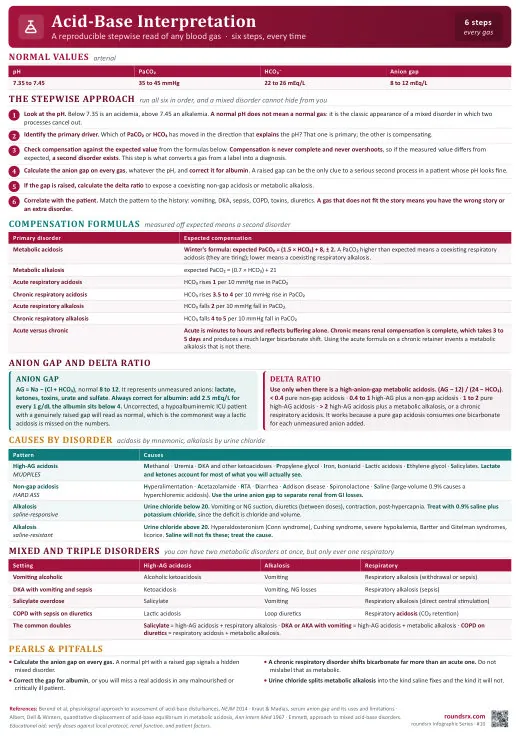
Metabolic Alkalosis
- C, Contraction alkalosis (volume depletion: diuretics, GI losses, burns)
- L, Licorice (glycyrrhizin inhibits 11β-HSD2 → apparent mineralocorticoid excess) / Laxative abuse (chronic/surreptitious → volume contraction + hypokalemia, mimics Bartter/Gitelman)
- E, Endocrine: Conn's (primary hyperaldosteronism), Cushing syndrome, Bartter, Gitelman
- V, Vomiting / NG suction (#1 cause overall)
- E, Exogenous alkali: milk-alkali syndrome, massive citrate (transfusion), IV NaHCO₃
- R, Refeeding alkalosis (intracellular shift of phosphate/K⁺ drives H⁺ into cells)
- P, Post-hypercapnic (rapid correction of chronic respiratory acidosis leaves retained HCO₃⁻)
- D, Diuretics (loop, thiazide, both active use and post-diuretic states)
| UCl < 20 (Saline-Responsive) | UCl > 20 (Saline-Resistant) |
|---|---|
| Vomiting / NGT suction (#1 cause) | Primary hyperaldosteronism |
| Post-diuretic use (drug cleared / last dose >24h ago) | Current (active) diuretic use |
| Post-hypercapnic | Cushing syndrome |
| Chloride-losing diarrhea (rare) | Bartter/Gitelman syndrome |
| Treatment: NS + KCl | Treatment: Treat underlying cause |
The chloride in KCl is doing just as much work as the potassium. Here's why the specific salt matters:
- Cl⁻ is the "anion companion" the kidney needs to dump HCO₃⁻. The distal tubule (pendrin transporter) exchanges intracellular HCO₃⁻ for luminal Cl⁻. No Cl⁻ delivered → no HCO₃⁻ excreted.
- K-acetate and K-citrate are metabolized to HCO₃⁻ in the liver -giving these to an alkalotic patient makes the alkalosis worse.
- K-phosphate is fine for K⁺ but provides phosphate, not chloride -doesn't help the kidney excrete bicarbonate.
- Hypokalemia itself perpetuates alkalosis via H⁺/K⁺ shift and renal H⁺ wasting → K⁺ must be repleted, and giving it as Cl⁻ fixes two deficits with one order.
Bottom line: NS + KCl works because it replaces both missing anions (Cl⁻) and cations (K⁺) with a form the kidney can use to dump HCO₃⁻. Swapping in K-acetate defeats the treatment.
| Mechanism | Chloride-Responsive (UCl < 20) | Chloride-Resistant (UCl > 20) |
|---|---|---|
| GI H⁺ loss | Vomiting, NG suction, villous adenoma (rare) | , |
| Renal H⁺ loss | Post-diuretic use (drug cleared, last dose >24h ago), post-hypercapnic | Hyperaldosteronism, Cushing, Bartter/Gitelman, licorice ingestion, current (active) diuretic use |
| HCO₃⁻ gain | Citrate in massive transfusion, milk-alkali syndrome | , |
| Contraction | Diuretics (volume loss concentrates HCO₃⁻) | , |
| Intracellular H⁺ shift | Hypokalemia (H⁺ moves into cells as K⁺ moves out) | , |
- Don't over-ventilate, target the patient's baseline/home PaCO₂ (often 50–65 mmHg in chronic CO₂ retainers), not 40. Check old ABGs or discharge summaries.
- Lower minute ventilation if alkalosis develops (reduce rate or tidal volume) → allow PaCO₂ to rise.
- Replace chloride, NS (not LR) gives Na⁺ and Cl⁻; the kidney needs Cl⁻ to excrete HCO₃⁻.
- Correct K⁺ and Mg²⁺, hypokalemia perpetuates the alkalosis via distal H⁺ secretion.
- Acetazolamide 250–500 mg IV/PO is the pharmacologic option if volume overload prevents saline, induces renal HCO₃⁻ wasting (watch for hypokalemia).
- Rarely: HCl infusion via central line for severe pH >7.55 refractory to the above.
- Saline-responsive (UCl < 20): IV NS (provides Cl⁻ for kidney to excrete HCO₃⁻) + KCl repletion. Fix the volume and chloride deficit.
- Saline-resistant (UCl > 20): Treat underlying cause (e.g., spironolactone for hyperaldosteronism, stop diuretics)
- Severe/refractory: Acetazolamide (Diamox) 250–500 mg IV -forces renal HCO₃⁻ wasting
- Life-threatening (pH > 7.55): Consider HCl infusion (0.1–0.2 N) via central line, or dialysis
Three deficits maintain a chloride-responsive metabolic alkalosis. You must replace all three -fixing volume alone won't correct it.
- Chloride (Cl⁻) -the kidney can only excrete HCO₃⁻ when paired with a reabsorbable anion. Cl⁻ depletion = HCO₃⁻ retention. Give: NS (154 mEq/L Cl⁻).
- Contraction (volume) -volume depletion activates RAAS → proximal Na⁺/HCO₃⁻ reabsorption. Until ECF volume is restored, the kidney "clings" to bicarbonate. Give: isotonic crystalloid.
- K⁺ (potassium) -hypokalemia drives intracellular H⁺ shift, renal H⁺ secretion, and ammoniagenesis. The alkalosis will not resolve without K⁺ repletion. Give: KCl 10-40 mEq/h (KCl, not K-phos or K-acetate -chloride matters).
Mnemonic: "Chloride, Contraction, K⁺" -or remember that NS + KCl covers all three in one order.
| Step | Condition | Action |
|---|---|---|
| 1 | Check urine Cl⁻ | UCl < 20 → saline-responsive. UCl > 20 → saline-resistant. |
| 2a | Saline-responsive | IV NS 125–250 mL/h + KCl 10–40 mEq/h. Goal: replace Cl⁻ deficit and correct volume. |
| 2b | Saline-resistant | Identify and treat underlying cause: spironolactone for hyperaldosteronism, stop offending diuretics, dexamethasone suppression for Cushing. |
| 3 | Refractory (HCO₃⁻ > 40 despite above) | Acetazolamide 250–500 mg IV q6–12h, forces renal HCO₃⁻ wasting. Monitor K⁺ (causes K⁺ loss). |
| 4 | Severe / life-threatening (pH > 7.55) | HCl infusion 0.1–0.2 N via central line at 100–200 mL/h. Or: NH₄Cl, or hemodialysis with low-bicarbonate bath. |
- ABG -confirm primary metabolic alkalosis (↑ pH, ↑ HCO₃⁻, compensatory ↑ PaCO₂)
- Urine chloride -key classification tool. < 20 = saline-responsive, > 20 = saline-resistant
- BMP -K⁺ (usually low), Cl⁻ (usually low)
- Urine electrolytes -Na⁺, K⁺, Cl⁻
- If saline-resistant: renin, aldosterone, cortisol
| Drug | Dose | Indication |
|---|---|---|
| IV Normal Saline | 125–250 mL/h | Saline-responsive alkalosis -provides Cl⁻ |
| Potassium Chloride (KCl) | 10–40 mEq/h IV (max 40 mEq/h via central) | K⁺ repletion -essential for correction |
| Acetazolamide (Diamox) | 250–500 mg IV q6–12h | Refractory alkalosis -carbonic anhydrase inhibitor → renal HCO₃⁻ wasting |
| Spironolactone (Aldactone) | 25–100 mg PO daily | Hyperaldosteronism-related alkalosis |
Patient: 34F with hyperemesis gravidarum at 10 weeks gestation. Vomiting 8–10x/day for 2 weeks. Lethargic, dry mucous membranes. HR 112, BP 88/52. Labs: pH 7.56, PaCO₂ 48, HCO₃⁻ 38, K⁺ 2.6, Cl⁻ 78, Na⁺ 132.
Assessment:
- Primary metabolic alkalosis (pH 7.56, HCO₃⁻ 38)
- Expected PaCO₂ = 0.7 × 38 + 21 = 47.6, matches (appropriate respiratory compensation)
- Urine Cl⁻: 8 mEq/L → saline-responsive
- Severe hypokalemia (2.6) and hypochloremia (78)
Treatment:
- IV NS at 200 mL/h, volume resuscitation + Cl⁻ replacement
- KCl 40 mEq in 1L NS x 3, aggressive K⁺ repletion (cannot correct alkalosis without fixing K⁺)
- Ondansetron 4 mg IV q8h, antiemetic to stop ongoing losses
- Monitor: BMP q6h, urine Cl⁻ at 24h (should rise > 20 once repleted, confirming correction)
Result: After 3L NS + 120 mEq KCl over 24h: pH 7.44, HCO₃⁻ 26, K⁺ 3.8, Cl⁻ 98. Alkalosis corrected.
Key lesson: Classic saline-responsive alkalosis. The triad of vomiting + low UCl + hypokalemia = give NS + KCl aggressively. Must fix K⁺ to fix the alkalosis.
Patient: 68M with CHF (EF 25%) on furosemide 80 mg BID. Admitted for dyspnea. Labs: pH 7.52, PaCO₂ 50, HCO₃⁻ 36, K⁺ 2.9, Cl⁻ 82, Cr 1.4. Urine Cl⁻: 42 mEq/L.
Assessment:
- Metabolic alkalosis from chronic loop diuretic use (contraction alkalosis + Cl⁻/K⁺ wasting)
- UCl is 42, but patient is on active furosemide → UCl is unreliable. This is saline-responsive masquerading as saline-resistant.
- Challenge: cannot give aggressive NS to a patient with EF 25%, will worsen volume overload
Treatment:
- Hold or reduce furosemide, stop the ongoing Cl⁻/K⁺ losses
- Acetazolamide 250 mg IV q12h, forces renal HCO₃⁻ wasting without volume loading (ideal for CHF patients who cannot tolerate NS)
- KCl 40 mEq PO q8h + IV KCl as needed, K⁺ repletion essential
- Spironolactone 25 mg daily, K⁺-sparing diuretic, also blocks aldosterone-driven H⁺ secretion
- Monitor: Daily weights, I/Os, BMP q8h, telemetry (K⁺ 2.9 = arrhythmia risk)
Key lesson: In CHF patients, you cannot just give NS. Acetazolamide is the key tool, it corrects the alkalosis without adding volume. Always pair with K⁺ repletion since acetazolamide causes additional K⁺ wasting.
Patient: 52F with resistant hypertension (on 3 agents including amlodipine, losartan, HCTZ). Incidental labs show K⁺ 2.8 and HCO₃⁻ 34. BP 168/102 despite medications. No vomiting, no diarrhea.
Assessment:
- Metabolic alkalosis with hypokalemia in the absence of GI losses or diuretics other than HCTZ
- Urine Cl⁻: 38 mEq/L → saline-resistant
- Resistant HTN + spontaneous hypokalemia + metabolic alkalosis = screen for primary hyperaldosteronism
Workup:
- Step 1: Morning aldosterone/renin ratio (ARR). Hold HCTZ for 2 weeks, switch losartan to verapamil (does not affect RAAS). Result: aldosterone 28 ng/dL, PRA 0.3 ng/mL/h → ARR = 93 (cutoff > 30).
- Step 2: Confirmatory test, oral sodium loading or saline infusion test. Aldosterone fails to suppress → confirmed primary hyperaldosteronism.
- Step 3: CT adrenals → 1.8 cm left adrenal adenoma. Adrenal vein sampling confirms lateralization.
Treatment:
- Laparoscopic left adrenalectomy, unilateral adenoma with confirmed lateralization
- Pre-op: Spironolactone 50 mg BID + KCl supplementation to normalize K⁺ and BP
- Post-op: HTN resolved on 1 agent. K⁺ and HCO₃⁻ normalized. Alkalosis corrected.
Key lesson: Resistant HTN + hypokalemia + metabolic alkalosis = think primary hyperaldosteronism (Conn syndrome). It is the most common secondary cause of HTN (5–10% of all HTN). Screen with aldosterone/renin ratio. Saline-resistant alkalosis that does not correct with NS, must treat the underlying cause.