Mitral Regurgitation
| Feature | Acute MR | Chronic MR |
|---|---|---|
| Causes | Papillary rupture (post-MI), endocarditis, chordae rupture | Myxomatous (MVP), rheumatic, functional (LV dilation) |
| Presentation | Flash pulmonary edema, cardiogenic shock | Asymptomatic years → dyspnea |
| Treatment | EMERGENCY SURGERY | Surgery when criteria met |
| Feature | Acute MR | Chronic MR |
|---|---|---|
| LA size | Normal (no time to dilate) | Enlarged (compensatory dilation) |
| LA pressure | Markedly elevated → pulmonary edema | Only mildly elevated (compliant LA absorbs volume) |
| LV size | Normal | Dilated (eccentric hypertrophy from volume overload) |
| Murmur | May be soft/absent (equalization of pressures) or decrescendo | Holosystolic, blowing, radiates to axilla |
| Hemodynamics | Cardiogenic shock, pulmonary edema | Gradual decompensation over years |
| CXR | Flash pulmonary edema, normal heart size | Cardiomegaly, chronic congestion |
| Urgency | Surgical emergency. Stabilize with nitroprusside/IABP | Elective surgery when criteria met |
| Parameter | Mild | Moderate | Severe |
|---|---|---|---|
| Regurgitant volume (mL/beat) | <30 | 30–59 | ≥60 |
| Regurgitant fraction (%) | <30 | 30–49 | ≥50 |
| EROA (cm²) | <0.20 | 0.20–0.39 | ≥0.40 |
| Vena contracta (cm) | <0.3 | 0.3–0.69 | ≥0.7 |
| Color jet area | Small, central | Moderate | Large (>40% LA area) or wall-hugging eccentric jet |
| Feature | Primary (Degenerative) MR | Secondary (Functional) MR |
|---|---|---|
| Pathology | Intrinsic valve disease (leaflets, chordae, papillary muscles) | Normal valve; MR from LV dilation/dysfunction |
| Common causes | Myxomatous/MVP, rheumatic, endocarditis, radiation | Ischemic cardiomyopathy, dilated cardiomyopathy |
| Treatment | Mitral valve repair (preferred) or replacement | Optimize GDMT first; MitraClip if persistent COAPT, 2018 |
- TTE (severity, LV size/function), TEE for surgical planning
- ECG: Afib common
- CXR, BNP
- Cardiac cath pre-op
| Indication | Action |
|---|---|
| Symptomatic severe MR | Surgery (repair > replacement) |
| Asymptomatic + EF ≤60% | Surgery |
| Asymptomatic + LVESD ≥40mm | Surgery |
| Secondary MR + HFrEF | MitraClip if on optimal GDMT COAPT 2018 |
| Asymptomatic + new AF | Consider surgery (Class IIa) |
| Asymptomatic + pulm HTN | PASP >50 mmHg at rest, consider surgery (Class IIa) |
| Criterion | COAPT Eligibility |
|---|---|
| MR severity | Moderate-severe to severe (EROA ≥0.3 cm², regurgitant volume ≥45 mL) |
| Symptoms | NYHA II–IVa despite optimal GDMT |
| LVEF | 20–50% |
| LVESD | ≤70 mm |
| GDMT | Must be on maximally tolerated guideline-directed medical therapy |
| Anatomy | Suitable valve morphology for clip placement (assessed by TEE) |
| Heart Team | Deemed prohibitive or high surgical risk |
| Drug | Role |
|---|---|
| ACEi/ARB | Afterload reduction. Reduces regurgitant fraction |
| Diuretics | Volume management |
| GDMT (HF pillars) | For secondary MR with HF |
| Nitroprusside | Acute severe MR bridge to surgery (ICU only) |
Patient: 66M, day 5 post-inferior STEMI (delayed presentation, no reperfusion). Sudden onset severe dyspnea with pink frothy sputum.
Vitals: HR 125, BP 78/52, RR 32, SpO2 82% on NRB.
Exam: New harsh holosystolic murmur at apex radiating to axilla. Bilateral crackles to apices. JVD. Cold, clammy extremities.
CXR: Flash pulmonary edema with normal heart size (classic for acute MR).
Bedside echo: Flail posterior mitral leaflet with severe eccentric MR jet, ruptured posteromedial papillary muscle head. LVEF 40%.
Management:
- Intubation for respiratory failure
- IABP placed for hemodynamic support (afterload reduction + coronary perfusion augmentation)
- Nitroprusside drip initiated with arterial line monitoring
- Emergent CT surgery consultation, mitral valve replacement (repair often not feasible with ruptured papillary muscle)
- Intraoperative finding: necrotic posteromedial papillary muscle with complete rupture
Teaching point: Papillary rupture is a mechanical complication of MI occurring 3–7 days post-infarct. The posteromedial papillary muscle (single blood supply from PDA) is affected far more often than anterolateral. Normal heart size on CXR + flash pulmonary edema = acute MR. This is a surgical emergency with ~75% mortality without surgery.
Patient: 54F with known myxomatous mitral valve prolapse and severe MR, followed with serial echos. Previously LVEF 68%, LVESD 36mm. Latest echo: LVEF 58%, LVESD 42mm. Patient reports mild exertional dyspnea (NYHA II).
Echo details: Posterior leaflet prolapse (P2 segment), EROA 0.52 cm², regurgitant volume 72 mL, vena contracta 0.8 cm. Moderate LA dilation. New onset AF on ECG.
Decision analysis:
- Three independent triggers for surgery: (1) Symptoms (NYHA II dyspnea), (2) EF ≤60% (now 58%), (3) LVESD ≥40mm (now 42mm)
- Additionally: new AF is a Class IIa indication
- P2 prolapse is the most favorable anatomy for repair (>98% success rate)
Management: Referred for mitral valve repair (not replacement) at a high-volume center. Successful posterior leaflet repair with annuloplasty ring. Post-op echo: trivial residual MR, EF 52% (expected transient drop after eliminating low-resistance LA pathway).
Teaching point: Do not wait for EF to drop to 40%, EF ≤60% in severe MR already represents significant dysfunction. Multiple triggers were present here. P2 prolapse is the ideal repair scenario. Repair at high-volume centers (>25 repairs/year) has superior outcomes.
Patient: 71M with ischemic cardiomyopathy (prior LAD stent), LVEF 28%, on maximally tolerated GDMT (sacubitril/valsartan, carvedilol, spironolactone, dapagliflozin, hydralazine/ISDN). Persistent NYHA III symptoms despite 6 months of optimized therapy.
Echo: Dilated LV (LVESD 58mm), severe functional MR with central jet. Leaflets structurally normal but tethered with incomplete coaptation. EROA 0.35 cm², regurgitant volume 50 mL.
Assessment:
- Secondary MR from LV dilation, valve is structurally normal
- Already on maximal GDMT with CRT-D in place
- COAPT criteria met: EROA ≥0.3, LVEF 20–50%, LVESD ≤70mm, persistent symptoms on optimal therapy
- STS score high risk for open surgery
- MR appears disproportionate to LV dilation (COAPT phenotype, not MITRA-FR)
Management: Proceeded with MitraClip (transcatheter edge-to-edge repair). Post-procedure: MR reduced to mild, NYHA improved to II, no HF hospitalization at 1-year follow-up. COAPT, 2018
Teaching point: In secondary MR, always optimize GDMT first (including CRT if indicated). MitraClip is reserved for patients with persistent symptoms despite maximal therapy who meet COAPT criteria. The key is ensuring MR is disproportionate to LV size.
| Parameter | Frequency |
|---|---|
| Echo | q6–12mo severe; q1–2y moderate |
| AF surveillance | ECG at visits |
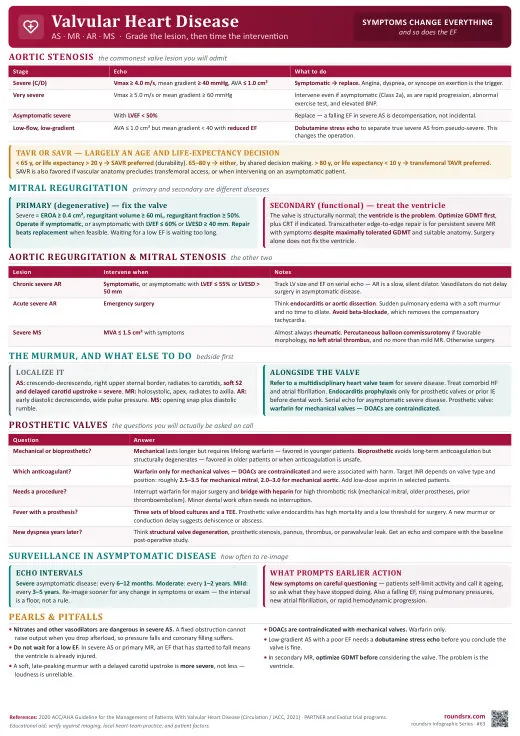
Text version
- Regurgitant volume ≥60 mL/beat (mild <30, moderate 30–59).
- Regurgitant fraction ≥50% (mild <30, moderate 30–49).
- EROA ≥0.40 cm² (mild <0.20, moderate 0.20–0.39).
- Vena contracta ≥0.7 cm (mild <0.3, moderate 0.3–0.69).
- Color jet: large (>40% of LA area) or a wall-hugging eccentric jet.
- Workup: TTE for severity and LV size/function, TEE for surgical planning, ECG (AF is common), CXR, BNP, and cardiac cath pre-op.
- Acute MR causes: papillary rupture post-MI, endocarditis, chordae rupture. LA is normal size with markedly elevated pressure, so it presents as flash pulmonary edema and cardiogenic shock.
- Chronic MR causes: myxomatous (MVP), rheumatic, functional from LV dilation. The compliant dilated LA absorbs the volume, so patients stay asymptomatic for years before dyspnea.
- Acute murmur may be soft or absent (pressures equalize) or decrescendo; chronic is holosystolic, blowing, radiating to the axilla.
- Primary (degenerative) MR: intrinsic valve disease (myxomatous/MVP, rheumatic, endocarditis, radiation). Treatment is repair, preferred over replacement.
- Secondary (functional) MR: structurally normal valve, MR driven by LV dilation or dysfunction (ischemic or dilated cardiomyopathy). Optimize GDMT first, MitraClip if MR persists.
- Papillary rupture timing: typically 3–7 days after inferior MI, hitting the posteromedial papillary muscle.
- Echo q6–12 months for severe MR, q1–2 years for moderate, because the surgical triggers (EF, LVESD) are echo findings that appear before the patient feels anything.
- ECG at visits for AF surveillance. New AF in asymptomatic severe MR is itself a Class IIa indication for surgery.
- Track LVESD and EF as a trend, not a snapshot. A drift from EF 68% to 58% or LVESD 36 mm to 42 mm is the signal to operate even if the patient feels well.
- Expect a transient EF drop after repair, because eliminating the low-resistance LA pathway unmasks true LV function.
- Waiting for EF to fall to 40% before operating. The LV ejects into the low-pressure LA so EF is artificially inflated; EF 60% in severe MR already means significant dysfunction (a normal heart would be >70%). The surgical threshold is EF ≤60%.
- Trusting color jet area in an eccentric jet. Wall-hugging (Coanda effect) jets look smaller than they are, so use quantitative measures (EROA, regurgitant volume, vena contracta).
- Missing acute MR because the murmur is quiet. In acute MR, LA and LV pressures equalize, so the murmur can be soft or absent even in cardiogenic shock.
- Reading a normal heart size on CXR as reassuring. In flash pulmonary edema it is the classic tell for acute MR (no time for the LA or LV to dilate).
- Referring MitraClip for the wrong phenotype. Confirm the MR is disproportionate to LV dilation; proportionate MR in a very dilated LV is the MITRA-FR population that did not benefit.
- Defaulting to replacement in degenerative MR. Posterior leaflet prolapse has >95% repair success at experienced centers.
- Symptomatic severe MR: surgery, repair preferred over replacement.
- Asymptomatic with EF ≤60%: surgery, because the EF has already fallen further than the number suggests.
- Asymptomatic with LVESD ≥40 mm: surgery, the LV is decompensating structurally.
- Asymptomatic with new AF: consider surgery (Class IIa).
- Asymptomatic with pulmonary hypertension, PASP >50 mmHg at rest: consider surgery (Class IIa).
- Secondary MR with HFrEF on optimal GDMT: MitraClip. COAPT eligibility is EROA ≥0.3 cm² or regurgitant volume ≥45 mL, NYHA II–IVa despite optimal GDMT, LVEF 20–50%, LVESD ≤70 mm, suitable anatomy on TEE, and prohibitive or high surgical risk per the Heart Team.
- COAPT, 2018: MitraClip reduced HF hospitalization and mortality in secondary MR with persistent symptoms despite optimal GDMT. This is what makes "optimize GDMT first" a prerequisite, not a formality.
- MITRA-FR, 2018: no benefit in secondary MR. The difference is the phenotype: COAPT enrolled disproportionate MR (severe MR relative to LV size), MITRA-FR enrolled proportionate MR where the LV was too dilated for a clip to help.
- Why the posteromedial papillary muscle ruptures: it has a single blood supply from the PDA, while the anterolateral has dual supply (LAD plus LCx) and is protected from single-vessel ischemia. That is why acute MR follows inferior MI.
- Repair volume matters: repair success exceeds 95% at experienced centers for degenerative MR (posterior leaflet prolapse), so where you refer changes the operation the patient gets.