Multiple Myeloma
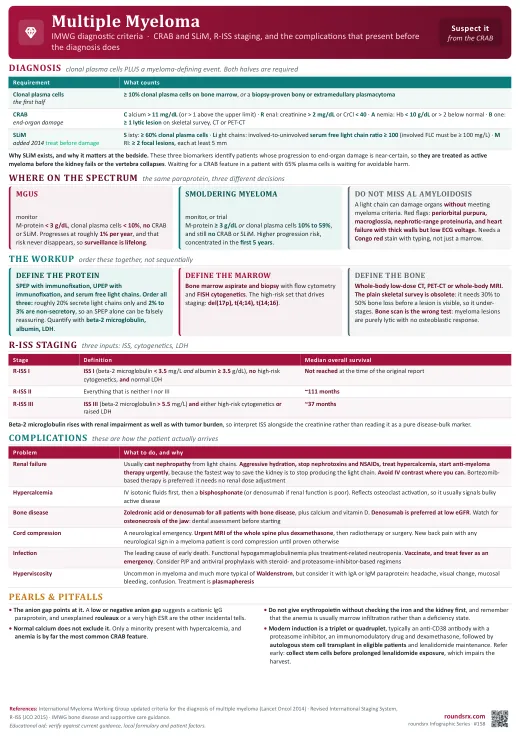
Multiple myeloma (MM) is a clonal plasma cell neoplasm in the bone marrow producing a monoclonal immunoglobulin (M-protein). Median age at diagnosis: 69 years, more common in African Americans (2×). The disease spectrum: MGUS → smoldering myeloma → active myeloma. Active myeloma requires CRAB criteria (end-organ damage): C alcium elevated (> 11) · R enal insufficiency (Cr > 2) · A nemia (Hgb < 10) · B one lesions (lytic on skeletal survey or PET/CT). SLiM criteria added in 2014: S ixty percent bone marrow plasma cells · Li ght chain ratio ≥ 100 · M RI with > 1 focal lesion ≥ 5mm -these define myeloma even without CRAB. IMWG, 2014
- SPEP + UPEP with immunofixation -detects M-protein. SPEP identifies the spike; immunofixation types it (IgG most common, then IgA). UPEP detects Bence Jones proteinuria (free light chains).
- Low anion gap -a clue, never a screen. IgG paraprotein is positively charged at physiologic pH, so it acts as an unmeasured cation and lowers the gap, but only ~22% of IgG gammopathies show it and IgA can raise the gap instead. An unexplained low gap earns an SPEP; a normal gap excludes nothing (see low anion gap causes).
- Serum free light chains (sFLC) -kappa:lambda ratio. Abnormal ratio with elevated involved chain supports monoclonal process. Essential for light-chain-only myeloma (15%).
- CBC -anemia (normocytic, rouleaux on smear), may have leukopenia/thrombocytopenia with advanced marrow infiltration
- BMP -hypercalcemia, renal insufficiency (light chain cast nephropathy -"myeloma kidney")
- Albumin + β2-microglobulin -ISS staging: Stage I (β2M < 3.5, alb ≥ 3.5), Stage III (β2M ≥ 5.5). R-ISS, 2015
- LDH -elevated = high tumor burden/aggressive biology
- Bone marrow biopsy + aspirate -≥ 10% clonal plasma cells = myeloma. Send cytogenetics/FISH: high-risk features: del(17p), t(4;14), t(14;16), gain(1q), del(1p).
- Skeletal survey (whole-body low-dose CT or PET/CT) -lytic lesions (punched-out). Do NOT use DEXA or conventional XR for screening. PET/CT preferred (more sensitive).
- Quantitative immunoglobulins -immune paresis (suppression of uninvolved Ig classes → infection risk)
- Viscosity -if IgM or very high M-protein (hyperviscosity rare in IgG myeloma, more common in Waldenström)
- Transplant-eligible (< 70, good performance): Induction → stem cell collection → autologous stem cell transplant (ASCT) → maintenance. Standard induction: VRd (bortezomib/lenalidomide/dexamethasone) × 3-4 cycles. [SWOG S0777, 2017]. Post-ASCT maintenance: lenalidomide until progression. DETERMINATION, 2022
- Transplant-ineligible: VRd (dose-adjusted) or DRd (daratumumab/lenalidomide/dex) until progression. MAIA, 2019
- Supportive care (intern-critical):
- Bone disease: Zoledronic acid 4 mg IV q4 weeks (or denosumab if CrCl < 30). Reduces skeletal events. Check dental clearance first (ONJ risk).
- Infection prophylaxis: Acyclovir (VZV on bortezomib), TMP-SMX or levofloxacin first 3 months, IVIG if recurrent infections with hypogammaglobulinemia
- VTE prophylaxis: Lenalidomide + dex → aspirin (low risk) or LMWH/DOAC (high risk: prior VTE, obesity, immobility)
- Renal protection: Aggressive hydration, avoid NSAIDs and contrast if possible, treat hypercalcemia
- Pain: Radiation for focal bone pain, vertebroplasty/kyphoplasty for compression fractures
| Drug | Dose | Route | Notes |
|---|---|---|---|
| Bortezomib | 1.3 mg/m² SQ weekly | SQ | Proteasome inhibitor. Peripheral neuropathy (dose-limiting). VZV reactivation → acyclovir prophylaxis. SWOG S0777, 2017 |
| Lenalidomide | 25 mg PO days 1-21/28 | PO | IMiD. VTE risk → thromboprophylaxis. Teratogenic. Dose-reduce for CrCl < 30. Maintenance post-ASCT: 10-15 mg. |
| Daratumumab | 16 mg/kg IV weekly → q2w → q4w | IV/SQ | Anti-CD38 mAb. Infusion reactions (pre-medicate). Interferes with blood bank crossmatch (anti-CD38 on reagent RBCs). MAIA, 2019 |
| Dexamethasone | 40 mg weekly (20 mg if > 75y) | PO | Backbone of all myeloma regimens. Hyperglycemia, insomnia, mood changes, infection risk. |
| Zoledronic acid | 4 mg IV over 15 min q4w | IV | Bone-modifying agent. Reduces SREs. Dental exam before starting (ONJ risk). Dose-adjust for CrCl. MRC Myeloma IX, 2012 |
| Carfilzomib | 20-56 mg/m² IV | IV | 2nd-gen proteasome inhibitor for relapsed MM. Cardiac toxicity (HF, HTN) -check echo baseline. Less neuropathy than bortezomib. |
| Drug | Dose | Route | Notes |
|---|---|---|---|
| Bortezomib | 1.3 mg/m² SQ weekly | SQ | Proteasome inhibitor. Peripheral neuropathy (dose-limiting). VZV reactivation → acyclovir prophylaxis. SWOG S0777, 2017 |
| Lenalidomide | 25 mg PO days 1-21/28 | PO | IMiD. VTE risk → thromboprophylaxis. Teratogenic. Dose-reduce for CrCl < 30. Maintenance post-ASCT: 10-15 mg. |
| Daratumumab | 16 mg/kg IV weekly → q2w → q4w | IV/SQ | Anti-CD38 mAb. Infusion reactions (pre-medicate). Interferes with blood bank crossmatch (anti-CD38 on reagent RBCs). MAIA, 2019 |
| Dexamethasone | 40 mg weekly (20 mg if > 75y) | PO | Backbone of all myeloma regimens. Hyperglycemia, insomnia, mood changes, infection risk. |
| Zoledronic acid | 4 mg IV over 15 min q4w | IV | Bone-modifying agent. Reduces SREs. Dental exam before starting (ONJ risk). Dose-adjust for CrCl. MRC Myeloma IX, 2012 |
| Carfilzomib | 20-56 mg/m² IV | IV | 2nd-gen proteasome inhibitor for relapsed MM. Cardiac toxicity (HF, HTN) -check echo baseline. Less neuropathy than bortezomib. |
Patient: 68M with fatigue, bone pain, and foamy urine × 2 months. Hgb 8.2, Ca 13.4, Cr 3.8 (baseline 1.0), total protein 10.8. SPEP: IgG kappa M-spike 5.1 g/dL. sFLC kappa 1240, ratio 98. BMBx: 72% clonal plasma cells.
Key findings: Active myeloma: CRAB criteria met (Ca 13.4, Renal Cr 3.8, Anemia Hgb 8.2) + SLiM (72% plasma cells). Myeloma kidney (cast nephropathy), light chains forming obstructive casts in distal tubules.
Management:
- Aggressive IVF (NS 200 mL/hr), dehydration worsens cast formation. Avoid IV contrast and NSAIDs
- Zoledronic acid 4 mg IV for hypercalcemia (hold if Cr > 4.5, use denosumab instead)
- Start VRd induction: bortezomib + lenalidomide (renal dose) + dexamethasone SWOG S0777, 2017
- Bortezomib is preferred in renal failure (not renally cleared, rapid light chain reduction)
- Transplant eligibility assessment, age alone does not exclude; assess fitness
Teaching point: Myeloma kidney is driven by free light chains, not M-protein. Rapid light chain reduction with bortezomib-based therapy is key to renal recovery. ~50% of patients with myeloma kidney recover renal function if treated promptly.
Patient: 58F with back pain and pathologic L2 compression fracture. Hgb 9.8, Ca 10.8, Cr 1.1. SPEP: IgA lambda M-spike 3.2 g/dL. BMBx: 45% plasma cells. PET/CT: multiple lytic lesions. FISH: standard risk [t(11;14)].
Key findings: Standard-risk myeloma. Fit, age < 65, transplant-eligible. Bone disease with pathologic fracture. Standard risk t(11;14) has favorable prognosis.
Management:
- VRd induction × 3-4 cycles → stem cell collection → high-dose melphalan + autologous SCT (ASCT)
- ASCT deepens response and extends PFS by ~12 months IFM 2009, 2017
- Lenalidomide maintenance post-ASCT until progression (doubles PFS)
- Zoledronic acid monthly × 2 years for bone protection
- Radiation to L2 fracture for pain + kyphoplasty consult for structural support
Teaching point: Lenalidomide maintenance after ASCT is standard of care, it roughly doubles PFS. For t(11;14) specifically, venetoclax-based combinations are emerging as highly effective (BCL-2 overexpression).
Patient: 62M found to have M-spike 2.8 g/dL on routine labs. Asymptomatic. Hgb 13.2, Ca 9.8, Cr 0.9. sFLC ratio 18. BMBx: 22% plasma cells. No lytic lesions on PET/CT. No SLiM criteria.
Key findings: Smoldering myeloma: ≥ 10% plasma cells + M-protein ≥ 3 g/dL, but NO CRAB or SLiM criteria. Risk of progression ~10%/year for first 5 years. High-risk features: sFLC ratio > 20, M-spike > 2, BMBx > 20%.
Management:
- Standard approach: observation with monitoring q3-6 months (SPEP, CBC, Ca, Cr, sFLC)
- No treatment unless CRAB or SLiM criteria develop
- 20/2/20 risk model: 2+ risk factors (plasma cells > 20%, M-spike > 2 g/dL, sFLC ratio > 20) = high-risk smoldering
- Clinical trial enrollment for high-risk smoldering (early intervention trials ongoing)
- Annual skeletal imaging (low-dose CT or PET/CT) to detect new bone lesions
Teaching point: Treating smoldering myeloma is NOT standard of care outside clinical trials. The CRAB and SLiM criteria define the line between observation and treatment. However, high-risk smoldering patients may benefit from early intervention, encourage trial enrollment.
Mr. Wallace is a 71-year-old man presenting with progressive low back pain × 3 months, fatigue, and 15 lb weight loss. Found to have: Hgb 8.4, Ca 12.8, Cr 2.6, total protein 11.2. SPEP: IgG kappa M-spike 4.2 g/dL. sFLC: kappa 890, lambda 12, ratio 74. Skeletal survey: multiple lytic lesions in spine, pelvis, skull. BMBx: 65% clonal plasma cells, FISH: standard risk.
- SPEP + sFLC q1-2 cycles -track M-protein decline (response criteria: CR, VGPR, PR per IMWG)
- CBC + BMP before each cycle -cytopenias, renal function
- Ca²⁺ -trending (hypercalcemia is a myeloma emergency)
- Peripheral neuropathy assessment -on bortezomib. Grade ≥ 2 → dose-reduce or switch to carfilzomib.
- Echo -baseline + periodic on carfilzomib (cardiotoxicity)
- Dental exam q6 months on bisphosphonates (ONJ monitoring)
- Cr + urine protein -myeloma kidney monitoring. Improving Cr on treatment = good prognostic sign.
- Quantitative Ig -immune paresis monitoring. IVIG if recurrent serious infections.