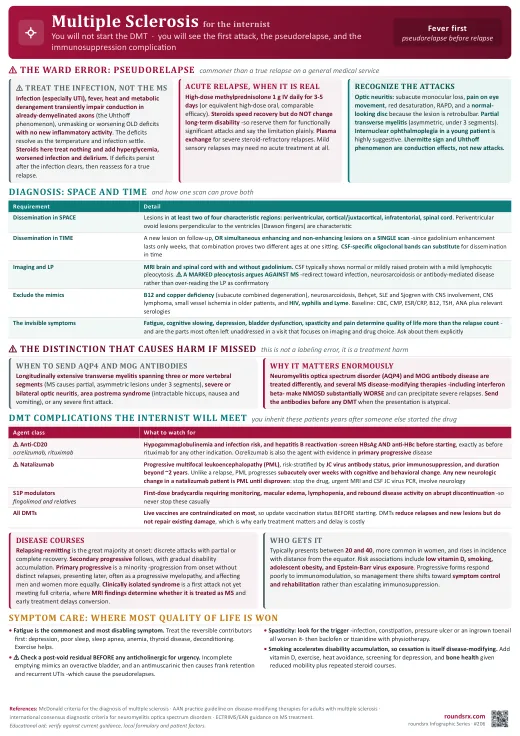
Multiple Sclerosis
Multiple sclerosis is a chronic immune-mediated demyelinating disease of the central nervous system, producing inflammatory demyelination and axonal loss in the brain, spinal cord and optic nerves. It typically presents between 20 and 40 years of age, is more common in women, and rises in incidence with distance from the equator. Risk associations include low vitamin D, smoking, obesity in adolescence, and Epstein-Barr virus exposure.
- Relapsing-remitting (RRMS) -the great majority at onset. Discrete attacks with partial or complete recovery between them.
- Secondary progressive -gradual accumulation of disability after an initially relapsing course, with or without superimposed relapses.
- Primary progressive -a minority, with progression from onset and no distinct relapses; presents later, often with a progressive myelopathy, and affects men and women more equally.
- Clinically isolated syndrome -a first demyelinating attack that does not yet meet full criteria; MRI findings determine whether it will be treated as MS, and early treatment delays conversion.
- Optic neuritis -subacute monocular visual loss with pain on eye movement, dyschromatopsia (colors appear washed out, red desaturation) and a relative afferent pupillary defect. The disc is usually normal on fundoscopy because the inflammation is retrobulbar.
- Partial transverse myelitis -sensory level, bandlike truncal sensations, limb weakness, bladder dysfunction. MS typically causes a partial, asymmetric cord lesion spanning fewer than three vertebral segments.
- Brainstem and cerebellar syndromes -diplopia from internuclear ophthalmoplegia (a highly suggestive finding in a young patient), vertigo, ataxia, dysarthria, and trigeminal neuralgia in someone young.
- Lhermitte sign (electric sensation down the spine on neck flexion) and the Uhthoff phenomenon -transient worsening of existing symptoms with heat, exercise or fever, which is a conduction effect rather than a new attack.
- The invisible symptoms that dominate quality of life: fatigue, cognitive slowing, depression, bladder dysfunction, spasticity and pain. These are what patients report as most disabling, and they are frequently unaddressed.
- The diagnosis requires evidence of CNS demyelinating lesions separated in space (different locations) and in time (different points in the disease course), with no better explanation. The McDonald criteria formalize this.
- Dissemination in space: lesions in at least two of the four characteristic regions -periventricular, cortical/juxtacortical, infratentorial, and spinal cord.
- Dissemination in time: a new lesion on follow-up imaging, simultaneous enhancing and non-enhancing lesions on a single scan (which demonstrates lesions of different ages at one sitting), or CSF-specific oligoclonal bands, which can substitute for dissemination in time.
- MRI brain and spinal cord with and without gadolinium is the central investigation; periventricular ovoid lesions perpendicular to the ventricles (Dawson fingers) are characteristic.
- Lumbar puncture -CSF-specific oligoclonal bands (present in serum-paired testing) support the diagnosis; typical CSF shows normal or mildly raised protein with a mild lymphocytic pleocytosis.
- Test aquaporin-4 (AQP4) IgG and MOG IgG when the presentation is atypical: longitudinally extensive transverse myelitis spanning three or more vertebral segments, severe or bilateral optic neuritis, area postrema syndrome (intractable hiccups, nausea and vomiting), or a severe first attack.
- ⚠ Why it matters enormously: neuromyelitis optica spectrum disorder and MOG antibody disease are treated differently, and several MS disease-modifying therapies make NMOSD worse -interferon beta and some others can precipitate severe relapses. Getting this wrong is not a labeling error, it is a treatment harm.
- Other mimics to consider: neurosarcoidosis, Behçet disease, SLE and Sjögren with CNS involvement, B12 deficiency (including nitrous oxide abuse, a common cause in young adults and easily mistaken for MS or Guillain-Barre) and copper deficiency (both cause subacute combined degeneration), CNS lymphoma, small vessel ischemic disease in older patients, and infections including HIV, syphilis and Lyme.
- Baseline screening labs to exclude mimics: CBC, CMP, ESR/CRP, B12, TSH, ANA, and HIV, syphilis and Lyme serology where the epidemiology fits.
- High-dose glucocorticoids -typically intravenous methylprednisolone 1 g daily for 3 to 5 days, or an equivalent high-dose oral regimen, which has comparable efficacy. Steroids speed recovery from a relapse but do not change long-term disability, which is why they are reserved for functionally significant attacks rather than every symptom flare.
- Plasma exchange for severe relapses that do not respond to steroids.
- Mild sensory relapses may need no acute treatment at all -the honest position is that the benefit is speed of recovery, not the eventual outcome.
- DMTs reduce relapse rate and new MRI lesion formation in relapsing disease; they do not repair existing damage, which is why early treatment matters and why delay is costly.
- The broad classes: injectables (interferon beta, glatiramer acetate), orals (dimethyl fumarate, teriflunomide, fingolimod and related sphingosine-1-phosphate modulators, cladribine), and monoclonal antibodies (natalizumab, ocrelizumab and other anti-CD20 agents, alemtuzumab). Higher-efficacy agents carry higher risk.
- The complications an internist will actually meet:
- Anti-CD20 agents (ocrelizumab, rituximab): hypogammaglobulinemia and infection risk, and hepatitis B reactivation -screen HBsAg and anti-HBc before starting, exactly as in the viral hepatitis topic.
- Natalizumab: progressive multifocal leukoencephalopathy (PML), with risk stratified by JC virus antibody status, prior immunosuppression and treatment duration. New or subacute cognitive, behavioral or focal deficits in a natalizumab patient are PML until proven otherwise.
- Fingolimod and S1P modulators: first-dose bradycardia requiring monitoring, macular edema, lymphopenia, and rebound disease activity on abrupt discontinuation.
- Live vaccines are contraindicated on most DMTs, so vaccination status should be brought up to date before starting.
- Ocrelizumab is the agent with evidence in primary progressive disease (ORATORIO, 2017), though the effect is a modest slowing rather than arrest -roughly a 24% relative reduction in confirmed disability progression, which is worth saying plainly before starting an infusion therapy. Progressive forms otherwise respond poorly to immunomodulation, and management shifts toward symptom control and rehabilitation.
- Fatigue -the commonest and most disabling symptom. Screen for and treat the reversible contributors first: depression, poor sleep, sleep apnea, anemia, thyroid disease and deconditioning. Exercise helps.
- Spasticity -baclofen or tizanidine, physiotherapy and stretching; botulinum toxin for focal spasticity. Look for the trigger: infection, constipation, pressure ulcer or an ingrown toenail can all worsen spasticity.
- Bladder dysfunction -check a post-void residual before prescribing, because an anticholinergic given to a patient with incomplete emptying causes retention. Treat urgency with antimuscarinics or mirabegron, and retention with intermittent catheterization.
- Neuropathic pain -gabapentinoids, duloxetine or a tricyclic; carbamazepine for trigeminal neuralgia.
- Depression is common and undertreated, and independently worsens fatigue and cognition. Screen for it deliberately.
- Vitamin D repletion, smoking cessation, exercise and heat avoidance -smoking accelerates disability accumulation, making cessation a disease-modifying intervention in its own right.
- Bone health -reduced mobility plus recurrent steroid courses is an osteoporosis risk profile, linking directly to that topic's secondary-cause workup.
Ms. Lindqvist is a 28-year-old woman with five days of blurred vision in the right eye and pain on eye movement. Exam: reduced visual acuity, red desaturation, a right relative afferent pupillary defect, and a normal-appearing optic disc. She recalls a two-week episode of numbness in both legs about a year ago that resolved without evaluation.
- Apparent relapse: infection and fever excluded first -pseudorelapse is commoner than relapse on a medical ward.
- Atypical features screened: long cord lesion, severe or bilateral optic neuritis, area postrema syndrome -send AQP4 and MOG antibodies.
- Mimics excluded: B12, TSH, ANA, ESR/CRP, HIV, syphilis, Lyme where relevant.
- DMT identified and its specific risk known: anti-CD20 (hepatitis B reactivation, hypogammaglobulinemia), natalizumab (PML), S1P modulators (bradycardia, rebound on stopping).
- Hepatitis B screening documented before anti-CD20 therapy.
- Vaccinations updated before starting a DMT -live vaccines are contraindicated on most.
- Post-void residual checked before any anticholinergic for bladder symptoms.
- Fatigue, mood, bone health and vitamin D addressed -these carry most of the quality-of-life burden and are the parts most often skipped.