Myasthenic Crisis
- Autoantibodies against AChR (acetylcholine receptor) at the neuromuscular junction → fatigable weakness
- Fatigable: weakness worsens with repeated use and improves with rest. Worse at end of day.
- Ocular symptoms (#1 presenting symptom): ptosis, diplopia -often asymmetric
- Generalized MG: proximal limb weakness, bulbar symptoms (dysphagia, dysarthria, nasal voice), respiratory failure
- Anti-AChR antibodies positive in ~85% of generalized MG. Anti-MuSK antibodies in ~5–8% (more bulbar involvement, worse prognosis).
- CT chest for thymoma -present in ~15% of MG patients. Thymectomy recommended for thymoma and for non-thymomatous generalized AChR+ MG age 18–65.
| Drug Class | Specific Agents |
|---|---|
| Antibiotics | Aminoglycosides (gentamicin, tobramycin), fluoroquinolones, macrolides (azithromycin -controversial), tetracyclines |
| Cardiac | Beta-blockers, calcium channel blockers, procainamide, quinidine |
| Neuromuscular blockers | Avoid succinylcholine (unpredictable response). Use non-depolarizing agents with caution (increased sensitivity → prolonged paralysis). |
| Other | Magnesium (blocks NMJ -avoid IV Mg unless life-threatening indication), D-penicillamine, checkpoint inhibitors, botulinum toxin, lithium |
| Feature | Myasthenic Crisis | Cholinergic Crisis |
|---|---|---|
| Cause | Disease exacerbation (undertreated) | Pyridostigmine overdose |
| Pupils | Normal or dilated | Miosis (constricted) |
| Secretions | Normal | Excessive (SLUDGE: salivation, lacrimation, urination, diarrhea, GI cramping, emesis) |
| Fasciculations | Absent | Present |
| Response to edrophonium | Improves | Worsens |
| Treatment | IVIG or PLEX + immunosuppression | Hold pyridostigmine, atropine for secretions |
| Drug | Role | Notes |
|---|---|---|
| Pyridostigmine (Mestinon) SYMPTOMATIC | AChE inhibitor -increases ACh at NMJ | First-line symptomatic treatment. 60 mg PO TID, titrate. Does NOT alter disease course -only improves symptoms. |
| Prednisone (Deltasone) | Immunosuppression | Most patients need immunosuppression beyond pyridostigmine. Start low, escalate slowly (risk of initial worsening). |
| Azathioprine (Imuran) | Steroid-sparing agent | Takes 6–12 months to work. Check TPMT before starting (deficiency → myelosuppression). |
| Mycophenolate (CellCept) | Steroid-sparing agent | Alternative to azathioprine. Common choice. Teratogenic. |
| Rituximab (Rituxan) | Anti-CD20 -refractory MG | Especially effective in anti-MuSK MG. Growing evidence for AChR+ refractory disease. |
| Efgartigimod (Vyvgart) | FcRn inhibitor -reduces pathogenic IgG | ADAPT, 2021: improved MG-ADL by ≥ 2 points in 67.7% vs 29.7% placebo. IV infusion cycles. |
| Thymectomy | Surgical -removes pathogenic antigen source | Indicated if thymoma. Also beneficial in AChR+ non-thymomatous MG < 65 yrs (MGTX, 2016). Response takes months. |
- AChR Ab (~85%)
- MuSK Ab if AChR neg
- CT chest -thymoma
- PFTs (FVC, NIF)
- Ice pack test -ptosis improvement
| Drug | Dose | Route | Notes |
|---|---|---|---|
| Pyridostigmine | 60mg q4-6h | PO | AChE inhibitor |
| Prednisone | Start low, titrate | PO | Can worsen MG initially |
| Azathioprine | 2-3mg/kg/day | PO | Steroid-sparing |
| IVIG | 0.4g/kg×5d | IV | Crisis |
| Rituximab | 375mg/m² | IV | Refractory |
Patient: 58F with known AChR Ab+ MG on pyridostigmine 60 mg QID. Admitted with worsening dyspnea and dysphagia after UTI (treated with ciprofloxacin). FVC 14 mL/kg (declining). Bilateral ptosis, weak neck flexion, nasal speech.
Key findings: Myasthenic crisis: respiratory failure from MG exacerbation. Triggered by UTI (infection is #1 precipitant) + ciprofloxacin (fluoroquinolones worsen NMJ transmission). FVC < 20 = intubation threshold.
Management:
- ICU admission, check FVC q4h (same monitoring protocol as GBS)
- IVIG 0.4 g/kg/day × 5 days OR PLEX q other day × 5 sessions (both equally effective)
- STOP ciprofloxacin, switch to a non-NMJ-affecting antibiotic (ceftriaxone, TMP-SMX)
- HOLD pyridostigmine during crisis (excess secretions complicate airway management)
- Intubate if FVC < 15 mL/kg, declining rapidly, or unable to handle secretions, use non-depolarizing NMB (avoid succinylcholine, MG patients are resistant)
Teaching point: The most common trigger for myasthenic crisis is infection, not medication non-compliance. Always review the med list, fluoroquinolones, aminoglycosides, beta-blockers, and magnesium can precipitate crisis. The MG medication "hit list" should be at every bedside.
Patient: 45M with 3 months of fluctuating diplopia, ptosis (worse in evening), difficulty chewing steak. Ice pack test: ptosis improves bilaterally. AChR antibodies positive. CT chest: anterior mediastinal mass 4 cm.
Key findings: New MG with thymoma, ~15% of MG patients have thymoma, and ~30% of thymoma patients develop MG. Thymectomy is indicated for ALL thymomas regardless of MG severity, plus for non-thymomatous MG per MGTX trial.
Management:
- Start pyridostigmine 60 mg PO TID (symptomatic relief, first-line)
- CT-guided biopsy of mediastinal mass → staging
- Thymectomy: robotic or open, both curative for thymoma + improves MG outcomes MGTX, 2016
- Pre-op optimization: may need IVIG or PLEX before surgery (reduce perioperative myasthenic crisis risk)
- Start prednisone LOW (10 mg, titrate up slowly), high-dose steroids can transiently worsen MG in first 2 weeks
Teaching point: Always get CT chest in new MG, thymoma is present in 15%. The MGTX trial showed thymectomy improves outcomes even in NON-thymomatous MG (AChR Ab+, age 18-65). Prednisone must be started low and titrated slowly to avoid initial worsening.
Patient: 32F with prominent bulbar symptoms: severe dysphagia, dysarthria, facial weakness, tongue atrophy. Minimal limb involvement. AChR antibodies NEGATIVE. MuSK antibodies POSITIVE. Failed pyridostigmine (made worse).
Key findings: MuSK-positive MG, distinct phenotype: bulbar and facial predominance, tongue/facial atrophy, poor response to pyridostigmine (often makes symptoms worse), and no benefit from thymectomy.
Management:
- Stop pyridostigmine (MuSK-MG often worsens with AChE inhibitors)
- Rituximab is emerging as first-line for MuSK-MG (excellent response rate ~70-80%)
- PLEX preferred over IVIG for acute exacerbations (MuSK antibodies are IgG4, not efficiently removed by IVIG)
- Prednisone + mycophenolate as standard immunosuppression
- No thymectomy (thymoma is extremely rare in MuSK-MG, and thymectomy does not improve outcomes)
Teaching point: MuSK-MG breaks all the rules of AChR-MG: pyridostigmine worsens it, thymectomy doesn't help, IVIG is less effective than PLEX, and rituximab works better than traditional immunosuppressants. Always check MuSK antibodies if AChR is negative.
- FVC every visit
- Med review -avoid aminoglycosides, FQs, BB, Mg
- Thymoma surveillance
- Infection screening on immunosuppression
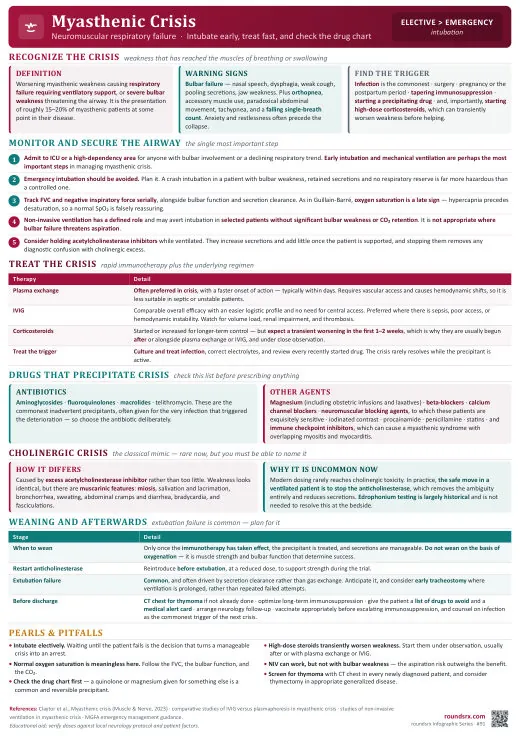
Text version
- Aminoglycosides or FQs in MG patient → crisis
- Not checking FVC (crisis can develop rapidly)
- Missing thymoma (CT chest in all new MG)
- Cholinergic crisis from pyridostigmine excess (SLUDGE symptoms)