Myocarditis
| Type | Presentation | Hemodynamics | Prognosis |
|---|---|---|---|
| Acute (non-fulminant) | Chest pain, dyspnea, palpitations. Preceded by viral URI 1–4 weeks prior. Mild-moderate LV dysfunction. | Stable. Mild EF reduction. | ~50% recover fully. ~25% develop chronic DCM. ~25% stable but reduced EF. |
| Fulminant | Rapid-onset cardiogenic shock within days. Severe biventricular failure. Arrhythmias. | Hemodynamic collapse. May need MCS (Impella, ECMO). | Paradoxically better long-term prognosis if they survive the acute phase -~90% recover LV function (robust immune response clears the virus). |
| Chronic active | Persistent HF symptoms > 3 months. Ongoing inflammation on biopsy. | Progressive LV dilation and dysfunction. | May progress to DCM. May need transplant evaluation. |
| Giant cell | Rapidly progressive HF + VT. Young-middle age. | Severe. Refractory arrhythmias. | Worst prognosis. Median survival ~5 months without transplant. Immunosuppression is indicated. |
- Viral (most common) -Coxsackievirus B, parvovirus B19, HHV-6, adenovirus, SARS-CoV-2, influenza
- Autoimmune -SLE, sarcoidosis, eosinophilic myocarditis (hypersensitivity)
- Drug/toxin -immune checkpoint inhibitors (PD-1/PD-L1 -pembrolizumab, nivolumab), doxorubicin, cocaine, amphetamines
- Giant cell myocarditis -idiopathic, associated with autoimmune diseases (IBD, thymoma)
| Test | Findings |
|---|---|
| Troponin | Elevated (may mimic MI). Often with recent viral prodrome. |
| ECG | Diffuse ST changes (may mimic pericarditis or STEMI), sinus tachycardia, arrhythmias (VT, heart block), low voltage. |
| Echo | New wall motion abnormalities (often non-territorial -unlike MI). Reduced EF. May see pericardial effusion. |
| Cardiac MRI KEY DIAGNOSTIC TOOL | Lake Louise criteria: (1) T2 hyperintensity (edema), (2) late gadolinium enhancement -mid-wall or epicardial pattern (unlike MI which is subendocardial/transmural). (3) T1 mapping abnormalities. Sensitivity ~80%, specificity ~90%. |
| Endomyocardial biopsy | Gold standard but rarely done (low sensitivity due to sampling error). Indicated in: fulminant myocarditis, suspected giant cell, no improvement despite treatment, need to guide immunosuppression. |
- Supportive care -standard HF therapy if reduced EF (ACEi/ARB, beta-blocker, diuretics as needed). Avoid NSAIDs in acute phase (may impair healing).
- Activity restriction -no competitive sports for 3–6 months minimum. Risk of fatal arrhythmias with exertion. Repeat echo and MRI before return to play.
- Arrhythmia management -telemetry monitoring. Life vest (wearable defibrillator) if EF < 35% acutely. Avoid permanent ICD in acute phase -EF may recover. Reassess at 3–6 months.
- Fulminant → ICU. Inotropes, vasopressors. Early MCS (Impella/ECMO) if deteriorating -these patients often recover if supported through the acute phase.
- Giant cell myocarditis → immunosuppression (cyclosporine + steroids ± azathioprine). Early transplant evaluation. Giant Cell Myocarditis Registry, 1997: immunosuppression improved survival from 3 months to 12 months.
- Checkpoint inhibitor myocarditis → stop drug + high-dose IV methylprednisolone 1g/day × 3–5 days, then oral taper.
| Parameter | Frequency | Target / Action |
|---|---|---|
| Vitals | q4h floor, q1–2h ICU | HR, BP, RR, SpO₂, Temp -notify for significant deviations |
| Labs (BMP, CBC) | Daily AM or as indicated | Trend Cr, K⁺, WBC, Hgb -adjust treatment based on trajectory |
| Disease-specific markers | Per clinical context | See Overview and Management tabs for condition-specific targets |
| I&Os | Strict if volume-sensitive | UOP ≥ 0.5 mL/kg/hr. Net fluid balance guides diuresis or resuscitation. |
| Telemetry | Continuous if indicated | Arrhythmia detection. Discontinue when no longer indicated (reduces alarm fatigue). |
| Clinical response | Each assessment | Symptom improvement, functional status, appetite, mental status -the exam matters more than labs |
- Troponin -elevated, trend q6-8h
- ECG -diffuse ST changes, arrhythmias
- Echo -EF, wall motion, pericardial effusion
- Cardiac MRI (gold standard) -T2 edema, mid-myocardial LGE
- ESR, CRP
- Endomyocardial biopsy -only if giant cell suspected
| Drug | Dose | Route | Notes |
|---|---|---|---|
| Lisinopril (Zestril) | 2.5-20 mg daily | PO | ACEi for LV remodeling. Start low, uptitrate. ARB if ACEi-intolerant. |
| Carvedilol (Coreg) | 3.125-25 mg BID | PO | Low-dose BB -titrate cautiously. Hold if cardiogenic shock or decompensated HF. |
| Furosemide (Lasix) | 20-80 mg PRN | IV/PO | Diuresis for fluid overload/congestion. Titrate to euvolemia. |
| Avoid NSAIDs | - | - | Worsen myocardial inflammation and necrosis. Contraindicated even though chest pain is prominent. |
| Immunosuppression | Per biopsy/pathology | IV/PO | ONLY for giant cell myocarditis (cyclosporine + steroids) or eosinophilic myocarditis (high-dose steroids). NOT for viral myocarditis. |
| IVIG | 2 g/kg over 2-5 days | IV | Consider in select cases (pediatric, fulminant). Evidence mixed. Not routine. |
| Inotropes / MCS | Per hemodynamics | IV | Milrinone or dobutamine for cardiogenic shock. Impella/ECMO for fulminant myocarditis with refractory shock. |
Patient: 26M with chest pain and dyspnea 10 days after a flu-like illness. Troponin 6.8, BNP 2400. ECG: diffuse ST elevation without reciprocal changes. Echo: EF 30%, global hypokinesis. No coronary disease on angiography.
Key findings: Acute viral myocarditis with new-onset HFrEF. Clean coronaries exclude ACS. Diffuse ST changes (not territorial) + recent viral prodrome + young patient = classic presentation.
Management:
- Cardiac MRI, Lake Louise criteria: T2 edema + LGE in non-coronary distribution (mid-wall/epicardial) confirms myocarditis
- GDMT for HFrEF: ACEi/ARB, beta-blocker (once stable), MRA if EF ≤ 35%
- Telemetry monitoring, arrhythmia risk highest in acute phase (VT/VF)
- NO NSAIDs (worsen inflammation and remodeling in myocarditis)
- Repeat echo at 3-6 months, most viral myocarditis recovers EF (60-70% normalize)
Teaching point: Do NOT place an ICD during acute myocarditis even if EF ≤ 35%. Most patients recover EF, wait ≥ 3-6 months and reassess. LifeVest (wearable defibrillator) is a bridge if high arrhythmia risk.
Patient: 32F with 2 days of progressive dyspnea, now in cardiogenic shock. HR 120, BP 72/48, cool extremities, lactate 6.2. Echo: EF 10%, global severe hypokinesis. Troponin 42. No prior cardiac history.
Key findings: Fulminant myocarditis, rapid-onset cardiogenic shock in a previously healthy patient. Paradoxically, fulminant myocarditis has BETTER long-term prognosis than acute myocarditis if the patient survives the acute phase (stronger immune response → better viral clearance).
Management:
- ICU, vasopressors/inotropes (dobutamine 5 mcg/kg/min + norepinephrine for MAP ≥ 65)
- Early mechanical circulatory support: Impella or VA-ECMO if refractory to inotropes
- Endomyocardial biopsy, rule out giant cell myocarditis (requires immunosuppression) or eosinophilic myocarditis
- Avoid beta-blockers acutely in cardiogenic shock (can worsen hemodynamics)
- If giant cell myocarditis on biopsy: high-dose steroids + cyclosporine (without immunosuppression, mortality > 80%)
Teaching point: Fulminant myocarditis is a "bridge to recovery" disease, patients who survive the acute phase often recover near-normal EF. Aggressive mechanical support (ECMO/Impella) saves lives. Biopsy is critical to exclude giant cell myocarditis.
Patient: 58M on pembrolizumab for melanoma × 3 cycles. New fatigue, dyspnea, palpitations. Troponin 2.4 (was normal at baseline). ECG: new conduction delay, PR prolongation. Echo: EF 45% (was 60%).
Key findings: Immune checkpoint inhibitor (ICI) myocarditis, occurs in 1-2% of ICI-treated patients but mortality is 25-50%. Can present with conduction abnormalities, arrhythmias, or HF. Often coexists with myositis and myasthenia gravis.
Management:
- Hold pembrolizumab immediately (permanently discontinue, do not rechallenge)
- High-dose methylprednisolone 1g IV daily × 3-5 days → prednisone 1 mg/kg with slow taper
- If steroid-refractory: add mycophenolate, infliximab, or abatacept
- Continuous telemetry, high-grade AV block and VT are common and often fatal
- Check CK (concurrent myositis), anti-AChR antibodies (concurrent MG), and cardiac MRI
Teaching point: ICI myocarditis is the most lethal irAE, early troponin monitoring and a low threshold for holding therapy saves lives. Conduction abnormalities (PR prolongation, BBB) may be the first sign before EF drops.
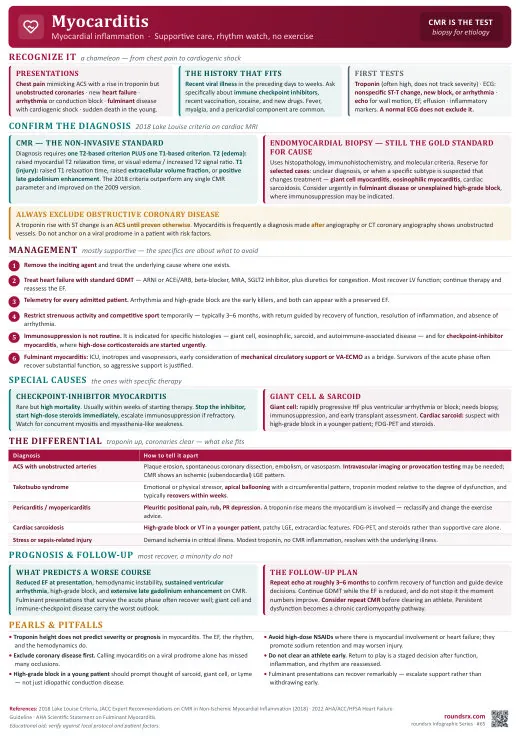
Text version
- Suspect: young patient + chest pain + troponin ↑ + new HF + recent viral illness
- ECG: diffuse ST changes, low voltage, arrhythmias
- Echo: reduced EF, regional or global wall motion abnormality
- Gold standard: Cardiac MRI -mid-myocardial LGE (not subendocardial like MI)
- Standard HF therapy: ACEi + low-dose BB + diuretics PRN
- Avoid NSAIDs (worsen myocardial necrosis in animal models)
- Activity restriction: no exercise × 3-6 months minimum
- Arrhythmia monitoring: telemetry (VT/VF risk during active inflammation)
- Follow-up echo at 3-6 months (EF should recover in most viral cases)
- ≥ 3 months from symptom onset
- EF normalized on echo
- No LGE on cardiac MRI (or stable/reduced)
- No arrhythmias on Holter + exercise stress test
- Normal inflammatory markers (CRP, troponin)
- Gradual return, individualized [ESC Sports Cardiology 2020]
- NSAIDs in acute myocarditis
- Early return to exercise (arrhythmia risk)
- Missing giant cell myocarditis (rapid HF + VT → biopsy)
- Confusing with STEMI (check MRI pattern)