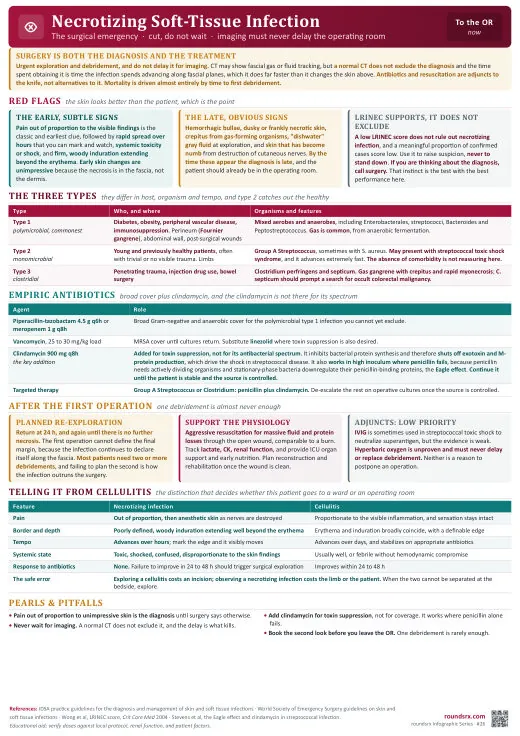
Necrotizing Fasciitis / Gas Gangrene
| Type | Organisms | Risk Factors |
|---|---|---|
| Type 1 (Polymicrobial) | Mixed aerobic + anaerobic | Diabetes, post-surgical, immunocompromised |
| Type 2 (Monomicrobial) | Group A Strep | Young, healthy, minor trauma |
| Gas Gangrene | C. perfringens | Trauma, surgical wounds |
- Pain OUT OF PROPORTION to exam, hallmark
- Rapidly spreading erythema, crepitus, bullae, dusky/necrotic skin
- Systemic toxicity: sepsis, shock. LRINEC ≥6 suggestive
- Clinical diagnosis, do NOT delay for imaging
- Labs: CBC, BMP (Na often low), CRP, lactate, CK, coags, blood cultures
- LRINEC score ≥6 suspicious, ≥8 highly suggestive
- Finger test: bedside incision, easy tissue dissection = nec fasc
- SURGICAL DEBRIDEMENT IS THE TREATMENT, antibiotics are adjunct
- Second-look operation 24–48h. Often serial debridements needed
- ICU for sepsis management
- IVIG for streptococcal toxic shock (1–2 g/kg, controversial but used)
| Drug | Dose | Role |
|---|---|---|
| Vancomycin | 25–30mg/kg load, 15–20mg/kg q8–12h | MRSA coverage |
| Piperacillin-Tazobactam | 4.5g IV q6h | Broad GN + anaerobe coverage |
| Clindamycin | 900mg IV q8h | TOXIN SUPPRESSION |
Patient: 62M with T2DM, presents with rapidly expanding erythema and exquisite pain on left lower leg after minor skin break. Temp 39.8°C, HR 128, BP 88/52. WBC 24K, lactate 5.4, Cr 2.8. Skin: dusky discoloration, hemorrhagic bullae, crepitus on palpation.
Key findings: Crepitus = subcutaneous gas (Clostridium or mixed anaerobes). Pain out of proportion to exam appearance. Hemodynamic instability. LRINEC score > 6 (high risk). Type I = polymicrobial (diabetics, immunocompromised).
Management:
- Emergent surgical debridement, this is the ONLY definitive treatment. Do NOT delay for imaging
- Vancomycin + piperacillin-tazobactam + clindamycin (triple therapy: MRSA + GNR/anaerobes + toxin suppression)
- Aggressive IVF resuscitation, vasopressors for septic shock, ICU admission
- Plan for re-look debridement in 24-48h (often need multiple OR trips, "second look")
- Wound VAC after debridement stabilizes; delayed closure or skin grafting
Teaching point: "When in doubt, cut it out." Delay to debridement is the modifiable driver of mortality, and going past 24 hours raises it roughly 9-fold. CT and MRI can miss early disease, if clinical suspicion is high, the patient goes to the OR, not radiology.
Patient: 35F previously healthy. Severe left arm pain after minor cut while gardening 48h ago. Now with rapidly spreading purple discoloration, bullae. Temp 40.1°C, HR 135, BP 78/42. WBC 2.8K (leukopenia), platelets 68K. Blood cultures: GPC in chains.
Key findings: Type II = monomicrobial GAS (Streptococcus pyogenes). Can occur in healthy young adults. Streptococcal toxic shock syndrome (STSS): hypotension + organ failure + soft tissue infection. Leukopenia paradoxically indicates severe disease.
Management:
- Emergent radical surgical debridement, may require amputation if limb-threatening
- Penicillin G 4 million units IV q4h + clindamycin 900 mg IV q8h (clindamycin stops exotoxin production)
- IVIG 1-2 g/kg × 1 dose (neutralizes streptococcal superantigens in STSS)
- ICU: vasopressors, ventilator support, blood products for DIC
- Notify public health, GAS necrotizing fasciitis is reportable in many jurisdictions
Teaching point: GAS necrotizing fasciitis can kill a healthy young adult in 24-48h. The clue is "pain out of proportion" + rapid systemic deterioration. IVIG is specifically beneficial for streptococcal toxic shock, it binds superantigens that drive the immune storm.
Patient: 58M with poorly controlled T2DM (A1c 11), presents with severe perineal pain, scrotal swelling, and foul-smelling discharge × 2 days. Temp 39.4°C, HR 130. Exam: scrotal erythema extending to perineum with crepitus. WBC 28K, lactate 4.8.
Key findings: Fournier gangrene = necrotizing fasciitis of the perineum/genitalia. Same pathophysiology as extremity necrotizing fasciitis. Diabetes is the #1 risk factor. Mortality 20-40% even with aggressive treatment.
Management:
- Emergent surgical debridement of all necrotic tissue (urology + general surgery)
- Same antibiotic regimen: vancomycin + piperacillin-tazobactam + clindamycin
- Fecal diversion (colostomy) if perineal wound is extensive (prevents fecal contamination)
- Suprapubic catheter if urethral involvement
- Daily wound care, re-look in 24-48h, wound VAC once clean, delayed reconstruction
Teaching point: Fournier gangrene follows the same treatment principles as all necrotizing fasciitis: emergent surgical debridement is the ONLY life-saving intervention. Antibiotics without surgery = death. The threshold for surgical exploration should be very low.
| Parameter | Frequency |
|---|---|
| Wound | q4–6h. Advancing necrosis = return to OR |
| Hemodynamics | Continuous ICU. MAP >65 |
| CBC, CRP, lactate | q6–12h |