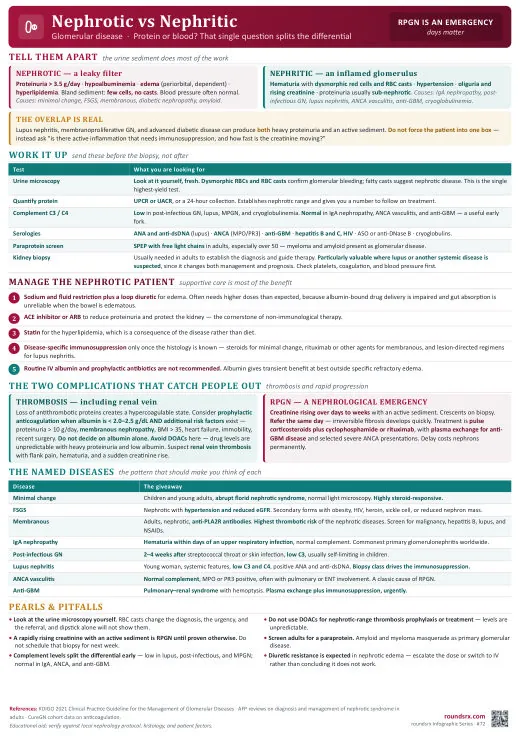
Nephrotic vs Nephritic Syndrome
| Feature | Nephrotic Syndrome | Nephritic Syndrome |
|---|---|---|
| Proteinuria | > 3.5 g/day (massive) | < 3.5 g/day (mild-moderate) |
| Hematuria | Absent or mild | Present -dysmorphic RBCs, RBC casts |
| Edema | Severe (periorbital, anasarca) | Mild-moderate |
| Albumin | ↓↓ (< 3 g/dL) | Normal or mildly ↓ |
| Lipids | ↑↑ Hyperlipidemia | Normal |
| Complement | Normal | Low in some (post-strep, lupus, MPGN) |
| BP | Variable | Hypertension |
| GFR | Initially preserved | ↓ (acute kidney injury) |
| Mechanism | Podocyte injury → protein leak | GBM inflammation → blood leak |
| Nephrotic | Nephritic |
|---|---|
| Minimal change disease (children #1) | IgA nephropathy (#1 worldwide) |
| FSGS (adults #1, especially AA) | Post-streptococcal GN (children) |
| Membranous nephropathy (PLA2R antibody) | Lupus nephritis (class III/IV) |
| Diabetic nephropathy | ANCA vasculitis (GPA, MPA) |
| Amyloidosis | Anti-GBM (Goodpasture) |
| Cause | Association | Biopsy Finding |
|---|---|---|
| Minimal Change Disease | Children (#1), NSAIDs, lymphoma (Hodgkin) | Normal on light microscopy; podocyte foot process effacement on EM |
| FSGS | HIV, obesity, heroin, African Americans | Focal and segmental sclerosis of glomeruli |
| Membranous Nephropathy | PLA2R antibody, cancer (lung, colon), hepatitis B | Subepithelial deposits ("spike and dome" on silver stain) |
| Diabetic Nephropathy | #1 secondary cause in adults, long-standing DM | Kimmelstiel-Wilson nodules, mesangial expansion |
| Amyloidosis | AL (myeloma) or AA (chronic inflammation) | Congo red stain → apple-green birefringence |
| Cause | Key Features | Biopsy / Diagnosis |
|---|---|---|
| IgA Nephropathy | Most common GN worldwide (Berger disease). Episodic gross hematuria with URI. | Mesangial IgA deposits on IF |
| Post-Streptococcal GN | Children 1–3 wk after pharyngitis. ASO titer ↑, low C3. | Subepithelial "humps" on EM, granular IF ("lumpy-bumpy") |
| Lupus Nephritis | Class III (focal) and IV (diffuse) are most severe. Low C3/C4, dsDNA+. | "Full house" IF (IgG, IgA, IgM, C3, C1q) |
| ANCA Vasculitis | GPA (c-ANCA/PR3) or MPA (p-ANCA/MPO). Pauci-immune GN. | Crescentic GN with few/no immune deposits (pauci-immune) |
| Anti-GBM / Goodpasture | Pulmonary hemorrhage + GN. Anti-GBM antibodies. | Linear IgG staining along GBM on IF |
| MPGN | Low C3 and C4. Hepatitis C association. | Mesangial and subendothelial deposits, "tram-tracking" of GBM |
- ACEi/ARB -reduce proteinuria (first-line for ALL proteinuric kidney disease)
- Diuretics -loop diuretics for edema. May need albumin co-infusion if severe hypoalbuminemia.
- Statin -hyperlipidemia management
- Anticoagulation -consider if albumin < 2.5 (loss of antithrombin III → hypercoagulable state → renal vein thrombosis)
- Disease-specific treatment -steroids (MCD), rituximab (MN, FSGS), immunosuppression
- Treat underlying cause -immunosuppression for lupus nephritis, ANCA vasculitis
- BP control -ACEi/ARB preferred
- Supportive -fluid/salt restriction, diuretics if edema
- Urgent nephrology + renal biopsy -rapidly progressive GN (RPGN) is an emergency
- Urinalysis with microscopy -proteinuria, hematuria, RBC casts (nephritic), fatty casts/oval fat bodies (nephrotic)
- Spot urine protein/creatinine ratio (UPCR) -> 3.5 = nephrotic range
- 24-hour urine protein -gold standard quantification
- BMP -creatinine, eGFR
- Albumin, lipid panel
- Serologies: ANA, dsDNA, complement (C3/C4), ANCA, anti-GBM, PLA2R Ab, hepatitis panel, HIV
- Renal biopsy -usually needed for definitive diagnosis
| Drug | Dose | Purpose |
|---|---|---|
| Lisinopril (Zestril) | 5–40 mg daily | Reduce proteinuria. First-line for ALL proteinuric kidney disease. |
| Furosemide (Lasix) | 20–80 mg IV/PO | Edema management. May need high doses with hypoalbuminemia. |
| Prednisone (Deltasone) | 1 mg/kg daily × 4–8 wk | Minimal change disease (dramatic response). Taper over weeks. |
| Rituximab (Rituxan) | 375 mg/m² IV | Membranous nephropathy, refractory FSGS, lupus nephritis |
| Cyclophosphamide (Cytoxan) | Varies | ANCA vasculitis, severe lupus nephritis |
Patient: 5-year-old boy presents with periorbital edema for 3 days. UA: 4+ protein, no blood. Labs: albumin 1.8 g/dL, cholesterol 380, Cr 0.4.
Diagnosis: Minimal change disease (most common nephrotic syndrome in children).
Key findings:
- Nephrotic range proteinuria (4+) with severe hypoalbuminemia (1.8)
- Periorbital edema - classic early sign in children (gravitational pooling while sleeping)
- No hematuria - confirms nephrotic (not nephritic) pattern
- Age 5 - MCD accounts for ~80% of nephrotic syndrome in children
Treatment: Prednisone 2 mg/kg/day (max 60 mg). Patient achieves complete remission within 4 weeks. No biopsy needed for first episode in children with typical presentation.
Patient: 45M with gross hematuria, HTN (168/98), lower extremity edema. Labs: Cr 2.8 (baseline 1.0), UA with RBC casts. ANCA positive (p-ANCA/MPO).
Diagnosis: ANCA-associated rapidly progressive glomerulonephritis (RPGN).
Key findings:
- RBC casts - pathognomonic for glomerulonephritis (nephritic pattern)
- Rapidly rising creatinine (1.0 → 2.8) - RPGN is a nephrology emergency
- p-ANCA/MPO positive - microscopic polyangiitis (MPA)
- Renal biopsy: crescentic GN with pauci-immune pattern (few/no immune deposits)
Treatment: Pulse IV methylprednisolone 500–1000 mg x 3 days, then cyclophosphamide (or rituximab). Urgent nephrology consult - delay = irreversible renal loss.
Patient: 55F with progressive bilateral lower extremity edema, foamy urine. Labs: albumin 2.1, UPCR 8.2, Cr 1.1, cholesterol 340. PLA2R antibody positive.
Diagnosis: Primary membranous nephropathy.
Key findings:
- Nephrotic range proteinuria (UPCR 8.2) with hypoalbuminemia and hyperlipidemia
- PLA2R antibody positive - confirms primary membranous (~70% of cases)
- Age-appropriate cancer screening needed - membranous can be paraneoplastic (lung, colon, breast)
- High risk for renal vein thrombosis - membranous has the highest thrombotic risk of all nephrotic causes
Treatment: Started on rituximab (first-line immunosuppression for primary MN per MENTOR trial). ACEi for proteinuria reduction. Anticoagulation given albumin < 2.5. Monitor PLA2R titers for treatment response.