Neutropenic Fever
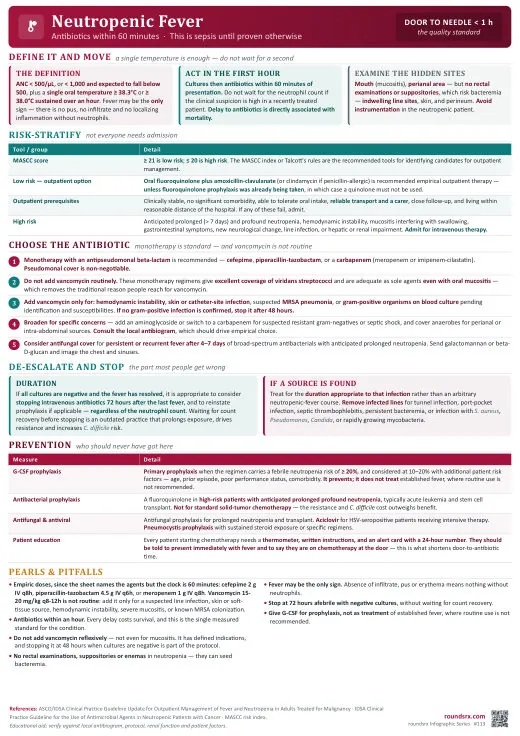
- Neutropenia: ANC < 500 cells/μL, or ANC < 1000 and expected to decline to < 500 within 48h
- Fever: single temperature ≥ 38.3°C (101°F) OR sustained ≥ 38.0°C (100.4°F) for ≥ 1 hour
- Profound neutropenia: ANC < 100 → highest risk of bacteremia and death
| Criterion | Points |
|---|---|
| Burden of illness: mild or no symptoms | +5 |
| Burden of illness: moderate symptoms | +3 |
| No hypotension (SBP ≥ 90) | +5 |
| No COPD | +4 |
| Solid tumor or no prior fungal infection | +4 |
| No dehydration requiring IV fluids | +3 |
| Outpatient at onset of fever | +3 |
| Age < 60 | +2 |
- Blood cultures × 2 sets (one from each lumen if central line + one peripheral). Draw BEFORE antibiotics but do NOT delay antibiotics for culture results.
- CBC with differential, BMP, LFTs, lactate
- UA + urine culture
- CXR (may be falsely negative -no neutrophils to create infiltrate)
- Sputum culture if productive cough
- Stool for C. diff if diarrhea
- Consider CT chest if pulmonary symptoms (CXR insensitive in neutropenia)
- Consider fungal markers (galactomannan, β-D-glucan) if prolonged neutropenia (> 7 days)
| Setting | Regimen | Notes |
|---|---|---|
| Standard empiric | Cefepime (Maxipime) 2g IV q8h 1ST LINE | Or piperacillin-tazobactam 4.5g IV q6h or meropenem 1g IV q8h. Anti-pseudomonal coverage is essential. Monotherapy is sufficient for uncomplicated cases IDSA, 2010. |
| Add vancomycin if: | Vancomycin (Vancocin) 15–20 mg/kg IV q8–12h | Hemodynamic instability, skin/soft tissue infection, catheter-site infection, known MRSA colonization, severe mucositis, PNA on imaging. Do NOT add vanc routinely -only for specific indications. |
| Add antifungal if: | Micafungin (Mycamine) 100 mg IV daily or voriconazole or liposomal amphotericin B | Persistent fever after 4–7 days of antibiotics with no identified source. Prolonged neutropenia (> 7 days). Consider CT chest for invasive aspergillosis (halo sign). Galactomannan, β-D-glucan. |
| Low-risk outpatient | Ciprofloxacin (Cipro) 750 mg PO BID + amoxicillin-clavulanate (Augmentin) 875 mg PO BID | Only if MASCC ≥ 21, reliable patient, close follow-up within 24h, no IV line infection. Must observe 4–6h first. |
- NOT routine in all neutropenic fever -per ASCO/IDSA, G-CSF is considered for: pneumonia, sepsis/septic shock, fungal infection, expected prolonged neutropenia (> 10 days), ANC < 100
- Dose: filgrastim 5 mcg/kg SC daily until ANC recovery
- Blood cultures × 2 sets -1 peripheral + 1 from each lumen of central line. Draw BEFORE antibiotics. If no central line, 2 peripheral sets from different sites.
- CBC with differential -confirm ANC < 500/μL (or < 1000 and expected to decline). Trend for nadir timing.
- BMP + LFTs -baseline renal/hepatic function for antibiotic dosing
- Lactate -if any concern for sepsis (tachycardia, hypotension)
- CXR -may be NORMAL even with pneumonia (neutropenic patients cannot mount an inflammatory infiltrate). A normal CXR does NOT exclude pulmonary infection.
- UA + urine culture -but note: pyuria may be absent (no WBCs to form pus)
- Skin exam -inspect ALL skin including perianal area, line sites, oral mucosa. Cellulitis without pus/erythema is common in neutropenia.
- Stool studies -C. diff PCR if diarrhea (mucositis + antibiotics = high risk)
- CT chest -if persistent fever day 4-5 despite antibiotics. Look for halo sign (invasive aspergillosis).
- Galactomannan + β-D-glucan -at day 4-5 if fevers persist (fungal biomarkers). Galactomannan specific for Aspergillus. β-D-glucan broad (not Mucor/Crypto).
- MASCC score -risk stratification for outpatient vs inpatient management (≥ 21 = low risk → may consider oral FQ + amoxicillin-clav)
| Drug | Dose | Route | Notes |
|---|---|---|---|
| Cefepime | 2g IV q8h | IV | First-line anti-pseudomonal β-lactam. Start within 1 hour of presentation. IDSA, 2010 |
| Meropenem | 1g IV q8h | IV | Alternative if prior ESBL, cefepime allergy, or hemodynamic instability. Also covers anaerobes. |
| Pip-tazo | 4.5g IV q6h | IV | Alternative first-line. Covers Pseudomonas + anaerobes. Avoid if concern for seizures (piperacillin lowers threshold). |
| Vancomycin | 15-20 mg/kg IV | IV | NOT routine. Add ONLY if: hemodynamic instability, skin/soft tissue infection, suspected line infection, known MRSA colonization, severe mucositis, or blood culture growing GP cocci. |
| Micafungin | 100 mg IV daily | IV | Empiric antifungal at day 4-5 if fever persists despite antibiotics. Echinocandin covers Candida + Aspergillus. |
| Voriconazole | 6 mg/kg q12h × 2 → 4 mg/kg q12h | IV/PO | If invasive aspergillosis suspected (halo sign on CT, positive galactomannan). Voriconazole Aspergillosis Trial, 2002 |
| G-CSF (filgrastim) | 5 mcg/kg SQ daily | SQ | Consider if ANC expected to be < 100 for > 10 days, pneumonia, sepsis, or invasive fungal infection. Not routine for uncomplicated neutropenic fever. |
| Levofloxacin + Amox-clav | 750 mg daily + 875 mg BID | PO | Outpatient option for LOW-RISK patients only (MASCC ≥ 21, expected short neutropenia, no comorbidities). |
Patient: 62M with AML on induction chemotherapy (7+3), day 12 post-chemo. Presents with fever 39.1C, no localizing symptoms. ANC 40.
Key findings: HR 102, BP 128/74, SpO2 97%. No oral mucositis, no line erythema, no skin lesions. CXR clear. UA bland. MASCC score 18 (high risk).
Management:
- Blood cultures x2 (1 peripheral + 1 from central line) BEFORE antibiotics
- Cefepime 2g IV q8h started within 60 minutes of fever onset
- No vancomycin (no hemodynamic instability, no line infection, no skin findings)
- Daily reassessment: add vancomycin if clinical deterioration, antifungal at day 4-5 if persistent fever
- Continue cefepime until ANC > 500 and afebrile ≥ 48h
Teaching point: Cefepime monotherapy is sufficient for uncomplicated neutropenic fever. Adding vancomycin empirically increases VRE selection and nephrotoxicity without improving outcomes. IDSA Guidelines, 2010
Patient: 45F with NHL on R-CHOP cycle 3, ANC 120. Fever 38.5C with rigors after PICC line flush. Erythema and tenderness at PICC insertion site.
Key findings: HR 115, BP 98/58. Tunnel erythema along PICC tract. Blood cultures drawn: differential time to positivity pending.
Management:
- Cefepime 2g IV q8h (anti-pseudomonal coverage)
- ADD vancomycin 25-30 mg/kg loading dose (suspected catheter-related infection)
- Blood cultures from PICC AND peripheral, differential time to positivity > 2h = line infection
- Consult ID for line removal vs salvage (tunnel infection usually requires removal)
- NS bolus 30 mL/kg for hypotension
Teaching point: Vancomycin is added to neutropenic fever ONLY for specific indications: line infection, hemodynamic instability, skin/soft tissue infection, gram-positive bacteremia, or severe mucositis. De-escalate at 48-72h if cultures negative for gram-positives.
Patient: 58M with AML, ANC 0, day 5 of cefepime for neutropenic fever. Still febrile (38.8C daily). Blood cultures negative. No source identified.
Key findings: CT chest: new 1.5 cm nodule with surrounding ground-glass halo ("halo sign"). Galactomannan index 1.8 (positive). Beta-D-glucan 245 (elevated).
Management:
- Start voriconazole 6 mg/kg IV q12h x2 doses (loading), then 4 mg/kg IV q12h
- Check voriconazole trough at day 5 (target 1-5.5 mcg/mL)
- Continue cefepime for bacterial coverage
- Consider G-CSF (ANC 0 for > 10 days with invasive fungal infection)
- Repeat CT chest in 1-2 weeks to assess response
Teaching point: Persistent fever at day 4-5 on broad-spectrum antibiotics triggers empiric antifungal therapy. The halo sign on CT suggests invasive aspergillosis. Voriconazole is preferred over amphotericin B. Herbrecht et al., 2002
- Temperature curve -defervescence expected within 3-5 days on appropriate antibiotics. Persistent fever at day 4-5 = expand workup (CT chest, fungal markers, line cultures)
- ANC daily -recovery above 500/μL is the key milestone. Antibiotics generally continued until ANC > 500 AND afebrile × 48h.
- Blood cultures at 48h -if initial cultures positive, repeat to document clearance. If persistent bacteremia → evaluate for endovascular source, line removal.
- Daily clinical assessment -new symptoms (cough, diarrhea, skin changes, abdominal pain), line sites (erythema, drainage), perianal exam, oral mucositis grade
- Galactomannan + β-D-glucan at day 4-5 if fever persists -repeat twice weekly if high suspicion for invasive fungal infection
- CRP trending -useful adjunct for tracking infection response (if rising on day 3-4, consider broadening coverage)
- Cr + LFTs -drug toxicity monitoring (vancomycin nephrotoxicity, voriconazole hepatotoxicity)
- Trough levels -vancomycin AUC/MIC targeting, voriconazole trough 1-5.5 mcg/mL
Text version
- Delaying cefepime (start within 1 hour)
- Routine vancomycin (not needed unless specific indication)
- Missing perianal abscess (physical exam including perirectal)
- Not considering antifungal at day 4-5