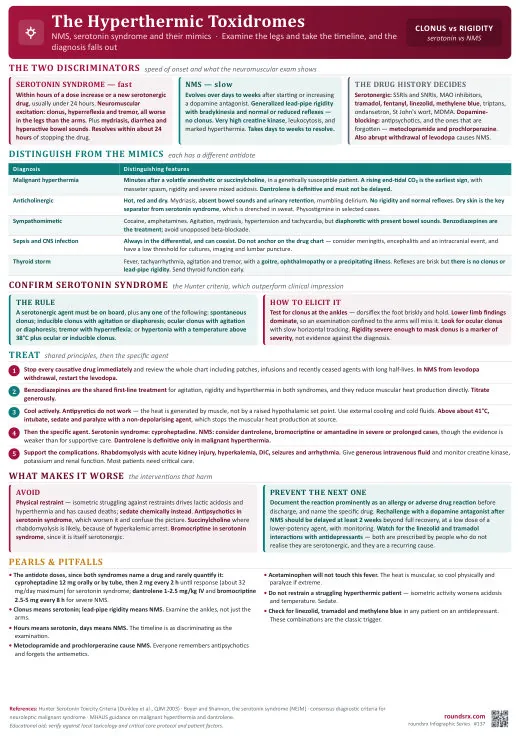
NMS vs Serotonin Syndrome
| Feature | NMS | Serotonin Syndrome |
|---|---|---|
| Mechanism | Dopamine ANTAGONISM (decreased dopamine) | Serotonin EXCESS (increased serotonin) |
| Causative drugs | Haloperidol, olanzapine, risperidone, metoclopramide, prochlorperazine. Also sudden withdrawal of dopamine agonists (levodopa). | SSRIs, SNRIs, MAOIs, tramadol, linezolid (weak MAOI!), fentanyl, ondansetron, triptans, St. John's Wort, MDMA, dextromethorphan |
| Onset | SLOW -days to weeks after starting/increasing dose | FAST -hours after starting, dose change, or drug interaction |
| Key finding | LEAD-PIPE RIGIDITY (diffuse, not clonus) | CLONUS (especially lower extremity) + hyperreflexia |
| Temperature | Very high (> 40°C common) | Variable (mild to very high) |
| Mental status | Altered (encephalopathy, obtundation) | Agitation, confusion, restlessness |
| Autonomic | Tachycardia, labile BP, diaphoresis | Tachycardia, hypertension, diaphoresis, mydriasis |
| GI symptoms | Usually absent | Diarrhea (serotonin stimulates gut motility) |
| Labs | CK markedly elevated (often > 1,000), leukocytosis, metabolic acidosis | CK may be mildly elevated, otherwise normal |
| Treatment | STOP offending agent, dantrolene + bromocriptine, cooling, ICU | STOP offending agent, benzodiazepines (first-line), cyproheptadine, cooling |
| Duration | Days to weeks to resolve | Usually resolves within 24 hours of stopping drug |
| Step | Intervention | Details |
|---|---|---|
| 1. STOP offending agent | Discontinue ALL antipsychotics/dopamine antagonists | This is the most important step. If NMS from levodopa withdrawal → restart levodopa immediately. |
| 2. Aggressive cooling | Ice packs, cooling blankets, cold IV fluids | Target temp < 39°C. Antipyretics (acetaminophen) do NOT work -this is not cytokine-mediated fever, it's muscle-generated heat. |
| 3. Dantrolene | Dantrolene (Dantrium) 1–2.5 mg/kg IV | Direct-acting muscle relaxant (blocks ryanodine receptor → reduces Ca²⁺ release from SR → reduces muscle contraction and heat generation). May repeat q5–10 min to max 10 mg/kg/day. |
| 4. Bromocriptine | Bromocriptine (Parlodel) 2.5 mg PO/NG q8h | Dopamine agonist -directly counteracts the dopamine blockade causing NMS. Continue for 10 days after NMS resolves (prevent relapse). |
| 5. Supportive | ICU admission, IVF, monitoring | Watch for rhabdomyolysis (check CK), AKI, DIC, aspiration, respiratory failure. Intubation may be needed. |
| Step | Intervention | Details |
|---|---|---|
| 1. STOP offending agent | Discontinue ALL serotonergic drugs | Most cases resolve within 24h of stopping the offending drug(s). Review full medication list carefully. |
| 2. Benzodiazepines | Lorazepam 1–2 mg IV or diazepam 5–10 mg IV | FIRST-LINE -controls agitation, reduces muscle activity and heat generation, lowers seizure threshold. Repeat as needed. |
| 3. Cyproheptadine | Cyproheptadine (Periactin) 12 mg PO/NG load, then 2 mg q2h | Serotonin 5-HT2A antagonist -directly blocks excess serotonin. Only available PO/NG (no IV form). Max 32 mg/day. |
| 4. Cooling | External cooling measures | For temperature > 41°C. Avoid antipyretics (ineffective). |
| 5. Avoid | Do NOT give antipsychotics for agitation | Some antipsychotics have serotonergic activity and could worsen SS. Do NOT give dantrolene (ineffective -muscle activity in SS is from neural excitation, not peripheral). |
- CK (creatine kinase) -markedly elevated in NMS (often > 1,000, can be > 10,000). Mildly elevated or normal in SS.
- BMP -Cr (AKI from rhabdo in NMS), K⁺ (hyperK from muscle breakdown), glucose
- CBC -leukocytosis common in NMS (not from infection -stress response)
- LFTs -may be elevated in NMS (hepatic injury)
- Coags (PT/INR, aPTT, fibrinogen) -DIC screening in severe NMS
- UA -myoglobinuria in NMS (dipstick + blood, no RBCs)
- TSH -rule out thyroid storm (hyperthermia + tachycardia differential)
- Toxicology screen -rule out sympathomimetic toxicity, anticholinergic syndrome
- Medication reconciliation -CRITICAL. Identify the offending drug(s). Review ALL medications, supplements, and OTC drugs for serotonergic or dopamine-blocking activity.
| Drug | Dose | Indication | Key Notes |
|---|---|---|---|
| Dantrolene (Dantrium) | 1–2.5 mg/kg IV, repeat q5–10 min | NMS only | Direct muscle relaxant (ryanodine receptor blocker). Max 10 mg/kg/day. Monitor for hepatotoxicity. NOT for SS. |
| Bromocriptine (Parlodel) | 2.5 mg PO/NG q8h | NMS only | Dopamine agonist -directly counteracts D2 blockade. Continue 10 days after resolution. Can also use amantadine 100 mg PO q12h. |
| Cyproheptadine (Periactin) | 12 mg PO/NG load, then 2 mg q2h | SS only | 5-HT2A antagonist. PO only (no IV form). Max 32 mg/day. Sedating (antihistamine). NOT for NMS. |
| Lorazepam | 1–2 mg IV PRN | SS first-line; adjunct in NMS | Controls agitation, reduces muscle hyperactivity, prevents seizures. Can use diazepam 5–10 mg IV as alternative. |
Patient: 34M brought to ED after found confused at group home. Started haloperidol 10 mg IM 3 days ago for acute psychosis. Temp 40.2°C, HR 128, BP 170/95. Diffuse lead-pipe rigidity.
Key findings: CK 18,400, WBC 16K, Cr 2.8 (baseline 0.9). Diaphoretic, mute, tremulous. Recently started high-potency antipsychotic. Classic NMS: fever + rigidity + AMS + autonomic instability.
Management:
- Stop haloperidol immediately
- Dantrolene 1-2.5 mg/kg IV q6h (skeletal muscle relaxant, reduces rigidity and thermogenesis)
- Bromocriptine 2.5 mg PO/NG TID (dopamine agonist, reverses central dopamine blockade)
- Aggressive IVF (NS 200 mL/hr) for rhabdomyolysis, target UOP > 200 mL/hr
- ICU admission, continuous temperature monitoring, serial CK q6h
Teaching point: NMS = "lead-pipe rigidity" with slow onset (days). High-potency typical antipsychotics (haloperidol) are highest risk. CK is often dramatically elevated (> 1000).
Patient: 45F on sertraline 200 mg daily, presents 6 hours after starting tramadol for back pain. Temp 38.6°C, HR 112, agitated, diaphoretic. Bilateral ankle clonus, hyperreflexia throughout. Dilated pupils.
Key findings: Hunter Criteria positive: inducible clonus + agitation + diaphoresis. Precipitant: addition of tramadol (serotonergic) to SSRI. CK 380 (mildly elevated). Onset within hours.
Management:
- Stop all serotonergic agents (sertraline and tramadol)
- Cyproheptadine 12 mg PO load → 4 mg q6h (serotonin antagonist, first-line antidote)
- Benzodiazepines for agitation: lorazepam 2 mg IV PRN
- Active cooling if temp > 40°C; avoid antipyretics (ineffective, heat is from muscle activity)
- IVF resuscitation, cardiac monitoring, most cases resolve within 24-72h
Teaching point: SS = "clonus + hyperreflexia" with rapid onset (hours). Key distinguisher from NMS: clonus and hyperreflexia (NMS has rigidity and hyporeflexia). Tramadol is a commonly missed serotonergic agent.
Patient: 58M on quetiapine and duloxetine, presents with confusion, temp 39.4°C, diaphoresis, tremor. Exam: increased tone in lower extremities, 3+ reflexes bilaterally, bilateral ankle clonus.
Key findings: On both an antipsychotic (quetiapine) and serotonergic agent (duloxetine). CK 620. Features overlap: fever + AMS + autonomic instability present in both conditions.
Management:
- Stop both quetiapine and duloxetine
- Key distinguisher: clonus + hyperreflexia → favors serotonin syndrome over NMS
- Start cyproheptadine 12 mg PO load (treat as SS given clonus)
- Benzodiazepines for agitation and muscle hyperactivity
- Monitor CK trending, if > 5000 or rising, add dantrolene for possible NMS component
Teaching point: The exam is the key differentiator: NMS → lead-pipe rigidity + hyporeflexia. SS → clonus + hyperreflexia + tremor. When in doubt, treat both, cyproheptadine won't worsen NMS, and supportive care overlaps.
| Parameter | Frequency | Target / Action |
|---|---|---|
| Temperature | q1–2h | Target < 39°C. Active cooling if > 40°C. Antipyretics ineffective. |
| CK | q6–12h (NMS) | Trend for rhabdomyolysis severity. If rising → aggressive IVF for renal protection. |
| BMP (K⁺, Cr) | q6–12h | Watch for hyperK (NMS) and AKI. |
| Neurological exam | q2–4h | Rigidity assessment (NMS), clonus assessment (SS), mental status. |
| Vitals | q1–2h ICU | HR, BP (labile in both), SpO₂, RR. |
| Coags | Daily if NMS severe | DIC screening (PT, fibrinogen, D-dimer). |