Obstructive Sleep Apnea
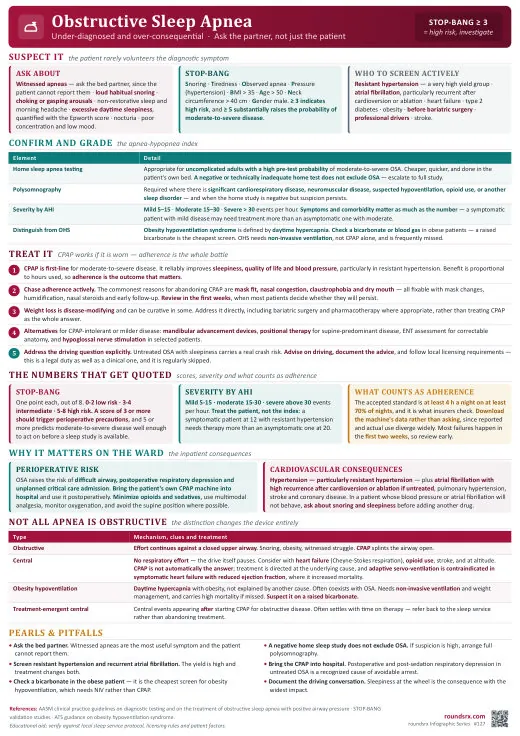
- Polysomnography (PSG) = gold standard. Measures AHI (apnea-hypopnea index).
- Home sleep apnea testing (HSAT) -acceptable for uncomplicated suspected OSA (no significant comorbidities). Underestimates AHI, and the reason matters: HSAT has no EEG, so it cannot tell sleep from quiet wakefulness and divides events by total recording time rather than total sleep time. Every awake hour in the denominator dilutes the index, which is why the result is often reported as a respiratory event index (REI) rather than an AHI. A patient who slept poorly during the study can be pushed a whole severity band too low, so a negative HSAT in a high-suspicion patient does not rule out OSA and should go to in-lab PSG. Actigraphy integrated into the HSAT device is the AASM-suggested fix (2018, conditional): it supplies an estimated total sleep time for the denominator when no other objective measure of sleep time is available.
| AHI | Severity | Treatment |
|---|---|---|
| 5–14 | Mild | CPAP if symptomatic. Weight loss, positional therapy, oral appliance. |
| 15–29 | Moderate | CPAP recommended. Weight loss. |
| ≥ 30 | Severe | CPAP strongly recommended. Significant CV risk if untreated. |
| Letter | Question |
|---|---|
| S | Snoring loudly? |
| T | Tired / daytime sleepiness? |
| O | Observed apneas during sleep? |
| P | Pressure -treated for HTN? |
| B | BMI > 35? |
| A | Age > 50? |
| N | Neck circumference > 40 cm (16 in)? |
| G | Gender -male? |
- Resistant hypertension -OSA is the #1 cause of resistant HTN. Screen all patients with HTN on ≥ 3 drugs.
- Atrial fibrillation -OSA increases Afib risk 2–4×. Untreated OSA increases Afib recurrence after cardioversion and ablation.
- Heart failure -intermittent hypoxia → increased afterload → RV/LV dysfunction
- Stroke -independent risk factor
- Pulmonary hypertension -chronic intermittent hypoxia → pulmonary vasoconstriction
| Feature | OSA | OHS |
|---|---|---|
| Definition | Repetitive upper airway collapse during sleep | BMI ≥30 + awake hypercapnia (PaCO₂ >45) not explained by another cause |
| Daytime PaCO₂ | Normal | Elevated (>45 mmHg) -THE distinguishing feature |
| Mechanism | Mechanical pharyngeal obstruction | ↓ Chest wall compliance + impaired central respiratory drive + coexisting OSA (90%) |
| ABG (awake) | Normal | Chronic respiratory acidosis (↑CO₂, ↑HCO₃⁻ from renal compensation) |
| Serum HCO₃⁻ | Normal | Elevated (>27 mEq/L) -a screening clue on BMP |
| Sleep study | AHI ≥5 with symptoms | 90% also have OSA. Key is the awake hypercapnia, not the AHI |
| Treatment | CPAP (splints airway open) | BiPAP with backup rate (needs inspiratory pressure support to ventilate, not just splint). Average volume-assured pressure support (AVAPS) is emerging. |
| Why CPAP fails in OHS | N/A -CPAP is sufficient | CPAP only holds the airway open. OHS patients also have impaired respiratory drive + restrictive physiology → need the extra pressure support of BiPAP to move air in and out |
| Mortality | Increased CV risk if untreated | Higher than OSA alone. 18-month mortality ~23% if untreated (vs ~9% for OSA alone) |
| Screening tip | STOP-BANG ≥3 | Obese patient with unexplained elevated HCO₃⁻ on BMP → check ABG → if PaCO₂ >45 → OHS |
- Bring home CPAP to hospital -use immediately postop
- Minimize opioids -multimodal analgesia (acetaminophen, NSAIDs, regional anesthesia)
- Continuous pulse oximetry (not just spot checks)
- Semi-upright positioning (not flat supine)
- Avoid benzodiazepines
Patient: 52M, BMI 38, on amlodipine 10, lisinopril 40, chlorthalidone 25, BP still 152/94. Daytime somnolence (Epworth 18), witnessed apneas by wife, morning headaches. Sleep study: AHI 48, nadir SpO₂ 72%.
Key findings: Severe OSA (AHI > 30) causing resistant hypertension. OSA is the #1 secondary cause of resistant HTN. Nocturnal hypoxemia → sympathetic surges → sustained daytime HTN. Also increases risk of Afib, stroke, and sudden cardiac death.
Management:
- Auto-CPAP titration, start 4-20 cmH₂O auto-adjusting (most patients need 8-12 cmH₂O)
- Mask fitting is critical for compliance, trial nasal pillows, nasal mask, or full face mask based on preference
- Weight loss counseling, 10% weight loss can reduce AHI by 26-50%
- Recheck BP after 3 months of CPAP, may be able to reduce antihypertensives
- Screen for metabolic syndrome, T2DM (OSA independently worsens insulin resistance)
Teaching point: CPAP reduces BP by ~3-5 mmHg on average, modest but clinically meaningful in resistant HTN. The benefit is greatest in patients who use CPAP > 4h/night. Non-compliant patients get no benefit, making adherence counseling essential.
Patient: 64F, BMI 42, scheduled for elective knee replacement. STOP-BANG score 6 (high risk). Never had a sleep study. Anesthesia requesting clearance.
Key findings: High pre-test probability of OSA (STOP-BANG ≥ 5). Undiagnosed OSA increases perioperative risk: post-op respiratory depression from opioids, difficult intubation, hypoxemia, Afib, ICU admission.
Management:
- Home sleep apnea test (HSAT) or in-lab polysomnography before elective surgery
- If OSA confirmed: start CPAP pre-operatively (even 1-2 weeks of use reduces perioperative complications)
- Perioperative precautions: CPAP at bedside post-op, minimize opioids (use multimodal analgesia), continuous pulse oximetry, semi-upright positioning
- Avoid benzodiazepines (worsen upper airway collapse)
- Anesthesia alert: potential difficult airway, have video laryngoscope available
Teaching point: STOP-BANG is the validated screening tool for OSA: Snoring, Tired, Observed apnea, Pressure (HTN), BMI > 35, Age > 50, Neck > 40 cm, Gender male. Score ≥ 5 = high probability of moderate-severe OSA.
Patient: 58M, BMI 52, presents with progressive dyspnea, lower extremity edema, somnolence. ABG: pH 7.32, PaCO₂ 58, PaO₂ 52, HCO₃ 34. Hgb 18.2 (polycythemia). Echo: RV dilation, estimated RVSP 55 mmHg. Sleep study: AHI 62.
Key findings: OHS = obesity (BMI ≥ 30) + awake daytime hypercapnia (PaCO₂ > 45) + sleep-disordered breathing, without another cause of hypoventilation. Elevated bicarb = chronic respiratory acidosis with metabolic compensation. Polycythemia from chronic hypoxia.
Management:
- Bilevel PAP (BiPAP) with backup rate, preferred over CPAP in OHS (addresses both obstruction AND hypoventilation)
- Supplemental O₂ titrated to SpO₂ 88-92% (avoid over-oxygenation, may worsen hypercapnia)
- Weight loss: bariatric surgery referral (most effective long-term intervention for OHS)
- Diuretics for right heart failure (RV volume overload from chronic pulmonary HTN)
- Monitor ABGs, PaCO₂ should improve with consistent BiPAP use over weeks
Teaching point: OHS is NOT just "severe OSA." It's a distinct entity with daytime hypercapnia requiring BiPAP with backup rate (not just CPAP). Untreated OHS has 18% mortality at 18 months vs 3% with treatment. Weight loss is curative.
| Medication | Dose | Mechanism | Notes |
|---|---|---|---|
| Semaglutide (Wegovy) EMERGING | 0.25mg SQ weekly → titrate to 2.4mg weekly | GLP-1 RA → weight loss → reduced pharyngeal fat → improved AHI | SELECT, 2023: ~20% weight loss. Dual benefit: weight + AHI reduction. Not yet FDA-approved specifically for OSA. |
| Tirzepatide (Mounjaro/Zepbound) EMERGING | 2.5mg SQ weekly → titrate to 15mg weekly | GIP/GLP-1 dual agonist → greater weight loss → AHI improvement | SURMOUNT-OSA, 2024: Up to 62.8% reduction in AHI. May become first-line pharmacologic adjunct for obese OSA. |
| Modafinil (Provigil) | 200mg PO daily (AM) | Wakefulness-promoting agent | For residual daytime sleepiness DESPITE adequate CPAP use. Does NOT treat the apnea itself -treats the symptom only. Not a substitute for CPAP. |
| Armodafinil (Nuvigil) | 150mg PO daily (AM) | R-enantiomer of modafinil, longer half-life | Same indication as modafinil -residual sleepiness on CPAP. Slightly longer duration of action. |
| Solriamfetol (Sunosi) | 75mg PO daily → max 150mg | Dopamine/norepinephrine reuptake inhibitor | FDA-approved for excessive daytime sleepiness in OSA (on CPAP). More potent wakefulness effect than modafinil. Avoid in uncontrolled HTN. |
| Acetazolamide (Diamox) | 250mg PO BID | Carbonic anhydrase inhibitor → metabolic acidosis → stimulates ventilation | Used for central sleep apnea (CSA) and high-altitude OSA. NOT standard for typical OSA. May reduce AHI in select cases. |
Text version
- Not screening resistant HTN patients for OSA
- Poor CPAP adherence (mask fitting + education + follow-up critical)
- Not bringing home CPAP to hospital (perioperative risk)
- Prescribing sedatives/opioids without screening for OSA