Oncologic Emergencies
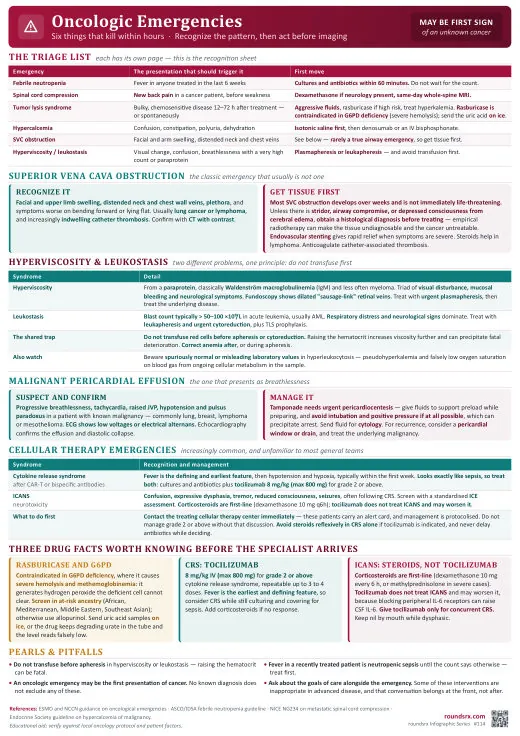
Oncologic emergencies are complications of cancer or its treatment that require immediate intervention to prevent death or irreversible organ damage. The key emergencies: (1) Superior vena cava (SVC) syndrome -obstruction of SVC, usually by lung cancer or lymphoma. (2) Malignant spinal cord compression (MSCC) -epidural metastasis compressing the cord. (3) Brain metastases with herniation -elevated ICP. (4) Hyperviscosity syndrome -Waldenström macroglobulinemia or multiple myeloma. (5) Tumor lysis syndrome -covered separately. (6) Febrile neutropenia -covered separately. (7) Malignant pericardial effusion/tamponade. The intern's role: recognize the pattern, start dexamethasone, and call oncology/radiation/surgery.
- SVC syndrome: CT chest with contrast (confirms obstruction + identifies cause). CXR may show widened mediastinum. Tissue diagnosis before radiation if patient is stable.
- Cord compression: MRI entire spine with contrast -gold standard. Order STAT. Must image ENTIRE spine (multiple levels in 10-38%). Check post-void residual (early bladder dysfunction).
- Brain mets: MRI brain with contrast. CT if MRI unavailable. Fundoscopy for papilledema. Assess for midline shift and herniation signs.
- Hyperviscosity: Serum viscosity (> 4-5 cP = symptomatic). Fundoscopy ("sausage-link" retinal veins). SPEP + serum free light chains. Peripheral smear (rouleaux).
- Malignant tamponade: Echocardiography (pericardial effusion + RA/RV diastolic collapse). Pulsus paradoxus > 10 mmHg. ECG: low voltage, electrical alternans.
- SVC syndrome: Elevate HOB. Dexamethasone 10 mg IV (if lymphoma suspected -exquisitely steroid-sensitive). Radiation therapy for NSCLC. Endovascular stenting for rapid relief. Anticoagulation if thrombus. Do NOT delay treatment for tissue diagnosis if severely symptomatic.
- Cord compression: Dexamethasone 10 mg IV STAT → 4 mg IV q6h. Must give within 24h of symptom onset -neurologic outcome correlates with pre-treatment function. Radiation (most common treatment). Surgery if: unknown primary (need tissue), radioresistant tumor, mechanical instability, or single-level disease with good prognosis. Patchell, Lancet 2005
- Brain mets: Dexamethasone 10 mg IV → 4 mg q6h (reduce edema). Anticonvulsants only if seizure has occurred (not prophylactic). Surgery for single resectable met with controlled primary. SRS (stereotactic radiosurgery) for ≤ 4 mets. WBRT for diffuse mets or poor prognosis.
- Hyperviscosity: Emergent plasmapheresis. Avoid pRBC transfusion before pheresis (increases viscosity further). Start definitive chemotherapy after pheresis.
- Tamponade: Pericardiocentesis (echo-guided). Pericardial window if recurrent. Intrapericardial chemotherapy or sclerotherapy for malignant effusions.
| Drug | Dose | Route | Notes |
|---|---|---|---|
| Dexamethasone | 10 mg IV bolus → 4 mg q6h | IV | For cord compression, brain mets, SVC (lymphoma). Reduces vasogenic edema. Start immediately -do not wait for imaging. |
| Levetiracetam | 500-1000 mg BID | IV/PO | If seizure with brain mets. NOT for prophylaxis in brain mets without seizure. |
| Mannitol | 0.5-1 g/kg IV | IV | Impending herniation from brain mets. Osmotic diuresis reduces ICP. Bridge to dexamethasone effect. |
| Hypertonic saline 3% | 150-250 mL bolus | IV | Alternative to mannitol for acute ICP crisis. |
| Radiation therapy | Per radiation oncology | - | Mainstay for cord compression, SVC (solid tumors), brain mets (WBRT/SRS). |
| Heparin | Weight-based | IV | SVC syndrome with associated thrombus. |
- Neuro exam q4h -for cord compression and brain mets. Motor strength, sensory level, rectal tone, post-void residual. Deterioration = urgent re-imaging.
- Serum viscosity -before and after plasmapheresis. Target < 4 cP.
- Blood glucose -high-dose dexamethasone causes significant hyperglycemia. Sliding scale insulin + glucose checks q6h.
- Pericardial effusion reaccumulation -repeat echo at 24-48h post-pericardiocentesis. 40-70% recurrence rate with malignant effusions.
- Respiratory status -SVC syndrome patients at risk for airway compromise. Keep intubation equipment at bedside.
Mr. Johnson is a 62-year-old man with known Stage IV NSCLC (right upper lobe, 3 cycles of pembrolizumab) presenting with 2 days of progressive lower extremity weakness and urinary retention. Exam: 4/5 hip flexors bilateral, absent ankle reflexes, T10 sensory level, post-void residual 400 mL. No saddle anesthesia. VS stable. MRI spine: T9-T10 epidural mass with cord compression.