Opioid Rotation & Conversion
- Intolerable side effects (nausea, sedation, pruritus, myoclonus) despite dose adjustments
- Inadequate analgesia despite dose escalation (true tolerance vs ceiling effect)
- Renal failure (rotate away from morphine -M6G accumulates) McPherson et al., 2018
- Route change required (PO → IV, or vice versa)
| Pain Type | Agent | Notes |
|---|---|---|
| Neuropathic | Gabapentin (Neurontin) 100–300 mg TID → titrate to 1200 mg TID or pregabalin (Lyrica) 75 mg BID → 300 mg BID | First-line for neuropathic pain. Start low, titrate slow (sedation, dizziness). Reduce dose in CKD. Also: duloxetine 30–60 mg daily (good for diabetic neuropathy). NeuPSIG (Finnerup), 2015 |
| Bone metastases | Dexamethasone (Decadron) 4–8 mg daily + radiation therapy (single fraction effective) + NSAIDs if tolerated | Steroids reduce peri-tumor edema → rapid pain relief. Bisphosphonates/denosumab for skeletal events prevention. |
| Bowel obstruction | Dexamethasone (Decadron) 8–16 mg IV daily + octreotide (Sandostatin) 100–300 mcg SC TID + glycopyrrolate for secretions | Medical management for malignant bowel obstruction when surgery is not appropriate. |
| Visceral / somatic | Acetaminophen (Tylenol) 1g q6h (scheduled, not PRN) + NSAIDs (ibuprofen 400–600 mg TID or ketorolac 15 mg IV q6h × 5 days max) | Scheduled acetaminophen reduces opioid requirements by 20–30%. Elia et al., 2005 NSAIDs: avoid in CKD, GI bleed risk, CHF. Ketorolac: max 5 days (renal toxicity). |
| Muscle spasm | Baclofen 5–10 mg TID or tizanidine 2–4 mg TID | Avoid cyclobenzaprine in elderly (anticholinergic → delirium). Baclofen: reduce dose in CKD (renally cleared). |
Presentation: 72M with advanced pancreatic cancer on morphine SR 60 mg PO BID + morphine IR 15 mg PO q4h PRN (using 4 doses/day). Complaints: severe nausea, myoclonus (arm jerks), and pruritus despite antiemetics. Cr 1.8 (baseline 0.9). Total 24h morphine: 120 mg SR + 60 mg PRN = 180 mg PO/day.
Conversion: 180 mg PO morphine / 5 = 36 mg PO hydromorphone equivalent. Apply 25% reduction (rising Cr) = 27 mg/day. New regimen: hydromorphone ER 12 mg PO q12h (24 mg scheduled) + hydromorphone IR 3 mg PO q3h PRN (10-15% of TDD). Bowel regimen: PEG 3350 + senna (docusate removed per AGA-ACG 2023 - no benefit). AGA-ACG, 2023
Outcome: Nausea and myoclonus resolved within 48h (morphine-specific side effects). Pain controlled with 1-2 breakthrough doses/day.
Presentation: 45F post-exploratory laparotomy, POD 3, tolerating PO. Current: hydromorphone PCA - basal rate 0 mg/hr, demand dose 0.2 mg q10min. Over past 24h: used 18 demands (3.6 mg IV hydromorphone/day). Ready for PO transition.
Conversion: 3.6 mg IV hydromorphone x 4 (IV:PO ratio) = 14.4 mg PO hydromorphone/day. No cross-tolerance reduction needed (same drug, just route change). New regimen: hydromorphone 2 mg PO q4h scheduled (12 mg/day) + hydromorphone 2 mg PO q3h PRN. Also: scheduled acetaminophen 1g q6h (reduces opioid requirement 20-30%), ibuprofen 400 mg TID if no contraindications. Taper plan: reduce by 25% every 2-3 days as surgical pain resolves.
Key point: Always add multimodal adjuvants when converting to oral. PCA-to-PO conversion is based on actual PCA usage, not the demand settings.
Presentation: 58M with metastatic lung cancer on oxycodone ER 80 mg BID + oxycodone IR 20 mg q4h PRN (using 4 doses/day). Total: 240 mg oxycodone/day. Attending requests rotation to methadone due to cost and neuropathic pain component (methadone has NMDA antagonist activity).
Conversion: 240 mg oxycodone = ~360 mg oral morphine equivalents (oxycodone x 1.5). At this high dose (>300 mg OME), methadone conversion is NOT 1:1 - the ratio is approximately 12:1 to 20:1 (morphine:methadone). Using 15:1 ratio: 360/15 = 24 mg methadone/day. Further reduce 50% for safety = 12 mg/day. Start methadone 5 mg PO TID (15 mg/day) with oxycodone IR 10 mg q4h PRN for breakthrough during transition.
Critical teaching: Methadone reaches steady state in 5-7 days due to long half-life. Do NOT increase methadone dose during the first week. Deaths occur when clinicians increase the dose on day 2-3 because the patient reports pain - the methadone hasn't peaked yet. QTc monitoring required (obtain baseline ECG, repeat at steady state). Weschules & Bain, 2008
| Parameter | Frequency | Target / Action |
|---|---|---|
| Pain scores | q4h + 1h after each PRN dose | Target ≤ 4/10 or functional goals (e.g., able to ambulate, sleep). Track breakthrough use -if > 3 PRN doses/day, increase scheduled dose. |
| Sedation (Pasero Opioid-Induced Sedation Scale) | q4h with vitals (q1–2h first 24h post-rotation) | S = sleep, easy to arouse; 1 = awake, alert (acceptable); 2 = slightly drowsy (acceptable); 3 = frequently drowsy (hold dose, reduce); 4 = somnolent (hold, consider naloxone). Naloxone (Narcan) must be at bedside. |
| Respiratory rate | q4h (q1h first 24h of new opioid) | RR < 10 → hold opioid. RR < 8 or unresponsive → naloxone 0.04–0.4 mg IV (titrate to respirations, not consciousness). Monitor closely × 48–72h after rotation. |
| Bowel regimen | Daily assessment (BM frequency) | Start bowel regimen with ALL opioids, PEG 3350 (MiraLAX) 17g daily + senna 8.6 mg BID. No BM × 3 days → add bisacodyl or methylnaltrexone (Relistor) 12 mg SC if refractory. Tolerance does NOT develop to constipation. Do not use docusate (no better than placebo, AGA-ACG 2023). |
| Pruritus | Each assessment | Common opioid side effect (histamine release). Rotation may resolve it. Treat with low-dose nalbuphine 2.5 mg IV or hydroxyzine 25 mg PO. Avoid diphenhydramine (additive sedation). |
| Nausea | Each assessment | Often resolves with rotation. Ondansetron 4 mg IV/PO q8h PRN. Haloperidol 0.5–1 mg PO/IV for refractory opioid-induced nausea. |
| Functional status | Daily | Can the patient ambulate, participate in PT, perform ADLs? Pain management goal is function, not a number. Reassess total opioid requirements and consider multimodal adjuncts. |
- Pain assessment -numeric rating scale (0–10), functional goals ("What would you like to be able to do?"), pain quality (nociceptive vs neuropathic), exacerbating/relieving factors. The number alone is insufficient.
- Current opioid regimen -exact drug, dose, route, frequency (scheduled + PRN). Calculate total 24h opioid consumption including all breakthrough doses actually taken.
- Equianalgesic calculation -convert current total 24h dose to oral morphine equivalents (OME), then convert to the new opioid using equianalgesic table. Apply 25–50% reduction for incomplete cross-tolerance.
- Reason for rotation -intolerable side effects (nausea, myoclonus, pruritus, sedation), analgesic tolerance despite dose escalation, cost/formulary, route change needed (PO → IV or vice versa)
- Renal function (BMP, CrCl) -affects opioid metabolism. Morphine: avoid in CKD (active metabolite M6G accumulates → prolonged sedation/respiratory depression). Hydromorphone: safer in CKD but metabolite H3G can accumulate. Fentanyl: safest in renal failure (no active metabolites).
- Hepatic function (LFTs) -most opioids are hepatically metabolized (CYP3A4, CYP2D6). Severe liver disease → reduced clearance → dose reduce and extend intervals. Methadone especially affected.
| Opioid | PO Dose (equianalgesic) | IV Dose | PO:IV Ratio | Notes |
|---|---|---|---|---|
| Morphine (MS Contin) | 30 mg | 10 mg | 3:1 | Reference standard. Avoid in CKD (M6G accumulates). IR: q4h. ER: q8–12h. |
| Hydromorphone (Dilaudid) | 6 mg | 1.5 mg | 4–5:1 | Preferred in renal impairment. 5× more potent than morphine PO. IR: q3–4h. ER: q12–24h. |
| Oxycodone (OxyContin) | 20 mg | N/A (no IV form) | - | 1.5× more potent than morphine PO. IR: q4–6h. ER: q12h. |
| Fentanyl patch (Duragesic) | 12 mcg/hr patch ≈ 30 mg PO morphine/24h | Variable | - | For stable opioid requirements ONLY (not acute pain). Takes 12–24h to reach peak effect. No active metabolites -safest in CKD/ESRD. Mercadante & Bruera, 2016 |
| Methadone (Dolophine) | Non-linear conversion | Variable | ~2:1 | DANGER t½ = 15–60h. QTc prolongation. NMDA antagonist. Use dedicated methadone conversion tables -NOT the standard equianalgesic table. Weschules & Bain, 2008 Consult pharmacy or palliative care. |
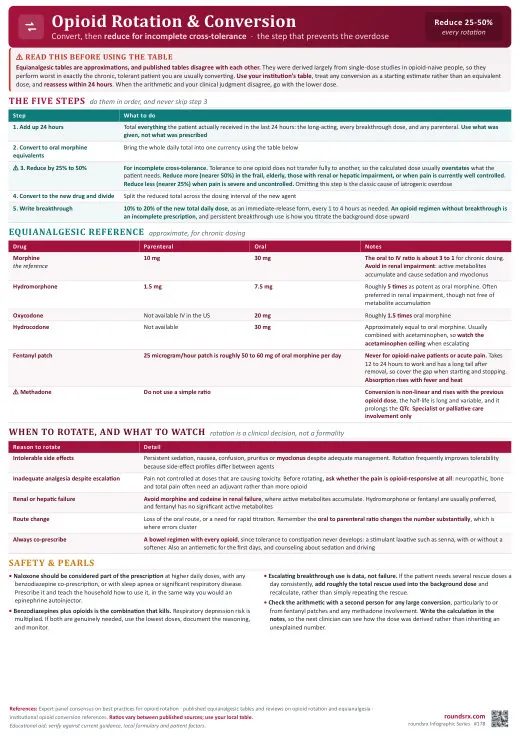
Text version
📊 Equianalgesic: PO morphine 30 = oxycodone 20 = hydromorphone 6. IV morphine 10 = hydromorphone 1.5.
⚠️ Cross-tolerance: Always reduce calculated dose by 25–50% -cross-tolerance is INCOMPLETE.
🚨 Methadone: Non-linear conversion, long t½ (15–60h), QTc risk. Use dedicated tables. Experienced prescribers only.
📈 Monitor: Closely × 48–72h after rotation. Pain scores, sedation, RR. Narcan at bedside.