Opioid Use Disorder
Opioid use disorder is a chronic medical disease, and the medications that treat it are among the most effective interventions in medicine. Treatment with buprenorphine or methadone substantially reduces all-cause and overdose mortality, with cohort data showing mortality roughly halved or better while patients are retained in treatment. Framing this as a moral problem, or as something to be addressed after the "real" medical issue, costs lives in a way that few other omissions on a medicine service do.
Counseling alone is not equivalent to medication. Referral to a program without medication, or a "detox" admission with no medication at discharge, is not neutral: it is associated with worse outcomes than medication treatment. This is the single most common well-intentioned error in this disease.
- Patients with OUD are admitted often -for endocarditis, skin and soft tissue infection, osteomyelitis, overdose, trauma- and each admission is a point of contact with a system they may otherwise avoid.
- Starting medication in hospital increases the chance the patient is still in treatment weeks later, compared with referral alone at discharge. The initiation is the intervention; the referral by itself frequently fails.
- Untreated withdrawal drives patients out of the building. Discharge against medical advice is common in this population, and undertreated withdrawal is a leading and modifiable reason. Treating withdrawal properly is not a comfort measure, it is what keeps the patient present long enough to finish antibiotics for their endocarditis.
- Say "person with opioid use disorder", not "abuser" or "addict". Stigmatizing terms in the chart measurably change how subsequent clinicians judge and treat the same patient.
- Toxicology results are "positive" or "negative", never "clean" or "dirty". The alternative frames a laboratory value as a statement about the person's worth.
- "Medication for opioid use disorder" (MOUD), not "replacement" or "substitution" -the latter implies one drug is being swapped for another, which misrepresents what a stable, non-euphoric, life-preserving therapy is doing.
- OUD is a DSM-5 clinical diagnosis based on a pattern of problematic use causing impairment or distress, graded by how many criteria are met: 2 to 3 mild, 4 to 5 moderate, 6 or more severe. The criteria cover loss of control, craving, failure to meet obligations, use despite harm, and continued use in hazardous situations.
- ⚠ Tolerance and physical withdrawal do not count toward the diagnosis when opioids are taken as prescribed under medical supervision. This distinction matters: a patient on long-term opioid therapy for cancer pain is physically dependent without having a use disorder, and conflating the two both stigmatizes them and misdirects treatment.
- Screen rather than wait for the obvious. A single question about past-year use of illicit drugs or non-prescribed medications performs well as an opening, and normalizing it for everyone avoids the profiling that determines who gets asked.
- The Clinical Opiate Withdrawal Scale (COWS) scores eleven items -resting pulse, sweating, restlessness, pupil size, bone or joint aches, runny nose or tearing, gastrointestinal upset, tremor, yawning, anxiety or irritability, and gooseflesh- to grade severity objectively.
- Its main use here is timing. Traditional buprenorphine initiation requires the patient to be in at least moderate withdrawal, conventionally a COWS of about 8 to 12 or higher, before the first dose, because giving buprenorphine too early is what precipitates withdrawal.
- Score objective signs, and be aware of what mimics them. Tachycardia, sweating and agitation are not specific: sepsis, alcohol withdrawal, thyrotoxicosis and pain all raise the score. In a patient with endocarditis, deciding that a rising COWS is withdrawal rather than worsening infection is a clinical judgment, not a calculation.
| Screen for | Why, and what to do |
|---|---|
| HIV and hepatitis C | Both are substantially more prevalent with injection use, and both are treatable to the point of cure or durable control. HCV is curable with direct-acting antivirals, and ongoing drug use is not a reason to withhold treatment. Offer HIV pre-exposure prophylaxis to those at continued risk. |
| Hepatitis B, plus vaccination | Screen and vaccinate the non-immune. Also vaccinate against hepatitis A and confirm tetanus status. |
| Infective endocarditis | A common and frequently missed cause of admission. Have a low threshold for blood cultures and echocardiography with fever plus injection use. Right-sided disease is classic but left-sided occurs and behaves differently. |
| Skin, soft tissue and bone | Abscess, cellulitis, osteomyelitis and epidural abscess. Back pain with fever in someone who injects deserves imaging, not analgesia alone. |
| Psychiatric comorbidity | Depression, anxiety, PTSD and other substance use disorders are common and affect retention. Concurrent benzodiazepine or alcohol use raises overdose risk but is not a reason to withhold buprenorphine or methadone. |
| Pregnancy | Changes management substantially. Buprenorphine or methadone is the standard of care in pregnancy; withdrawal management alone is not recommended because relapse risk is high and carries fetal risk. Coordinate with obstetrics and pediatrics early. |
| Drug | Mechanism | Practical points |
|---|---|---|
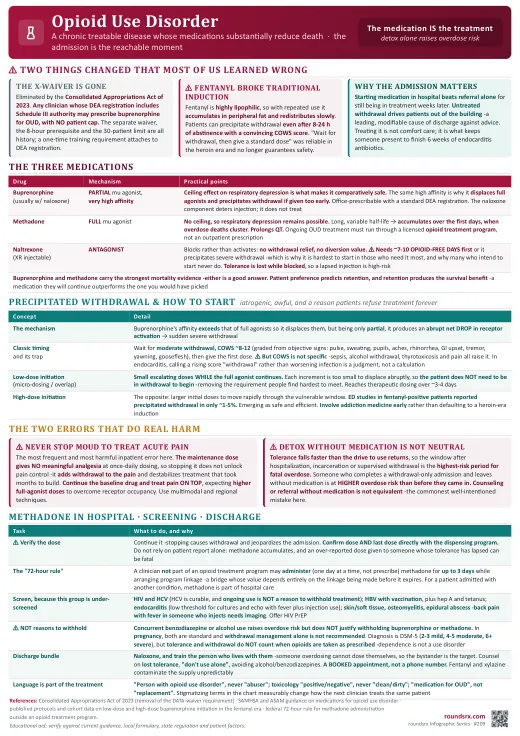
| Buprenorphine usually with naloxone | Partial mu agonist with very high receptor affinity | The ceiling effect on respiratory depression is what makes it comparatively safe -partial agonism means the respiratory effect plateaus, so overdose risk is far lower than with a full agonist. The same high affinity is why it displaces full agonists and precipitates withdrawal if given too early. Prescribable in any office setting with a standard DEA registration. The naloxone component is poorly absorbed sublingually and is there to deter injection, not to treat. |
| Methadone | Full mu agonist | No ceiling effect, so respiratory depression remains possible and dose increases must be cautious. Long and variable half-life means accumulation over the first days, when overdose deaths cluster. Also prolongs the QT interval. For ongoing OUD treatment it must be dispensed through a licensed opioid treatment program, not by outpatient prescription. |
| Naltrexone extended-release injectable | Opioid antagonist | Blocks rather than activates, so there is no withdrawal relief and no diversion value. ⚠ Requires roughly 7 to 10 days opioid-free before the first dose, or it precipitates severe withdrawal -which is exactly why it is hard to start in the people who need treatment most, and why many who intend to start it never do. X:BOT, 2018 quantified this: the intention-to-treat advantage for buprenorphine came largely from patients who never got started on naltrexone at all, whereas among those successfully inducted the two performed comparably. The induction barrier, not the drug's pharmacology, is the problem. Best suited to patients already through withdrawal, such as those leaving controlled settings. Tolerance is lost while blocked, so overdose risk is high if the injection lapses. |
- The mechanism: buprenorphine's affinity for the mu receptor exceeds that of full agonists, so it displaces them. Because it is only a partial agonist, replacing a full agonist with it produces an abrupt net drop in receptor activation and therefore sudden, severe withdrawal. It is iatrogenic, deeply unpleasant, and a powerful reason for a patient to refuse treatment ever again.
- The classic prevention is timing: wait until the patient is already in moderate withdrawal (COWS about 8 to 12) so that receptor occupancy by the full agonist has fallen, then give the first dose.
- ⚠ Why that fails with fentanyl: fentanyl is highly lipophilic, so with repeated use it accumulates in peripheral fat and redistributes slowly. Patients can therefore have meaningful fentanyl still coming out of tissue even after 8 to 24 hours or more of abstinence and a convincing COWS score. Waiting for withdrawal, the rule that worked reliably in the heroin era, no longer guarantees safety.
- Low-dose initiation (also called micro-dosing or rapid overlap) gives very small, escalating buprenorphine doses while the full agonist continues, building up over several days. Because each increment is small, it does not produce the abrupt displacement that causes precipitated withdrawal, and the patient does not have to be in withdrawal to begin -which removes the requirement people find hardest to meet. Protocols reach therapeutic dosing over roughly three to four days.
- High-dose initiation takes the opposite approach, giving substantially larger initial doses to move quickly through the vulnerable window. Emergency department studies in fentanyl-positive patients reported precipitated withdrawal in only about 1 to 5 percent, and it is emerging as a safe and efficient option.
- Both are active practice, not fringe technique. The right move on a general medicine service is to involve addiction medicine early where available and to choose a protocol deliberately, rather than defaulting to a heroin-era induction and being surprised.
- A patient already on methadone should have it continued during admission -stopping it causes withdrawal and jeopardizes the admission.
- ⚠ Verify the dose with the dispensing program directly before giving it, and confirm when the last dose was taken. Do not rely on the patient's report alone: methadone accumulates, and an over-reported dose administered to someone whose tolerance has lapsed can be fatal.
- The "72-hour rule" lets a clinician who is not part of an opioid treatment program administer methadone for up to three days to relieve withdrawal while arranging linkage to a program. The medication is administered, generally one day at a time, rather than prescribed. It is a bridge, and its value depends entirely on the linkage actually being made before it expires.
- For a patient admitted for another condition, methadone can be provided as part of that hospital care; the opioid treatment program requirement governs ongoing outpatient treatment, not inpatient administration.
- Naloxone for every patient, and teach someone who lives with them to use it -a person in overdose cannot administer it themselves, so the bystander is the actual target of the training.
- Counsel explicitly on lost tolerance after any period of reduced use, and that using alone is what turns an overdose into a death. Advise against mixing with alcohol or benzodiazepines.
- Fentanyl and xylazine now contaminate the supply unpredictably, so a dose that was tolerated before may not be. Drug checking supplies, where legally available, and syringe service programs reduce infectious complications and are a route back into care.
- Meet the patient where they are. Someone not ready to stop still benefits from naloxone, vaccination, HCV treatment and a door left open. Making future care conditional on abstinence today is how people disappear from care entirely.
"Ms. T is a 34-year-old woman who injects fentanyl daily, admitted with tricuspid valve endocarditis and Staphylococcus aureus bacteremia, now day two of a planned six-week antibiotic course. Overnight her COWS rose to 14 with objective sweating, mydriasis and gooseflesh, and she has asked twice about leaving. I think the withdrawal is the immediate threat to her antibiotic course, because undertreated withdrawal is a leading modifiable reason patients in her situation leave against advice, and leaving on day two of endocarditis treatment is a far greater risk to her than her drug use is this week. Given daily fentanyl I am not comfortable with a traditional induction despite the COWS of 14, since fentanyl redistributes from fat and she could still precipitate. I have asked addiction medicine to help choose between a low-dose overlap and a high-dose initiation, and I have started symptomatic management meanwhile. She has not been screened for HIV or hepatitis C, so I have sent both and checked hepatitis B immunity for vaccination. For discharge she will need naloxone with training for her partner, counseling on lost tolerance, and a confirmed appointment rather than a phone number, since referral without a booked follow-up usually fails. I would also flag in the chart that her buprenorphine must not be held if she needs a procedure."
- Is withdrawal actually controlled? A rising COWS is a reason to act today, not to observe -it predicts the patient leaving before treatment is complete.
- Has medication been offered this admission, and if declined, was it re-offered? Willingness changes across an admission, and a single refusal on day one is not a standing answer.
- If already on MOUD, is the dose verified with the program and being given? Check it has not been quietly held for a procedure.
- Pain plan compatible with the maintenance medication, and documented so the overnight team does not stop it.
- Infectious screening sent (HIV, HCV, HBV) and vaccination ordered.
- Discharge: naloxone in hand with a trained bystander, a booked follow-up rather than a referral number, enough medication to bridge the gap, and lost-tolerance counseling delivered.
| Decision | Approach and why |
|---|---|
| Framing | A chronic treatable disease whose medications substantially reduce mortality. Counseling or referral without medication is not equivalent, and a withdrawal-only admission leaves the patient at higher overdose risk than before, because tolerance falls faster than the drive to use returns. |
| Who can prescribe | The X-waiver is gone (Consolidated Appropriations Act 2023). Any DEA registration with Schedule III authority, no patient cap. |
| Diagnose | DSM-5: 2-3 mild, 4-5 moderate, 6+ severe. Tolerance and withdrawal do not count when opioids are taken as prescribed -dependence is not the same as a use disorder. |
| Choose the drug | Buprenorphine (partial agonist, ceiling on respiratory depression, office-prescribable) or methadone (full agonist, no ceiling, accumulates early, QT, needs an opioid treatment program) -both have the strongest mortality evidence. Naltrexone needs 7-10 opioid-free days, which is why it so often never gets started. Patient preference predicts retention, and retention produces the survival benefit. |
| ⚠ Induction | Classic: wait for COWS ~8-12. But fentanyl is lipophilic and redistributes from fat, so drug persists past 8-24 h despite a convincing score. Use low-dose overlap (small escalating doses while the full agonist continues, no withdrawal required) or high-dose initiation (~1-5% precipitated withdrawal in fentanyl-positive ED patients). Involve addiction medicine. |
| ⚠ Acute pain on MOUD | Never stop the maintenance dose. It gives no meaningful analgesia, so stopping it only adds withdrawal to pain. Continue it and treat pain on top, expecting higher full-agonist requirements; use multimodal and regional techniques. |
| Screen | HIV, HCV, HBV with vaccination; endocarditis, skin, soft tissue and spinal infection; psychiatric comorbidity. Ongoing use is not a reason to withhold HCV cure. In pregnancy, buprenorphine or methadone is standard and withdrawal management alone is not recommended. |
| Discharge | Naloxone with a trained bystander, lost-tolerance counseling, "don't use alone", and a booked appointment rather than a phone number. |
- The medication is the treatment. Detox without it, or referral without it, is worse than not admitting the problem at all, because it removes tolerance without removing risk.
- Fentanyl broke the induction rule you were taught. A reassuring COWS no longer guarantees a safe traditional start.
- Never hold maintenance therapy for pain. Treat on top of it.