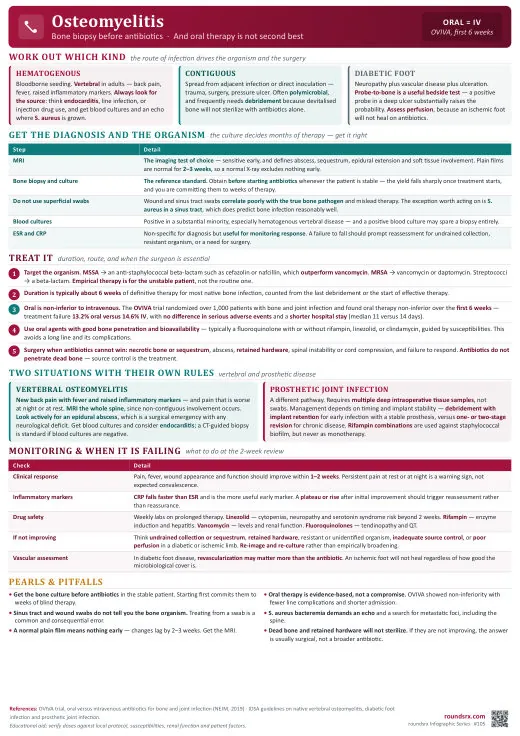
Osteomyelitis
| Type | Mechanism | Typical Patient | Common Organisms |
|---|---|---|---|
| Hematogenous | Bacteremia seeds bone (metaphysis in children, vertebral body in adults) | Children, IVDU (vertebral), sickle cell disease | S. aureus (#1 overall). Salmonella in SCD. Pseudomonas in IVDU. |
| Contiguous spread | Direct extension from adjacent soft tissue infection, open fracture, or surgery | Post-surgical, trauma, diabetic foot ulcers, decubitus ulcers | S. aureus, coagulase-negative staph (hardware). Polymicrobial (diabetic foot -add gram-negatives + anaerobes). |
| Vascular insufficiency | Chronic ischemia + minor trauma/ulceration → infection spreads to bone | Diabetic foot, peripheral arterial disease | Polymicrobial: S. aureus, Streptococcus, Enterococcus, gram-negatives (E. coli, Proteus), anaerobes (Bacteroides). |
| Feature | Acute | Chronic |
|---|---|---|
| Duration | < 2 weeks of symptoms | > 6 weeks, or recurrent |
| Pathology | Suppurative infection, edema | Sequestrum (dead bone), involucrum (new bone around dead bone), sinus tracts |
| Treatment | Antibiotics often curative alone | Usually requires surgical debridement + prolonged antibiotics |
| Scenario | Empiric Regimen | Rationale |
|---|---|---|
| Native bone, acute | Vancomycin (Vancocin) (MRSA coverage) + Ceftriaxone (Rocephin) 2g IV daily (gram-negatives) | Covers MRSA + gram-negatives while awaiting cultures. Narrow once sensitivities return. |
| Diabetic foot | Vancomycin (Vancocin) + Piperacillin-tazobactam (Zosyn) 3.375g IV q6h | Polymicrobial -need MRSA + gram-negatives + anaerobic coverage. |
| Post-surgical / hardware | Vancomycin (Vancocin) + Cefepime (Maxipime) 2g IV q8h | Covers MRSA + Pseudomonas + skin flora. Hardware infections often need surgical removal. |
| Vertebral | Vancomycin (Vancocin) + Ceftriaxone (Rocephin) | S. aureus is #1. If IVDU, cover Pseudomonas (use cefepime instead of ceftriaxone). |
| Sickle cell disease | Ceftriaxone (Rocephin) 2g IV daily | Salmonella is #1 in SCD (not S. aureus). Ceftriaxone covers Salmonella + S. aureus. |
- Chronic osteomyelitis with sequestrum or sinus tracts
- Failed medical therapy (persistent infection after adequate antibiotics)
- Hardware-associated infection -often requires implant removal
- Abscess requiring drainage
- Spinal epidural abscess with neurological compromise -neurosurgical emergency
- Diabetic foot with non-healing ulcer and extensive bony involvement -may need amputation
- ESR and CRP -elevated in >90% of cases. ESR >70 is highly suggestive. Use to monitor treatment response.
- Blood cultures (×2 sets) -positive in ~50% of hematogenous osteomyelitis. Always obtain before antibiotics.
- CBC -WBC may be normal in chronic osteomyelitis. Left shift suggests acute infection.
- Plain radiographs -first-line imaging. Changes take 10–14 days to appear (periosteal reaction, lytic lesions). Normal X-ray does NOT rule out early osteomyelitis.
- MRI with gadolinium -imaging gold standard. Sensitivity 90–100%, specificity 80–90%. Shows bone marrow edema, soft tissue extent, abscess.
- Bone biopsy with culture -diagnostic gold standard. Identifies organism and sensitivities. Essential for targeted therapy. IR-guided or open surgical.
- Probe-to-bone test -bedside test for diabetic foot ulcers. PPV ~89% if positive.
| Organism | First-Line | Alternative | Duration / Notes |
|---|---|---|---|
| MSSA* *= Methicillin-Sensitive Staph aureus | Nafcillin (Nallpen) 2g IV q4h or Cefazolin (Ancef) 2g IV q8h | Oral step-down: Cephalexin (Keflex) 1g PO QID or Dicloxacillin (Dynapen) 500mg PO QID | 6 weeks. IV × 1–2 weeks then oral step-down per OVIVA. Cefazolin preferred for ease of outpatient dosing (q8h vs q4h). |
| MRSA* *= Methicillin-Resistant Staph aureus | Vancomycin (Vancocin) 15–20 mg/kg IV q8–12h (target AUC/MIC 400–600) | Oral step-down: TMP-SMX (Bactrim) DS 1–2 tabs PO BID + Rifampin (Rifadin) 300mg PO BID | 6 weeks. Rifampin for biofilm penetration (hardware infections). Never use rifampin monotherapy -resistance develops rapidly. |
| Streptococcus | Ceftriaxone (Rocephin) 2g IV daily | Penicillin G or Amoxicillin (Amoxil) 1g PO TID | 6 weeks. Strep are reliably penicillin-sensitive. |
| Pseudomonas | Cefepime (Maxipime) 2g IV q8h or Piperacillin-tazobactam (Zosyn) | Ciprofloxacin (Cipro) 750mg PO BID (oral option with good bone penetration) | 6 weeks. Cipro has excellent oral bioavailability and bone penetration -preferred oral agent for Pseudomonas osteo. |
| Salmonella (SCD) | Ceftriaxone (Rocephin) 2g IV daily | Ciprofloxacin (Cipro) 500mg PO BID | 6 weeks. Most common cause of osteomyelitis in sickle cell disease. |
| Polymicrobial (diabetic foot) | Vancomycin (Vancocin) + Piperacillin-tazobactam (Zosyn) | Oral step-down: Amoxicillin-clavulanate (Augmentin) 875mg PO BID + TMP-SMX (Bactrim) (if MRSA) | 6 weeks. Surgical debridement is almost always needed. Vascular assessment essential. |
Patient: 62M IVDU with 3 weeks of progressive back pain and low-grade fevers. MRI spine: L3-L4 vertebral body edema, disc enhancement, paravertebral phlegmon. Blood cultures: MSSA. No epidural abscess.
Key findings: Vertebral osteomyelitis (most common location for hematogenous osteomyelitis in adults). IVDU + S. aureus bacteremia. Must rule out epidural abscess (MRI with contrast is the gold standard). No surgical indication without abscess or instability.
Management:
- Nafcillin 2g IV q4h × 6 weeks (MSSA → beta-lactam preferred over vancomycin for efficacy)
- Add rifampin 300 mg PO BID after 2 weeks of IV therapy (enhances biofilm penetration, always in combination, never alone)
- TTE → if positive or high suspicion: TEE to rule out endocarditis (IVDU + S. aureus = 30% concurrent IE)
- Pain management: NSAIDs + acetaminophen; opioids PRN initially; gabapentin for neuropathic component
- PICC line for outpatient IV antibiotics (OPAT) if clinically stable after initial improvement
Teaching point: Every case of vertebral osteomyelitis needs an MRI of the ENTIRE spine (multifocal in 10-15%) and evaluation for endocarditis (especially S. aureus). Blood cultures are positive in 50-60%, get them before antibiotics.
Patient: 68M with T2DM (A1c 10.2), presents with non-healing plantar ulcer × 3 months over 2nd metatarsal head. Ulcer depth: bone is palpable with sterile probe ("probe to bone" positive). XR: periosteal reaction and cortical erosion of 2nd metatarsal.
Key findings: Diabetic foot osteomyelitis, "probe to bone" test has 89% PPV for osteomyelitis when positive in a diabetic foot ulcer. X-ray changes confirm chronic osteomyelitis (periosteal reaction, cortical destruction).
Management:
- MRI foot (best imaging) to delineate extent of bone involvement and surgical planning
- Bone biopsy + culture before antibiotics if possible (wound swabs are unreliable, contaminated with skin flora)
- Empiric: vancomycin + piperacillin-tazobactam (cover MRSA + GNR + anaerobes) → narrow based on bone culture
- Surgical debridement or limited amputation (ray amputation) for devitalized bone, antibiotics alone cannot cure dead bone
- Offloading: total contact cast or removable walking boot (pressure relief is essential for healing)
Teaching point: Wound swab cultures do NOT reflect bone pathogens, bone biopsy is the gold standard for guiding antibiotic therapy. If bone is visible or palpable in a diabetic foot ulcer, treat as osteomyelitis. MRI is the best imaging modality (sensitivity 90%, specificity 80%).
Patient: 74F, 2 years post-right TKR. Progressive knee pain and swelling × 6 weeks, low-grade fever. Knee aspirate: WBC 28,000 (80% PMNs), culture growing coagulase-negative Staph (CoNS). CRP 68, ESR 82.
Key findings: Chronic prosthetic joint infection (PJI), onset > 3 months post-op. CoNS is #1 organism in chronic PJI (biofilm former on prosthetic material). Synovial WBC > 3,000 with > 80% PMNs meets MSIS criteria for PJI in a prosthetic joint.
Management:
- Two-stage exchange arthroplasty (gold standard for chronic PJI): remove prosthesis → antibiotic spacer × 6-8 weeks → reimplant new prosthesis
- IV vancomycin × 6 weeks (CoNS, often methicillin-resistant) + rifampin 300 mg PO BID (biofilm penetration)
- Alternative (select cases): DAIR (debridement, antibiotics, implant retention) if: < 3 weeks of symptoms, stable implant, susceptible organism
- ID consult for antibiotic optimization and duration
- Withhold reimplantation until CRP normalizes and repeat aspiration is negative
Teaching point: Rifampin is the key drug in prosthetic joint infections, it penetrates biofilms that other antibiotics cannot reach. But NEVER use rifampin alone (rapid resistance in days). Always combine with vancomycin, TMP-SMX, or a fluoroquinolone.
- ESR and CRP -check weekly. CRP normalizes faster (1–2 weeks). ESR may take weeks to decline. Failure to trend down suggests treatment failure or undrained collection.
- CBC with differential -weekly. Monitor WBC normalization.
- Vancomycin levels -if on vancomycin, target AUC/MIC 400–600. Check trough before 4th dose, then 1–2× weekly.
- Renal function (BMP) -weekly if on vancomycin or aminoglycosides. Watch for nephrotoxicity.
- LFTs -if on rifampin (hepatotoxic). Baseline then q2 weeks.
- PICC line site -daily inspection for infection, thrombosis if on prolonged IV therapy.
- Repeat imaging -not routine. Repeat MRI only if clinical concern for treatment failure or new collection. Imaging lags behind clinical improvement.