Goals of Care & Symptom Management
- Any new serious diagnosis (advanced cancer, end-stage organ failure, severe dementia)
- Significant clinical deterioration or ICU admission
- Repeated hospitalizations for chronic progressive disease
- "Would you be surprised if this patient died in the next year?" -if no, initiate GOC discussion.
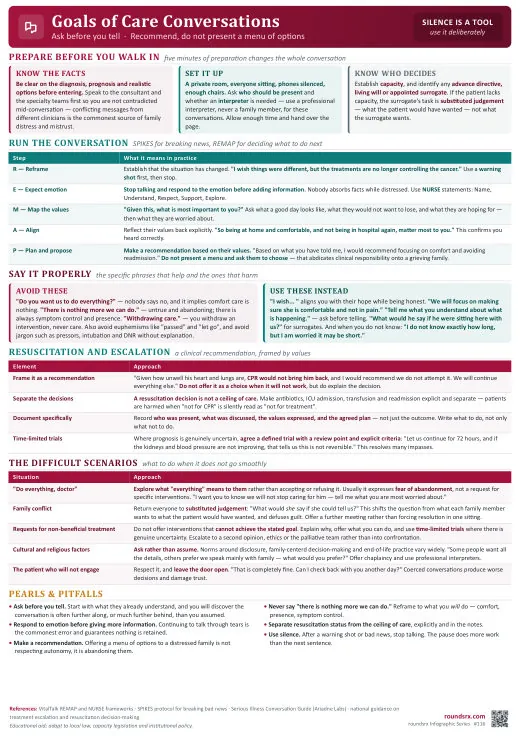
| Step | What to Say |
|---|---|
| R -Reframe | "I want to step back and talk about the big picture of what's going on." |
| E -Expect emotion | Pause. Acknowledge. "I can see this is hard to hear." NURSE: Name, Understand, Respect, Support, Explore. |
| M -Map values | "What matters most to you?" "What does a good day look like?" "Are there things worse than death to you?" |
| A -Align | "Based on what you've told me -that being independent and not suffering are most important -I'd recommend..." |
| P -Plan | Concrete next steps. Document. Communicate with team. Revisit as things change. |
- Avoid: "Do you want us to do everything?" (misleading -implies no CPR = giving up)
- Better: "If your heart were to stop, CPR involves chest compressions that often break ribs, a breathing tube, and electric shocks. In someone with your condition, the chance of surviving to leave the hospital is about ___%. Given what you've told me about what matters most to you, I would recommend..."
- Make a recommendation. Patients want guidance, not just options.
| Symptom | First-Line | Notes |
|---|---|---|
| Pain | Morphine (MS Contin) 2–5 mg IV/SC q2–4h PRN or oxycodone 5–10 mg PO q4h. Scheduled + PRN for constant pain. | Titrate to comfort. No ceiling for opioids in end-of-life care. Add adjuncts: acetaminophen (scheduled), gabapentin (neuropathic), dexamethasone (bone mets, inflammation). |
| Dyspnea | Morphine (MS Contin) 2–4 mg IV/SC q2–4h PRN. Fan to face. Oxygen if hypoxic. | Opioids are the most effective treatment for dyspnea in palliative care. They reduce the sensation of breathlessness centrally. Low doses are safe and don't hasten death Opioids for Dyspnea Trial, 2003. Anxiolytics (lorazepam 0.5–1 mg) if anxiety-driven. |
| Nausea / vomiting | Ondansetron (Zofran) 4–8 mg IV q6h or haloperidol 0.5–1 mg IV q6h (good for opioid-induced or chemical causes) | Match anti-emetic to mechanism: chemoreceptor trigger zone → haloperidol/ondansetron. GI dysmotility → metoclopramide. Raised ICP → dexamethasone. Vestibular → meclizine. |
| Terminal secretions ("death rattle") | Glycopyrrolate 0.2–0.4 mg IV/SC q4h or atropine drops 1% SL q4h | Anticholinergics reduce new secretion production. Suctioning is uncomfortable and often futile. Reposition to lateral. Reassure family -the sound is often more distressing to family than to the patient. |
| Terminal agitation / delirium | Haloperidol (Haldol) 1–2 mg IV/SC q4h. Add lorazepam 1–2 mg if refractory. | Rule out reversible causes first (urinary retention, constipation, pain, medication). If actively dying and refractory → palliative sedation with midazolam or phenobarbital infusion (requires palliative care consult + family discussion). |
Palliative care improves quality of life through symptom management, GOC discussions, and psychosocial support. Appropriate at any illness stage -concurrent with curative treatment. Palliative care ≠ hospice.
- ESAS symptom scores (0-10)
- Functional status -PPS, ECOG
- Prognostication -surprise question, PPI
- Advance directives review
- Psychosocial/spiritual screening
- Pain: WHO ladder + adjuvants (gabapentin, duloxetine, dexamethasone)
- Dyspnea: Morphine 2-5mg SL + fan at face + O₂ if hypoxic
- Nausea: Ondansetron, haloperidol, metoclopramide
- Delirium: Haloperidol 0.5-2mg. Treat reversible causes.
- GOC: REMAP framework
| Drug | Dose | Route | Notes |
|---|---|---|---|
| Morphine | 2-5mg PO/SL q2-4h | PO/SL | Pain + dyspnea |
| Gabapentin | 100-900mg TID | PO | Neuropathic pain |
| Dexamethasone | 4-8mg daily | PO/IV | Bone mets, edema, obstruction |
| Haloperidol | 0.5-2mg q4-6h | PO/IV | Nausea + delirium |
| Glycopyrrolate | 0.2mg SL q4h | SL | Secretions |
| Lorazepam | 0.5-1mg SL q4h | SL | Anxiety, agitation |
Patient: 78M with metastatic pancreatic cancer, ECOG 4, declining PO intake × 2 weeks. Family ambivalent about hospice. Current: morphine PCA, ondansetron, IV fluids.
Key findings: PPS 20%. Recurrent SBO from peritoneal carcinomatosis. No further oncologic options. Patient previously expressed "no machines" but no formal advance directive.
Management:
- Goals of care conversation using REMAP framework with patient and family
- Transition PCA to SQ morphine infusion 2 mg/hr for comfort
- D/C IV fluids (contributes to secretions and edema at end of life)
- Add glycopyrrolate 0.2 mg SQ q4h PRN for secretions
- Hospice referral, inpatient hospice given symptom burden
Teaching point: IV fluids at end of life often worsen symptoms (secretions, edema, dyspnea). Discontinuing is not "giving up", it is symptom management.
Patient: 62F with metastatic breast cancer to bone. Pain 9/10 despite oxycodone 40 mg q4h. Somnolent but still reporting severe pain. Cr 2.4 (new).
Key findings: Opioid neurotoxicity (myoclonus, somnolence with persistent pain). Renal failure accumulating active metabolites. Current opioid dose equivalent: 360 MME/day.
Management:
- Opioid rotation to hydromorphone (no active renal metabolites), reduce by 25-50% for cross-tolerance
- Dexamethasone 4 mg IV q6h for bone pain and peritumoral edema
- Radiation oncology consult for palliative XRT to painful metastases
- Add gabapentin 100 mg TID (renal dose) for neuropathic component
- IV hydration to address prerenal AKI
Teaching point: Opioid rotation is indicated when dose escalation causes toxicity without adequate analgesia. Hydromorphone and fentanyl are preferred in renal failure.
Patient: 85M with end-stage IPF, on 15L high-flow, SpO₂ 78%. DNR/DNI. Progressive dyspnea with visible distress. Family at bedside.
Key findings: Terminal respiratory failure. No reversible cause. Patient previously documented desire for comfort-focused care. PPS 10%.
Management:
- Morphine 2 mg IV q15min PRN for dyspnea (titrate to comfort, not respiratory rate)
- Fan directed at face, stimulates trigeminal V2 branch, reduces air hunger
- Lorazepam 0.5 mg SL q4h PRN for anxiety component
- Continue supplemental O₂ for comfort (not to target SpO₂)
- Proactive family communication: normalize Cheyne-Stokes breathing, explain death rattle
Teaching point: Morphine for dyspnea does not hasten death at appropriate doses. The principle of double effect permits symptom management even if it theoretically shortens life.
Text version
- Jumping to code status without mapping values first
- Withholding morphine for dyspnea (effective and safe at appropriate doses)
- Not considering palliative care consult until patient is dying
- O₂ for non-hypoxic dyspnea (fan at face is equally effective Fan for Dyspnea Trial, 2010)