Palliative Extubation
Palliative extubation (compassionate extubation, terminal wean) is the planned withdrawal of mechanical ventilation when the goals of care have shifted to comfort-focused measures. This is NOT euthanasia and is NOT physician-assisted death, it is the removal of a life-sustaining treatment that is no longer consistent with the patient's wishes or best interests. It is ethically and legally supported by every major medical society.
Death may occur minutes to days after extubation. Families need to understand this range. Some patients (especially those with intact respiratory drive on minimal settings) may survive for days or even be discharged to hospice.
- Patient/surrogate decision to transition to comfort care
- Terminal illness with no further curative options
- Goals of care no longer consistent with mechanical ventilation
- Advance directive specifying no prolonged mechanical ventilation
- There is no ethical or legal distinction between withholding and withdrawing treatment
- The intent is to relieve suffering, not to hasten death (principle of double effect)
- Patient autonomy: competent patients (or surrogates) have the right to refuse any medical treatment
- Family meeting: Ensure ALL key decision-makers are present (or via phone). Set clear expectations about the process and timeline. Death may occur in minutes or days.
- Discontinue monitors and alarms. The family should NOT hear alarms going off. Turn off telemetry, SpO2 monitor, ventilator alarms. Remove unnecessary lines (arterial line, etc.).
- Ensure comfort medications are at the bedside BEFORE extubation. Do not start the process until you have drawn up morphine, glycopyrrolate, and midazolam.
- Suction the oropharynx gently before extubation to minimize secretions.
- Wean ventilator settings: Reduce FiO2 to 21% and PEEP to 0 (or 5). This allows a more gradual transition rather than abrupt cessation.
- Pre-medicate: Give morphine 2-4 mg IV 10-15 minutes before extubation to prevent air hunger.
- Notify chaplain, social work if family desires.
- Remove restraints (patient should be free)
- Disconnect monitors (turn off all alarms)
- Suction oropharynx
- Reduce vent support gradually OR extubate directly (either approach is acceptable)
- Extubate: deflate cuff, remove ETT
- Apply oxygen via nasal cannula at 2-4 L (for COMFORT, not saturation monitoring)
- Assess comfort immediately, give morphine if any signs of distress
- Stay with the family (or have nursing present continuously)
- Pronounce when appropriate (no specific time requirement)
There is no diagnostic "workup" per se, but a structured checklist is essential:
- Goals of care documented?, Written consent from surrogate or documented patient wishes (advance directive).
- Ethics consult needed?, If there is disagreement among family members or between team and family.
- Legal requirements met?, State-specific requirements for withdrawal of life-sustaining treatment. Two-physician concurrence in some jurisdictions.
- DNR/DNAR order written?, Essential before extubation. Prevents Code Blue being called.
- Unnecessary interventions discontinued?, Vasopressors, antibiotics, labs, blood draws, nutrition, scheduled medications not contributing to comfort.
- Comfort medications ordered and at bedside?, Morphine, glycopyrrolate, lorazepam, haloperidol, scopolamine patch.
- Family ready and present?, Ask if they want clergy, specific family members, or rituals before proceeding.
- Organ donation discussed?, OPO should be notified per hospital protocol (may have been already).
| Drug | Indication | Dose | Notes |
|---|---|---|---|
| Morphine | Dyspnea, pain | 2-5 mg IV q15min PRN | First-line for air hunger and pain. Titrate to comfort. No ceiling dose for comfort care. Start infusion at 2-5 mg/h if frequent boluses needed. Hydromorphone (Dilaudid) 0.5-1 mg IV is an alternative. |
| Glycopyrrolate (Robinul) | Secretions ("death rattle") | 0.2 mg IV q4h PRN | Anticholinergic, reduces new secretion production. Does NOT clear existing secretions (suction for that). Start early, prevention is easier than treatment. |
| Lorazepam (Ativan) | Agitation, air hunger, anxiety | 1-2 mg IV PRN q2-4h | Adjunct for anxiety and terminal restlessness. Can also help with air hunger refractory to opioids. |
| Haloperidol (Haldol) | Terminal delirium | 0.5-1 mg IV q4-6h PRN | For terminal agitation/delirium not controlled by benzodiazepines. Avoid in QTc prolongation. |
| Scopolamine patch | Secretions (long-acting) | 1-3 patches behind ear q72h | Takes 6-12h to take effect. Apply early if death rattle anticipated. Alternative to glycopyrrolate for sustained effect. |
Mrs. Williams is an 82-year-old woman with metastatic pancreatic cancer, intubated 5 days ago for respiratory failure from bilateral pleural effusions and pneumonia. Despite maximum medical therapy, she has not improved. Family meeting held yesterday with oncology, ICU, and palliative care present. Family reports her advance directive states she would not want prolonged mechanical ventilation. Surrogate (daughter) has elected to transition to comfort-focused care. Plan: discontinue vasopressors, antibiotics, and monitoring. Pre-medicate with morphine 4 mg IV. Extubate at family's readiness. Comfort medications at bedside: morphine drip, glycopyrrolate, lorazepam, haloperidol. Chaplain notified. DNR order in place.
- Comfort assessment, the ONLY vital sign that matters now. Observe for grimacing, accessory muscle use, restlessness, tachypnea as signs of distress.
- Do NOT monitor: SpO2, blood pressure, heart rate on monitors. These are turned off to avoid distressing the family with alarms and numbers.
- Secretion assessment: Listen for "death rattle" (gurgling with respirations). Treat with glycopyrrolate or scopolamine. Reassure family this is not choking or suffering.
- Medication effectiveness: After each dose, reassess in 10-15 minutes. If still distressed, redose or titrate up.
- Bedside nursing, continuous or very frequent (q15-30 min) presence. The patient and family should never be alone during this process.
- Time of death: Pronounce when breathing has ceased and no pulse is palpable. There is no specific observation period required (institutional policies vary, typically 2-5 minutes of apnea).
| Parameter | Focus | Intervention |
|---|---|---|
| Respiratory distress | Tachypnea, accessory muscle use, nasal flaring, air hunger expression | Opioid bolus (morphine 2–5 mg IV or hydromorphone 0.2–0.5 mg IV); titrate infusion upward. Oxygen for comfort only (not SpO₂ targets). |
| Secretions / death rattle | Noisy/gurgling breathing from pooled oropharyngeal secretions | Glycopyrrolate 0.2 mg IV/SC q4h PRN, scopolamine patch, or atropine 1% ophthalmic drops 2–4 sublingual q4h. Reposition. Avoid deep suctioning (traumatic). |
| Agitation / restlessness | Purposeless movement, pulling at lines, facial grimacing | Midazolam 1–2 mg IV q1h PRN or lorazepam 0.5–2 mg IV. Escalate to continuous infusion if persistent. Rule out pain, full bladder, positioning. |
| Pain | Grimacing, tachycardia, hypertension (unreliable late), vocalization | Pre-emptive opioid before any repositioning/procedure. Continuous infusion rather than relying on PRN. |
| Family presence | Anyone at bedside; questions; cultural/spiritual needs | Chaplain, social work, bereavement services. Allow family to participate (hand-holding, music). Answer questions honestly. |
| Time of death | Apnea + absent pulse | Pronounce after 2–5 min of apnea (per institutional policy). Document time. Address family immediately, don't leave. |
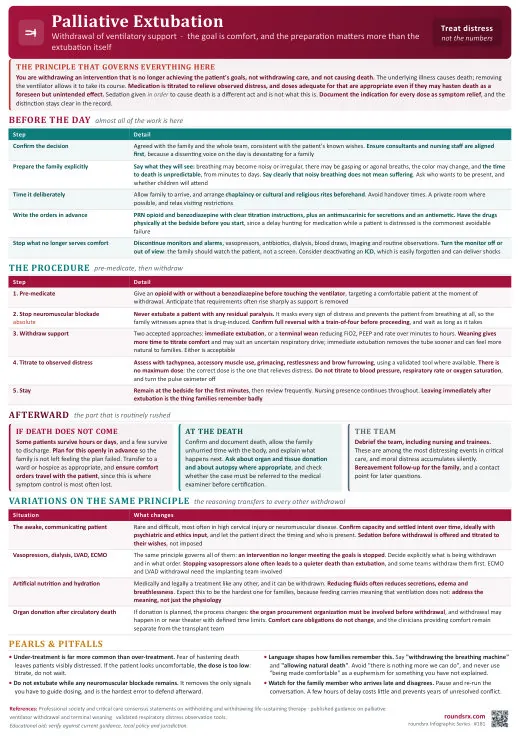
Text version
- Indications: patient or surrogate decision to transition to comfort care; terminal illness with no further curative options; goals of care no longer consistent with mechanical ventilation; advance directive specifying no prolonged ventilation.
- No ethical or legal distinction between withholding and withdrawing a treatment. Withdrawing feels harder emotionally, but the framework is identical, so discomfort is not a reason to continue.
- Principle of double effect: the intent is to relieve suffering; respiratory depression is a foreseeable but unintended side effect, not the means to the goal.
- Autonomy: a competent patient or their surrogate may refuse any medical treatment, which is what makes this ethically and legally supported by every major society.
- Tell the family the timeline honestly: death may occur minutes to days after extubation. Patients with intact respiratory drive on minimal settings may live for days or even discharge to hospice, and a family expecting minutes will read that as something going wrong.
- Goals of care documented? Written surrogate consent or a documented advance directive.
- DNR/DNAR written? Essential before extubation, otherwise a Code Blue gets called on a planned death.
- Comfort medications ordered and physically at the bedside? Morphine, glycopyrrolate, lorazepam, haloperidol, scopolamine patch. Do not start until they are drawn up, because a delay to pharmacy is a patient in air hunger.
- Unnecessary interventions stopped? Vasopressors, antibiotics, labs, blood draws, nutrition, and any scheduled medication not contributing to comfort.
- Legal requirements met? State-specific rules for withdrawal; two-physician concurrence in some jurisdictions.
- Ethics consult needed? Only if there is disagreement within the family or between team and family.
- Family ready and present? Ask about clergy, specific family members, or rituals before proceeding.
- Organ donation addressed? Notify the OPO per hospital protocol if not already done.
- Comfort is the only vital sign now: watch the face and the breathing pattern for grimacing, accessory muscle use, nasal flaring, restlessness, and tachypnea.
- Reassess 10–15 minutes after every dose; if still distressed, redose or titrate up.
- Secretions: listen for gurgling, treat with glycopyrrolate or scopolamine, reposition, and avoid deep suctioning because it is traumatic. Reassure the family this is not choking or suffering.
- Pain: dose pre-emptively before repositioning or any procedure, and prefer a continuous infusion over PRN chasing.
- Do NOT display SpO₂, BP, or HR. They are not outcome measures here and the numbers pull family and staff attention away from the patient.
- Bedside presence continuous or q15–30 min; the patient and family should never be alone.
- Time of death: pronounce after apnea with no palpable pulse, typically 2–5 minutes of apnea per institutional policy. Document the time and stay with the family, do not leave immediately.
- Titrating to respiratory rate or to death instead of to comfort. If the patient looks distressed, give more; that is treating dyspnea, not hastening death.
- Under-dosing out of fear of the double effect. The intent is comfort, and that intent is what makes the foreseeable respiratory depression ethically acceptable.
- Starting before the drugs are at the bedside.
- Leaving alarms and monitors on, which turns the family's last hour into a display of numbers.
- Extubating without a DNR order in place.
- Deep suctioning for the death rattle: traumatic and ineffective against secretions the anticholinergic cannot reach.
- Promising a time course. Minutes to days is the honest answer, and some patients survive to hospice discharge.
- Palliative care co-managing, for symptom titration and family support.
- Chaplain and social work before the extubation if the family desires; offer rather than wait to be asked, since afterward is too late for a ritual they wanted.
- Ethics when family members disagree with each other or with the team.
- Bedside nursing committed to continuous presence for the duration.
- The OPO per hospital protocol before withdrawal, because donation options close once the process starts.
- Bereavement services for the family afterward, and allow participation during (hand-holding, music).
- To the family: "We are removing a treatment that is no longer helping, not causing her death. The illness is doing that."
- To yourself and the team: AMA, AACN, and SCCM all hold there is no ethical or legal distinction between withholding and withdrawing treatment.
- The four conditions of double effect: the act is not inherently wrong, the intent is the good effect, the bad effect is not the means to the good effect, and there is proportionate reason.
- Worked example: post-extubation the patient is tachypneic to 28 with accessory muscle use, the family asks "Is he suffering?" Morphine 4 mg IV, and within 5 minutes the rate is 18 with the accessory use resolved. That is symptom management, you treated the dyspnea, not the number.