Pancytopenia
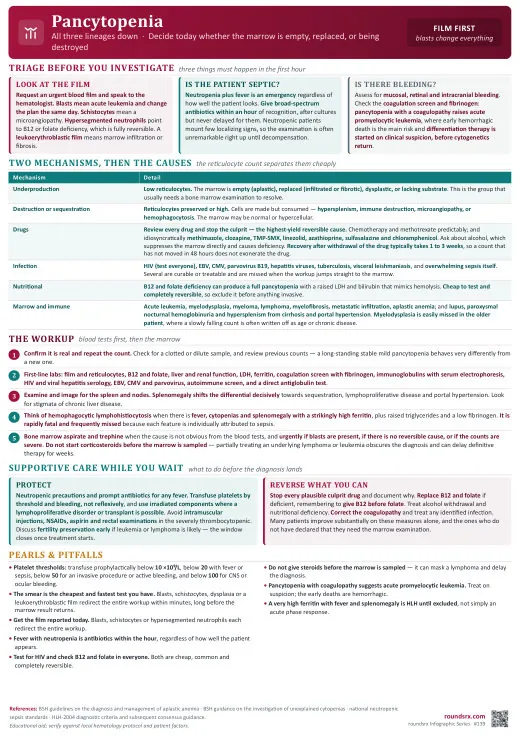
Pancytopenia = anemia + leukopenia + thrombocytopenia. Not a diagnosis but a lab finding requiring systematic workup. Framework: decreased production (marrow failure: aplastic anemia, MDS, leukemia, myelofibrosis, infiltration by solid tumor, infection, medication) vs increased destruction/sequestration (hypersplenism, autoimmune, HLH, DIC). The peripheral smear is the single most important initial test -it guides the entire workup.
- Peripheral smear -the MOST important test. Blasts → leukemia. Teardrop cells + leukoerythroblastic picture → myelofibrosis/marrow infiltration. Dysplastic cells → MDS. Schistocytes → TTP/DIC. Megaloblastic → B12/folate deficiency. Normal morphology → aplastic anemia, drug-induced, viral.
- Reticulocyte count -low = production problem. High (unexpected in pancytopenia) = peripheral destruction + splenic sequestration.
- B12 + folate -megaloblastic anemia can cause pancytopenia (ineffective hematopoiesis)
- LDH, haptoglobin, indirect bilirubin -hemolysis markers
- HIV, HBV, HCV, EBV, CMV, parvovirus B19 -viral marrow suppression
- ANA, RF -autoimmune causes (Felty syndrome = RA + splenomegaly + neutropenia)
- Copper level -copper deficiency mimics MDS (sideroblastic anemia + neutropenia)
- Flow cytometry -if blasts or abnormal lymphocytes on smear
- Bone marrow biopsy + aspirate -definitive test. Hypercellular = MDS, leukemia, megaloblastic. Hypocellular = aplastic anemia. Dry tap = myelofibrosis. Granulomas = infection (TB, fungal). Send: morphology, cytogenetics, flow, iron stain, reticulin stain.
| Mechanism | Cause | Key Clue |
|---|---|---|
| Decreased Production | Aplastic anemia | Hypocellular marrow, young patient, reticulocyte count low |
| MDS | Elderly, dysplastic cells on smear, cytogenetic abnormalities | |
| Leukemia | Blasts on peripheral smear or bone marrow > 20% | |
| B12/folate deficiency | Megaloblastic changes, hypersegmented neutrophils, elevated MCV | |
| HIV | Risk factors, low CD4, direct marrow suppression | |
| Medications | Methotrexate, chemotherapy, TMP-SMX, linezolid, valproate | |
| Increased Destruction | Hypersplenism | Splenomegaly on exam/imaging, liver disease history |
| HLH | Ferritin > 10,000, fever, splenomegaly, hypertriglyceridemia | |
| TTP/HUS | Schistocytes, elevated LDH, low haptoglobin, renal failure | |
| DIC | Schistocytes, elevated D-dimer, low fibrinogen, prolonged PT/aPTT | |
| Infiltration | Myelofibrosis | Teardrop cells, dry tap, splenomegaly, leukoerythroblastic picture |
| Metastatic cancer | Known primary, leukoerythroblastic smear, bone pain | |
| Storage diseases | Gaucher (glucocerebrosidase deficiency), hepatosplenomegaly |
| Finding | Suggests |
|---|---|
| Blasts | Acute leukemia (AML or ALL), obtain flow cytometry urgently |
| Teardrop cells | Myelofibrosis, expect dry tap on aspiration, order reticulin stain on biopsy |
| Megaloblastic changes | B12 or folate deficiency, check levels, MMA, homocysteine |
| Schistocytes | TTP/HUS or DIC, check ADAMTS13, fibrinogen, D-dimer, coags |
| Hypersegmented neutrophils | B12 or folate deficiency, ≥ 5 lobes is pathologic |
| Rouleaux formation | Multiple myeloma, check SPEP, serum free light chains |
- Unexplained pancytopenia after initial labs (smear, B12, folate, HIV unrevealing)
- Suspected leukemia or MDS based on clinical picture or smear
- Blasts seen on peripheral smear
- Leukoerythroblastic picture (nucleated RBCs + immature WBCs in periphery)
- Suspected infiltrative process (myelofibrosis, metastatic disease, storage disease)
- Treat the underlying cause:
- B12 deficiency: IM cyanocobalamin 1000 mcg daily × 7 → weekly × 4 → monthly. Pancytopenia resolves within weeks.
- Drug-induced: Stop offending agent (methotrexate, chemotherapy, TMP-SMX, linezolid, valproate). Recovery in 1-3 weeks typically.
- Aplastic anemia: Age < 40 + matched sibling donor → allogeneic stem cell transplant. Older patients → immunosuppressive therapy: horse ATG + cyclosporine + eltrombopag. RACE, 2022
- MDS: Risk stratify (IPSS-R). Low-risk → ESA, lenalidomide (del5q). High-risk → azacitidine [AZA-001] or transplant if eligible.
- Leukemia: Induction chemotherapy per subtype. APL = ATRA + arsenic trioxide (curative in > 90%).
- HLH: Etoposide-based protocol (HLH-2004). Dexamethasone. Cyclosporine. Treat trigger.
- Supportive care: pRBC for Hgb < 7 (or < 8 symptomatic). Platelets if < 10K or bleeding. Neutropenic precautions if ANC < 500. G-CSF if severe neutropenia with infection.
| Drug | Dose | Route | Notes |
|---|---|---|---|
| Cyanocobalamin | 1000 mcg IM daily × 7d | IM | B12 deficiency. Expect retic crisis at day 5-7. Monitor K⁺ (drops with new cell production). |
| Horse ATG (ATGAM) | 40 mg/kg/day × 4 days | IV | Aplastic anemia immunosuppression. Give with steroids (serum sickness prophylaxis). Scheinberg, 2011 |
| Cyclosporine | 5-6 mg/kg/day divided BID | PO | With ATG for aplastic anemia. Target trough 200-400. Nephrotoxicity, HTN, tremor. |
| Eltrombopag | 150 mg daily | PO | Added to ATG+CsA in aplastic anemia improves response. RACE, 2022 |
| Azacitidine | 75 mg/m² SQ × 7 days q28d | SQ | High-risk MDS. Delays AML transformation. AZA-001, 2009 |
| Lenalidomide | 10 mg daily × 21/28 days | PO | MDS with del(5q). 67% transfusion independence. VTE prophylaxis required. |
| Filgrastim (G-CSF) | 5 mcg/kg SQ daily | SQ | Severe neutropenia with infection. Not for chronic use in MDS (may accelerate AML). |
Patient: 25F presenting with fatigue, easy bruising, and recurrent infections over 3 months.
Labs: WBC 1.2, Hgb 6.8, Plt 15K, reticulocyte count 0.2% (inappropriately low), MCV 98.
Peripheral smear: Pancytopenia with normal morphology, no blasts, no dysplasia, no schistocytes.
Workup:
- B12, folate, HIV, hepatitis panel, all normal
- LDH and haptoglobin, normal (no hemolysis)
- Flow cytometry, no PNH clone
- Bone marrow biopsy: markedly hypocellular (< 10% cellularity), fat-predominant, no blasts, no fibrosis
Diagnosis: Severe aplastic anemia (SAA), meets criteria: ANC < 500, Plt < 20K, retic < 1% with hypocellular marrow.
Treatment: No matched sibling donor → started on horse ATG + cyclosporine + eltrombopag. Supportive care with irradiated, leukoreduced blood products. Neutropenic precautions.
Patient: 68M presenting with progressive fatigue, paresthesias in both feet, and unsteady gait over 6 months.
Labs: WBC 3.1, Hgb 7.2, Plt 95K, MCV 112 (markedly elevated), reticulocyte count 0.8%.
Peripheral smear: Oval macrocytes, hypersegmented neutrophils (6-lobed), anisocytosis, poikilocytosis.
Workup:
- B12: < 100 pg/mL (severely low, normal > 300)
- Methylmalonic acid: elevated (confirms tissue B12 deficiency). With nitrous oxide abuse the serum B12 is typically normal, so MMA and homocysteine are the tests that make the diagnosis (detail)
- Homocysteine: elevated
- Anti-intrinsic factor antibodies: positive → pernicious anemia
Diagnosis: Megaloblastic pancytopenia from B12 deficiency (pernicious anemia). No bone marrow biopsy needed, smear + B12 level diagnostic.
Treatment: IM cyanocobalamin 1000 mcg daily × 7 days → weekly × 4 → monthly for life. Reticulocyte crisis at day 5. Monitor K⁺ closely. Neuro symptoms may take months to improve.
Patient: 72F presenting with early satiety, weight loss, night sweats, and progressive fatigue over 4 months.
Exam: Massive splenomegaly (palpable 8 cm below costal margin).
Labs: WBC 2.4, Hgb 8.5, Plt 68K, LDH elevated.
Peripheral smear: Teardrop cells (dacrocytes), nucleated RBCs, immature myeloid precursors, classic leukoerythroblastic picture.
Workup:
- Bone marrow aspiration: dry tap, unable to aspirate despite multiple attempts
- Core biopsy: extensive reticulin and collagen fibrosis, megakaryocyte atypia, osteosclerosis
- JAK2 V617F mutation: positive
- DIPSS-Plus risk score: intermediate-2
Diagnosis: Primary myelofibrosis (PMF). Dry tap + teardrop cells + leukoerythroblastic smear is the classic triad.
Treatment: Started ruxolitinib (JAK2 inhibitor) for symptom control and splenomegaly. Evaluated for allogeneic transplant given intermediate-2 risk.
Mrs. Chen is a 72-year-old woman referred for pancytopenia found on routine labs: Hgb 8.1, WBC 2.8 (ANC 900), platelets 78K. No B symptoms. No bleeding. No infections. Medications: metformin, lisinopril. Peripheral smear: macrocytosis, hypersegmented neutrophils, oval macrocytes. B12 level: 89 pg/mL (low). MMA elevated. Folate normal. Retic count 0.5%.