Parkinson Disease
Parkinson disease (PD) is the second most common neurodegenerative disease after Alzheimer disease. Progressive loss of dopaminergic neurons in the substantia nigra pars compacta with alpha-synuclein aggregates (Lewy bodies). Motor symptoms appear only after roughly 60-80% of nigral dopaminergic neurons are lost, which is why the disease is already well established at diagnosis and why symptomatic therapy works: you are replacing a neurotransmitter the surviving circuit can still use.
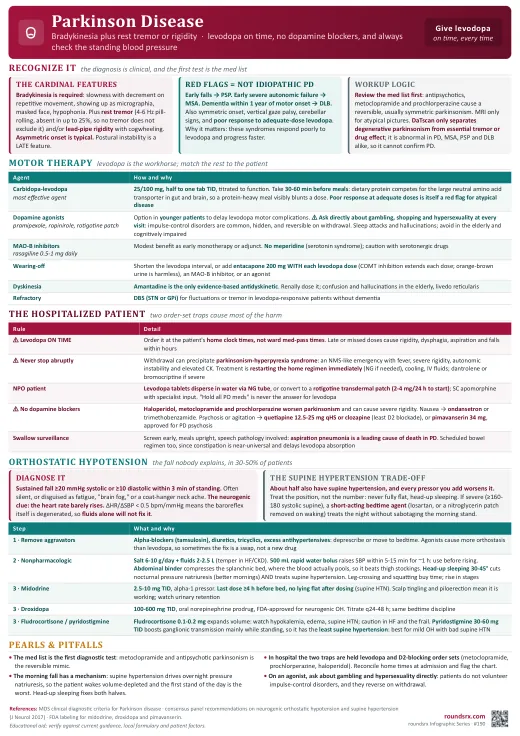
- Bradykinesia -required for the diagnosis. Slowness with decrement in amplitude on repetitive movement (finger taps get smaller and slower). Smallness shows up as micrographia, hypomimia (masked face), hypophonia.
- Rest tremor -4-6 Hz, classically pill-rolling, suppresses with action and re-emerges with distraction. Absent in up to 20-25%, so no tremor does not exclude PD.
- Rigidity -lead-pipe resistance through the range, cogwheeling when tremor is superimposed. Asymmetric onset is typical of idiopathic PD.
- Postural instability -a LATE feature. Early falls should make you question the diagnosis and think PSP.
- Prodromal: constipation, anosmia, REM sleep behavior disorder (acting out dreams), depression. These reflect synuclein pathology starting outside the nigra (gut, olfactory bulb, brainstem).
- Autonomic: orthostatic hypotension (30-50% of patients, dedicated tab), urinary urgency, erectile dysfunction, drenching sweats.
- Neuropsychiatric: depression and anxiety are common and treatable; psychosis is usually medication-related; dementia develops in a majority with long disease duration (if dementia starts within 1 year of motor symptoms, think dementia with Lewy bodies instead).
- The diagnosis is clinical (MDS criteria: bradykinesia plus tremor or rigidity, with supportive features and no red flags). No lab or scan is required in a classic presentation.
- Medication review FIRST -drug-induced parkinsonism from antipsychotics, metoclopramide (Reglan), or prochlorperazine (Compazine) is the reversible mimic you cannot afford to miss. It is typically symmetric and resolves over weeks to months after stopping the offender.
- MRI brain -not to diagnose PD (usually normal) but to exclude structural mimics when the picture is atypical: vascular parkinsonism (lower-body predominant, stepwise), normal pressure hydrocephalus (gait apraxia + incontinence + cognitive change), midbrain atrophy of PSP.
- DaTscan (ioflupane SPECT) -shows presynaptic dopaminergic degeneration. Useful ONLY when the question is "essential tremor or drug-induced parkinsonism vs a degenerative syndrome," because it is abnormal in PD, MSA, PSP, and DLB alike and therefore cannot distinguish among them. Do not order it to "confirm PD" in a classic case.
- Levodopa response -a robust, sustained response supports idiopathic PD; a poor response at adequate doses (up to ~1,000 mg/day levodopa) is itself a red flag for an atypical syndrome.
- Orthostatic vitals at diagnosis and at least annually -neurogenic orthostatic hypotension is common, frequently asymptomatic until it causes a fall, and aggravated by every dopaminergic drug you will prescribe. Measure supine then after 1 and 3 minutes standing.
- Carbidopa-levodopa (Sinemet) is the most effective symptomatic therapy and first-line for most patients whose symptoms affect function. Typical start: 25/100 mg, half to one tablet TID, titrated to effect. Take 30-60 min before meals -dietary protein competes with levodopa for the intestinal and blood-brain large neutral amino acid transporter, so a protein-heavy meal can visibly blunt a dose.
- Why carbidopa: it blocks peripheral dopa-decarboxylase, so more levodopa reaches the brain and less becomes dopamine in the periphery (the source of nausea and orthostasis). Patients need roughly 75 mg/day of carbidopa for adequate peripheral blockade.
- Dopamine agonists (pramipexole (Mirapex), ropinirole (Requip), rotigotine (Neupro) patch) -an option in younger patients to delay levodopa motor complications. Avoid in the elderly and cognitively impaired: hallucinations, sedation and sudden sleep attacks, leg edema, and impulse control disorders (gambling, hypersexuality, compulsive shopping) -ask about these directly at every visit because patients rarely volunteer them.
- MAO-B inhibitors (rasagiline (Azilect), selegiline, safinamide (Xadago)) -modest symptomatic benefit as early monotherapy or adjunct. Avoid meperidine and use caution with serotonergic drugs (serotonin syndrome risk).
- Wearing-off between doses: shorten the dosing interval, or add entacapone (Comtan) 200 mg with each levodopa dose (COMT inhibition extends the levodopa half-life), an MAO-B inhibitor, or an agonist. Warn about harmless orange-brown urine with entacapone.
- Dyskinesia (involuntary choreiform movements at peak dose): amantadine is the only medication with consistent antidyskinetic evidence. Reduce the dose in renal impairment (renally cleared); watch for confusion and hallucinations in the elderly and livedo reticularis.
- Refractory fluctuations or tremor: refer for deep brain stimulation (STN or GPi) -best candidates are levodopa-responsive without dementia. Carbidopa-levodopa enteral gel (Duopa) is an alternative for severe fluctuations.
- Give levodopa ON TIME, on the patient's home schedule -not the ward's standard med-pass times. Late or missed doses cause rigidity, dysphagia, aspiration, falls, and panic; hospitalized PD patients have measurably worse outcomes when timing slips. Order it with explicit clock times.
- NEVER stop dopaminergic therapy abruptly -abrupt withdrawal can precipitate parkinsonism-hyperpyrexia syndrome, an NMS-like emergency (high fever, severe rigidity, autonomic instability, elevated CK, altered consciousness) with real mortality. Treat by restarting the home regimen immediately (NG if needed), cooling, IV fluids; dantrolene or bromocriptine in severe cases.
- NPO patient: levodopa via NG tube (tablets disperse in water), or convert to the rotigotine (Neupro) transdermal patch, or subcutaneous apomorphine with specialist input. "Hold all PO meds" is never the answer for levodopa.
- NO dopamine blockers: haloperidol, risperidone, olanzapine, metoclopramide, and prochlorperazine all worsen parkinsonism and can trigger severe rigidity. For nausea use ondansetron (Zofran) or trimethobenzamide. For psychosis or agitation use quetiapine (Seroquel) low-dose or clozapine (the two antipsychotics with the least D2 blockade), or pimavanserin (Nuplazid), which is approved specifically for PD psychosis.
- Dysphagia and aspiration: screen swallowing early, keep the patient upright for meals, involve speech pathology -aspiration pneumonia is a leading cause of death in PD.
- Delirium precautions, early mobility, and fall precautions -check orthostatic vitals before first ambulation, because admission (bed rest, new antihypertensives, volume shifts) reliably worsens orthostatic hypotension.
Definition: a sustained fall of ≥20 mmHg systolic or ≥10 mmHg diastolic within 3 minutes of standing. In PD it comes from degeneration of postganglionic sympathetic noradrenergic neurons (a baroreflex failure), aggravated by levodopa, dopamine agonists, and deconditioning. It affects 30-50% of patients, is often asymptomatic or presents atypically (fatigue, "brain fog," neck-and-shoulder "coat-hanger" ache), and is an independent predictor of falls, syncope, and cognitive impairment.
- Deprescribe or move the offenders: alpha-blockers (tamsulosin, doxazosin), diuretics, tricyclics, and excess antihypertensives. In a patient with nOH plus supine hypertension, move needed BP agents to bedtime rather than morning -the goal is to treat the position, not the clock-time number.
- Reassess the dopaminergic regimen: agonists cause more orthostasis than levodopa; sometimes the fix is trading agonist for levodopa rather than adding a pressor.
- Fluids 2-2.5 L/day and liberal salt 6-10 g/day -expands plasma volume, the substrate every other measure depends on. (Temper in HF or advanced CKD.)
- Rapid water bolus: 16 oz (~500 mL) of water drunk quickly raises SBP within 5-15 minutes for about an hour (osmopressor response) -useful before getting out of bed or before a long stand.
- Abdominal binder -compresses the splanchnic bed, where most of the orthostatic pooling actually happens, which is why a binder outperforms and out-complies thigh-high compression stockings. Put it on before standing, take it off when supine.
- Head-up sleeping: raise the head of the bed 30-45 degrees -reduces nocturnal pressure natriuresis (so the patient wakes less volume-depleted and morning OH improves) and simultaneously blunts supine hypertension. One intervention treats both halves of the problem.
- Physical counter-maneuvers -leg crossing, buttock clenching, squatting when presyncopal: skeletal muscle pumping buys the seconds needed to sit down safely.
- Stand in stages (supine to sitting to standing with a pause at each), and prefer small, frequent, lower-carbohydrate meals if symptoms cluster after eating (postprandial splanchnic pooling).
- Midodrine (ProAmatine) 2.5-10 mg TID -alpha-1 agonist, constricts both venous capacitance and arterial resistance vessels. Last dose at least 4 hours before bedtime and no lying flat within 4 hours of a dose -it causes supine hypertension. Expect piloerection and scalp tingling (evidence it is working); watch urinary retention in men.
- Droxidopa (Northera) 100-600 mg TID -oral norepinephrine prodrug, FDA-approved specifically for nOH. Same supine-hypertension caution: last dose 3-4 hours before bed, titrate every 24-48 h.
- Fludrocortisone 0.1-0.2 mg daily -mineralocorticoid volume expansion. Watch potassium (it wastes K), edema, and supine hypertension; use cautiously in HF and the frail elderly for exactly those reasons.
- Pyridostigmine (Mestinon) 30-60 mg TID -augments ganglionic transmission preferentially during standing (when sympathetic traffic is highest), so it improves standing BP with the LEAST supine hypertension. Modest effect; best for mild OH coexisting with bad supine hypertension.
- About half of nOH patients also have supine hypertension (≥140/90 lying flat), and every pressor you add makes it worse. Do not chase daytime numbers with standard antihypertensives -that recreates the falls problem you started with.
- Manage positionally first: never lie fully flat, head-up sleeping, avoid daytime naps lying down. If supine BP is severe (≥160-180 systolic) despite that, a short-acting evening agent (losartan or a nitroglycerin patch applied at bedtime and removed on waking) treats the night without sabotaging the morning stand.
- Monitoring: orthostatic vitals at 1 and 3 minutes at every visit, plus a home log of sitting and standing readings (morning and evening). Symptoms correlate poorly with numbers, so treat the patient, not just the drop.
| Drug | Role | Dose | Why / Watch For |
|---|---|---|---|
| Carbidopa-levodopa (Sinemet) FIRST-LINE | Motor symptoms | 25/100 mg, 0.5-1 tab TID, titrate to effect | Most effective agent. Take 30-60 min before meals (protein competes for transport). NEVER stop abruptly (parkinsonism-hyperpyrexia). Nausea, orthostasis, dyskinesia with time. |
| Rotigotine (Neupro) | Agonist; NPO conversion | Patch 2-4 mg/24h start | The transdermal escape route when a PD patient is NPO. Impulse control disorders, sleep attacks, hallucinations in elderly. |
| Pramipexole (Mirapex) | Agonist (younger patients) | 0.125 mg TID, slow titration | Delays levodopa complications; ask about gambling/compulsions at every visit. Renally cleared. |
| Rasagiline (Azilect) | MAO-B inhibitor | 0.5-1 mg daily | Mild benefit, once daily. No meperidine (serotonin syndrome); caution with SSRIs. |
| Entacapone (Comtan) | Wearing-off | 200 mg WITH each levodopa dose (max 8/day) | COMT inhibition extends each levodopa dose. Orange-brown urine is harmless; can amplify dyskinesia (reduce levodopa). |
| Amantadine | Dyskinesia | 100 mg BID-TID | Only evidence-based antidyskinetic. Renally dose; confusion/hallucinations in elderly; livedo reticularis. |
| Quetiapine (Seroquel) | PD psychosis | 12.5-25 mg qHS, titrate | Minimal D2 blockade, so it treats psychosis without freezing the patient. Clozapine has the best evidence but needs ANC monitoring. Pimavanserin (Nuplazid) 34 mg daily is the approved PD-psychosis agent. |
| Midodrine (ProAmatine) nOH | Orthostatic hypotension | 2.5-10 mg TID | Alpha-1 pressor. Last dose ≥4h before bed; no lying flat after dosing (supine HTN). Scalp tingling = it is working. |
| Droxidopa (Northera) nOH | Neurogenic OH (FDA-approved) | 100-600 mg TID, titrate q24-48h | Norepinephrine prodrug. Same supine-HTN discipline: last dose 3-4h before bed, head-up sleeping. |
| Fludrocortisone nOH | Volume expansion | 0.1-0.2 mg daily | Works via salt/water retention, so it needs the salt+fluid base to work. Hypokalemia, edema, supine HTN; caution in HF. |
Mr. Alvarez is a 74-year-old man with 8 years of Parkinson disease on carbidopa-levodopa 25/100 two tabs at 6 AM, 11 AM, 4 PM, and 9 PM plus rasagiline, admitted with aspiration pneumonia. Overnight he was made NPO and his 6 AM levodopa was held; by rounds he is rigid, tremulous, and unable to swallow his secretions. Supine BP 148/86, standing 96/60 at 3 minutes with HR rising only from 72 to 78. He fell at home twice this month, "mostly in the mornings."
- Levodopa timing -were all doses given within 30 min of home schedule? Reconcile daily; this is the highest-yield checkbox on the list.
- Med list scan -any dopamine blocker (metoclopramide, prochlorperazine, haloperidol) added overnight? Remove it and document why.
- Orthostatic vitals before ambulation -supine, 1 min, 3 min standing with HR. Falls in hospital usually happen on the way to the bathroom.
- Swallow status -any coughing with meals, wet voice, or worsening "off" time? Re-screen and involve SLP early; aspiration is the killer complication.
- Bowel regimen -constipation is near-universal, worsens levodopa absorption (delayed gastric emptying), and precipitates delirium. Scheduled, not PRN.
- Delirium check and sleep -reorient, minimize overnight vitals if stable, avoid anticholinergics and benzodiazepines (both worsen cognition and falls).
- Disposition planning -PT/OT early; a PD patient deconditioned by a week in bed loses ground that takes months to regain.