PBC / PSC
| Feature | PBC (Primary Biliary Cholangitis) | PSC (Primary Sclerosing Cholangitis) |
|---|---|---|
| Gender | 90% female | ~70% male |
| Age | Middle-aged (40-60) | Young adults (30-40) |
| Key Antibody | Anti-mitochondrial antibody (AMA) -95% sensitive | p-ANCA (nonspecific) |
| Imaging | Normal bile ducts on MRCP | Beading on MRCP (multifocal strictures + dilations) |
| Pathology | Destruction of small intrahepatic bile ducts | Inflammation and fibrosis of intra- and extrahepatic bile ducts |
| Symptoms | Pruritus, fatigue | Pruritus, jaundice, RUQ pain, cholangitis episodes |
| Associated Conditions | Sjogren, thyroiditis, celiac, RA | Ulcerative colitis (70%), cholangiocarcinoma |
| Cancer Risk | Hepatocellular carcinoma (if cirrhosis) | Cholangiocarcinoma (lifetime risk 10-15%), gallbladder cancer, colon cancer (if UC) |
| Treatment | Ursodiol (UDCA) works | NO proven medical therapy |
- First-line: Ursodiol (UDCA) 13-15 mg/kg/day (split BID). Improves LFTs, delays histologic progression, improves transplant-free survival. Poupon, NEJM 1991
- Incomplete response to UDCA: add a PPAR agonist: elafibranor (Iqirvo) 80 mg daily (dual PPAR-alpha/delta) or seladelpar (Livdelzi) 10 mg daily (PPAR-delta), each given with UDCA, or alone if UDCA is not tolerated. Add if ALP >1.67x ULN or bilirubin elevated after 12 months of UDCA. Bezafibrate or fenofibrate are off-label alternatives. CHANGED 2025 Obeticholic acid (Ocaliva) is no longer available in the US: it was withdrawn at FDA request over a risk of serious liver injury, including in patients without cirrhosis, and the approval was formally withdrawn in November 2025. Do not prescribe it. POISE, NEJM 2016
- Pruritus management: Cholestyramine (first-line for itch), rifampin, naltrexone, sertraline
- Liver transplant for decompensated cirrhosis. PBC can recur post-transplant but rarely clinically significant.
- NO proven medical therapy -this is the critical teaching point.
- Ursodiol is commonly prescribed but does NOT improve transplant-free survival in PSC. High-dose ursodiol (28-30 mg/kg) was actually HARMFUL -increased mortality, need for transplant, and serious adverse events. Lindor, Hepatology 2009
- ERCP with balloon dilation for dominant strictures causing cholangitis or progressive jaundice.
- Liver transplant -definitive treatment. PSC can recur post-transplant (~20%).
- Cancer screening: CA 19-9 + MRCP annually for cholangiocarcinoma. Colonoscopy annually if concomitant UC (elevated colon cancer risk).
- AMA (anti-mitochondrial antibody) -95% sensitive and highly specific for PBC. AMA-positive + cholestatic LFTs often sufficient for diagnosis without biopsy.
- LFTs -cholestatic pattern: elevated ALP, GGT. ALT/AST may be mildly elevated.
- IgM -typically elevated in PBC (vs. IgG in AIH)
- Liver biopsy -may not be needed if AMA+ with typical cholestatic LFTs. Shows granulomatous destruction of small bile ducts ("florid duct lesion").
- MRCP -diagnostic study of choice. Shows multifocal strictures and dilations of intra- and/or extrahepatic bile ducts ("beading" or "string of pearls").
- LFTs -cholestatic pattern (elevated ALP, GGT).
- p-ANCA -positive in ~80% but not specific.
- Colonoscopy -screen for UC even if asymptomatic (70% of PSC patients have UC).
- CA 19-9 -baseline and annually for cholangiocarcinoma screening.
- Liver biopsy -"onion skin" periductal fibrosis is classic but often not needed if MRCP is diagnostic.
| Drug | Indication | Dose | Notes |
|---|---|---|---|
| Ursodiol (UDCA) PBC 1ST LINE | PBC | 13-15 mg/kg/day PO | Improves LFTs and transplant-free survival in PBC. Split BID. Take with food. NOT effective for PSC. |
| Elafibranor (Iqirvo) / Seladelpar (Livdelzi) | PBC (UDCA-incomplete) | Elafibranor 80 mg daily; seladelpar 10 mg daily | PPAR agonists, given with UDCA or alone if UDCA is not tolerated. These replaced obeticholic acid, which was withdrawn from the US market in 2025 for hepatotoxicity. Seladelpar may also improve pruritus, which the older agent worsened. POISE, NEJM 2016 |
| Cholestyramine | Pruritus (PBC/PSC) | 4 g BID-QID | First-line for cholestatic pruritus. Separate from other medications by 2-4 hours (bile acid sequestrant binds drugs). |
| Rifampin | Pruritus (refractory) | 150-300 mg BID | Second-line for pruritus. Monitor LFTs (hepatotoxic). Effective in PBC/PSC-related itch. |
| Naltrexone | Pruritus (refractory) | 25-50 mg daily | Opioid antagonist for cholestatic pruritus. Can precipitate opioid withdrawal -start low dose. |
Patient: 52F with fatigue and pruritus × 1 year. ALP 380, GGT 290, ALT 62, bilirubin 1.8. AMA positive (titer 1:640). MRCP: normal bile ducts. Liver biopsy: florid duct lesion with granulomatous destruction of small bile ducts.
Key findings: Classic PBC: middle-aged woman + cholestatic labs + AMA positive + normal MRCP. Biopsy confirms but is not required if AMA > 1:40 + cholestatic pattern.
Management:
- Ursodiol (UDCA) 13-15 mg/kg/day in divided doses (first-line, slows disease progression)
- Assess response at 1 year: ALP < 1.67× ULN = adequate response (Paris criteria)
- If inadequate response: add a PPAR agonist, elafibranor 80 mg daily or seladelpar 10 mg daily. Obeticholic acid was withdrawn from the US market in 2025 for hepatotoxicity and should no longer be used
- Cholestyramine 4g BID-QID for pruritus (bile acid sequestrant). If refractory: rifampin, naltrexone
- Screen for osteoporosis (cholestasis impairs vitamin D absorption), hypothyroidism (autoimmune overlap)
Teaching point: PBC is diagnosed by AMA + cholestatic labs, biopsy is rarely needed. Ursodiol slows progression to cirrhosis and improves transplant-free survival. Response at 1 year predicts long-term outcome.
Patient: 34M with UC on mesalamine. Progressive jaundice, pruritus, RUQ pain. ALP 520, bilirubin 6.8, CA 19-9 42 (mildly elevated). MRCP: multifocal beading/strictures with dominant stricture at common hepatic duct.
Key findings: PSC with dominant stricture, must rule out cholangiocarcinoma (CCA). Lifetime CCA risk in PSC is 10-15%. Any new dominant stricture or rapidly rising bilirubin/CA 19-9 is concerning.
Management:
- ERCP with brush cytology + FISH analysis of dominant stricture (rule out CCA)
- If benign: balloon dilation of dominant stricture ± short-term stent placement
- No role for ursodiol in PSC (high-dose UDCA showed harm in trials)
- Annual CCA screening: CA 19-9 + MRCP
- Colonoscopy annually (PSC + UC = very high colon cancer risk, right-sided predominance)
Teaching point: PSC has no effective medical therapy, treatment is managing complications and screening for malignancy. Liver transplant is the only curative option, but PSC recurs in 20-25% of transplanted livers.
Patient: 45F with fatigue, ALP 320, ALT 280 (mixed pattern). AMA positive (1:320), ANA positive (1:160), IgG 2800 mg/dL (elevated). Biopsy: interface hepatitis with plasma cells AND bile duct destruction.
Key findings: PBC-AIH overlap syndrome (~10% of PBC patients). Features of both: cholestatic pattern (ALP elevated, AMA+) + hepatitic pattern (high ALT, high IgG, interface hepatitis on biopsy).
Management:
- Ursodiol 13-15 mg/kg/day (for the PBC component)
- Add prednisone 30 mg daily → taper + azathioprine 50 mg → titrate to 1-2 mg/kg (for the AIH component)
- Monitor ALT and ALP separately, both should improve with dual therapy
- Check TPMT before starting azathioprine (risk of myelosuppression if deficient)
- Long-term: aim for biochemical remission (normal ALT + ALP < 1.5× ULN)
Teaching point: Overlap syndrome is suspected when a PBC patient has disproportionately elevated transaminases (ALT > 5× ULN) or elevated IgG. Biopsy is essential, interface hepatitis confirms the AIH component and justifies adding immunosuppression.
Mr. Olsen is a 32-year-old man with ulcerative colitis on mesalamine, presenting with progressive jaundice, pruritus, and fatigue over 3 months. Labs: ALP 480, GGT 320, ALT 85, bilirubin 4.2. p-ANCA positive. MRCP shows multifocal intrahepatic and extrahepatic bile duct strictures with beading pattern. Dominant stricture at the common hepatic duct with upstream dilation.
- LFTs -q3-6 months. Track ALP response to UDCA. Incomplete response: ALP >1.67x ULN after 12 months.
- Bilirubin -rising bilirubin is the strongest predictor of poor prognosis in PBC.
- Thyroid function -screen for hypothyroidism (frequently associated).
- DEXA -osteoporosis risk is elevated in cholestatic liver disease.
- Fat-soluble vitamins -A, D, E, K. Malabsorption from cholestasis.
- CA 19-9 + MRCP -annually for cholangiocarcinoma screening.
- Colonoscopy -annually if concomitant UC (elevated colon cancer risk). Even after liver transplant.
- LFTs -q3-6 months. New cholangitis episodes may indicate dominant stricture.
- Gallbladder ultrasound -annually. Increased gallbladder cancer risk. Low threshold for cholecystectomy if polyps found.
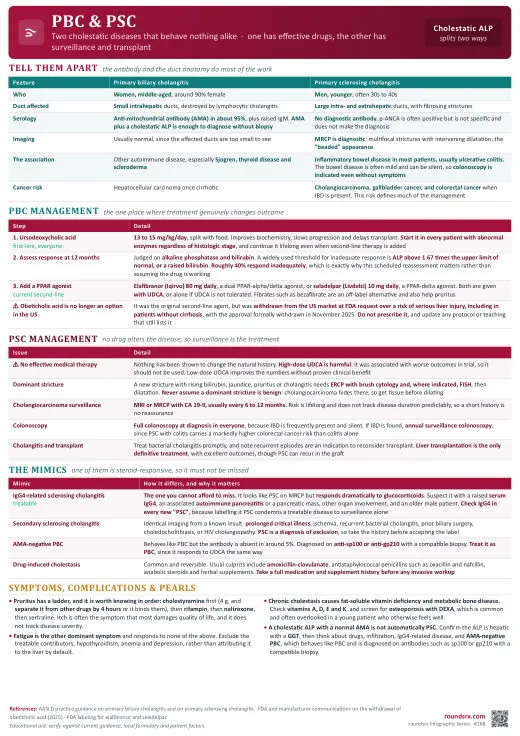
Text version
- Who: 90% female, middle-aged (40 to 60). Presents with pruritus and fatigue
- Antibody: AMA (anti-mitochondrial antibody), 95% sensitive and highly specific. AMA-positive plus cholestatic LFTs is often enough to diagnose without biopsy
- Labs: cholestatic pattern (ALP, GGT up), AST/ALT mildly up. IgM elevated (contrast: IgG in AIH)
- Imaging: normal bile ducts on MRCP, because the target is small intrahepatic ducts that imaging cannot see
- Pathology: granulomatous destruction of small intrahepatic bile ducts, the "florid duct lesion"
- Associations: Sjogren, thyroiditis, celiac, RA
- Cancer risk: hepatocellular carcinoma, only once cirrhotic
- Who: ~70% male, young adults (30 to 40). Pruritus, jaundice, RUQ pain, recurrent cholangitis episodes
- Antibody: p-ANCA positive in ~80% but nonspecific, so it does not make the diagnosis. AMA is negative
- Labs: cholestatic pattern (ALP, GGT up). CA 19-9 at baseline for later cancer surveillance
- Imaging: MRCP is the diagnostic study of choice, showing multifocal strictures and dilations of intra- and/or extrahepatic ducts ("beading", "string of pearls")
- Pathology: "onion skin" periductal fibrosis, often not needed if MRCP is diagnostic
- Associations: ulcerative colitis in 70%, so colonoscopy even if asymptomatic
- Cancer risk: cholangiocarcinoma, lifetime 10 to 15%, plus gallbladder cancer and colon cancer if UC
- PBC, LFTs q3 to 6 months: track the ALP response to UDCA, since ALP >1.67× ULN at 12 months defines incomplete response and triggers add-on therapy
- PBC, bilirubin: a rising bilirubin is the strongest predictor of poor prognosis
- PBC, thyroid function and DEXA: hypothyroidism is frequently associated, and cholestatic liver disease carries elevated osteoporosis risk
- PBC, fat-soluble vitamins A, D, E, K: cholestasis causes malabsorption
- PSC, CA 19-9 + MRCP annually for cholangiocarcinoma, which is hard to spot against already-abnormal ducts
- PSC, colonoscopy annually if UC, including after liver transplant, because the colon cancer risk persists
- PSC, gallbladder ultrasound annually: increased gallbladder cancer risk, low threshold for cholecystectomy if polyps
- PSC, LFTs q3 to 6 months: new cholangitis episodes may signal a dominant stricture
- Giving ursodiol for PSC and calling it treated. It is widely prescribed but does not improve transplant-free survival, and high-dose was harmful
- Assigning AMA to PSC or beading to PBC. AMA positive plus normal MRCP is PBC; AMA negative plus beading is PSC
- Treating a new dominant stricture in PSC as benign. Get brush cytology with FISH before dilating, cholangiocarcinoma lives there
- Obeticholic acid at all: it was withdrawn from the US market in 2025 for hepatotoxicity. Black box contraindication, and it makes pruritus worse in everyone
- Missing PBC-AIH overlap (~10% of PBC). Disproportionate transaminases (ALT >5× ULN) or elevated IgG should prompt biopsy, since interface hepatitis justifies adding immunosuppression
- PSC with a dominant stricture plus rising bilirubin or CA 19-9: ERCP with brush cytology and FISH to rule out cholangiocarcinoma before anything else
- PBC with ALP >1.67× ULN or elevated bilirubin after 12 months of UDCA: hepatology for a PPAR agonist (elafibranor or seladelpar), this defines the inadequate responder
- Decompensated cirrhosis in either disease: transplant referral, this is the definitive treatment and the only curative option in PSC
- PBC patient with ALT >5× ULN or elevated IgG: biopsy for overlap syndrome, because the AIH component needs prednisone plus azathioprine (check TPMT) on top of ursodiol
- New PSC diagnosis: colonoscopy even if asymptomatic, since 70% have UC and it changes surveillance
- Poupon, NEJM 1991: established ursodiol as PBC first-line therapy
- POISE, NEJM 2016: obeticholic acid improved ALP in PBC patients with an inadequate UDCA response
- Lindor, Hepatology 2009: high-dose ursodiol (28 to 30 mg/kg) in PSC increased mortality, transplant need, and serious adverse events. This is why "just give ursodiol" is the wrong reflex in PSC
- Mechanistic why: ursodiol replaces toxic bile acids with a hydrophilic non-toxic one, which helps PBC's small-duct cholangiocyte injury but does nothing for PSC's large-duct fibrosis and stricturing