Pericarditis & Pericardial Disease
- Pleuritic chest pain -sharp, worse with inspiration and supine, improved leaning forward
- Pericardial friction rub -scratchy, 3-component (best heard with diaphragm, patient leaning forward)
- Diffuse ST elevation with PR depression (concave-up, diffuse -NOT territorial like STEMI)
- New or worsening pericardial effusion on echo
| Feature | Pericarditis | STEMI |
|---|---|---|
| ST elevation | Diffuse, concave-up ("smiley face") | Territorial (matches coronary distribution), convex-up |
| PR segment | PR depression (except aVR -PR elevation) | Usually normal |
| Reciprocal changes | None (except aVR) | Present (ST depression in opposite leads) |
| Q waves | Absent | May develop |
| T-wave evolution | ST normalizes BEFORE T inversions | T inversions occur WITH persistent ST elevation |
- Beck's triad: hypotension, JVD, muffled heart sounds (only ~30% have all three)
- Pulsus paradoxus > 10 mmHg (SBP drop > 10 with inspiration) -most sensitive clinical sign
- Echo: RA collapse in systole (earliest), RV diastolic collapse, IVC plethora (no collapse with inspiration)
- Electrical alternans on ECG (swinging heart) -classic but uncommon
- Treatment: emergent pericardiocentesis -subxiphoid approach, echo-guided. Drain as much as possible. Send fluid for cell count, protein, LDH, glucose, gram stain, culture, cytology, ADA.
| Drug | Dose | Duration | Notes |
|---|---|---|---|
| NSAIDs 1ST LINE | Ibuprofen 600 mg PO TID or ASA 750–1000 mg PO TID | 1–2 weeks, taper over 2–4 weeks | First-line anti-inflammatory. ASA preferred post-MI (NSAIDs impair scar formation). Add PPI for gastric protection. |
| Colchicine (Colcrys) ADD TO ALL | 0.5 mg BID (if > 70 kg) or 0.5 mg daily (if ≤ 70 kg) | 3 months | COPE, 2005 + ICAP, 2013: colchicine reduced recurrence by ~50%. Should be added to ALL pericarditis treatment. GI side effects (diarrhea). Renal dose if CrCl < 30. |
| Corticosteroids LAST RESORT | Prednisone 0.25–0.5 mg/kg/day | Taper over weeks–months | Avoid if possible -steroids increase recurrence rate. Use only if NSAIDs + colchicine contraindicated or failed, or autoimmune etiology confirmed. Taper VERY slowly. |
Patient: 26M, previously healthy, presents with 2 days of sharp pleuritic chest pain worse lying flat and improved leaning forward. Recent URI 10 days ago.
Key findings: T 100.4°F, HR 88, BP 122/74. Pericardial friction rub on auscultation. ECG: diffuse concave ST elevation + PR depression. Troponin 0.18 (mildly elevated). CRP 8.4. Echo: small circumferential effusion, no tamponade.
Management:
- Ibuprofen 600 mg PO TID x 1-2 weeks, then taper by 200-400 mg/week. PPI for GI protection.
- Colchicine 0.5 mg BID x 3 months (reduces recurrence by ~50%)
- Activity restriction until symptoms resolved AND CRP normalized (critical with troponin elevation)
- Repeat echo in 1 week; CRP weekly until normalized
- Avoid steroids, increase recurrence risk
Teaching point: The mildly elevated troponin indicates myopericarditis (myocardial involvement). This does not change treatment but mandates strict exercise restriction, return to sport only after 3-6 months symptom-free with normal CRP, ECG, and echo. ICAP, 2013
Patient: 41F, 3rd episode of pericarditis in 18 months. Initially treated with NSAIDs alone (no colchicine). Second episode treated with prednisone 40 mg with rapid taper. Now recurs 2 weeks after completing steroid taper.
Key findings: Pleuritic chest pain, CRP 12.8, small effusion on echo. No tamponade physiology. ECG with recurrent ST changes.
Management:
- Restart ibuprofen 600 mg TID + colchicine 0.5 mg BID x 6 months (longer duration for recurrence)
- If steroid-dependent: very slow taper (decrease by 2.5 mg every 2-4 weeks only if asymptomatic + CRP normal)
- If refractory to colchicine + NSAIDs + slow steroid taper: consider anakinra (IL-1 receptor antagonist)
- Avoid exercise until CRP normalizes
Teaching point: Steroids are an independent risk factor for recurrent pericarditis. COPE, 2005 demonstrated colchicine should be first-line for all pericarditis. In steroid-dependent recurrent pericarditis, AIRTRIP, 2016 showed anakinra achieved complete response in 80%+ of patients.
Patient: 63M, admitted 3 weeks ago for anterior STEMI with PCI to LAD. Now re-presents with pleuritic chest pain, low-grade fever, and new pericardial friction rub.
Key findings: ECG: diffuse ST elevation (different from prior focal anterior changes). Troponin re-elevated to 0.42. CRP 15.2. Echo: moderate pericardial effusion, no tamponade. On aspirin 81 mg + ticagrelor (DAPT).
Management:
- Aspirin 750-1000 mg TID (preferred NSAID post-MI)
- Colchicine 0.5 mg BID x 3 months
- Avoid ibuprofen post-MI, interferes with aspirin's antiplatelet effect
- Continue DAPT (do not stop ticagrelor for pericarditis)
- Monitor for tamponade, anticoagulated patients at higher risk of hemorrhagic effusion
Teaching point: Dressler syndrome is autoimmune pericarditis occurring 2-10 weeks post-MI. Use aspirin (not ibuprofen) as the anti-inflammatory because ibuprofen competitively inhibits aspirin's irreversible COX-1 platelet binding. Avoid anticoagulation if large effusion due to hemorrhagic tamponade risk.
| Parameter | Frequency | Target / Action |
|---|---|---|
| CRP | Weekly until normal | Guides duration of therapy. Do NOT taper NSAIDs until CRP normalizes. Premature taper = recurrence. |
| ECG | At diagnosis, then at follow-up | Monitor ST/PR normalization through 4 stages. Persistent changes may suggest constrictive physiology. |
| TTE (Echo) | Repeat in 1-2 weeks | Confirm effusion resolution. Repeat sooner if hemodynamic compromise or clinical worsening. |
| Symptoms | Each visit | Pleuritic chest pain, dyspnea, positional symptoms. Worsening = consider effusion enlargement or recurrence. |
| Renal function (Cr) | 1-2 weeks after starting NSAIDs | NSAID nephrotoxicity. Check BMP especially in elderly, CKD, heart failure, or concurrent ACEi/ARB. |
| Activity restriction | Until CRP normal + asymptomatic | Non-athletes: restrict until symptom resolution. Athletes: no competitive sports for minimum 3 months (6 months if myopericarditis). |
| Test | Findings | Clinical Significance |
|---|---|---|
| 12-lead ECG | Diffuse ST elevation (concave up), PR depression, Spodick sign (downsloping TP segment) | Stage I changes present in ~80%. Diffuse = not in a coronary territory (distinguishes from STEMI). |
| TTE (Echocardiogram) | Pericardial effusion size, tamponade physiology (RA/RV collapse, IVC plethora, respiratory variation) | Assess effusion size and hemodynamic impact. Repeat in 1-2 weeks to monitor resolution. |
| Troponin | Elevated if myopericarditis | Mild elevation suggests myocardial involvement. Does NOT change treatment but restricts activity longer. |
| CRP / ESR | Elevated (CRP often markedly) | CRP guides treatment duration -continue colchicine + NSAIDs until CRP normalizes. |
| CBC | Leukocytosis (if infectious/inflammatory) | WBC differential helps distinguish viral (lymphocytic) vs bacterial (neutrophilic). |
| BMP | Cr (baseline), electrolytes | Baseline renal function before NSAID therapy. Monitor during treatment. |
| Blood cultures | If infectious etiology suspected | Obtain if febrile, immunocompromised, or subacute presentation suggesting bacterial/TB pericarditis. |
| Drug | Dose | Duration | Notes |
|---|---|---|---|
| Ibuprofen (Advil) 1ST LINE | 600 mg PO TID | 1-2 weeks, then taper over 2-3 weeks | First-line NSAID. Take with PPI for GI protection. Taper by 200-400 mg/week. |
| Colchicine (Colcrys) 1ST LINE | 0.5 mg BID (0.5 mg daily if <70 kg) | 3 months (first episode), 6 months (recurrent) | Halves recurrence rate. COPE, 2005 + ICAP, 2013. GI side effects (diarrhea) -dose-reduce if needed. |
| Aspirin | 750-1000 mg PO TID | 1-2 weeks, then taper | Preferred over ibuprofen if recent MI (post-infarction pericarditis / Dressler syndrome). |
| Prednisone 2ND LINE ONLY | 0.25-0.5 mg/kg/day | Slow taper over weeks-months | Only if contraindication to NSAIDs (renal failure, GI bleeding). Increases recurrence risk. Always use with colchicine. |
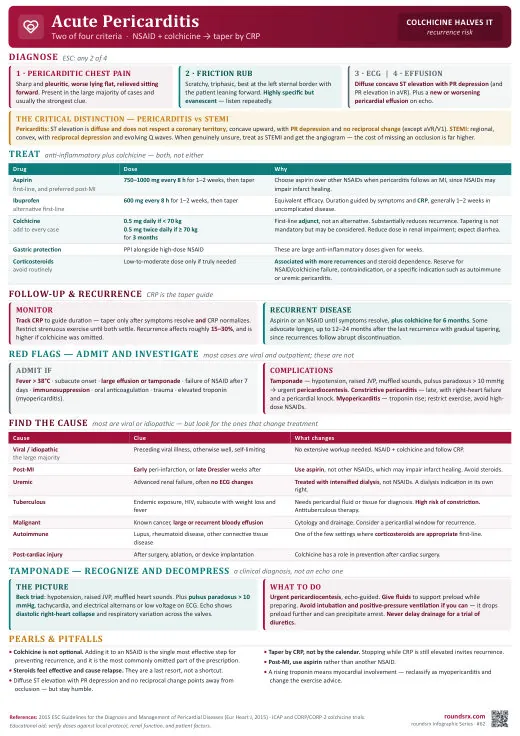
Text version
- Pleuritic chest pain (sharp, worse lying flat, better leaning forward)
- Pericardial friction rub
- Diffuse ST elevation + PR depression on ECG
- New or worsening pericardial effusion on echo
- Ibuprofen 600 mg TID × 2 weeks (taper over weeks)
- Colchicine 0.5 mg BID × 3 months (halves recurrence) [COPE, 2005, ICAP, 2013]
- Activity restriction until CRP normalizes + symptoms resolve
- Myopericarditis (troponin ↑): no exercise × 3-6 months
- Beck's triad: hypotension + JVD + muffled heart sounds
- Pulsus paradoxus > 10 mmHg
- Echo: RV diastolic collapse (most specific), IVC plethora
- Treatment: emergent pericardiocentesis (echo-guided)
- Missing tamponade
- Using steroids first-line (high recurrence)
- Anticoagulation → hemorrhagic effusion
- Not adding colchicine from day 1
- Confusing with STEMI on ECG