Perioperative Medicine
Preoperative risk assessment, medication management around surgery, and co-management of medical issues in surgical patients. Know when to bridge anticoagulation (hint: usually don't), when to order a stress test (hint: rarely), and which medications to hold or continue.
🔍 Overview
Cardiac Risk Assessment
Revised Cardiac Risk Index (RCRI / Lee Index) -6 independent predictors of major cardiac events after non-cardiac surgery Lee, Circulation 1999:
- High-risk surgery (intraperitoneal, intrathoracic, suprainguinal vascular)
- History of ischemic heart disease
- History of heart failure
- History of cerebrovascular disease (stroke/TIA)
- Diabetes on insulin
- Creatinine > 2.0 mg/dL
| RCRI Score | Risk of Major Cardiac Event | Approach |
|---|---|---|
| 0 | ~3.9% | Low risk -proceed to surgery |
| 1 | ~6.0% | Low-intermediate -proceed if good functional capacity (≥ 4 METs) |
| 2 | ~10.1% | Intermediate -consider stress testing if poor functional capacity AND will change management |
| ≥ 3 | ~15% | High risk -stress testing if will change management, cardiology consult |
Functional Capacity
≥ 4 METs = adequate functional capacity (low cardiac risk regardless of RCRI). 4 METs ≈ climbing one flight of stairs, walking on level ground at 4 mph, doing heavy housework (scrubbing floors, moving furniture). If a patient can do these activities without chest pain or dyspnea, they can likely tolerate surgery without further cardiac testing.
🚨 Management
Cardiac Medication Management
NEVER start a new beta-blocker within 24h of surgery. The POISE trial showed that starting metoprolol perioperatively increased stroke and death despite reducing MI. Only continue beta-blockers if the patient is already on one. POISE, NEJM 2008
- Beta-blockers: CONTINUE if already on one (withdrawal can cause rebound tachycardia and ischemia). Do NOT start new ones perioperatively.
- Statins: CONTINUE perioperatively -associated with reduced cardiac events and mortality.
- ACE inhibitors/ARBs: Generally HOLD morning of surgery (risk of refractory hypotension with anesthesia). Resume postop when tolerating PO.
Anticoagulation Management
| Agent | When to Stop | Bridge? | Key Notes |
|---|---|---|---|
| Warfarin | 5 days before | Bridge with LMWH ONLY if HIGH thrombotic risk: mechanical mitral valve, recent VTE (< 3 months), CHA₂DS₂-VASc ≥ 7 | BRIDGE Trial, NEJM 2015 -most AF patients do NOT need bridging. Bridging increases bleeding without reducing thrombosis. |
| DOACs (apixaban, rivaroxaban) | 2–3 days before (longer if CrCl < 50 for dabigatran) | No bridging needed | Short half-lives. If urgent reversal needed: idarucizumab (dabigatran), andexanet alfa (Xa inhibitors), or PCC. |
| Aspirin | Continue for most surgeries | N/A | Exception: intracranial surgery -hold 7 days before. For most non-cardiac surgery, continuing aspirin is safe. |
| P2Y12 inhibitors (clopidogrel, ticagrelor) | Clopidogrel: 5 days. Ticagrelor: 3–5 days. | No | If patient has recent coronary stent (< 6 weeks BMS, < 6 months DES), surgery should be delayed if possible. Cardiology consult. |
🔄 Updated Practice: Old teaching: stop anticoagulation and bridge all AF patients with heparin before surgery. Current practice: the BRIDGE trial (NEJM 2015) showed that most AF patients do NOT need bridging, no-bridging was non-inferior for thromboembolism and caused significantly less major bleeding. Bridge only for the highest-risk patients: mechanical mitral valve, recent VTE (<3 months), or very high CHA₂DS₂-VASc (≥7). When in doubt, don't bridge.
Diabetes Management
- Metformin: HOLD day of surgery (risk of lactic acidosis with contrast or hypoperfusion). Resume when eating and renal function stable.
- SGLT2 inhibitors: HOLD 3–4 days before surgery (risk of euglycemic DKA -normal glucose but elevated ketones + anion gap). FDA Safety Communication, 2020
- Basal insulin: Reduce to 50–80% of usual dose the night before surgery. Do NOT hold completely (risk of DKA in type 1).
- Bolus/prandial insulin: HOLD the morning of surgery (patient is NPO).
- Oral agents (sulfonylureas, TZDs): HOLD morning of surgery.
- GLP-1 agonists (semaglutide, liraglutide): May hold -risk of delayed gastric emptying and aspiration. ASA recommends holding day of surgery for daily formulations, 1 week for weekly formulations.
Pulmonary Risk Reduction
Updated Practice: Old teaching -get preop PFTs on everyone. WRONG -routine preop PFTs do NOT predict postoperative pulmonary complications and are NOT recommended. Clinical assessment (history, exam, functional capacity) is sufficient.
- Incentive spirometry: Start preop and continue postop -reduces atelectasis and pneumonia.
- Smoking cessation: Ideally ≥ 8 weeks before surgery if possible. Even 24–48h of cessation reduces CO levels and improves O₂ delivery.
- Avoid NG tube if possible (increases aspiration risk).
- Early mobilization postop -most important intervention for preventing pulmonary complications.
🧪 Workup
Preoperative Testing
Only order tests that will change management. Routine "preop labs" without indication increase cost and false positives without improving outcomes.
- ECG: If RCRI ≥ 1, known cardiac disease, or symptoms. Not needed for low-risk patients undergoing low-risk surgery.
- CBC: If anticipated blood loss, anemia symptoms, or liver/renal disease.
- BMP: If renal disease, diabetes, diuretic use, or major surgery with expected fluid shifts.
- Coags (PT/INR): If on anticoagulants, liver disease, or bleeding history.
- Type & screen: If blood loss anticipated.
- Glucose: If diabetic -day-of-surgery glucose management.
- Pregnancy test: All women of childbearing age (many institutions mandate this).
- Stress test: Only if it will change management AND the patient has poor functional capacity (< 4 METs) AND elevated RCRI (≥ 2). Do NOT get routine preop stress tests.
- PFTs: NOT routinely indicated. Only if new/unexplained dyspnea or for lung resection surgery.
- CXR: NOT routinely indicated. Only if acute pulmonary symptoms or significant cardiopulmonary disease.
💊 Medications
Perioperative Medication Management
| Drug Class | Action | Rationale |
|---|---|---|
| Beta-blockers | CONTINUE (do NOT start new) | Withdrawal → rebound tachycardia/ischemia. POISE trial: starting new BB → ↑ stroke + death. |
| Statins | CONTINUE | Pleiotropic anti-inflammatory effects reduce periop cardiac events. |
| ACEi/ARBs | HOLD morning of surgery | Risk of refractory intraop hypotension. Resume when tolerating PO and hemodynamically stable. |
| Warfarin | STOP 5 days before | Bridge only for HIGH thrombotic risk (mechanical mitral valve, recent VTE <3mo). |
| DOACs | STOP 2–3 days before | No bridging needed. Extend to 4–5 days for dabigatran if CrCl < 50. |
| Aspirin | CONTINUE (most cases) | Hold for intracranial surgery. Otherwise, continue. |
| Metformin | HOLD day of surgery | Lactic acidosis risk with hypoperfusion/contrast. |
| SGLT2 inhibitors | HOLD 3–4 days before | Euglycemic DKA risk perioperatively. |
| Basal insulin | Reduce to 50–80% night before | Prevent hypoglycemia while NPO. Do NOT hold entirely in type 1. |
| Sulfonylureas | HOLD morning of surgery | Hypoglycemia risk while NPO. |
| GLP-1 agonists | HOLD (daily: day of; weekly: 1 wk) | Delayed gastric emptying → aspiration risk with anesthesia. |
📋 On Rounds
When do you bridge anticoagulation for a patient on warfarin undergoing elective surgery?
Bridge with LMWH ONLY for patients at HIGH thrombotic risk: (1) Mechanical mitral valve (or any mechanical valve with additional risk factors), (2) Recent VTE within 3 months, (3) Very high CHA₂DS₂-VASc (≥ 7). For the vast majority of AF patients, do NOT bridge. The landmark BRIDGE trial (NEJM 2015) showed that bridging in AF patients did not reduce thromboembolism but significantly increased major bleeding.
What is the RCRI (Revised Cardiac Risk Index)?
The RCRI (Lee Index) is the most widely used tool for preoperative cardiac risk stratification. It has 6 independent predictors (1 point each): (1) High-risk surgery (intraperitoneal, intrathoracic, suprainguinal vascular), (2) Ischemic heart disease, (3) Heart failure, (4) Cerebrovascular disease, (5) Diabetes on insulin, (6) Cr > 2.0. Score interpretation: 0 = ~3.9% risk of major cardiac event, 1 = ~6%, 2 = ~10%, ≥3 = ~15%.
Why should you NOT start new beta-blockers perioperatively?
The POISE trial (NEJM 2008) randomized patients to extended-release metoprolol vs placebo started within 2–4h before surgery. Results: metoprolol reduced MI (4.2% vs 5.7%) BUT doubled the rate of stroke (1.0% vs 0.5%) and increased overall mortality (3.1% vs 2.3%). The mechanism: beta-blockers cause perioperative hypotension and bradycardia → cerebral hypoperfusion → stroke.
When should you get a preoperative stress test?
Preop stress tests are indicated only when ALL THREE conditions are met: (1) The result will change management (i.e., you would cancel or modify the surgery based on the result). (2) The patient has poor functional capacity (< 4 METs -cannot climb one flight of stairs). (3) The patient has elevated cardiac risk (RCRI ≥ 2 or known significant cardiac disease). If any of these is missing, a stress test is NOT indicated.
Postoperative Monitoring
| Parameter | Frequency | Target / Action |
|---|---|---|
| Vitals | q4h floor, q1–2h PACU | Watch for hypotension (bleeding, sepsis), tachycardia (pain, PE, bleeding), fever. |
| Glucose | q6h if diabetic (AC + HS) | Target 140–180 mg/dL inpatient. Avoid hypoglycemia. Sliding scale + reduced basal. |
| DVT prophylaxis | Assess daily | SQ heparin 5,000 units q8h or enoxaparin 40 mg SQ daily. SCDs if anticoag contraindicated. |
| I&Os | Strict if major surgery | UOP ≥ 0.5 mL/kg/hr. Monitor for fluid overload or hypovolemia. |
| Pain management | Each assessment | Multimodal: acetaminophen + NSAIDs (if no contraindication) + opioids PRN. Minimize opioids. |
| Incentive spirometry | q1h while awake | 10 breaths q1h. Prevents atelectasis and postop pneumonia. |
⚡ Summary
Perioperative Medicine -Key Points
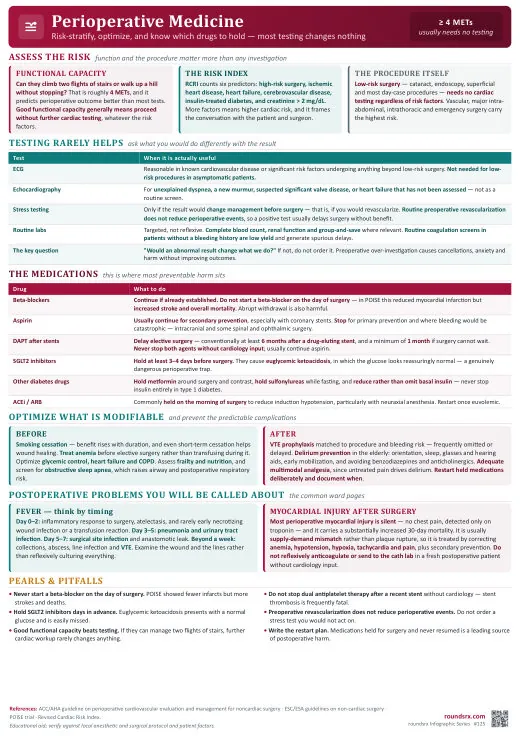
Assess Risk With RCRI Plus Function
Revised Cardiac Risk Index: high-risk surgery, ischemic heart disease, heart failure, cerebrovascular disease, insulin-treated diabetes, creatinine above 2. Combine it with functional capacity: a patient who can climb two flights of stairs, roughly 4 METs, has a low event rate regardless of the checklist. Poor or unassessable functional capacity is what should trigger further testing, not the score alone.
Do Not Start a Beta Blocker Before Surgery
POISE showed starting perioperative metoprolol reduced myocardial infarction but increased stroke and death. Continue a beta blocker in a patient already taking one, since abrupt withdrawal causes rebound ischemia, but never start one within 24 h of the operation.
Most AF Patients Do Not Need Bridging
BRIDGE showed no-bridging was non-inferior for thromboembolism and caused significantly less major bleeding. Reserve bridging for genuinely high thrombotic risk: mechanical mitral valve, recent stroke or VTE, or antiphospholipid syndrome. Stop DOACs 24 to 48 h before, longer with renal impairment, and no bridging is needed for them at all given their short half-life.
Skip Routine Preoperative Testing
Routine PFTs do not predict postoperative pulmonary complications and are not recommended; clinical assessment is sufficient. The same applies to routine chest films, ECGs in low-risk patients and broad laboratory panels. Order a test only if the result would change the anesthetic or the operation; incidental abnormalities cause delay and cascade without benefit.
Manage Antiplatelets Around Stents
Delay elective surgery for at least 6 months after a drug-eluting stent and 1 month after a bare metal stent. Continue aspirin through most operations where possible. Premature interruption of dual antiplatelet therapy causes stent thrombosis, which carries very high mortality, so the timing conversation is with cardiology and surgery together, not unilaterally.
Reduce Pulmonary Risk With What Actually Works
Smoking cessation, ideally at least 4 to 8 weeks before, incentive spirometry, early mobilization, lung expansion techniques and good pain control, plus screening for and treating obstructive sleep apnea. Upper abdominal and thoracic surgery, long operations and poor functional status are the main risk factors, and they are what should prompt these measures.
Get the Diabetes Medications Right
Hold metformin on the day of surgery, hold SGLT2 inhibitors 3 to 4 days before because of euglycemic DKA risk, and hold sulfonylureas while NPO. Continue basal insulin, usually dose-reduced; never stop it entirely in type 1, since that causes DKA within hours. Target 100 to 180 mg/dL perioperatively, and do not postpone surgery on A1c alone.
Plan the Postoperative Watch
Myocardial injury after non-cardiac surgery is common and usually silent, so a rising troponin in a high-risk patient matters even without chest pain. Also anticipate delirium in the elderly (minimize anticholinergics and benzodiazepines), postoperative ileus, VTE prophylaxis timing around neuraxial anesthesia, and adequate multimodal analgesia to allow mobilization.
Related Topics
Discharge Planning ChecklistFalls & Delirium PreventionVTE Prophylaxis