Peripheral Artery Disease
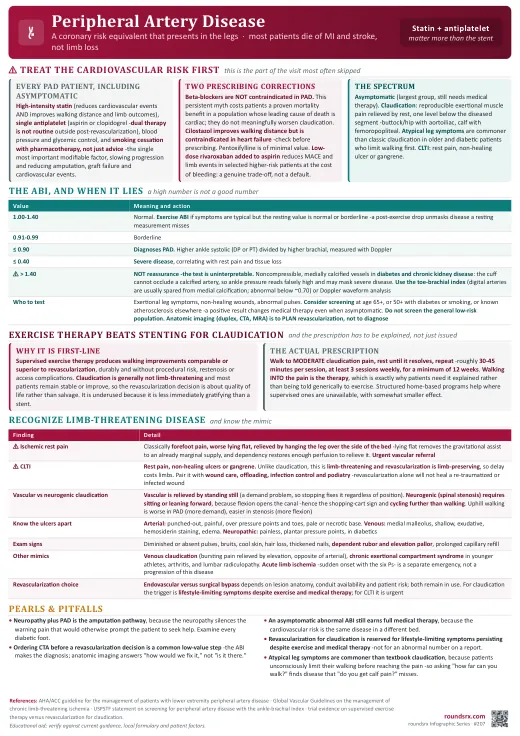
PAD is atherosclerosis, and atherosclerosis is a systemic disease. A patient with PAD has roughly the cardiovascular risk of a patient with established coronary disease, and the leading causes of death are myocardial infarction and stroke, not limb loss. That single fact reorders the whole encounter: the highest-value interventions are the statin, the antiplatelet, blood pressure control and smoking cessation, not the angiogram.
- Asymptomatic PAD -the largest group. Detected by ABI, and still carries the elevated cardiovascular risk that warrants medical therapy.
- Claudication -reproducible exertional muscle pain relieved by rest within minutes, in the muscle group one level below the diseased segment: buttock and hip pain with aortoiliac disease, calf pain with femoropopliteal disease.
- Atypical leg symptoms -more common than classic claudication, particularly in older patients and diabetics who limit their walking before symptoms appear.
- Chronic limb-threatening ischemia (CLTI) -rest pain, non-healing ulcers or gangrene. Rest pain is classically in the forefoot, worse lying flat, and relieved by hanging the leg over the side of the bed because gravity aids perfusion. This is a limb-at-risk diagnosis requiring urgent vascular referral.
- Acute limb ischemia -sudden onset with the six Ps, a separate emergency covered in its own topic.
- Diminished or absent pulses, bruits, cool skin, hair loss, thickened nails, dependent rubor and elevation pallor, and prolonged capillary refill.
- Arterial ulcers -punched-out, painful, over pressure points and the toes, with a pale or necrotic base. Contrast with venous ulcers (medial malleolus, shallow, exudative, with hemosiderin staining and edema) and neuropathic ulcers (painless, over plantar pressure points, in diabetics).
- Examine the feet of every diabetic -the combination of neuropathy and PAD is what produces the diabetic foot infection pathway, and neuropathy silences the warning pain.
- The ABI is the first-line test: the higher ankle systolic pressure (dorsalis pedis or posterior tibial) divided by the higher brachial pressure, measured with a Doppler probe.
- Interpretation: normal is roughly 1.00-1.40; 0.91-0.99 borderline; ≤ 0.90 diagnoses PAD; ≤ 0.40 indicates severe disease and correlates with rest pain and tissue loss.
- ⚠ An ABI above 1.40 is not a good result -it means noncompressible, calcified vessels, typical of diabetes and chronic kidney disease, and it renders the ABI uninterpretable. Use the toe-brachial index (digital arteries are usually spared from medial calcification; a TBI below about 0.70 is abnormal) or Doppler waveform analysis instead.
- Exercise ABI when resting ABI is normal or borderline but symptoms are typical -a post-exercise drop unmasks disease that a resting measurement misses.
- Anatomic imaging (duplex ultrasound, CT or MR angiography) is for planning revascularization, not for making the diagnosis. Ordering it before a revascularization decision has been made is a common low-value step.
- Exertional leg symptoms, non-healing wounds, or abnormal pulse exam -symptom-driven testing.
- Consider screening ABI in patients at meaningfully elevated risk: age 65 and over, or age 50 and over with diabetes or smoking history, or known atherosclerosis in another vascular bed -because a positive result changes medical therapy even when asymptomatic.
- Do not screen the general low-risk population -the USPSTF found insufficient evidence for routine ABI screening in asymptomatic adults without risk factors.
- Neurogenic claudication (spinal stenosis) -the key discriminator is what relieves it: vascular claudication is relieved by standing still, neurogenic claudication requires sitting or leaning forward. Patients with stenosis can cycle further than they can walk; the reverse is true in PAD.
- Venous claudication (bursting pain relieved by elevation), chronic compartment syndrome in younger athletes, arthritis, and radiculopathy.
- Statin -high intensity, for every patient with PAD, which is a coronary risk equivalent. Statins reduce cardiovascular events and also improve walking distance and limb outcomes.
- Antiplatelet therapy -single agent (aspirin or clopidogrel) for symptomatic PAD. Dual antiplatelet therapy is not routine outside the post-revascularization setting.
- Low-dose rivaroxaban added to aspirin (COMPASS, 2017) reduces major adverse cardiovascular and limb events in selected higher-risk patients, at the cost of increased bleeding -a genuine trade-off requiring an individualized discussion rather than reflexive use.
- Smoking cessation is the single most important modifiable factor -it slows progression, reduces amputation and graft failure, and lowers cardiovascular events. Offer pharmacotherapy and behavioral support, not just advice.
- Blood pressure and diabetes control per standard targets. Beta-blockers are NOT contraindicated in PAD -this is a persistent myth; they do not worsen claudication meaningfully and should be used when otherwise indicated.
- Cilostazol improves walking distance in claudication (a phosphodiesterase-3 inhibitor with vasodilator and antiplatelet effects), but is contraindicated in heart failure, which is the reason to check before prescribing. Pentoxifylline is of minimal value.
- Supervised exercise therapy is first-line for claudication and produces walking improvements comparable or superior to revascularization, with durable benefit and none of the procedural risk. It is underused because it is less immediately gratifying than a stent.
- The prescription is specific: walking to moderate claudication pain, resting until it resolves, repeating for roughly 30-45 minutes per session, at least three sessions a week, for a minimum of 12 weeks. Walking into the pain is the therapy, which is why patients need it explained rather than simply being told to exercise.
- Structured home-based programs help when supervised programs are unavailable, though with somewhat smaller effect.
- For claudication: reserved for lifestyle-limiting symptoms that persist despite exercise therapy and medical management -claudication is generally not limb-threatening, and most patients remain stable or improve, so the decision is about quality of life rather than salvage.
- For chronic limb-threatening ischemia: urgent vascular referral -rest pain, non-healing ulceration or gangrene means revascularization is limb-preserving, and delay costs limbs.
- Endovascular versus surgical bypass depends on lesion anatomy, conduit availability and patient risk; both remain in use.
- Wound care, offloading, infection control and podiatry are integral to CLTI outcomes -revascularization alone does not heal a wound that is being re-traumatized or infected.
Mr. Sørensen is a 68-year-old man, 40 pack-year smoker with hypertension and type 2 diabetes, reporting right calf pain after walking about two blocks, relieved within minutes of stopping, progressive over a year. Exam: absent right dorsalis pedis, diminished posterior tibial, hair loss over the shin, no ulcers. Resting ABI on the right is 0.68. He is on metformin and lisinopril but no statin and no aspirin.
- ABI measured for exertional leg symptoms, non-healing wounds or abnormal pulses.
- High ABI (> 1.40) recognized as uninterpretable -toe-brachial index in diabetics and CKD.
- Statin and antiplatelet started -the most commonly missed part of the visit.
- Smoking cessation offered with pharmacotherapy, not just advice.
- Supervised exercise therapy referred and explained, before considering revascularization for claudication.
- Rest pain, ulceration or gangrene triggers urgent vascular referral -CLTI is limb-threatening.
- Beta-blockers not withheld when otherwise indicated.
- Feet examined and podiatry arranged in diabetics -neuropathy plus PAD is the amputation pathway.