Pleural Effusion
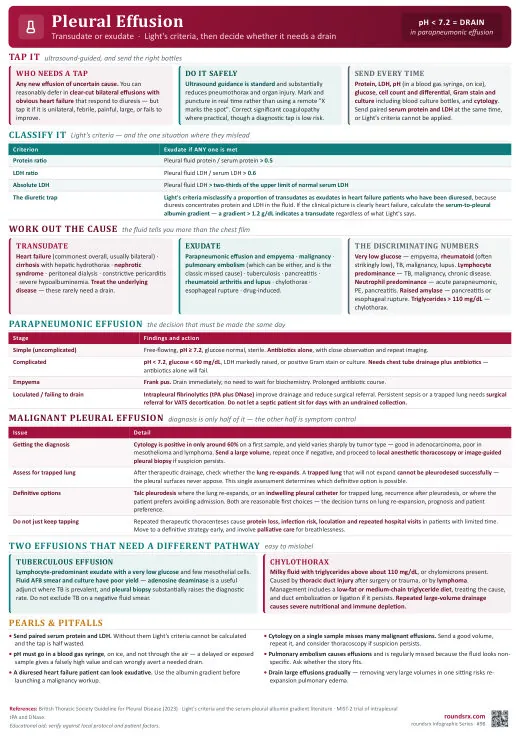
| Criterion | Exudate Cutoff |
|---|---|
| Pleural protein / Serum protein | > 0.5 |
| Pleural LDH / Serum LDH | > 0.6 |
| Pleural LDH | > 2/3 upper limit of normal for serum LDH |
| Transudative | Exudative |
|---|---|
| CHF (most common overall) | Pneumonia / parapneumonic (most common exudate) |
| Hepatic hydrothorax (cirrhosis) | Malignancy (lung, breast, lymphoma) |
| Nephrotic syndrome | PE |
| Peritoneal dialysis | TB (lymphocyte-predominant, ADA > 40) |
| Hypothyroidism | Autoimmune (SLE, RA) |
| Pancreatitis (elevated amylase) | |
| Esophageal rupture (low pH, high amylase) |
| Always Send | If Indicated |
|---|---|
| Cell count with differential | Cytology (if malignancy suspected -send ≥ 60 mL) |
| Protein, LDH, glucose | ADA (adenosine deaminase) -TB (> 40 suggestive) |
| Gram stain, culture | Amylase -pancreatitis, esophageal rupture |
| pH | Triglycerides -chylothorax (> 110 mg/dL) |
| + serum protein, LDH, albumin (same day) | Hematocrit -hemothorax (pleural Hct > 50% of blood) |
- New effusion of unknown etiology -diagnostic thoracentesis
- Clinically significant (dyspnea) -therapeutic thoracentesis (remove up to 1.5 L per session)
- Suspected empyema or complicated parapneumonic -emergent drainage
| Category | Fluid Features | Management |
|---|---|---|
| Simple parapneumonic | Clear, pH > 7.2, glucose > 60, LDH < 1000, culture negative | Antibiotics alone. May not need drainage. |
| Complicated parapneumonic | pH < 7.2, glucose < 60, LDH > 1000, or positive gram stain/culture | Chest tube drainage + antibiotics. Consider tPA/DNase instillation MIST2, 2011. |
| Empyema | Frankly purulent fluid or positive culture | Chest tube drainage mandatory. If loculated or not draining → tPA/DNase or VATS. Prolonged antibiotics (3–6 weeks). |
- Positive cytology or biopsy confirms malignancy
- Recurrent → indwelling pleural catheter (IPC) or talc pleurodesis
- Median survival with malignant effusion: 3–12 months (depends on primary cancer)
- IPC allows outpatient drainage, avoids repeated thoracenteses. Can achieve spontaneous pleurodesis in ~50%.
Patient: 74M, HFrEF (EF 25%), on aggressive diuresis with IV furosemide. Large right-sided pleural effusion tapped for dyspnea relief.
Key findings: Pleural fluid: protein ratio 0.55, LDH ratio 0.52, LDH 160 (ULN 200). Meets 1 of 3 Light's criteria (protein ratio > 0.5) → classified as exudate. But: bilateral LE edema, JVD, BNP 2,800.
Management:
- Check serum-pleural albumin gradient: 1.8 g/dL (> 1.2 confirms true transudate)
- This is a Light's criteria false-positive, diuretics concentrated the pleural protein
- No further invasive workup needed; treat underlying CHF
- Optimize diuresis (uptitrate furosemide, add metolazone if needed)
- If recurrent despite optimal HF management → consider tunneled pleural catheter
Teaching point: Light's criteria misclassify ~25% of CHF transudates as exudates, especially in diuresed patients. The serum-effusion albumin gradient (> 1.2 g/dL = transudate) corrects for this. Always apply clinical context before ordering extensive exudative workup.
Patient: 56F, DM2 and alcohol use disorder, admitted with RLL pneumonia 5 days ago on ceftriaxone + azithromycin. Persistent fever despite antibiotics, worsening dyspnea.
Key findings: CXR: enlarging right-sided effusion with loculations on ultrasound. Thoracentesis: turbid fluid, pH 6.9, glucose 28, LDH 2,800, gram stain: gram-positive cocci in chains. Protein ratio 0.8.
Management:
- Chest tube placement, complicated parapneumonic effusion (pH < 7.2, glucose < 60, positive gram stain)
- Broaden antibiotics: vancomycin + piperacillin-tazobactam
- Intrapleural tPA (10 mg) + DNase (5 mg) BID x 3 days for loculated effusion
- CT surgery consult for VATS if inadequate drainage after tPA/DNase
- Repeat imaging in 24-48h to assess drainage adequacy
Teaching point: Pleural fluid pH is the single most important test for determining if a parapneumonic effusion needs drainage. pH < 7.2 = complicated = chest tube. MIST2, 2011 showed that combination tPA + DNase (not either alone) significantly improved fluid drainage and reduced surgical referral.
Patient: 68F, never-smoker, presents with 3 months of progressive dyspnea and 15-lb weight loss. No fever, no cough. CXR: massive left-sided effusion with contralateral mediastinal shift.
Key findings: Thoracentesis: 2L bloody fluid. Exudate by Light's criteria (protein ratio 0.72, LDH ratio 0.85). Cytology: adenocarcinoma (TTF-1 positive, consistent with lung primary). Glucose 42, pH 7.18.
Management:
- Symptomatic improvement with large-volume thoracentesis (limit to 1.5L per session to avoid re-expansion pulmonary edema)
- Low pH + low glucose in malignant effusion = high tumor burden, poor prognosis
- For recurrent effusion: tunneled pleural catheter (PleurX) preferred over pleurodesis for most patients
- Oncology referral for staging and driver mutation testing (EGFR, ALK, ROS1)
- Goals of care discussion given advanced malignancy
Teaching point: Malignant effusions are exudative and often bloody. Low glucose and low pH in a malignant effusion predict poor survival and failed pleurodesis. Tunneled pleural catheters allow outpatient drainage and achieve spontaneous pleurodesis in ~45% of patients. Lung and breast cancer are the most common causes.
Text version
- Not doing thoracentesis on new effusion (it's the test)
- Missing false exudate in diuresed CHF (check albumin gradient)
- Not sending pH/glucose on parapneumonic effusion (determines tube need)
- Chest tube delay in empyema