Post-Cardiac Arrest Care (ROSC)
- Post-arrest brain injury -cerebral edema, impaired autoregulation, seizures (30–40% of arrests)
- Post-arrest myocardial dysfunction -global systolic/diastolic dysfunction (peaks at 24–48 hrs, often reversible)
- Systemic ischemia/reperfusion injury -cytokine storm, coagulopathy, multi-organ dysfunction
- Precipitating cause -must identify and treat (ACS, PE, electrolytes, toxins)
| H's | Clue / How to Find | Fix |
|---|---|---|
| Hypovolemia | Flat IVC on echo, trauma, GI bleed | Volume resuscitation, blood products, source control |
| Hypoxia | SpO₂, cyanosis, airway obstruction | Secure airway, ventilate, confirm ETT placement |
| Hydrogen ion (acidosis) | ABG -pH < 7.1, severe DKA, renal failure, sepsis | Bicarb, treat underlying cause |
| Hypo/Hyperkalemia | ECG (peaked T's, wide QRS, sine wave), BMP | Calcium, insulin/glucose, dialysis (hyperK). IV KCl, Mg (hypoK). |
| Hypothermia | Core temp < 30°C (86°F), exposure history, near-drowning | Active rewarming. "Not dead until warm and dead." |
| Hypoglycemia | Fingerstick glucose, diabetic on insulin/sulfonylureas, altered mental status pre-arrest | D50W 25–50 mL IV push (1–2 amps). Recheck glucose q15min. |
| T's | Clue / How to Find | Fix |
|---|---|---|
| Tension pneumothorax | Absent breath sounds, tracheal deviation, hypotension, distended neck veins | Needle decompression (2nd ICS MCL) → chest tube |
| Tamponade (cardiac) | Distended neck veins, muffled heart sounds, hypotension (Beck's triad). Echo: effusion + RV collapse. | Pericardiocentesis (subxiphoid, echo-guided) |
| Toxins | Med hx, pill bottles, toxidrome. Common: TCA, digoxin, beta-blockers, CCBs, opioids. | Specific antidotes. Bicarb (TCA), digibind, glucagon (BB), high-dose insulin (CCB), naloxone. |
| Thrombosis -PE | RV dilation on echo, history of immobility/DVT, PEA arrest | tPA 50mg IV push (if Category E PE during arrest), surgical/IR embolectomy |
| Thrombosis -MI | 12-lead ECG: STEMI or new LBBB, regional wall motion abnormality on echo | Emergent cath lab -even during CPR (in select patients) |
| Trauma | Mechanism of injury, external signs of hemorrhage, unstable pelvis, distended abdomen | Massive transfusion protocol, surgical intervention, pelvic binder. Address hemorrhagic shock. |
- Survivor of VF or hemodynamically unstable VT NOT from a clearly reversible cause
- Sustained VT with structural heart disease (ischemic or non-ischemic cardiomyopathy), whether or not hemodynamically tolerated
- Syncope with inducible sustained VT on EP study in a patient with structural heart disease
- Genetic arrhythmia syndromes with prior cardiac arrest: long QT, Brugada, ARVC, CPVT, HCM with prior arrest
- Acute MI with complete revascularization and no residual ischemia, VF within 24-48h of MI is often attributable to acute ischemia alone and doesn't by itself mandate secondary ICD
- Electrolyte derangement (severe hypokalemia, hypomagnesemia), fully corrected, no structural substrate
- Drug-induced QT prolongation, offending drug stopped and QTc normalized off the agent
- Commotio cordis (blunt chest impact causing VF), structurally normal heart, no long-term risk
- Severe acid-base or metabolic disturbance, cause identified and corrected
- Illicit drug-induced arrest (cocaine, methamphetamine) with structurally normal heart and commitment to abstinence
- Post-MI primary prevention: wait ≥ 40 days if EF persistently ≤ 35% (DINAMIT 2004, IRIS 2009, no benefit from earlier ICD). But secondary prevention ICDs can go in sooner if the arrest was NOT attributable to the acute MI itself.
- Post-revascularization (CABG/PCI): wait ≥ 90 days before primary prevention ICD assessment, EF often recovers with revascularization.
- New cardiomyopathy (ischemic or non-ischemic): ≥ 3 months of maximally tolerated GDMT before primary prevention ICD assessment, 30-40% of patients recover EF above 35% on GDMT.
- Neurologically devastated survivors: defer ICD, prognostication must first confirm meaningful neurologic recovery. Implanting in a patient who will not wake up is not appropriate.
- EP consultation to decide ICD vs no ICD
- Echocardiogram to document EF (primary vs secondary prevention logic differs)
- Coronary angiography (if not already done) to rule out ischemic substrate
- Cardiac MRI if etiology unclear, detects ARVC, infiltrative disease, myocarditis, scar burden
- QTc measurement off all QT-prolonging drugs
- Toxicology screen and medication review
- Family history + genetic testing if channelopathy or ARVC suspected; family screening
- GDMT initiation if structural heart disease (ARNI/ACEi/ARB, BB, MRA, SGLT2i)
- Wearable cardioverter-defibrillator (LifeVest) bridge if ICD decision deferred (pending GDMT trial, revascularization recovery, neurologic prognostication), VEST 2018 evidence mixed; used pragmatically in many centers.
- Return precautions and AED-at-home counseling for the family
| Drug | Dose | Role | Notes |
|---|---|---|---|
| Norepinephrine (Levophed) | 0.1–1 mcg/kg/min | Vasopressor (first-line) | Maintain MAP ≥ 65–70 post-ROSC. Post-arrest myocardial dysfunction is common -monitor CO. |
| Dobutamine (Dobutrex) | 2–15 mcg/kg/min | Post-arrest cardiogenic shock | Add if MAP adequate but echo shows severely reduced EF. Titrate to echo/clinical response. |
| Propofol (Diprivan) | 5–50 mcg/kg/min | Sedation during TTM | Reduces shivering, facilitates temperature control. Monitor for propofol infusion syndrome. |
| Meperidine / Buspirone | Meperidine 25–50 mg IV PRN | Anti-shivering during TTM | Shivering increases metabolic demand and raises temperature. Treat aggressively. Magnesium also helps. |
| Aspirin + Heparin | Per ACS protocol | If ACS precipitant | Do not withhold antiplatelet/anticoagulation for neurologic concerns alone. Treat the cause. |
| Insulin infusion | Target BG 140–180 mg/dL | Glycemic control | Avoid both hypoglycemia and severe hyperglycemia. Tight control (< 110) increases hypoglycemia and worsens outcomes. |
Presentation: 58M found unresponsive at home. EMS: VF, defibrillated × 2, ROSC after 18 minutes of CPR. Arrives intubated. 12-lead ECG shows inferior STEMI.
Priorities: Cath lab activated immediately, PCI does not wait for neurologic prognostication. Post-PCI, initiate temperature control: a constant target ≤ 37.5°C (99.5°F) with a device for at least 36 h (72 h in many protocols) and active fever prevention per TTM2, 2021. Titrate FiO₂ to SpO₂ 90–98%, avoid hyperoxia and hypoxia. MAP ≥ 65 with Norepinephrine; add Dobutamine if echo shows post-arrest low EF.
Teaching point: STEMI post-arrest goes to the cath lab regardless of coma. Post-arrest myocardial stunning is reversible, echo EF often normalizes by 48–72h. Rewarm slowly (0.25°C/hr (0.45°F/hr)) to avoid rebound hyperthermia.
Presentation: 65F, out-of-hospital VF arrest, ROSC after 12 minutes. TTM completed (fever prevention protocol). Now day 3 post-normothermia, still comatose. GCS 5 (E1V1M3). Absent pupillary reflexes bilaterally. EEG shows burst suppression pattern. Family asking about prognosis.
Workup: SSEP, bilateral N20 waves absent (strongest predictor of poor neurologic outcome). MRI brain ordered. NSE level elevated. CT head: no hemorrhage, diffuse cerebral edema.
Management: Do not withdraw support yet, full 72h post-normothermia is mandatory. Convene multidisciplinary meeting (neurology, ICU, palliative). Absent bilateral N20 SSEPs + absent pupillary reflexes + burst suppression EEG = convergent poor prognosis. Family meeting with honest, compassionate goals-of-care discussion.
Teaching point: No single test predicts outcome, multimodal assessment required. Early withdrawal is a self-fulfilling prophecy.
Presentation: 45M found unresponsive, suspected fentanyl overdose. EMS: PEA, ROSC after 8 minutes of CPR and Naloxone administration. Non-shockable rhythm. Arrives intubated, GCS 6.
Priorities: No cardiac cause, PCI not indicated. ECG: no STEMI. Bedside echo: normal EF, no wall motion abnormality. CT head to rule out intracranial pathology. Target SpO₂ 90–98%, normocapnia (PaCO₂ 35–45). Fever prevention protocol initiated. Continuous EEG, treat seizures aggressively if present.
Goals of care: 8 minutes of CPR is relatively short, prognosis may be better than prolonged arrest. Defer prognostication ≥ 72h post-normothermia. If no meaningful neurologic recovery expected on reassessment, early goals-of-care conversation with family. Address substance use disorder, consider Buprenorphine initiation prior to discharge if recovery occurs.
Teaching point: Hypoxic arrests (OD, asphyxia) receive the same post-arrest bundle, TTM, avoid hyperoxia, EEG monitoring. The cause determines whether you go to the cath lab, not the post-arrest protocol itself.
| Parameter | Frequency | Target / Action |
|---|---|---|
| Vitals | q4h floor, q1–2h ICU | HR, BP, RR, SpO₂, Temp -notify for significant deviations |
| Labs (BMP, CBC) | Daily AM or as indicated | Trend Cr, K⁺, WBC, Hgb -adjust treatment based on trajectory |
| Disease-specific markers | Per clinical context | See Overview and Management tabs for condition-specific targets |
| I&Os | Strict if volume-sensitive | UOP ≥ 0.5 mL/kg/hr. Net fluid balance guides diuresis or resuscitation. |
| Telemetry | Continuous if indicated | Arrhythmia detection. Discontinue when no longer indicated (reduces alarm fatigue). |
| Clinical response | Each assessment | Symptom improvement, functional status, appetite, mental status -the exam matters more than labs |
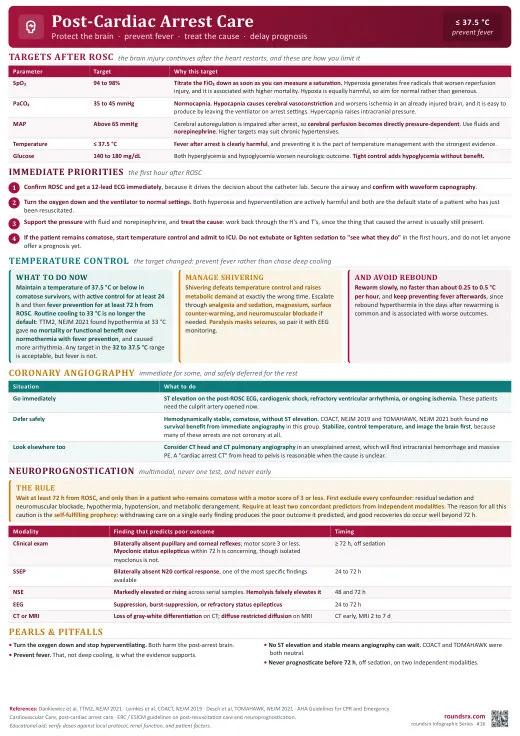
Text version
- Hypovolemia, Hypoxia
- Hydrogen ion, Hypo/hyperK
- Hypothermia, Hypoglycemia
- Tension PTX, Tamponade
- Toxins, Thrombosis (PE/MI)
- Trauma
- Wait ≥ 72h post-rewarming
- Neuro exam + SSEP + EEG
- MRI brain + NSE levels
- No single test is definitive
- Hyperoxia (FiO₂ 1.0 left on)
- Early prognostication
- Missing post-arrest NCSE
- Delaying PCI for STEMI