PRES
Posterior Reversible Encephalopathy Syndrome (PRES) is a clinico-radiographic syndrome characterized by vasogenic edema predominantly in the posterior (occipital/parietal) white matter. Pathophysiology: failure of cerebral autoregulation leads to blood-brain barrier breakdown and vasogenic edema.
- Severe hypertension -most common trigger. Exceeds upper limit of autoregulation.
- Eclampsia / pre-eclampsia -one of the most important causes in young women
- Immunosuppressants -tacrolimus, cyclosporine (calcineurin inhibitors) -common in transplant patients
- Chemotherapy -especially VEGF inhibitors (bevacizumab)
- Autoimmune disease -SLE, TTP, thrombotic microangiopathy
- Renal failure -especially with fluid overload and hypertension
Classic features: seizures (most common presenting symptom, 60-75%), headache (50%), visual disturbances (cortical blindness, blurry vision, visual field defects -33%), altered mental status (28%), and hypertension (often severe). Typically acute/subacute onset over hours to days.
- TREAT THE CAUSE -this is the most important step:
- Hypertensive emergency: lower BP gradually (IV antihypertensives -nicardipine, labetalol)
- Eclampsia: magnesium sulfate + delivery
- Drug-induced: discontinue offending agent (tacrolimus, cyclosporine, chemotherapy)
- Seizure management: Benzodiazepines for acute seizures. Levetiracetam (Keppra) for prophylaxis/maintenance (fewer drug interactions than phenytoin in transplant patients).
- BP control: Target 25% reduction in MAP over first few hours. Avoid precipitous drops (risk of ischemia). IV nicardipine or labetalol preferred.
- Usually REVERSIBLE if treated promptly -clinical and radiographic improvement typically within days to weeks. Delayed treatment can lead to permanent infarction, hemorrhage, and death.
- MRI brain (with FLAIR) -study of choice. Shows bilateral, symmetric white matter edema in posterior regions (occipital/parietal lobes). FLAIR and T2 sequences show hyperintense signal. DWI helps distinguish vasogenic (PRES) from cytotoxic (stroke) edema.
- CT head -less sensitive, may appear normal early. Can show low-density areas in posterior regions. Rule out hemorrhage.
- BP -often severely elevated (but PRES can occur at normal BPs, especially drug-induced)
- BMP -renal function, electrolytes
- CBC, LDH, peripheral smear, haptoglobin -rule out TTP/HUS if thrombocytopenia present
- Urine protein/Cr ratio -if pregnant or postpartum (pre-eclampsia workup)
- Drug levels -tacrolimus, cyclosporine trough levels if applicable
- LP -typically not needed. CSF may show mild protein elevation. Mainly to rule out meningitis/encephalitis if diagnosis uncertain.
| Drug | Indication | Dose | Notes |
|---|---|---|---|
| Nicardipine BP CONTROL | Hypertensive PRES | 5 mg/hr IV, titrate by 2.5 mg/hr q5-15 min (max 15 mg/hr) | Preferred -titratable, consistent effect. No cerebral vasoconstriction. |
| Labetalol | Hypertensive PRES | 10-20 mg IV bolus, double q10 min (max 300 mg) or 1-2 mg/min drip | Alternative to nicardipine. Avoid in severe bradycardia, asthma, heart block. |
| Levetiracetam (Keppra) | Seizure prophylaxis | 500-1000 mg IV/PO BID | Preferred in transplant patients (no CYP interactions -does not affect tacrolimus/cyclosporine levels). |
| Lorazepam (Ativan) | Acute seizures | 2-4 mg IV PRN | First-line for acute seizure control. |
| Magnesium sulfate | Eclampsia-related PRES | 4-6 g IV load, then 1-2 g/hr | Standard of care for eclamptic seizures. Also has antihypertensive effect. |
Mrs. Kim is a 45-year-old woman who is 6 months post-renal transplant on tacrolimus, presenting with sudden-onset severe headache, blurry vision, and a witnessed generalized tonic-clonic seizure. BP on arrival: 210/115. Neuro exam: confused, bilateral visual field deficits. Tacrolimus trough elevated at 18 (target 5-8). MRI brain: bilateral symmetric T2/FLAIR hyperintensity in the occipital and parietal white matter consistent with vasogenic edema. No restricted diffusion. No hemorrhage.
- Blood pressure -continuous arterial line or frequent NIBP. Target 25% MAP reduction over first hours, then gradually normalize.
- Neurologic exam -serial neuro checks q1-2h. Document mental status, vision, motor function.
- Repeat MRI -in 1-2 weeks to confirm radiographic resolution. If not improving, reconsider diagnosis.
- Seizure monitoring -consider continuous EEG if altered mental status persists or recurrent seizures.
- Drug levels -if calcineurin inhibitor-related, check trough levels and hold/reduce dose until resolution.
- Urine output and renal function -especially if pre-eclampsia or renal failure is the trigger.
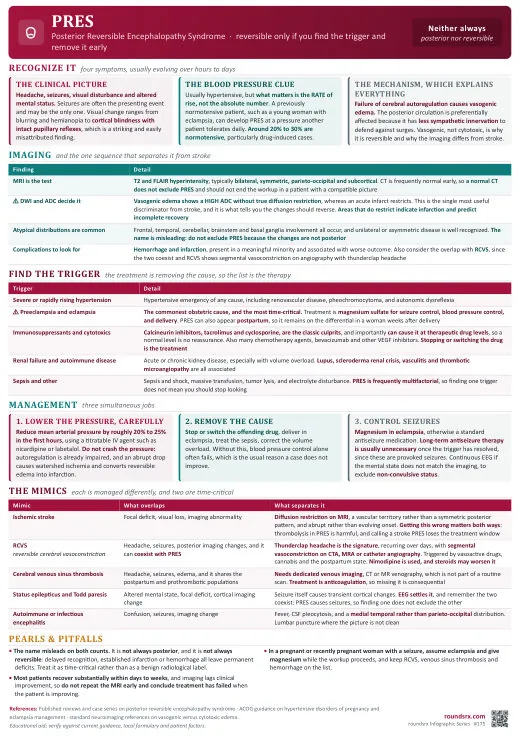
Text version
- Severe hypertension: most common trigger, BP exceeds the upper limit of cerebral autoregulation
- Eclampsia / pre-eclampsia: one of the most important causes in young women
- Immunosuppressants: tacrolimus, cyclosporine (calcineurin inhibitors), common in transplant patients
- Chemotherapy: especially VEGF inhibitors (bevacizumab)
- Autoimmune disease: SLE, TTP, thrombotic microangiopathy
- Renal failure: especially with fluid overload plus hypertension
- Note: PRES can occur at normal BP, especially drug-induced, so a normal blood pressure does not exclude it
- Seizures (60 to 75%), the most common presenting symptom, then headache (50%), visual disturbance (cortical blindness, blurry vision, field defects, 33%), altered mental status (28%), and often severe hypertension. Acute to subacute over hours to days
- MRI brain with FLAIR is the study of choice: bilateral, symmetric white matter edema in the posterior (occipital/parietal) regions, hyperintense on FLAIR and T2
- DWI is what separates PRES from stroke: vasogenic edema is DWI normal or dark (no restricted diffusion); cytotoxic stroke edema is DWI bright with ADC dark. Restricted diffusion in PRES means progression to infarction, a poor prognostic sign
- CT head is less sensitive and may be normal early. Use it to rule out hemorrhage, not to rule out PRES
- Labs: BMP for renal function and electrolytes; CBC, LDH, smear, haptoglobin to exclude TTP/HUS if thrombocytopenic; urine protein/Cr if pregnant or postpartum; tacrolimus or cyclosporine trough if applicable
- LP is typically not needed (CSF may show mild protein elevation), mainly to exclude meningitis or encephalitis if the diagnosis is uncertain
- BP continuously (arterial line or frequent NIBP): target 25% MAP reduction over the first hours, then normalize gradually, because overshooting risks ischemia
- Serial neuro checks q1 to 2h, documenting mental status, vision, and motor function, since these are what tell you the edema is resolving
- Repeat MRI in 1 to 2 weeks to confirm radiographic resolution. If it is not improving, reconsider the diagnosis
- Continuous EEG if altered mental status persists or seizures recur, to catch nonconvulsive activity
- Calcineurin inhibitor trough levels if drug-related, and hold or reduce the dose until resolution
- Urine output and renal function, especially when pre-eclampsia or renal failure is the trigger
- Dropping the BP precipitously. The target is a 25% MAP reduction over hours, not normalization in minutes, because a fast drop causes ischemia
- Trusting a normal CT. CT is less sensitive and may be normal early; MRI with FLAIR is what makes the diagnosis
- Assuming the name is literal. PRES is not always posterior (frontal lobes, brainstem, cerebellum can be involved) and not always reversible
- Excluding PRES because the BP is normal. Drug-induced PRES can occur at normal blood pressures
- Reaching for phenytoin in a transplant patient. It induces CYP3A4, which metabolizes tacrolimus and cyclosporine, so immunosuppressant levels crash and the graft is at risk of rejection. Levetiracetam is renally cleared with no CYP interactions
- Calling restricted diffusion "still PRES" and relaxing. It signals progression to infarction
- Seizure plus visual change plus severe hypertension: get the MRI, do not sit on it, because the window in which this is reversible is short
- Transplant patient with a supratherapeutic calcineurin inhibitor trough: hold the drug, that is the trigger and removing it is the treatment
- Pregnant or postpartum: eclampsia pathway, magnesium sulfate plus delivery, involve obstetrics immediately
- Thrombocytopenia on the CBC: send LDH, smear, and haptoglobin to exclude TTP/HUS, which is a different emergency with a different treatment
- Restricted diffusion, hemorrhage, or no improvement on repeat imaging: reconsider the diagnosis and escalate, this is no longer simple reversible PRES
- Pathophysiology: failure of cerebral autoregulation leads to blood-brain barrier breakdown and vasogenic edema
- Why posterior: the posterior (vertebrobasilar) circulation has less sympathetic innervation than the anterior (carotid) circulation, and sympathetic tone is what maintains autoregulation during acute hypertension, so the posterior circulation breaks through into hyperperfusion first
- Why levetiracetam over phenytoin: phenytoin is metabolized by and induces CYP3A4, dramatically lowering tacrolimus and cyclosporine levels and risking acute rejection
- The one-line takeaway: PRES is a clinical-radiographic diagnosis, and treating the trigger is what drives recovery