Preventive Care & Screening
The bread and butter of outpatient medicine. Know the USPSTF A/B recommendations cold -cancer screening, cardiovascular risk assessment, and immunizations. This is what keeps patients out of the hospital.
🔬 Cancer Screening (USPSTF)
| Cancer | Test | Age / Frequency | Key Notes |
|---|---|---|---|
| Breast | Mammography | 40–74, every 2 years (USPSTF 2024 update -lowered from 50 to 40) | Shared decision 40–49 in prior guidelines. Now routine. High-risk (BRCA, family hx) → may add MRI. |
| Cervical | Pap ± HPV | 21–65. Pap q3 years (21–29). Pap + HPV co-test q5 years or HPV alone q5 years (30–65). | Stop at 65 if adequate prior screening. No screening if hysterectomy (no cervix) for non-cancer indication. |
| Colorectal | Colonoscopy, FIT, Cologuard | 45–75. Colonoscopy q10 years, FIT annually, Cologuard q3 years. | USPSTF 2021 lowered from 50 to 45. 76–85 = selective. Family hx → start 10 years before youngest affected relative or age 40. |
| Lung | Low-dose CT (LDCT) | 50–80, ≥ 20 pack-years, current or quit within 15 years. Annual. | NLST, 2011: 20% mortality reduction. NELSON, 2020: confirmed. Shared decision-making required. |
| Prostate | PSA | 55–69: shared decision-making. USPSTF does NOT recommend routine screening. | PSA has high false-positive rate → unnecessary biopsies. Discuss benefits/harms. Not recommended > 70. |
Other Key Screenings
| Condition | Screening | Population |
|---|---|---|
| AAA | One-time abdominal US | Men 65–75 who ever smoked |
| Hepatitis C | Anti-HCV antibody | All adults 18–79 (one-time). USPSTF 2020. |
| HIV | HIV Ag/Ab combo | All adults 15–65 (one-time or more if high-risk). USPSTF 2019. |
| Diabetes | Fasting glucose, A1c, or OGTT | 35–70 with overweight/obesity. Screen q3 years. |
| Osteoporosis | DEXA scan | Women ≥ 65. Younger postmenopausal if FRAX 10-year hip fracture risk ≥ 3%. |
| Depression | PHQ-2 → PHQ-9 | All adults. USPSTF 2016. |
❤️ Cardiovascular Risk
Statin Therapy (2026 ACC/AHA Dyslipidemia Guideline)
What changed in 2026. CHANGED The 2013 Pooled Cohort Equation (PCE) is retired. Primary-prevention statin decisions now run on the 10-year PREVENT-ASCVD score (ages 30 to 79, no race input, needs an eGFR). The same patient scores roughly 40 to 50% lower on PREVENT than on the PCE, so the bands were lowered to compensate: low < 3%, borderline 3 to < 5%, intermediate 5 to < 10%, high ≥ 10% (2018: < 5 / 5 to 7.5 / 7.5 to 20 / ≥ 20%). Do not carry 7.5% or 20% across to a PREVENT number: an old cutoff applied to the new score withholds statins from people the guideline means to treat. NEW 2026 Primary prevention also has numeric LDL-C and non-HDL-C goals for the first time. Which PREVENT output drives which drug: Which PREVENT number do I use?
Work down the table: the first four rows are treated without a risk score, because the risk is already established by the disease itself. The score only decides for everyone left over.
| Who | 2026 recommendation, and why | vs 2018 |
|---|---|---|
| 1. Clinical ASCVD (prior MI, stroke or TIA, PAD, coronary revascularization) Secondary prevention: do not run PREVENT, it is not validated after an event | High-intensity statin (atorvastatin 40–80 mg or rosuvastatin 20–40 mg) 4S, 1994. Goal LDL-C < 55 and non-HDL-C < 85 for very-high-risk ASCVD, which is most patients (multiple major events, or one major event plus multiple high-risk conditions); LDL-C < 70 and non-HDL-C < 100 for the rest. Not at goal on a maximally tolerated statin: add ezetimibe, then a PCSK9 antibody, because event reduction tracks the absolute LDL-C drop. | CHANGED 2018 used a single LDL-C threshold of 70 for all clinical ASCVD. 2026 splits the goal (< 55 vs < 70) and pairs each with a non-HDL-C goal. |
| 2. LDL-C ≥ 190 | High-intensity statin, no risk score needed. The score underestimates risk here because exposure has been lifelong; likely familial hypercholesterolemia, so screen first-degree relatives and refer to a lipid specialist. Aim for a ≥ 50% LDL-C reduction and add ezetimibe early if short of it. | UNCHANGED indication. EARLIER START 2026 stresses treating heterozygous FH from diagnosis. |
| 3. Diabetes, age 40–75 | Moderate-intensity statin regardless of the score (Class 1; atorvastatin 10–20 mg, rosuvastatin 5–10 mg), goal LDL-C < 100 and non-HDL-C < 130, because diabetes at this age carries enough baseline risk that the calculator cannot talk you out of treating. High-intensity is reasonable with multiple ASCVD risk factors (Class 2a), goal LDL-C < 70 and non-HDL-C < 100. A PREVENT-ASCVD score ≥ 10% adds ezetimibe or a PCSK9 antibody (Class 2b); it does not set the statin intensity. | UNCHANGED moderate-intensity for all at 40–75. CHANGED the old teaching "high-intensity if risk ≥ 7.5%" is retired: intensity follows the number of risk factors, and the score (≥ 10% on PREVENT) only triggers add-on therapy. NEW 2026 numeric goals. |
| 4. CKD stage 3 or higher, or HIV, age 40–75 NEW 2026 | Statin indicated regardless of the score (Class 1). CKD (eGFR < 60, confirmed over ≥ 3 months): moderate-intensity statin, with or without ezetimibe, because moderate CKD carries event rates close to those of established ASCVD. Starting a statin on maintenance dialysis has not shown benefit. HIV: pitavastatin 4 mg, the statin with the least CYP3A4 interaction with antiretrovirals and the one the trial tested REPRIEVE, 2023. | CHANGED In 2018 both were only risk enhancers that nudged a borderline score. Each is now a statin indication on its own, so a low PREVENT score no longer excuses them. |
| 5. Everyone else, age 30–79, LDL-C 70–189: PREVENT-ASCVD ≥ 10% (high risk) | High-intensity statin (Class 1) for a ≥ 50% LDL-C reduction, goal LDL-C < 70 and non-HDL-C < 100. Add ezetimibe if still above goal on a maximally tolerated statin. | CHANGED 2018 high risk was PCE ≥ 20%. NEW 2026 2018 set no numeric primary-prevention goal. |
| PREVENT-ASCVD 5 to < 10% (intermediate) | At least a moderate-intensity statin is recommended (Class 1) after a clinician-patient discussion, goal LDL-C < 100 and non-HDL-C < 130 (Class 2a). If the decision is still uncertain, a CAC score should be used (Class 1): a zero permits deferral (but not in a current smoker, diabetes, or a strong family history of premature ASCVD), while ≥ 100 means treat to LDL-C < 70. See the CAC ladder. | CHANGED 2018 intermediate was PCE 7.5 to 20%, with no goal. CAC was Class 2a and is now Class 1. |
| PREVENT-ASCVD 3 to < 5% (borderline) | A moderate-intensity statin can be considered after a benefit-risk discussion. The number needed to treat is higher here, so risk enhancers carry the decision (Class 2a): premature ASCVD in a parent or sibling, Lp(a) ≥ 125 nmol/L (50 mg/dL), LDL-C persistently 160–189 or apoB ≥ 120, hsCRP ≥ 2 mg/L on more than one occasion, chronic inflammatory disease, CKM syndrome, reproductive risk markers, South Asian or Filipino ancestry. A present enhancer supports starting; an absent one does not lower the risk. | CHANGED 2018 borderline was PCE 5 to 7.5%. ABI < 0.9 is no longer a listed enhancer, metabolic syndrome and CKD folded into CKM syndrome, and CAC is not an enhancer: it is the separate reclassification step. |
| PREVENT-ASCVD < 3% (low) | Lifestyle counseling, reassess in 4 to 6 years. Exception, ages 30–59: a moderate-intensity statin is reasonable (Class 2a) if LDL-C is 160–189 or the 30-year PREVENT-ASCVD risk is ≥ 10%, because 10-year risk is almost always low at that age even when lifetime exposure is high. | CHANGED 2018 low was PCE < 5%. NEW 2026 the 30-year horizon; the PCE stopped at 10 years and started at age 40. |
Hypertension (2025 AHA/ACC)
- Stage 1 HTN: 130–139 or 80–89. Start a drug now with clinical CVD, diabetes, CKD, or a 10-year PREVENT total CVD risk ≥ 7.5% (2025 AHA/ACC, Class 1). Below 7.5%: lifestyle for 3 to 6 months, then treat if BP is still ≥ 130/80, because the absolute benefit at low risk is real but slow to accrue. CHANGED The 2017 rule was ASCVD ≥ 10% on the Pooled Cohort Equation. This is the total CVD output, not the PREVENT-ASCVD number that drives statins: BP lowering prevents heart failure as much as MI and stroke, so the matching outcome includes HF. See which PREVENT number to use.
- Stage 2 HTN: ≥ 140/90. Start 2-drug combination therapy. Reassess in 1 month.
- Target: < 130/80 for most adults SPRINT, 2015.
- First-line agents: ACEi/ARB (preferred if DM, CKD, proteinuria, HF), thiazide (chlorthalidone preferred), CCB (amlodipine). Start 2 of 3 for stage 2.
- Resistant HTN (≥ 3 drugs at max doses): screen for OSA, hyperaldosteronism, renal artery stenosis. Add spironolactone PATHWAY-2, 2015.
🏥 Rounds
Pimp Questions
USPSTF recently lowered the mammography screening start age. What changed and why?
In 2024, USPSTF lowered the recommended start age for mammography screening from 50 to 40, with biennial screening through age 74. The change was driven by rising breast cancer incidence in women under 50 -particularly Black women, who have higher rates of aggressive subtypes (triple-negative) and present at younger ages. The prior recommendation (50–74, with "individual decision" for 40–49) led to disparities in screening uptake.
A 52-year-old man with no heart disease or diabetes has an LDL-C of 130 and a 10-year PREVENT-ASCVD risk of 8%. Does he need a statin?
Yes. 8% on PREVENT-ASCVD is intermediate risk (5 to < 10%), where at least a moderate-intensity statin is recommended (Class 1) after a clinician-patient discussion, with a goal of LDL-C < 100 and non-HDL-C < 130 (Class 2a). If the decision is still uncertain, a CAC score should be used (Class 1): zero permits deferral, ≥ 100 moves the goal to LDL-C < 70. vs 2018: the old answer was "Group 4, Pooled Cohort Equation 7.5 to 20%". PREVENT runs about 40 to 50% lower in the same patient, so the bands fell to 3 / 5 / 10%; never read a PREVENT score against 7.5%. Risk enhancers decide at borderline risk (3 to < 5%), and ABI is no longer one of them.
When do you start lung cancer screening with LDCT and who qualifies?
USPSTF 2021 recommendation: Annual LDCT for adults aged 50-80 with ≥ 20 pack-year smoking history who currently smoke OR quit within the last 15 years. This was expanded from the previous criteria (55-80, ≥ 30 pack-years) to capture more at-risk individuals. Stop screening when: the person has not smoked for 15 years, develops a health problem that limits life expectancy or willingness to have curative surgery, or turns 81.
What cancer screenings are recommended by USPSTF and at what ages?
Breast: Mammography every 2 years, ages 40-74 (updated 2024 -lowered from 50). Cervical: Pap every 3 years ages 21-29, Pap + HPV co-test every 5 years ages 30-65. Colorectal: Start at 45 (updated from 50). Options: colonoscopy q10y, FIT annually, Cologuard q3y, CT colonography q5y, flex sig q5y. Lung: Annual LDCT ages 50-80 with ≥ 20 pack-year history + currently smoke or quit within 15 years. Prostate: Shared decision-making ages 55-69 (PSA screening -NOT universal recommendation). Not recommende
🔍 Overview
Overview
Preventive medicine is the highest-yield intervention. USPSTF Grade A/B recommendations guide screening. Key domains: cancer screening, CV risk, immunizations, behavioral counseling.
🧪 Workup
Workup
- Cancer screening: mammogram, Pap/HPV, colonoscopy, LDCT
- CV risk: PREVENT calculator (2026; replaces the Pooled Cohort Equation, and needs lipids, BP and an eGFR), plus Lp(a) once in every adult because it is genetically fixed and no risk score sees it
- Metabolic: A1c q3y if ≥35 + overweight
- Depression: PHQ-2 annually
- Hep C: one-time 18-79
- HIV: at least once 15-65
- Osteoporosis: DEXA 65F/70M
🚨 Management
Management
- Statin by 10-year PREVENT-ASCVD (2026): ≥ 10% high-intensity, goal LDL-C < 70; 5 to < 10% at least moderate-intensity, goal < 100; 3 to < 5% decided by risk enhancers or CAC. Diabetes, CKD stage 3+ and HIV at 40-75, and LDL-C ≥ 190, are treated regardless of the score. vs 2018: the Pooled Cohort cutoffs of 7.5% and 20% are retired, because PREVENT runs 40 to 50% lower
- ASA: limited, age 40-59 with ≥ 10% 10-year CVD risk on the Pooled Cohort Equation (the tool USPSTF 2022 used, so do not substitute a PREVENT score); shared decision because bleeding offsets most of the benefit, and never start at ≥ 60
- BP <130/80 [SPRINT, 2015]
- Smoking: 5 A's + varenicline+NRT
- Vaccines: flu, COVID, Tdap, shingrix≥50, pneumococcal conjugate ≥50 (PCV15/20/21), HPV≤26
💊 Medications
Medications
| Drug | Dose | Route | Notes |
|---|---|---|---|
| Atorvastatin (Lipitor) | 40-80mg | PO | High-intensity statin |
| Varenicline | 1mg BID × 12wk | PO | Smoking cessation |
| ASA 81mg | Daily | PO | Very limited role in primary prevention. ASCEND, 2018: bleeding offsets benefit in diabetes. USPSTF 2022: do NOT initiate for age ≥ 60. Consider only age 40–59 with ≥ 10% 10-year CVD risk via shared decision-making. That 10% is a Pooled Cohort Equation number, the tool USPSTF used in 2022; PREVENT runs roughly 40 to 50% lower, so do not read a PREVENT score against it. |
📋 On Rounds
📣 Sample Presentation
One-Liner
"Mrs. Thompson is a 52-year-old healthy woman presenting for her annual wellness visit. She is up to date on Pap smear (last year, normal) and mammogram (last year, normal). No colonoscopy yet. BMI 26, BP 128/82."
Key Points to Cover on Rounds
Cancer screening: colonoscopy due (age 52, average risk -schedule). Mammogram current (biennial, next in 1 year). Pap current (HPV co-test last year, repeat every 5 years; every 3 years applies to cytology alone). Lung CT: not indicated (non-smoker). CV risk: TC 196, HDL 58, LDL-C 122, eGFR 92. 10-year PREVENT-ASCVD risk 1.5% (low, < 3%) and 30-year risk 9.4% (< 10%), so no statin is indicated: lifestyle, recalculate in 4 to 6 years. Lp(a) sent once, since no score captures it. BP 128/82: the diastolic of 82 makes this stage 1 hypertension (130–139 or 80–89), not "elevated". PREVENT total CVD risk is 2.4% (< 7.5%) with no diabetes, CKD or CVD, so lifestyle for 3 to 6 months, confirm with home readings, and treat only if still ≥ 130/80. Fasting glucose 94, A1c 5.4 (normal, rescreen in 3 years). Immunizations: flu (today), COVID booster (due), Tdap (up to date), Shingrix dose 1 today (eligible from age 50; dose 2 in 2 to 6 months). Depression screening: PHQ-2 negative. Osteoporosis: not yet (screen at 65). Plan: colonoscopy referral, lifestyle counseling (diet, exercise, weight), return in 1 year.
⚡ Summary
Summary
Cancer Screening: Know the Ages
Breast: mammography every 2 years from 40 to 74 (lowered from 50 in 2024). Cervical: Pap every 3 years from 21 to 29, then Pap plus HPV co-test every 5 years from 30 to 65. Colorectal: start at 45 (lowered from 50), by colonoscopy every 10 years, annual FIT, stool DNA every 3 years, or CT colonography every 5. Lung: annual low-dose CT from 50 to 80 with a 20 pack-year history in current smokers or those who quit within 15 years.
Prostate Screening Is a Conversation, Not a Protocol
Shared decision-making from 55 to 69; it is not a universal recommendation. The tradeoff is a modest mortality benefit against overdiagnosis and the morbidity of treating cancers that would never have caused harm. Document the discussion rather than reflexively ordering or omitting the PSA.
Statins by Risk, Not by LDL Alone
Clinical ASCVD or LDL-C 190 or above: high-intensity statin, no risk score needed. Diabetes, CKD stage 3 or higher, or HIV at ages 40 to 75: a statin regardless of the score (at least moderate-intensity in diabetes), because the disease already establishes the risk. Otherwise run PREVENT-ASCVD: 10% or above gets a high-intensity statin (goal LDL-C under 70), 5 to under 10% at least moderate-intensity (goal under 100), and 3 to under 5% is decided with risk enhancers. Coronary artery calcium scoring resolves the uncertain intermediate-risk patient (Class 1 in 2026): a score of zero permits deferral, and 100 or above means treat to LDL-C under 70. vs 2018: the Pooled Cohort Equation and its 7.5% and 5 to 7.5% cutoffs are retired. PREVENT scores run about 40 to 50% lower in the same patient, so the old numbers must never be applied to it.
Use the Current Blood Pressure Thresholds
Normal below 120/80, elevated 120 to 129 systolic, stage 1 hypertension 130 to 139 or 80 to 89, stage 2 at 140/90 or above. Confirm with out-of-office readings before labeling anyone hypertensive, because white coat hypertension is common and a diagnosis made on a single clinic reading commits the patient to lifelong therapy.
Screen for the Non-Cancer Conditions Too
Diabetes or prediabetes from 35 to 70 in overweight adults. One-time abdominal aortic aneurysm ultrasound in men 65 to 75 who have ever smoked. Osteoporosis with DEXA in women 65 and over. Hepatitis C once in all adults 18 to 79, hepatitis B and HIV at least once, with more frequent HIV testing by risk. Depression, intimate partner violence and unhealthy alcohol use in all adults.
Vaccinate on Schedule
Influenza annually, COVID-19 per current guidance, Tdap once then Td every 10 years, shingles (Shingrix, two doses) from 50, RSV in older adults, and HPV through 26 with shared decision-making to 45. Pneumococcal conjugate is now routine from age 50 (lowered from 65 by ACIP in October 2024), given as a single dose of PCV15, PCV20 or PCV21, and still indicated from 19 with risk conditions. If PCV15 is the one used, it must be followed by PPSV23 at least a year later, or after 8 weeks in immunocompromised patients and those with a cochlear implant or CSF leak, because PCV15 alone leaves serotype gaps that the polysaccharide vaccine covers; PCV20 and PCV21 need no follow-on dose. Hospital admission is an opportunity, since inpatient vaccination reaches people who do not attend primary care. Check the current ACIP schedule rather than memorizing it -it is revised annually and the pneumococcal and RSV recommendations in particular have changed repeatedly in recent years.
Screening Has Harms as Well as Benefits
False positives, overdiagnosis, procedural complications and the anxiety of incidental findings are real costs, which is why the recommendations specify ages and intervals rather than 'more is better'. Stop screening when life expectancy is under about 10 years, since the benefit of finding an early cancer accrues years later while the harms are immediate.
Behavioral Counseling Outperforms Most Tests
Smoking cessation is the single highest-yield intervention in medicine. Add diet and physical activity counseling, alcohol reduction, and weight management. These change more outcomes than any screening test on the list, and they are what the screening visit exists to deliver.
📄 One Pager
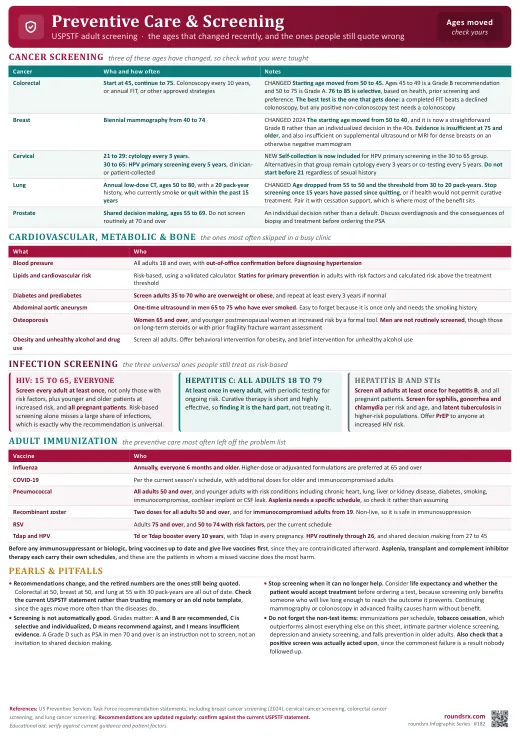
Text version
📄 One Pager
Primary Care · One Pager
Preventive Care
Mammogram q2y 40-74. Pap/HPV 21-65. Colonoscopy at 45. LDCT 50-80 if ≥ 20 pack-years. PREVENT-ASCVD risk → statin (≥ 10% high-intensity, 5 to < 10% moderate). PHQ-2 depression screen annually.
Cancer Screening
Breast: mammogram q2y 40-74. Cervical: Pap q3y (21-29) or Pap/HPV q5y (30-65). Colon: start age 45 (colonoscopy q10y, FIT annually, Cologuard q3y). Lung: LDCT 50-80 if ≥ 20 pack-year smoker.
Cardiovascular Prevention
10-year PREVENT-ASCVD risk (2026; replaces the Pooled Cohort Equation, whose 7.5% and 20% cutoffs are retired because PREVENT runs 40 to 50% lower). Statin: high-intensity if ≥ 10% (goal LDL-C < 70) or known ASCVD; at least moderate if 5 to < 10% (goal < 100); risk enhancers or CAC decide at 3 to < 5%. Diabetes, CKD stage 3+ and HIV at 40-75, and LDL-C ≥ 190: statin regardless of the score. ASA: limited role (ages 40-59, ≥ 10% risk on the Pooled Cohort Equation per USPSTF 2022, shared decision). BP target < 130/80 [SPRINT, 2015].
Other Screening
Depression: PHQ-2 annually. Diabetes: A1c q3y if ≥ 35 + overweight. Osteoporosis: DEXA at 65F/70M. Hepatitis C: one-time for all 18-79. HIV: at least once for all 15-65.
Key Drugs
Flu vaccineAnnual
Shingrix≥ 50 (2 doses)
Pneumococcal conjugate≥ 50
ColonoscopyEvery 10 years starting at 45
Pitfalls
- Not doing colonoscopy at 45 (USPSTF lowered from 50)
- Missing LDCT eligibility in former smokers
- PSA screening without shared decision-making
- Forgetting Hepatitis C screening (one-time, all adults)
Related Topics
Obesity Management & GLP-1 AgentsOutpatient Diabetes ManagementOutpatient Lipid ManagementSmoking Cessation