Prognostication Tools
| Tool | Population | What It Predicts |
|---|---|---|
| Surprise Question | Any serious illness | "Would I be surprised if this patient died in the next 12 months?" If no → initiate palliative discussion. |
| PPS (Palliative Performance Scale) | Cancer and non-cancer | Functional status 0–100%. PPS ≤ 50% → median survival ~6 months. PPS ≤ 30% → days to weeks. |
| PPI (Palliative Prognostic Index) | Cancer | Predicts survival < 3 weeks vs > 6 weeks based on PPS, oral intake, edema, dyspnea, delirium. |
| APACHE II/IV | ICU patients | ICU mortality prediction. Higher score = higher mortality. |
| MELD score | Liver disease | 3-month mortality in cirrhosis. Transplant prioritization. |
| Seattle Heart Failure Model | Heart failure | 1–5 year survival in chronic HF based on multiple variables. |
- Ask before telling: "How much information would you like to know about what to expect?"
- Use ranges: "We're talking about days to weeks" or "weeks to months" rather than specific dates
- Frame honestly: "I hope for the best, but I'm worried we may be looking at weeks rather than months"
- Acknowledge uncertainty: "No one can predict exactly -these are estimates based on what we know"
- Functional decline trajectory: Describe what to expect (increasing sleep, decreasing intake, less interaction)
| Time Frame | Clinical Indicators |
|---|---|
| Months | Declining functional status, weight loss, increasing symptoms, frequent hospitalizations |
| Weeks | Bed-bound most of day, minimal oral intake, drowsy, dependent for all ADLs |
| Days | Bed-bound, minimal consciousness, mottling, Cheyne-Stokes breathing, no oral intake |
| Hours | Unresponsive, irregular breathing, cool/mottled extremities, mandibular breathing |
| Trajectory | Pattern | Typical Diseases | Prognostic Challenge |
|---|---|---|---|
| Cancer | Preserved function → rapid decline in final weeks | Solid tumors, hematologic malignancies | Relatively predictable; decline signals end-stage |
| Organ Failure | Gradual decline + acute exacerbations + partial recovery | CHF, COPD, ESRD, cirrhosis | Unpredictable; each exacerbation may be fatal |
| Dementia/Frailty | Slow progressive decline over years | Alzheimer's, vascular dementia, frailty syndrome | Very prolonged; hard to identify terminal phase |
| Sudden Death | Full function → death | MI, PE, stroke, trauma, arrhythmia | No prognostic window; emphasizes advance planning for all |
- Functional status -PPS, Karnofsky, ECOG performance status
- Nutritional status -weight loss trajectory, BMI, intake history (albumin reflects inflammation, NOT nutrition per ASPEN 2021)
- Disease-specific markers -tumor markers, MELD, NYHA class, eGFR trajectory
- Hospitalization frequency -readmissions suggest declining trajectory
- Symptom burden -increasing symptom load suggests progression
- Patient/family understanding and wishes
Scenario: 78M with metastatic colon cancer, no further chemo options. PPS 40% (mainly in bed, extensive disease, considerable assistance, normal-reduced intake, drowsy). Family asks: "How much time does he have?"
Assessment:
- PPS 40% - median survival ~4-6 weeks
- PPI: PPS 30-50 (2.5) + reduced intake (1) + no edema (0) + no dyspnea at rest (0) + no delirium (0) = 3.5 - predicts survival > 6 weeks
- Clinical trajectory: declining over past 2 weeks, now bed-bound most of day
- Lab markers: albumin 2.1, rising LDH - poor prognostic signs
Communication: "Based on what we're seeing, I'm worried we may be looking at weeks to a few months. I hope I'm wrong, but I want to make sure you have time to do the things that matter most to your family."
Teaching point: Use multiple tools (PPS + PPI + clinical trajectory + labs) rather than relying on any single predictor. Convergence of multiple indicators increases confidence.
Scenario: 82F with NYHA Class IV HF, EF 15%, on home inotropes. Third hospitalization in 2 months. Not a transplant or LVAD candidate. Surprise question: "No, I would not be surprised if she died in the next 12 months."
Assessment:
- Seattle Heart Failure Model: estimated 1-year survival < 25%
- Recurrent hospitalizations despite optimized GDMT - marker of end-stage trajectory
- NYHA IV + inotrope dependence - median survival 6-12 months without advanced therapies
- Functional trajectory: organ failure pattern with stepwise decline and incomplete recovery between exacerbations
Communication: "Her heart is getting weaker despite our best treatments. Each hospitalization is harder to recover from. I think we're looking at months rather than years. I want to make sure we're focusing on what matters most to her."
Teaching point: Heart failure prognostication is harder than cancer because of the unpredictable exacerbation pattern. Patients may die suddenly from arrhythmia even when "stable." Use the surprise question to trigger earlier GOC discussions.
Scenario: 89F with advanced Alzheimer's, FAST stage 7C (nonambulatory, minimal verbal, requires total care). Recurrent aspiration pneumonia. Nursing home asks about feeding tube placement.
Assessment:
- FAST 7C - median survival ~12 months (range 6-24 months)
- Recurrent aspiration pneumonia in advanced dementia - 6-month mortality ~50%
- CASCADE study: feeding tubes do NOT prevent aspiration, do NOT improve survival, and increase agitation in advanced dementia
- Functional trajectory: slow progressive decline typical of dementia/frailty trajectory
Communication: "Your mother's dementia has reached an advanced stage where her body is losing the ability to swallow safely. A feeding tube would not prevent aspiration and studies show it doesn't help people with advanced dementia live longer. I'd recommend we focus on careful hand feeding for comfort and pleasure, and discuss what your mother would have wanted."
Teaching point: The Choosing Wisely campaign and multiple studies recommend against feeding tubes in advanced dementia. This is one of the clearest evidence-based recommendations in palliative care. Frame as what you CAN do (hand feeding, comfort), not what you won't do.
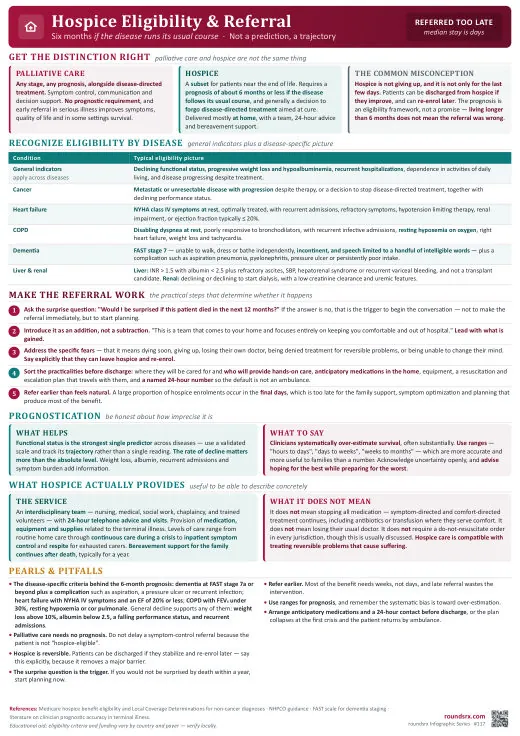
Text version
- Surprise question (any serious illness): "Would I be surprised if this patient died in the next 12 months?" If no, start the palliative discussion. Sensitivity and specificity ~70%, so it is a screening trigger, not a prognosis.
- PPS, Palliative Performance Scale (cancer and non-cancer): functional status 0–100% in 10% increments across ambulation, activity and evidence of disease, self-care, intake, and consciousness. PPS ≤ 50% predicts median survival ~6 months; PPS ≤ 30% means days to weeks.
- PPI, Palliative Prognostic Index (cancer): combines PPS, oral intake, edema, dyspnea at rest, and delirium. PPI > 6 predicts survival < 3 weeks (sensitivity 83%, specificity 85%).
- PaP, Palliative Prognostic Score (cancer): dyspnea, anorexia, KPS, clinical prediction of survival, WBC, lymphocyte %. Sorts into group A (> 70% chance of 30-day survival), B (30–70%), C (< 30%).
- APACHE II/IV (ICU): ICU mortality prediction, higher score means higher mortality.
- MELD (liver disease): 3-month mortality in cirrhosis and transplant prioritization.
- Seattle Heart Failure Model (heart failure): 1–5 year survival in chronic HF.
- KPS vs ECOG (performance status): KPS 0–100 (100 normal), ECOG 0–5 (0 fully active, 5 dead). KPS < 40 or ECOG ≥ 3 signals limited treatment tolerance and poor short-term prognosis.
- Months: declining functional status, weight loss, increasing symptoms, frequent hospitalizations.
- Weeks: bed-bound most of the day, minimal oral intake, drowsy, dependent for all ADLs.
- Days: bed-bound, minimal consciousness, mottling, Cheyne-Stokes breathing, no oral intake.
- Hours: unresponsive, irregular breathing, cool and mottled extremities, mandibular breathing.
- These physical signs are what let you narrow the range you give the family, which is why the exam at the door matters more than any score in the last days.
- Cancer: preserved function, then rapid decline in the final weeks. Relatively predictable, so the onset of decline itself signals end-stage.
- Organ failure (CHF, COPD, ESRD, cirrhosis): gradual decline with acute exacerbations and partial recovery. Unpredictable, because any exacerbation may be the fatal one, which is why the surprise question earns its place here.
- Dementia and frailty: slow progressive decline over years. Very prolonged, so the terminal phase is hard to identify at all.
- Sudden death (MI, PE, stroke, trauma, arrhythmia): full function to death, no prognostic window, which is the argument for advance care planning in everyone.
- Functional status: PPS, Karnofsky, or ECOG, the strongest single bedside predictor across diseases.
- Nutrition: weight loss trajectory, BMI, intake history. Albumin reflects inflammation, not nutrition, per ASPEN 2021.
- Disease-specific markers: tumor markers, MELD, NYHA class, eGFR trajectory.
- Hospitalization frequency: readmissions mark a declining trajectory even when each individual admission looks survivable.
- Symptom burden: a rising symptom load suggests progression.
- Labs: albumin < 2.5, elevated LDH, leukocytosis, lymphopenia, elevated CRP, rising creatinine. Low albumin is the strongest single lab predictor across disease types.
- Patient and family understanding and what they want to know.
- Trusting your own estimate: physicians overestimate survival by 3–5× on average, driven by optimism bias, therapeutic optimism, anchoring to the patient's best functional state instead of the current trajectory, and pressure from families who want hope.
- Applying a tool outside its population: PPI and PaP are validated in cancer, MELD in liver disease, Seattle in heart failure, APACHE in the ICU. A score's threshold does not transfer to another score's decision.
- Relying on one predictor: converge PPS plus PPI plus clinical trajectory plus labs; agreement between them is what raises confidence.
- Treating the surprise question as a prognosis: it screens for who needs the conversation, it does not estimate survival.
- Reading albumin as a nutrition marker and then treating the number instead of the disease.
- Feeding tubes in advanced dementia: they do not prevent aspiration, do not improve survival, and increase agitation. Offer careful hand feeding for comfort and pleasure instead.
- You would not be surprised if the patient died within 12 months.
- PPS ≤ 50% (median ~6 months) and certainly at PPS ≤ 30% (days to weeks), because at that point the window for planning is closing.
- PPI > 6 in a cancer patient, predicting survival < 3 weeks.
- Recurrent hospitalizations despite optimized therapy in organ failure, since each exacerbation may be fatal and a stable-looking patient can die suddenly from arrhythmia.
- Advanced dementia with recurrent aspiration, when the question of a feeding tube is being raised.
- Family asks "how long?" Answer with a range, not a refusal.
- Christakis, 2000 physicians overestimate survival by 3–5× on average.
- Downar, 2017 surprise question performance for 12-month mortality, good enough to screen, not to prognosticate.
- Morita, 1999 PPI > 6 predicts survival < 3 weeks in cancer.
- Pirovano, 1999 PaP score validation, three 30-day survival groups.
- Lunney, 2003 four end-of-life trajectories, which is why prognostic communication differs by disease.
- Teno, 2012 feeding tubes do not improve survival in advanced dementia.