Pulmonary Embolism
| Category | Description | Criteria | Disposition | Treatment |
|---|---|---|---|---|
| A SUBCLINICAL Old: incidental (not previously classified) | Asymptomatic, incidental PE (found on CT for another reason) | No symptoms attributable to PE. Incidental finding (e.g., cancer staging CT). | ED discharge with DOAC | Anticoagulation. Segmental or larger → treat. Isolated subsegmental → shared decision-making (treat vs surveillance). |
| B LOW SEVERITY Old: Low-risk PE | Symptomatic, low clinical severity | PESI* (Pulmonary Embolism Severity Index) ≤ 85 (class I–II), sPESI* (simplified PESI) = 0, Hestia < 1. Normal hemodynamics. B1 = subsegmental, B2 = non-subsegmental. | Early discharge (24–48h or directly from ED) | DOAC (apixaban or rivaroxaban). No heparin bridge. Close follow-up in 48–72h HESTIA, 2011. |
| C ELEVATED SEVERITY Old: Intermediate-low (C1–C2) / Submassive (C3) | Elevated clinical severity score ± RV dysfunction ± biomarkers | PESI III–V, sPESI ≥ 1, or Hestia ≥ 1. C1 = normal RV + normal biomarkers C2 = abnormal RV OR elevated biomarker C3 = abnormal RV AND elevated biomarker | Hospitalize. C3 → monitored bed (ICU/stepdown) | Anticoagulation. PERT* (Pulmonary Embolism Response Team) assessment for C2–C3 (Class 1). Close monitoring first 24–72h. Advanced therapy only if clinical deterioration. |
| D INCIPIENT FAILURE Old: Submassive PE (high-risk subset) | Incipient cardiopulmonary failure | D1 = transient hypotension (SBP < 90 that responds to fluids/single pressor) D2 = normotensive shock (AKI, lactate ↑, oliguria, altered MS, ↑ O2 requirement, worsening RV strain) | Hospitalize, ICU/monitored bed | Anticoagulation + PERT (Class 1). CDT* (Catheter-Directed Thrombolysis) or mechanical thrombectomy may be considered (Class 2b). Systemic tPA if rapidly deteriorating. |
| E CARDIOPULMONARY FAILURE Old: Massive PE | Persistent hypotension / cardiac arrest | E1 = SBP < 90 for ≥ 15 min despite resuscitation, requiring vasopressors, or cardiac arrest | ICU. Emergent intervention. | Systemic thrombolysis (Class 1). CDT / mechanical thrombectomy (Class 2a). Surgical embolectomy if others unavailable. VA-ECMO* (Veno-Arterial Extracorporeal Membrane Oxygenation) as bridge. |
| Step | Ask | If YES → |
|---|---|---|
| 1 | Hemodynamic collapse? Cardiac arrest, or SBP < 90 for ≥ 15 min despite fluids, requiring vasopressors. | E Activate PERT, prepare systemic tPA / thrombectomy / ECMO. |
| 2 | Incipient failure? Transient hypotension responding to fluids or single pressor (D1), OR normotensive shock: lactate ↑, AKI, oliguria, altered MS, rising O2 needs, worsening RV strain (D2). | D ICU, PERT consult, anticoag + consider CDT/thrombectomy (Class 2b). |
| 3 | Symptomatic with elevated severity? PESI III–V, sPESI ≥ 1, or Hestia ≥ 1, but hemodynamically stable. Then sub-classify using RV + biomarkers: • Both normal → C1 (ward) • One abnormal (RV OR biomarker) → C2 (monitored bed + PERT) • Both abnormal (RV AND biomarker) → C3 (ICU/stepdown + PERT) | C Hospitalize. Monitoring intensity matches the subcategory. |
| 4 | Symptomatic but low severity? sPESI = 0, PESI class I–II, Hestia 0, normal vitals, no RV strain, no biomarker elevation. B1 = subsegmental, B2 = non-subsegmental. | B DOAC, early discharge or directly from ED, 48–72h follow-up. |
| 0 | Asymptomatic incidental finding (e.g., PE seen on cancer staging CT, no PE-attributable symptoms). | A Outpatient DOAC if segmental or larger; shared decision-making if isolated subsegmental. |
| Mechanism | Examples |
|---|---|
| Stasis | Immobilization, post-op (especially ortho), long flights, paralysis, obesity, heart failure |
| Hypercoagulability | Cancer (especially pancreatic, lung, GI), OCPs/HRT, pregnancy/postpartum, Factor V Leiden, prothrombin mutation, antiphospholipid syndrome, nephrotic syndrome |
| Endothelial injury | Surgery, trauma, central venous catheters, prior DVT/PE, smoking |
- Dyspnea -most common symptom (~80%), often acute onset
- Pleuritic chest pain -sharp, worse with inspiration (~50%)
- Tachycardia -often out of proportion to clinical picture
- Hypoxia -but ~20% have normal SpO2 (A-a gradient usually elevated)
- Syncope -suggests Category E PE (transient loss of CO). Present in ~10%. In patients hospitalized for first-episode syncope, ~17% had PE on systematic workup PESIT, 2016, consider PE workup in unexplained syncope with risk factors.
- Hemoptysis (~7%), leg swelling (concurrent DVT in ~50%)
- New-onset atrial fibrillation -RV dilation stretches the RA → Afib
| Criterion | Points |
|---|---|
| Clinical signs/symptoms of DVT | 3.0 |
| PE is #1 diagnosis or equally likely | 3.0 |
| Heart rate > 100 | 1.5 |
| Immobilization (≥ 3 days) or surgery in past 4 weeks | 1.5 |
| Previous DVT/PE | 1.5 |
| Hemoptysis | 1.0 |
| Active cancer (treatment within 6 months or palliative) | 1.0 |
Score > 4 (PE likely): Go directly to CTPA. Skip D-dimer (too many false positives).
| Test | When | Key Points |
|---|---|---|
| CTPA | Gold standard -test of choice | Sensitivity > 95%. Shows clot location, RV/LV ratio (> 0.9 = RV dysfunction, which makes it Category C2 or higher), saddle PE. Avoid if contrast allergy or severe CKD → V/Q scan. Look for RV enlargement, septal bowing, reflux of contrast into IVC/hepatic veins. |
| D-dimer | Low/intermediate pretest (Wells ≤ 4) | High sensitivity (~95%), low specificity (~50%). Negative = rules out PE (NPV > 99%). Age-adjusted cutoff: age × 10 for > 50yo. Elevated in: cancer, pregnancy, post-op, DIC, infection -many false positives. Never order if high pretest probability. |
| V/Q Scan | Contrast allergy, severe CKD, pregnancy (controversial) | Reports as normal, low, intermediate, or high probability. Most useful if result is normal (rules out) or high probability (rules in). Intermediate = non-diagnostic → need CTPA or further workup. Best in patients with normal baseline CXR. |
| Bedside Echo | Unstable patient -cannot go to CT | Does NOT confirm PE but supports empiric treatment if: RV dilation (RVEDD > LVEDD), septal bowing (D-sign), McConnell's sign (RV free wall akinesis with apical sparing, ~95% specific), 60/60 sign (RVSP < 60 + PA acceleration time < 60 ms), TAPSE < 16 mm. |
| Troponin | All confirmed PE | Elevated = myocardial injury from RV strain. An abnormal biomarker makes it Category C2, and abnormal RV and biomarker makes it Category C3. Prognostic -higher mortality, increased risk of hemodynamic deterioration. Serial trending useful. |
| BNP / NT-proBNP | All confirmed PE | Elevated = RV pressure overload. BNP > 100 or NT-proBNP > 600 = higher risk. Combined with troponin for risk stratification. |
| Lower Extremity US | DVT suspected, or CTPA unavailable | Concurrent DVT found in ~50% of PE. Positive DVT + symptoms = treat for PE even without CTPA. Also useful in pregnancy to avoid radiation. |
| ECG | All suspected PE | Most common: sinus tachycardia. Classic findings (often absent): S1Q3T3, RBBB, RV strain pattern (T-wave inversions V1-V4), right axis deviation. New Afib in ~10%. Normal ECG does NOT rule out PE. |
| Modality | Key Findings | Clinical Significance |
|---|---|---|
| ECG | Sinus tachycardia (most common, ~40%). S1Q3T3 (deep S wave in lead I, Q wave in lead III, and T-wave inversion in lead III, reflects acute right-heart strain rotating the heart's electrical axis; classic but only ~20% of PEs). New RBBB, incomplete or complete (acute RV pressure overload slows right-sided conduction). TWI V1–V4 (RV strain pattern, repolarization abnormality across the right precordial leads). Right axis deviation. New atrial fibrillation (~10%, RV dilation stretches the right atrium). Low-voltage QRS or ST-depression in inferior leads. | None are sensitive or specific. Normal ECG does NOT rule out PE. Main value: rule out STEMI and pericarditis. S1Q3T3 + TWI V1–V4 together suggest larger clot burden / RV strain, associated with Categories C2–D. |
| Chest X-Ray | Normal CXR is the single most common finding (24–40%). Overall sensitivity ~33%, specificity ~59%, so CXR cannot rule PE in or out. Most common abnormal findings: linear/plate-like atelectasis (~70% of abnormal CXRs; splinting from pleuritic pain and surfactant dysfunction), small unilateral pleural effusion (30–50%, usually on the PE side), elevated hemidiaphragm (~20%, splinting on the PE side). Eponymous signs (high specificity, low sensitivity, mostly boards / pattern recognition):
| Primary role: rule out mimics (pneumonia, pneumothorax, large effusion, pulmonary edema, widened mediastinum suggesting aortic dissection). Never exclude PE based on CXR, since 24–40% of confirmed PEs have a normal film. Essential baseline before V/Q scan, since V/Q is most reliable when the baseline CXR is clear; abnormal CXR pushes you to CTPA. Pearl: sudden hypoxia + tachycardia + a clear chest is a classic PE clue. When the CXR cannot explain the patient's oxygen requirement, PE moves up the differential. |
| Lower-Extremity Doppler Ultrasound | Non-compressible common femoral or popliteal vein = acute DVT (primary finding). Loss of respiratory phasicity in the vein. Absent color Doppler flow within the lumen. Directly visible intraluminal echogenic thrombus. Concurrent DVT found in ~50% of confirmed PE. | Positive DVT + PE-compatible symptoms = treat as PE even without CTPA (same anticoagulation). Especially useful in pregnancy (avoids fetal radiation), contrast allergy, severe CKD. Negative scan does NOT rule out PE, proximal calf-vein DVTs can still embolize. |
| Spiral CT (CTPA) | Intraluminal filling defect in pulmonary artery (dark clot surrounded by bright contrast within the vessel, the direct diagnostic sign). Saddle PE (large clot straddling the main PA bifurcation like a saddle over a horse's back, occludes both left and right pulmonary arteries). RV/LV ratio > 1.0 (measured on axial reconstructions, the RV is bigger than the LV, indicating acute pressure overload; prognostic for Category C2–C3). Septal bowing into LV (same mechanism as echo D-sign). Reflux of contrast into IVC / hepatic veins (contrast injected into an arm vein normally flows forward through the right heart, but with failing RV the tricuspid valve leaks and contrast washes backward down the IVC, sign of severe RV dysfunction). Pulmonary infarct (wedge-shaped peripheral opacity, same finding as Hampton's hump on CXR, seen earlier on CT). Enlarged main PA (> 29 mm, upstream dilation from proximal clot). | Gold standard. Sensitivity > 95%, specificity > 97%. Also drives risk stratification (RV/LV ratio separates C1 from C2–C3). Avoid if contrast allergy or severe CKD (CrCl < 30), use V/Q scan. Look explicitly at the RV in the report; don't just read "PE positive/negative." |
| V/Q Scan | Mismatched segmental perfusion defects (a lung segment ventilates normally on the radiolabeled gas scan but shows no perfusion on the radiolabeled-albumin scan, because the clot blocks blood flow while the airway is still open; this is the hallmark of PE). Reported by PIOPED criteria (from the Prospective Investigation of Pulmonary Embolism Diagnosis, 1990 landmark study, established the four-tier probabilistic reporting): normal, low, intermediate, or high probability. | Normal scan rules out PE (NPV > 95%). High-probability scan rules in PE (PPV ~85%). Intermediate / low probability = non-diagnostic in ~70% of cases, need CTPA or lower-extremity US. Preferred in pregnancy (lower breast radiation than CTPA by some protocols), contrast allergy, and severe CKD. Requires clear baseline CXR. |
| Echocardiography (Bedside / TTE) | Six bedside findings, in order of how often you'll see them:
| Does not definitively diagnose PE. In an unstable patient with compatible clinical picture, RV strain findings support empiric systemic thrombolysis without CTPA. Also central to risk stratification: RV dysfunction defines the transition from C1 to C2–C3. Serial echo tracks RV recovery after treatment. |
| Pulmonary Angiography | Direct catheter-based contrast injection into the pulmonary arteries. Intraluminal filling defect or abrupt vessel cutoff. Allows measurement of PA pressures. | Historical gold standard, replaced by CTPA for diagnosis (CTPA is non-invasive, faster, as accurate). Still clinically relevant as the access route during catheter-directed therapy (EKOS, FlowTriever, Penumbra Indigo), diagnostic angiography and intervention occur together. Invasive, risk of contrast load and catheter-induced arrhythmia. Rarely indicated for diagnosis alone. |
- DOACs are recommended over VKAs (Class 1) per AHA/ACC 2026: Apixaban 10 mg BID × 7 days → 5 mg BID or Rivaroxaban 15 mg BID × 21 days → 20 mg daily. No heparin bridging needed AMPLIFY, 2013 EINSTEIN-PE, 2012. Apixaban preferred over rivaroxaban based on COBRRA, 2026 (54% less bleeding, equal efficacy).
- If using warfarin: bridge with LMWH/UFH until INR 2-3 × 2 consecutive days. Monitor INR weekly then monthly.
- Category A: Asymptomatic/incidental PE → can discharge from ED with DOAC.
- Category B: Symptomatic low-severity → early discharge (24–48h or directly from ED) if sPESI = 0 AND Hestia criteria negative (see below).
- Hemodynamically unstable (SBP < 100, requiring pressors)
- Thrombolysis or embolectomy needed
- Active bleeding or high bleeding risk
- Need > 24h O2 to maintain SpO2 > 90%
- PE diagnosed while on anticoagulation
- Severe pain requiring IV analgesia > 24h
- Medical or social reason for admission (> 24h)
- CrCl < 30 mL/min
- Severe liver disease
- Pregnancy
- History of HIT
| Modality | Mechanism | When to Consider |
|---|---|---|
| EKOS (EkoSonic) | Ultrasound-assisted catheter-directed lysis. Low-dose tPA (9–17 mg over 12–24h) delivered directly into PA with ultrasound waves to enhance clot penetration. | Category D–E (Class 2a for E1, Class 2b for D1–D2) per AHA/ACC 2026. Validated in HI-PEITHO, 2026 (61% reduction in decompensation, no increased bleeding) ULTIMA, 2014. |
| FlowTriever | Mechanical aspiration thrombectomy. No lytic agent needed, purely mechanical clot removal. | Class 2a for Category E1, Class 2b for D1–D2, Class 3 (No Benefit) for A–C1 per AHA/ACC 2026. Preferred over systemic tPA when bleeding risk is high FLARE, 2020. |
| Penumbra Indigo | Continuous aspiration mechanical thrombectomy (CAT). | Similar indications to FlowTriever. Lytic-free option. Same class recommendations per AHA/ACC 2026. |
| Surgical Embolectomy | Open cardiothoracic surgery to remove clot from PA. | Last resort. Category E when CDT unavailable and patient failing. Requires cardiothoracic surgery and cardiopulmonary bypass. |
| Scenario | Duration | Notes |
|---|---|---|
| Provoked PE (major reversible risk factor: surgery, immobilization, trauma, OCPs) | 3 months then stop | Transient risk factor removed. Low recurrence after stopping (~3%/year). AHA/ACC 2026: stopping at end of initial treatment phase is recommended when a major reversible risk factor is identified. |
| Unprovoked PE (no identifiable trigger) or persistent risk factors | ≥ 3–6 months, then extend indefinitely | AHA/ACC 2026: extended anticoagulation beyond 3–6 months is recommended for first acute PE without a major reversible risk factor. Extended-dose DOAC (apixaban 2.5 mg BID or rivaroxaban 10 mg daily) reduces recurrence with lower bleeding AMPLIFY-EXT, 2013. |
| Recurrent VTE (2nd unprovoked event) | Indefinite | Lifelong anticoagulation. Use extended-dose DOAC for lower bleeding risk. |
| Cancer-associated PE | Indefinite (while cancer active) | LMWH historically preferred CLOT, 2003. DOACs (edoxaban, rivaroxaban, apixaban) now acceptable alternatives, but avoid DOACs in GI/GU cancers (higher mucosal bleeding) Hokusai-VTE Cancer, 2018. |
| PE with thrombophilia | Consider indefinite | Antiphospholipid syndrome = indefinite warfarin (avoid DOACs,TRAPS, 2018). Factor V Leiden homozygous = consider indefinite. Heterozygous = treat like unprovoked. |
- Absolute contraindication to anticoagulation (active life-threatening bleed) + acute proximal DVT/PE
- Recurrent PE despite therapeutic anticoagulation
- Always use retrievable filters -remove within 30-90 days once anticoagulation can be started. Permanent filters cause long-term complications (IVC thrombosis, filter migration, fracture).
- IVC filter is NOT a substitute for anticoagulation. Start anticoag as soon as safe and retrieve the filter.
| Absolute | Relative |
|---|---|
|
|
Patient: 45M, post-op day 3 from knee surgery, sudden-onset dyspnea, HR 110, SpO2 92%, BP 128/82.
Pre-test probability: Wells score = 4.5 (HR > 100 = 1.5, immobilization/surgery = 1.5, PE most likely dx = 1.5) → PE likely → CTPA directly (skip D-dimer).
CT-PA: Saddle PE with RV dilation, RV/LV ratio 1.2.
Risk stratification:
- Hemodynamically stable (BP > 90) → NOT massive
- RV dilation on CT + troponin 0.08 (elevated) + BNP 450 → Category C3 PE
- sPESI score: age > 45 (+1), HR > 110 (+1) = 2 → high risk for decompensation
Treatment:
- Anticoagulation: Heparin drip (80 units/kg bolus → 18 units/kg/hr). Target aPTT 60-80.
- Disposition: ICU admission. Activate PERT if available.
- Monitor: Serial troponin q6h, repeat echo in 24h, continuous telemetry.
- Escalation plan: If SBP drops < 90, increasing O2, or worsening RV → catheter-directed therapy or half-dose tPA.
- Transition: Once stable × 24-48h → apixaban 10 mg BID × 7 days → 5 mg BID.
- Duration: Provoked (surgery) → 3 months. OCPs stopped.
Patient: 62F with metastatic ovarian cancer, found unresponsive. PEA arrest. No pulse. CPR initiated.
Bedside echo during CPR: Severely dilated RV, septal bowing into LV, no pericardial effusion.
Clinical reasoning: PEA arrest + cancer + massively dilated RV → Category E PE until proven otherwise.
Treatment:
- Push-dose tPA: Alteplase 50 mg IV bolus during CPR. Continue CPR for 60–90 min (tPA needs time).
- Second bolus: If no ROSC after 15 min → repeat alteplase 50 mg IV.
- ROSC achieved: Start heparin drip (no bolus after tPA). ICU admission. Post-ROSC care.
- Imaging: CTPA once stable confirms bilateral PE with large clot burden.
- Long-term: Cancer-associated PE → indefinite anticoagulation with LMWH (GU cancer, avoid DOACs).
Key lesson: In cardiac arrest with suspected PE, do NOT wait for imaging. Empiric tPA saves lives. Relative contraindications are overridden when the patient is coding.
Patient: 28F on OCPs, presents with 2 days of pleuritic chest pain and mild dyspnea. HR 88, BP 124/76, SpO2 98%.
Wells score: 4.5 (HR < 100 = 0, PE most likely dx = 3, OCPs = 1.5) → PE likely → CTPA.
CT-PA: Subsegmental PE in right lower lobe. RV/LV ratio 0.7 (normal). No RV strain.
Risk stratification:
- Hemodynamically stable, no RV dysfunction, troponin negative, BNP normal → Low-risk PE
- sPESI = 0 (age < 80, no cancer, no cardiopulm disease, HR < 110, SBP > 100, SpO2 > 90%)
- Hestia criteria, all absent
Treatment:
- Outpatient management: sPESI = 0 + Hestia negative → safe for discharge.
- Rivaroxaban 15 mg BID × 21 days → 20 mg daily. No heparin bridge needed.
- Stop OCPs. Discuss alternative contraception.
- Follow-up: PCP in 48–72 hours. Repeat imaging NOT routinely needed.
- Duration: 3 months (provoked, OCP-related). No thrombophilia workup unless recurrent.
Key lesson: Not every PE needs admission. Low-risk PE with sPESI = 0 and Hestia-negative can go home safely on a DOAC.
Patient: 31F, 28 weeks pregnant, acute dyspnea and tachycardia (HR 115). SpO2 94%. Left leg swelling for 3 days.
D-dimer: Elevated, but D-dimer is physiologically elevated in pregnancy → not reliable.
Diagnostic approach:
- Step 1: Lower extremity compression US → positive for left popliteal DVT.
- Step 2: DVT confirmed + symptoms → treat for PE without CTPA (avoid radiation if DVT already found).
Treatment:
- Enoxaparin 1 mg/kg BID (weight-based, use pre-pregnancy or actual weight). DOACs are contraindicated in pregnancy.
- Monitor anti-Xa levels (target 0.6–1.0 at peak, 4h post-dose). Dose adjustments needed as pregnancy progresses.
- Delivery plan: Switch to UFH at 36 weeks (shorter half-life, reversible with protamine). Hold LMWH 24h before planned delivery.
- Postpartum: Resume LMWH → transition to DOAC or warfarin after delivery. Continue for minimum 3 months total AND at least 6 weeks postpartum.
Key lesson: In pregnancy, start with leg US, if DVT is found, treat without CT. LMWH is the anticoagulant of choice. Plan the delivery switch to UFH early.
Patient: 58M with newly diagnosed lung adenocarcinoma. Staging CT chest/abdomen/pelvis incidentally finds a segmental PE in the right pulmonary artery. Asymptomatic. HR 78, BP 132/80, SpO2 97%.
Clinical question: Does an incidental PE need treatment?
Answer: Yes.
- Incidental PE in cancer patients carries same mortality and recurrence risk as symptomatic PE.
- ISTH and ASCO guidelines: Treat incidental PE the same as symptomatic PE.
- Exception: isolated subsegmental PE, discuss with hematology, may consider surveillance.
Treatment:
- LMWH or DOAC (this is lung cancer, not GI, DOACs are acceptable).
- Apixaban 10 mg BID × 7 days → 5 mg BID.
- Duration: Indefinite while cancer is active. Reassess if cancer enters remission.
- Check for RV strain: Echo + troponin + BNP to rule out RV strain (Category C2 to C3) despite being asymptomatic.
Key lesson: Incidental PE in cancer patients is NOT benign. Treat it. Always check RV function even in asymptomatic patients.
Patient: 54M with unprovoked PE 4 months ago, currently on apixaban 5 mg BID. Presents with new pleuritic chest pain and dyspnea. HR 105, SpO2 93%.
CTPA: New segmental PE in left lower lobe. RV/LV ratio 0.8. Old clot in right PA partially resolved.
Key questions:
- Is the patient actually taking the medication? Check adherence, missed doses are the #1 cause of "failure."
- Is there an occult malignancy? Unprovoked recurrent VTE has up to 10% cancer detection rate within 1 year.
Workup:
- Age-appropriate cancer screening (CT chest/abdomen/pelvis, CBC, CMP, LDH, UA)
- Thrombophilia workup: antiphospholipid antibodies (lupus anticoagulant, anticardiolipin, beta-2 glycoprotein)
- Consider anti-Xa level to confirm adequate drug levels
Treatment:
- Switch to LMWH (enoxaparin 1 mg/kg BID), more reliable in cancer/malabsorption.
- Consider IVC filter if recurrent PE despite therapeutic anticoagulation.
- Lifelong anticoagulation, second unprovoked event = indefinite treatment.
Key lesson: Recurrent PE on a DOAC, check adherence first, then hunt for cancer and antiphospholipid syndrome. Switch drug class and plan for lifelong anticoagulation.
Patient: 67M with HTN, acute tearing chest pain radiating to back. Diaphoretic. HR 108, BP 185/110 right arm, 142/88 left arm. SpO2 95%.
Initial concern: Tachycardia + chest pain + dyspnea → PE was on the differential.
Red flags that point AWAY from PE:
- Tearing/ripping quality radiating to back, classic dissection.
- > 20 mmHg BP differential between arms, highly specific for type A dissection.
- Severe hypertension, PE typically causes hypotension, not hypertension.
- No VTE risk factors, no immobilization, surgery, or cancer history.
CTA chest: Stanford Type B aortic dissection. No PE.
Why this matters:
- If you gave heparin for presumed PE → catastrophic bleeding into false lumen.
- Always consider the differential before anticoagulating. PE, dissection, STEMI, and tamponade can all present with chest pain + tachycardia.
Key lesson: Not every tachycardic chest pain is PE. Check BP in both arms. Tearing pain to back + BP differential = dissection until proven otherwise. Anticoagulating a dissection can be fatal.
Patient: 48F, 1 week post-cesarean section, sudden collapse. HR 130, BP 78/50, SpO2 82% on NRB. Altered mental status.
Bedside echo: Massively dilated RV. Mobile thrombus seen in the right atrium straddling the tricuspid valve (thrombus-in-transit). McConnell's sign positive.
This is a surgical emergency:
- Thrombus-in-transit = clot trapped between venous system and pulmonary arteries. Mortality > 40% without intervention.
- Risk of complete PA occlusion if thrombus embolizes further.
Treatment:
- Systemic tPA 100 mg over 2 hours, despite being 1 week post-cesarean (relative contraindication overridden by life-threatening PE).
- Norepinephrine for hemodynamic support. Avoid aggressive fluids.
- If tPA fails or contraindicated: Emergent surgical embolectomy or catheter-directed therapy.
- VA-ECMO as bridge if available and patient continues to deteriorate.
- Post-stabilization: Heparin drip → transition to LMWH (postpartum, can use DOAC if not breastfeeding).
Key lesson: Thrombus-in-transit on echo is a surgical emergency. Don't wait for CT. Lyse immediately or call CT surgery. Post-surgical status is a relative, not absolute, contraindication when the patient is dying.
| Parameter | D – E (ICU) | C1 – C3 (Ward / Monitored bed) | A – B (Home / ED discharge) |
|---|---|---|---|
| Vitals | Continuous telemetry + q1–2h. Arterial line if on pressors. | Continuous telemetry + q2–4h. (C1 may step down to q4h once stable.) | q8h inpatient; home pulse ox optional after discharge. |
| Re-categorize | q6h first 24–48h, watch for drift toward/from C. | q12h first 24–48h, C2/C3 can decompensate to D. | At 48–72h follow-up visit. |
| Troponin | q6h × 24h then daily. Rising = decompensation. Falling = RV recovery. | q6–12h × 24h for C2–C3. Baseline only for C1. | Baseline if not already done. |
| BNP / NT-proBNP | Baseline + q24h. Falling = RV recovery. | Baseline for all C. Repeat at 24h for C2–C3. | Baseline only if category unclear. |
| Lactate | q4–6h until clearing. Rising lactate = normotensive shock (D2) → escalate. | Baseline for C3. Recheck if clinically worsening. | Not routine. |
| Echocardiography | Repeat at 24–48h. Track TAPSE, RV/LV ratio, septal position. | Repeat at 24–48h for C2–C3. Not routine for C1. | Not routine. Only if symptoms persist at follow-up. |
| aPTT (if heparin drip) | q6h until therapeutic (60–80), then q12–24h. | q6h until therapeutic, then q12–24h if still on heparin. | N/A (on DOAC). |
| Platelet count | Baseline then q2–3 days. HIT screen if on heparin > 4 days. | Baseline. q2–3 days if on heparin > 4 days. | Baseline. |
| Hemoglobin | Daily. Watch for bleeding, especially post-tPA. | Daily × 48h then as clinically indicated. | Baseline. Repeat if bleeding signs. |
| Renal function | Daily BMP. Contrast nephropathy (post-CTPA) + drug dosing. | Baseline + q24–48h. | Baseline. Confirm CrCl for DOAC dosing. |
| Bleeding assessment | q shift: gums, GI (stool guaiac), hematuria, ecchymoses, access sites. | Daily exam + patient-reported. | Educate patient on bleeding signs. |
| SpO2 / O2 requirement | Continuous. Increasing O2 = deterioration → escalate. | Continuous or q2–4h. Wean as tolerated. | Wean to SpO2 ≥ 92% before discharge. |
- SBP drops < 90 mmHg or new vasopressor requirement
- Rising troponin or BNP despite anticoagulation
- Worsening RV function on repeat echo
- Increasing O2 requirement or new intubation need
- New arrhythmia (Afib, VT)
- Altered mental status (low CO to brain)
- Apixaban: Stop heparin → start apixaban 10 mg BID × 7 days → 5 mg BID. No overlap needed.
- Rivaroxaban: Stop heparin → start rivaroxaban 15 mg BID × 21 days → 20 mg daily. No overlap needed.
- Edoxaban: Requires 5-10 days of parenteral anticoag first → then edoxaban 60 mg daily.
- Warfarin: Start warfarin while on heparin. Continue heparin until INR 2-3 × 2 consecutive days (typically 5-7 days overlap).
- Within 1 week of discharge: Communication or clinic evaluation to assess symptoms, bleeding, medication adherence, and early complications AHA/ACC 2026.
- At or before 3 months: Clinical visit to determine anticoagulation duration (stop vs extend). Reassess risk factors, provoked vs unprovoked status, bleeding risk. This is the key decision point AHA/ACC 2026.
- CTEPH screening at every visit for ≥ 1 year: If persistent dyspnea → echo → V/Q scan if elevated RVSP. CTEPH develops in 2–4% of PE survivors.
- Thrombophilia workup: Consider if unprovoked PE in patient < 50 (Factor V Leiden, prothrombin mutation, antiphospholipid antibodies). Test AFTER completing anticoagulation (DOACs and warfarin affect results).
- Cancer screening: If unprovoked PE in patient > 50 → age-appropriate cancer screening (colonoscopy, mammogram, CT chest, PSA if male).
- Anticoagulation therapeutic? → aPTT in range (60-80) if on heparin drip. Anti-Xa if using LMWH. Confirm DOAC dosing correct.
- Hemodynamics stable? → HR trending down? BP stable? O2 requirement decreasing? Any signs of deterioration?
- Troponin/BNP trend? → Falling = good. Rising = RV strain worsening → consider escalation.
- RV function reassessment? → Repeat echo in 24-48h for Category C3 to D. TAPSE, RV/LV ratio improving?
- Bleeding assessment? → Any signs of bleeding (GI, gums, hematuria, bruising)? Hgb stable?
- DVT prophylaxis bilateral? → Concurrent DVT? Lower extremity US result? SCDs on non-affected leg.
- Transition plan? → When to switch from heparin to oral DOAC? Which DOAC? Duration decision documented?
- IVC filter needed? → Only if anticoag contraindicated. If placed, document retrieval plan (30-90 days).
- Etiology workup? → Provoked vs unprovoked? If unprovoked and < 50yo: consider thrombophilia workup (after acute treatment). If > 50 + unprovoked: age-appropriate cancer screening.
- Disposition planning? → If low-risk (sPESI 0, Hestia negative): outpatient with 48-72h follow-up. Category C3 to D: when safe to step down from ICU?
| Drug (Brand) | Dose | Monitoring | Reversal | Notes |
|---|---|---|---|---|
| Apixaban (Eliquis) 1ST LINE | 10 mg BID × 7 days → 5 mg BID Extended: 2.5 mg BID | No routine monitoring. Anti-Xa if needed (rare). | Andexanet alfa (Andexxa). PCC 50 units/kg if unavailable. | Lowest bleeding risk of all DOACs. No bridging. Preferred in CKD (less renal clearance). Avoid if CrCl < 25. AMPLIFY, 2013 |
| Rivaroxaban (Xarelto) 1ST LINE | 15 mg BID × 21 days → 20 mg daily Extended: 10 mg daily | No routine monitoring. | Andexanet alfa. PCC if unavailable. | No bridging. Must take with food (bioavailability drops 40% without). Caution if CrCl < 30. EINSTEIN-PE, 2012 |
| Heparin (UFH) CATEGORY C3 TO E | 80 units/kg bolus → 18 units/kg/hr drip | aPTT q6h until therapeutic (60-80 sec), then q12-24h. | Protamine sulfate (1 mg per 100 units heparin given in past 2-3h). | Short half-life (60-90 min). Use when intervention likely or high bleed risk. Reversible. Monitor for HIT (platelet count q2-3 days). |
| Enoxaparin (Lovenox) BRIDGE / PREGNANCY | 1 mg/kg SC q12h Or 1.5 mg/kg SC daily | Anti-Xa level (target 0.6-1.0 for q12h dosing). Check in obesity, renal impairment, pregnancy. | Protamine (partial reversal only ~60%). | Bridge to warfarin or primary therapy in pregnancy. Avoid if CrCl < 30 → use UFH. Weight-based, no cap needed in obesity (check anti-Xa). |
| Edoxaban (Savaysa) | 60 mg daily (after 5-10 days of parenteral anticoag) | No routine monitoring. | PCC. No specific reversal agent. | Requires heparin/LMWH lead-in (unlike apixaban/rivaroxaban). Avoid if CrCl > 95 (paradoxically less effective). Good option for cancer-associated PE (non-GI) Hokusai-VTE Cancer, 2018. |
| Dabigatran (Pradaxa) | 150 mg BID (after 5-10 days of parenteral anticoag) | No routine monitoring. Renal function q6–12mo. | Idarucizumab (Praxbind) 5 g IV, specific monoclonal reversal. | Direct thrombin inhibitor. Requires heparin/LMWH lead-in. Avoid if CrCl < 30. GI upset common. Noninferior to warfarin for VTE RE-COVER, 2009. |
| Warfarin (Coumadin) | Start 5 mg daily, adjust to INR 2-3 | INR daily until stable, then weekly, then monthly. Target 2.0-3.0. | Vitamin K (oral/IV) + 4-factor PCC (KCentra) for life-threatening bleed. FFP if PCC unavailable. | Requires 5-7 day heparin/LMWH bridge. INR 2-3 × 2 consecutive days before stopping bridge. Many drug/food interactions. Last-line behind DOACs except in APS. |
| Drug | Dose | Route | Notes |
|---|---|---|---|
| Alteplase (tPA, Activase) CATEGORY E PE | 100 mg IV over 2 hours Cardiac arrest: 50 mg IV bolus | Systemic IV | Standard of care for Category E PE. Major bleeding ~10%, ICH ~2%. Start heparin drip after infusion (no bolus). Continue CPR 60-90 min post-tPA if in arrest. |
| Alteplase (low-dose, CDT) | 12-24 mg over 12-24 hours via catheter directly into PA | Catheter-directed (EKOS) | Used with ultrasound-assisted catheter. Significantly lower systemic bleeding than full-dose IV. Requires IR/interventional cardiology ULTIMA, 2014. |
| Half-dose tPA | 50 mg IV over 2 hours | Systemic IV | For Category C3 to D with deterioration. Lower bleeding risk than full dose. Improved pulmonary artery pressures in MOPETT trial MOPETT, 2013. Not universally accepted -discuss with attending. |
| Tenecteplase | Weight-based single bolus | Systemic IV | Single-bolus administration (easier than 2h alteplase infusion). Studied in PEITHO for submassive PE -reduced decompensation but increased bleeding/stroke. Not first-line for Category C3. |
| Agent | Dose | Why in PE | Avoid |
|---|---|---|---|
| Norepinephrine 1ST LINE | 0.01-3 mcg/kg/min | ↑ SVR + mild inotropy. Supports MAP without significantly increasing PVR. | - |
| Vasopressin ADJUNCT | 0.03 units/min (fixed) | V1-mediated vasoconstriction. Does not increase PVR. NE-sparing. | - |
| Dobutamine | 2-20 mcg/kg/min | If evidence of RV failure with low CO. Adds inotropy to support RV contractility. | Can worsen hypotension (beta-2 vasodilation). Only use with concurrent vasopressor. |
| Phenylephrine AVOID | - | - | Avoid in PE. Pure alpha agonist → increases PVR → worsens RV afterload → further RV failure. |
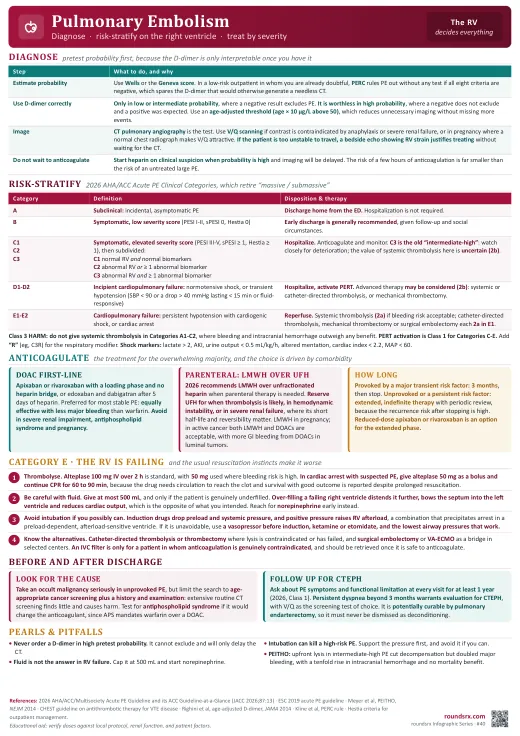
Text version
Category C3 to D (stable + RV strain): heparin drip. PERT. Serial troponin. Escalate if deteriorating.
Low-risk (sPESI 0 + Hestia negative): outpatient DOAC.
Unprovoked: ≥ 6 months, consider indefinite
Recurrent: Indefinite (reduced-dose DOAC)
Cancer: Indefinite (LMWH or DOAC, avoid DOAC in GI cancers)
APS: Warfarin (DOACs inferior)
- D-dimer without Wells/PERC (ordering reflexively)
- Aggressive fluids in Category E PE (worsens RV failure)
- Intubation without hemodynamic preparation
- Missing RV strain, so calling a C3 patient low-risk (not checking troponin/BNP)
- Routine tPA for Category C3 (PEITHO: ↑ bleeding)
- Not considering outpatient treatment for sPESI 0
- Forgetting CTEPH screening at 3-6 months
- DOACs in pregnancy or APS