PFT Interpretation
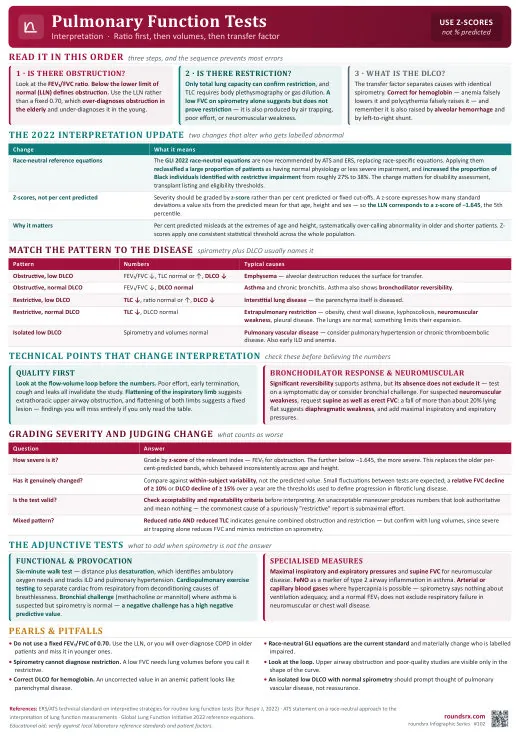
| FEV₁/FVC | Pattern | Examples |
|---|---|---|
| < 0.70 (or < LLN) | Obstructive GOLD Criteria, 2024 | COPD, asthma, bronchiectasis, bronchiolitis obliterans |
| Normal or ↑ | Restrictive (if TLC reduced) | ILD (IPF, sarcoidosis), chest wall disease, neuromuscular (ALS, myasthenia), obesity |
| ↓ with ↓ TLC | Mixed | Combined COPD + ILD, sarcoidosis |
- Positive response: FEV₁ or FVC improves ≥ 12% AND ≥ 200 mL after albuterol ATS/ERS Spirometry Standardization, 2005
- Positive → suggests asthma (reversible obstruction)
- Negative → suggests COPD (fixed obstruction), but some COPD patients have partial reversibility
| DLCO | Pattern | Think |
|---|---|---|
| Low DLCO + Obstruction | Emphysema (parenchymal destruction) | COPD (emphysema phenotype). Asthma has NORMAL DLCO -key differentiator. |
| Low DLCO + Restriction | Interstitial lung disease | IPF, sarcoidosis, hypersensitivity pneumonitis, drug-induced ILD |
| Low DLCO + Normal spirometry | Pulmonary vascular disease | Pulmonary hypertension, PE, early ILD |
| Normal/↑ DLCO + Restriction | Extrapulmonary restriction | Obesity, neuromuscular disease, chest wall deformity (lungs are normal) |
| ↑ DLCO | Increased pulmonary blood flow | Diffuse alveolar hemorrhage, polycythemia, L-to-R shunt, asthma, obesity |
| Volume | Obstructive | Restrictive |
|---|---|---|
| TLC | ↑ or normal (hyperinflation, air trapping) | ↓ (< 80% predicted) |
| RV | ↑↑ (air trapping) | ↓ or normal |
| RV/TLC ratio | ↑ | Normal or ↓ |
| FRC | ↑ | ↓ |
- Spirometry -FEV₁, FVC, ratio
- Lung volumes -TLC (confirm restriction)
- DLCO -low=emphysema/ILD; normal=asthma
- Bronchodilator response
- Methacholine challenge
- Flow-volume loop
| Drug | Dose | Route | Notes |
|---|---|---|---|
| Albuterol neb | 2.5mg | Neb | Reversibility testing |
| PFTs are diagnostic | not therapeutic | - | - |
Patient: 64M, 45-pack-year smoker. Progressive dyspnea × 3 years. PFTs: FEV₁ 42% predicted, FVC 78%, FEV₁/FVC 0.54, DLCO 48%. Post-bronchodilator: FEV₁ improves 6% and 90 mL.
Key findings: Obstructive pattern: FEV₁/FVC < 0.70 (the defining ratio). Low DLCO = emphysema (alveolar destruction). Minimal bronchodilator response (< 12% or < 200 mL) = COPD, not asthma. Reversibility requires BOTH thresholds, so failing either one means not reversible. GOLD Stage III (severe: FEV₁ 30-49%).
Management:
- LABA/LAMA combination inhaler (first-line for symptomatic COPD GOLD B-E)
- Add ICS only if eosinophils > 300 or frequent exacerbations despite dual bronchodilators
- Smoking cessation (the ONLY intervention proven to slow FEV₁ decline)
- Pulmonary rehab referral (improves exercise capacity, dyspnea, and QOL)
- Annual PFTs to track FEV₁ decline (normal: ~30 mL/yr; COPD smoker: 60-100 mL/yr)
Teaching point: FEV₁/FVC < 0.70 = obstruction. The FEV₁ alone determines severity (GOLD staging). Bronchodilator response distinguishes COPD (minimal) from asthma (significant: ≥ 12% AND ≥ 200 mL). But there is overlap, some patients have both.
Patient: 70F with progressive dyspnea and dry cough × 18 months. Bibasilar velcro crackles. PFTs: FEV₁ 62%, FVC 58%, FEV₁/FVC 0.85 (normal ratio), TLC 65%, DLCO 38%.
Key findings: Restrictive pattern: reduced TLC (< 80%) with preserved or elevated FEV₁/FVC ratio. Very low DLCO = impaired gas exchange (fibrosis thickens alveolar-capillary membrane). HRCT needed to determine cause.
Management:
- HRCT chest, look for UIP pattern (honeycombing, traction bronchiectasis = IPF) vs NSIP pattern (GGO predominant = potentially treatable)
- If UIP pattern: antifibrotic therapy (pirfenidone or nintedanib)
- Serial PFTs q3-6 months, FVC decline > 10% absolute or DLCO decline > 15% = disease progression
- 6-minute walk test (6MWT), desaturation > 4% = significant; supplemental O₂ if SpO₂ < 88%
- Early lung transplant referral if FVC < 80% or DLCO < 40% at diagnosis
Teaching point: FVC is the most important PFT for monitoring ILD progression, a 10% absolute decline in FVC over 6-12 months doubles mortality risk. DLCO is the most sensitive early marker but also declines with anemia and pulmonary HTN.
Patient: 58M with COPD and morbid obesity (BMI 48). PFTs: FEV₁ 45%, FVC 52%, FEV₁/FVC 0.62, TLC 72%, DLCO 55%. Lung volumes show decreased TLC but elevated RV/TLC ratio.
Key findings: Mixed pattern: FEV₁/FVC < 0.70 (obstruction) + TLC < 80% (restriction). Common in COPD + obesity, COPD + ILD overlap, or sarcoidosis. The reduced TLC from obesity masks hyperinflation from COPD.
Management:
- Separate the contributions: body plethysmography (most accurate TLC) + chest imaging to assess parenchyma
- Treat both: bronchodilators for COPD component + weight loss for restrictive component
- Weight loss target: 10% body weight → expect ~5-10% improvement in FVC
- If DLCO disproportionately low for the degree of obstruction: consider concurrent ILD or pulmonary HTN
- ABG if concern for OHS (BMI > 40 + daytime hypercapnia)
Teaching point: A "normal" FEV₁/FVC ratio in a patient with low FVC does NOT rule out obstruction, both FEV₁ and FVC may be proportionally reduced ("pseudo-normalization"). Always check lung volumes (TLC) to confirm true restriction.
- PFTs q6-12mo
- FVC decline >5-10%/yr in ILD → escalate
- DLCO <40% → O₂+transplant eval
- 6MWT
Text version
- Diagnosing restriction without lung volumes (need TLC)
- Missing asthma vs COPD distinction (reversibility + DLCO)
- Not correcting DLCO for anemia
- Ignoring the flow-volume loop (upper airway obstruction)