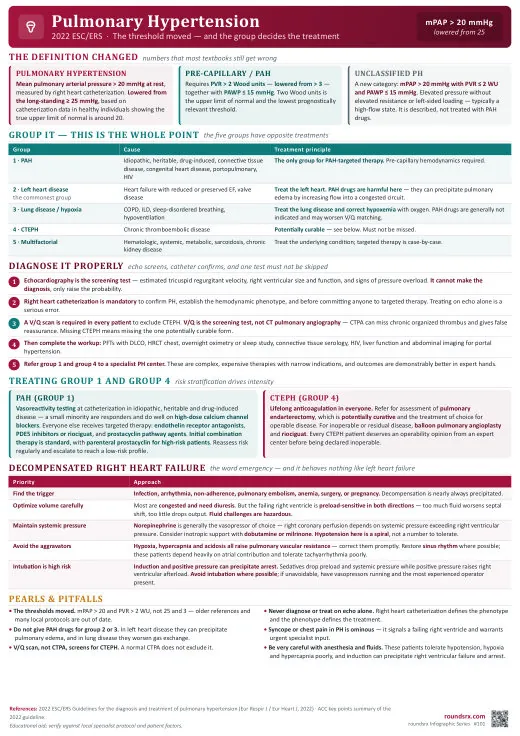
Pulmonary Hypertension
| Group | Category | Examples |
|---|---|---|
| 1 | Pulmonary Arterial HTN (PAH) | Idiopathic, heritable, CTD-associated (scleroderma), HIV, portopulmonary, drugs |
| 2 | Left heart disease | HFrEF, HFpEF, valvular disease -MOST COMMON cause of PH |
| 3 | Lung disease/hypoxia | COPD, ILD, OSA |
| 4 | CTEPH | Chronic thromboembolic PH -potentially curable with pulmonary endarterectomy |
| 5 | Multifactorial | Sarcoidosis, hematologic, metabolic |
| Type | mPAP | PAWP | PVR | Groups |
|---|---|---|---|---|
| Pre-capillary PH | ≥20 mmHg | ≤15 mmHg | >2 WU | Groups 1, 3, 4, 5 |
| Isolated post-capillary PH (IpcPH) | ≥20 mmHg | >15 mmHg | ≤2 WU | Group 2 |
| Combined pre- and post-capillary PH (CpcPH) | ≥20 mmHg | >15 mmHg | >2 WU | Group 2 (with vascular remodeling) or Group 5 |
| Feature | Details |
|---|---|
| Who gets tested? | All patients with idiopathic, heritable, or drug-associated PAH (Group 1 only). NOT for Groups 2-5 |
| Agents used | Inhaled nitric oxide (10-20 ppm) or IV epoprostenol or IV adenosine during RHC |
| Positive response | Reduction in mPAP ≥10 mmHg to reach absolute mPAP ≤40 mmHg with maintained or increased cardiac output |
| If positive (~10% of IPAH) | Trial of high-dose calcium channel blockers (nifedipine, diltiazem, or amlodipine). NOT verapamil (negative inotropy) |
| If negative | Initiate PAH-specific therapy based on risk stratification (ERA + PDE5i for most; add prostacyclin if high-risk) |
| Long-term CCB responders | Only ~5-7% of IPAH patients are true long-term CCB responders. Must reassess at 3-6 months |
| Parameter | Normal | Abnormal (PH) | Clinical Significance |
|---|---|---|---|
| mPAP | <20 mmHg | ≥20 mmHg | Defines PH. Correlates with disease severity |
| PAWP (PCWP) | 6-12 mmHg | >15 = post-capillary | Distinguishes Group 1 (pre-capillary) from Group 2 (post-capillary) |
| PVR | <2 WU | >2 WU = pre-capillary component | Elevated PVR with high PAWP = combined pre/post-capillary (CpcPH) |
| Cardiac output/index | CI >2.5 L/min/m² | CI <2.0 = severe RV failure | Low CI is a strong predictor of mortality |
| RAP | 0-5 mmHg | >14 = severe RV failure | Elevated RAP indicates RV failure and volume overload |
| SvO2 | 65-75% | <60% = inadequate CO | Low mixed venous sat reflects poor cardiac output |
- Treat underlying cause -Group 2: optimize HF. Group 3: supplemental O₂. Group 4: anticoagulation ± PTE
- PAH-specific therapy -only for Group 1 (and select Group 4/5). Based on vasoreactivity testing
- Avoid: excessive IV fluids (RV cannot handle volume), systemic vasodilators (worsen V/Q mismatch), high-dose diuretics (RV is preload-dependent)
| Pathway | Drugs | Notes |
|---|---|---|
| Endothelin receptor antagonists | Bosentan (Tracleer), Ambrisentan (Letairis), Macitentan (Opsumit) | Check LFTs monthly (hepatotoxicity). Teratogenic. |
| PDE-5 inhibitors | Sildenafil (Revatio), Tadalafil (Adcirca) | ↑ cGMP → pulm vasodilation. Avoid with nitrates. |
| Prostacyclin pathway | Epoprostenol (Flolan), Treprostinil (Remodulin), Iloprost (Ventavis) | Epoprostenol = most potent. Continuous IV infusion. Line infection risk. Never abruptly stop -rebound PH crisis. |
| sGC stimulator | Riociguat (Adempas) | For PAH or inoperable CTEPH. Contraindicated with PDE-5i. |
- Volume management: RV is preload-sensitive BUT volume overload worsens RV dilation → septal bowing → LV impairment. Target gentle diuresis with IV furosemide. Avoid aggressive fluid boluses.
- Vasopressors: Norepinephrine preferred (maintains systemic pressure without increasing PVR). Avoid phenylephrine (pure alpha = increases PVR). Consider vasopressin as adjunct.
- Inotropes: Dobutamine or milrinone to augment RV contractility. Milrinone also reduces PVR (pulmonary vasodilator).
- Pulmonary vasodilators: Inhaled NO or inhaled epoprostenol, reduce PVR without systemic hypotension. Avoid systemic vasodilators.
- Avoid: Intubation if possible (positive pressure ventilation ↑ PVR → RV collapse). If needed, use low tidal volumes, avoid hypoxia/hypercarbia/acidosis.
- Arrhythmia management: AF/flutter poorly tolerated in PH (loss of atrial kick devastating for stiff RV). Cardiovert early.
| Drug Class | Mechanism | Drugs | Route | Key Side Effects | Special Notes |
|---|---|---|---|---|---|
| Endothelin Receptor Antagonists (ERA) | Block ET-1 → reduce vasoconstriction + proliferation | Ambrisentan, Bosentan, Macitentan | PO | Hepatotoxicity (bosentan), peripheral edema, anemia | Teratogenic. Monthly LFTs for bosentan. SERAPHIN, NEJM 2013 |
| PDE-5 Inhibitors | ↑ cGMP → pulmonary vasodilation | Sildenafil, Tadalafil | PO | Headache, flushing, hypotension | Avoid with nitrates. Do NOT combine with riociguat |
| sGC Stimulator | ↑ cGMP (NO-independent) | Riociguat | PO | Hypotension, dizziness | For PAH or inoperable CTEPH. Contraindicated with PDE-5i. PATENT-1, NEJM 2013 |
| Prostacyclin Analogues | Vasodilation + antiproliferative + antiplatelet | Epoprostenol, Treprostinil, Iloprost | IV, SC, inhaled | Jaw pain, diarrhea, flushing, line sepsis (IV) | Epoprostenol = most potent, continuous IV. Never stop abruptly. Half-life 3-5 min |
| IP Receptor Agonist | Selective prostacyclin receptor agonist | Selexipag | PO | Headache, jaw pain, diarrhea, nausea | Oral alternative to parenteral prostacyclins. GRIPHON, NEJM 2015 |
| Calcium Channel Blockers | Vasodilation (for vasoreactive patients ONLY) | Nifedipine, Diltiazem, Amlodipine | PO | Hypotension, edema, bradycardia (diltiazem) | ONLY for positive vasoreactivity test (~5-10% of IPAH). NOT verapamil |
- TTE -RV dilation/dysfunction, TR jet velocity, RVSP estimate, RA pressure
- Right heart catheterization -diagnostic gold standard. mPAP ≥ 20 mmHg, PCWP, CO, PVR
- Vasoreactivity testing -inhaled NO or IV epoprostenol during RHC. + response → trial of CCB
- PFTs -exclude Group 3
- V/Q scan -exclude Group 4 (CTEPH)
- CT chest -parenchymal lung disease
- Labs: BNP/NT-proBNP, HIV, ANA, LFTs
- 6-minute walk distance -functional assessment
| Drug | Dose | Route | Key Notes |
|---|---|---|---|
| Sildenafil (Revatio) | 20 mg TID | PO | First-line oral. Avoid nitrates. |
| Tadalafil (Adcirca) | 40 mg daily | PO | Once daily dosing advantage |
| Ambrisentan (Letairis) | 5–10 mg daily | PO | ERA. Monthly LFTs. |
| Epoprostenol (Flolan) | 2–16 ng/kg/min | Continuous IV | Most potent. Never stop abruptly. Half-life 3–5 min. |
| Riociguat (Adempas) | 0.5–2.5 mg TID | PO | For PAH or CTEPH. Do not combine with PDE-5i. |
Patient: 38F with limited systemic sclerosis (CREST) presents with progressive exertional dyspnea over 6 months. Now WHO FC III (dyspnea with minimal activity). No orthopnea or PND. 6MWD: 310 meters (reduced). SpO2 drops to 88% with walking.
Workup:
- TTE: RV dilation with moderate dysfunction, RVSP 68 mmHg, moderate TR, RA enlarged, TAPSE 14mm (reduced), small pericardial effusion. LV normal. No valvular disease.
- Labs: BNP 480, ANA 1:640 (centromere pattern), anti-Scl-70 negative. HIV negative. Normal PFTs (no restrictive disease).
- V/Q scan: Normal perfusion (excludes CTEPH).
- RHC: mPAP 48 mmHg, PAWP 12 mmHg, PVR 8.5 WU, CI 2.1 L/min/m², RAP 12 mmHg, SvO2 58%.
- Vasoreactivity testing: Not performed (CTD-associated PAH, not idiopathic, vasoreactivity testing only for IPAH/heritable/drug-associated).
Assessment: Group 1 PAH (CTD-associated, scleroderma). Pre-capillary PH confirmed (mPAP 48, PAWP 12, PVR 8.5). High-risk features: WHO FC III, low CI, low SvO2, elevated RAP, pericardial effusion.
Management:
- Upfront triple therapy: Ambrisentan 5mg PO daily + tadalafil 40mg PO daily + IV treprostinil (started in ICU, titrated up).
- Supportive: Supplemental O2 to maintain SpO2 >90%, gentle diuresis for fluid overload, anticoagulation (patient-specific decision in CTD-PAH).
- Follow-up: 3-month reassessment: 6MWD improved to 385m, BNP decreased to 180, WHO FC II. Continued current regimen.
Key lesson: Scleroderma-associated PAH requires systematic workup. RHC is mandatory for diagnosis. Vasoreactivity testing is NOT done for CTD-PAH. High-risk patients warrant upfront triple therapy including parenteral prostacyclin per AMBITION Trial, NEJM 2015 principles.
Patient: 72M with HFpEF (EF 55%), HTN, DM2, BMI 38, and OSA presents with worsening exertional dyspnea and lower extremity edema. Referred for "pulmonary hypertension" after TTE showed elevated RVSP.
Workup:
- TTE: EF 55%, grade II diastolic dysfunction (E/e' 18), LA dilated, RVSP 55 mmHg, mild RV dilation, moderate TR.
- Labs: BNP 320, Cr 1.4, HbA1c 7.8.
- RHC: mPAP 38 mmHg, PAWP 22 mmHg, PVR 2.8 WU, CI 2.4 L/min/m².
Assessment: Combined pre- and post-capillary PH (CpcPH), Group 2. PAWP 22 (>15) confirms post-capillary component. PVR 2.8 (>2 WU) indicates additional pre-capillary vascular remodeling.
Management:
- Treat the underlying cause: Aggressive diuresis (IV furosemide 40mg → net negative 1-1.5L/day), sodium restriction, CPAP for OSA.
- HFpEF optimization: SGLT2 inhibitor started (EMPEROR-Preserved, NEJM 2021), MRA, BP control.
- PAH-specific therapy: NOT initiated. PAH drugs (ERAs, PDE-5i, prostacyclins) are contraindicated in Group 2 PH, they increase pulmonary blood flow into an already volume-overloaded left heart → worsening pulmonary edema.
- After optimization: Repeat TTE in 3 months showed RVSP decreased to 38 mmHg with euvolemia. RV function improved.
Key lesson: Always check PAWP before starting PAH therapies. Group 2 PH is treated by optimizing the underlying left heart disease, NOT with PAH-specific drugs. CpcPH (high PAWP + high PVR) is increasingly recognized but treatment remains focused on decongestion and LHD optimization.
Patient: 45F with known idiopathic PAH on IV epoprostenol (via Hickman catheter), ambrisentan, and tadalafil. Presents with 3 days of worsening dyspnea, abdominal distension, and lower extremity edema. Found to have Hickman line exit site erythema. T 38.9°C, HR 120, BP 84/52, SpO2 85% on 4L NC.
Labs: BNP 2,400 (baseline ~400), lactate 3.8, WBC 18k, blood cultures drawn. Cr 1.8 (baseline 0.9).
Assessment: Acute RV failure from PAH, triggered by line infection (sepsis increases PVR) + possible subtherapeutic epoprostenol delivery (line dysfunction).
Management:
- Critical: Do NOT stop epoprostenol. Verify pump function and line patency immediately. Increase epoprostenol dose by 2 ng/kg/min.
- Hemodynamic support: Norepinephrine for MAP >65 (maintains coronary perfusion). Avoid fluid boluses, RV is already volume-overloaded.
- Inhaled pulmonary vasodilator: Inhaled NO 20 ppm started via high-flow nasal cannula (reduce RV afterload without systemic hypotension).
- Diuresis: Furosemide 80mg IV bolus then 20mg/hr drip (goal 1-2L net negative/day). Monitor urine output closely.
- Infection: Vancomycin + cefepime empirically for line infection. IR consulted for line exchange over wire (cannot remove, need continuous epoprostenol access).
- Avoid intubation: Managed with high-flow nasal cannula at 50L/min, FiO2 60%. SpO2 improved to 92%.
- Outcome: Blood cultures grew MSSA. Antibiotics narrowed. RV function improved over 72h with diuresis and infection control. Hickman exchanged on day 4. Discharged on day 10 back to baseline.
Key lesson: Acute RV failure in PAH is a medical emergency. Identify and treat the trigger (infection, non-adherence, arrhythmia). NEVER stop epoprostenol. Avoid intubation and fluid boluses. Use norepinephrine (not phenylephrine) for systemic pressure, inhaled vasodilators for PVR reduction, and careful diuresis.