Incidental pulmonary nodules are found on ~30% of chest CTs. Most are benign. The key is risk-stratifying: size, morphology, growth, and patient risk factors determine surveillance vs biopsy vs resection.
๐ Nodule Workup
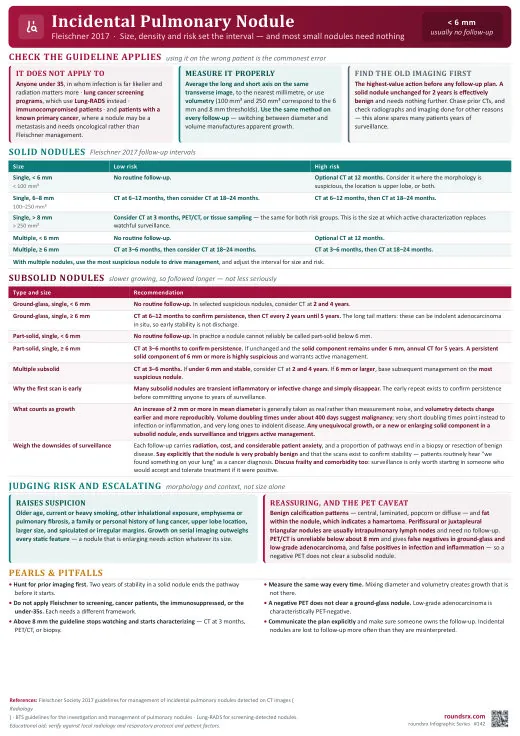
Fleischner Society Guidelines (2017) -Solid Nodules
Size
Low Risk (< 5% malignancy)
High Risk (โฅ 5% malignancy)
< 6 mm
No follow-up needed
Optional CT at 12 months
6โ8 mm
CT at 6โ12 months, then consider CT at 18โ24 months
CT at 6โ12 months, then CT at 18โ24 months
> 8 mm
CT at 3 months, PET-CT, or tissue sampling depending on clinical probability
High-Risk Features
Patient: smoking history, older age, family history of lung cancer, prior cancer, occupational exposures
Nodule: upper lobe location, spiculated margins, growth on serial imaging, part-solid morphology, > 8 mm
Ground-Glass and Part-Solid Nodules (GGN/PSN)
Pure ground-glass < 6 mm: no follow-up
Pure ground-glass โฅ 6 mm: CT at 6โ12 months, then q2 years ร 5 years
Part-solid (mixed) โฅ 6 mm: CT at 3โ6 months. If solid component โฅ 6 mm and persists โ PET or biopsy. Part-solid nodules have the highest malignancy rate of any morphology.
Stability for 2 years on serial CT does NOT guarantee benignity for ground-glass nodules -GGNs (often adenocarcinoma in situ) can be indolent for years before becoming invasive. Follow for 5 years minimum.
๐ฌ Lung Cancer Screening
LDCT Screening Criteria (USPSTF 2021)
Age 50โ80 years
โฅ 20 pack-year smoking history
Currently smoke or quit within the past 15 years
Annual low-dose CT (LDCT) -no IV contrast
NLST, 2011: LDCT screening reduced lung cancer mortality by 20% vs chest X-ray. NELSON, 2020: confirmed 24% reduction in lung cancer mortality in men, 33% in women.
Shared decision-making required. Discuss benefits (mortality reduction), harms (false positives, radiation, anxiety, unnecessary procedures), and the importance of smoking cessation (which reduces mortality far more than screening).
๐ On Rounds
Which nodule morphology has the highest malignancy rate?
Part-solid (mixed ground-glass and solid) nodules. They have a malignancy rate up to ~60% if they persist -higher than either pure solid or pure ground-glass nodules. The solid component usually represents the invasive component of an adenocarcinoma, while the ground-glass component represents in situ or minimally invasive disease.
When do you get a PET-CT for a pulmonary nodule vs just follow-up CT?
PET-CT is indicated for solid nodules โฅ 8 mm with intermediate probability of malignancy (5โ65% based on clinical risk). PET has ~90% sensitivity for malignancy but false negatives occur with: (1) nodules < 8 mm (below PET resolution), (2) GGOs/lepidic adenocarcinoma (low metabolic activity), (3) carcinoid tumors. False positives occur with: infection (TB granulomas, fungal), inflammation, sarcoidosis.
What makes a pulmonary nodule more likely to be malignant?
Higher risk features: (1) Size: > 8 mm (malignancy risk increases exponentially with size -6 mm = 1%, 20 mm = 15-20%), (2) Morphology: part-solid (HIGHEST malignancy rate of any type), spiculated margins, irregular shape, (3) Location: upper lobe (lung cancer more common), (4) Growth: any growth on serial imaging is concerning (doubling time 20-400 days for malignancy vs > 400 for benign)
How do you counsel a patient about an incidental pulmonary nodule?
This is a common and anxiety-provoking conversation. Key points: (1) Most nodules are benign -even in smokers, a 6 mm nodule has only ~1% chance of malignancy. Explain this clearly. (2) Follow-up is about tracking change -"we're watching to see if it grows. If it stays the same size over 2 years, it's almost certainly not cancer." (3) Specific follow-up plan with dates -"you'll need a repeat CT scan in [3/6/12] months.
Clinical Examples
๐ Case 1, Incidental Solid Nodule in a Smoker
Patient: 58M, 30-pack-year smoker. CT chest for cough reveals incidental 14 mm solid RUL nodule with spiculated borders. No prior CT for comparison. No symptoms concerning for malignancy.
Key findings: High-risk features: > 8 mm, solid, spiculated margins, upper lobe location, smoker > 30 pack-years. Fleischner Society guidelines: solid nodule > 8 mm in high-risk patient โ PET/CT or tissue sampling.
Management:
PET/CT, FDG avidity suggests malignancy (SUV > 2.5 has ~90% sensitivity for malignant nodules > 8 mm)
If PET-avid: CT-guided biopsy or navigational bronchoscopy for tissue diagnosis
If biopsy confirms NSCLC: staging with brain MRI โ surgical resection if early stage (lobectomy + mediastinal lymph node dissection)
If PET-negative: CT surveillance at 3 months, then annually ร 2-3 years (false negatives occur with low-grade adenocarcinoma)
Low-dose CT lung cancer screening annually (meets USPSTF criteria: age 50-80, โฅ 20 pack-years)
Teaching point: Spiculated margins are the single most concerning morphologic feature for malignancy (~90% PPV). Smooth, well-defined margins favor benign, but do not rule out cancer. Size + morphology + risk factors together determine the approach.
๐ Case 2, Small Incidental Ground-Glass Nodule
Patient: 45F never-smoker. CT PE study (negative for PE) incidentally shows a 6 mm pure ground-glass nodule (GGN) in the LLL. No solid component. No prior imaging.
Key findings: Pure GGN 6 mm, these are almost always preinvasive adenocarcinoma (AIS/MIA) or atypical adenomatous hyperplasia if persistent. Very slow-growing, doubling time often > 800 days. Low risk of metastasis even if malignant.
Management:
Fleischner 2017: 6 mm pure GGN โ follow-up CT at 6-12 months to confirm persistence
If persistent: CT annually ร 5 years (these grow very slowly, long surveillance needed)
No PET/CT (pure GGNs are often PET-negative even if malignant, low metabolic activity)
No biopsy unless growing or developing solid component
If develops solid component (> 5 mm solid): reclassify as part-solid โ more aggressive workup
Teaching point: Pure GGNs are indolent, even when malignant (AIS/MIA), they rarely metastasize. The danger is the development of a solid component, which transforms the prognosis. Part-solid nodules with solid component > 5 mm have the highest malignancy risk of all nodule types.
๐ Case 3, Multiple Nodules on Lung Cancer Screening
Patient: 62M, 35-pack-year smoker. Annual LDCT screening shows 3 new nodules: 4 mm solid RML, 7 mm solid RUL, and 9 mm part-solid LUL (6 mm solid component). No prior nodules.
Key findings: Multiple nodules with one dominant suspicious nodule (9 mm part-solid with 6 mm solid component). Lung-RADS 4B. The part-solid nodule with substantial solid component is the most concerning, warrants tissue diagnosis.
Management:
Dominant nodule (9 mm part-solid): PET/CT โ if avid, navigational bronchoscopy or CT-guided biopsy
4 mm solid: Fleischner โ follow-up CT at 12 months (low risk at this size)
7 mm solid: short-interval CT at 3 months or PET/CT given smoking history
If dominant nodule = cancer: full staging โ may need PET/CT of all nodules (separate primaries vs metastases)
Continue annual LDCT screening regardless of this finding
Teaching point: With multiple nodules, manage based on the most suspicious nodule. Part-solid nodules with solid component โฅ 6 mm have the highest malignancy risk (~60%). Multiple nodules in a smoker are more likely separate primary lung cancers than metastases from a single primary.
๐ฃ Sample Presentation
One-Liner
"Ms. Kim is a 55-year-old smoker whose CT chest for cough incidentally found a 12 mm solid right upper lobe pulmonary nodule. No prior imaging for comparison."
Key Points to Cover on Rounds
Incidental 12 mm solid RUL nodule in a smoker -intermediate-to-high malignancy risk. Per Fleischner: solid nodule โฅ8 mm โ consider CT at 3 months, PET-CT, or tissue sampling depending on clinical probability. Given risk factors (smoker, upper lobe, >8 mm): PET-CT ordered. If PET avid โ CT-guided biopsy or surgical excision. If PET negative โ CT follow-up at 3, 6, 12, 24 months. Lung-Rads if found on screening LDCT. Patient counseled about findings and follow-up plan documented. Smoking cessation strongly reinforced. Pulmonology referral placed.
๐งช Workup
Workup
See the Overview and Management tabs for the pulmonary nodule workup (Fleischner algorithm by size + morphology + risk, PET-CT for solid nodules โฅ 8mm with intermediate probability, biopsy vs serial CT decision, and Lung-Rads for screening-detected nodules).
๐ Medications
Medications
Pulmonary nodule evaluation is primarily diagnostic, there are no disease-specific pharmacotherapies. Agents involved are procedural (contrast for CT/PET, sedatives for biopsy) or directed at confirmed lung malignancy (see Oncology topics for lung cancer-specific regimens).
โก Summary
Fleischner
Solid nodule โฅ 8mm โ CT at 3 months, PET-CT, or biopsy based on risk. < 6mm in low-risk: no follow-up. Part-solid: longer follow-up, lower threshold for biopsy.
For solid nodules โฅ 8mm with intermediate probability of malignancy. PET avid โ biopsy or resect. PET negative โ follow with serial CT.
Part-Solid
Highest malignancy rate of any nodule type. GGO component may represent lepidic adenocarcinoma. Longer follow-up (5 years). Low threshold for biopsy if solid component > 5mm.
Document Everything
Incidental nodules lost to follow-up = major malpractice risk. Document finding, risk assessment, specific follow-up plan with date, and communicate to patient.
Lung-Rads
Used for LDCT screening findings (different from Fleischner which is for incidental nodules). Categories 1-4 guide follow-up intervals.
๐ Overview
Overview -Pulmonary Nodule & Lung Cancer Screening
See the tabs above for the complete clinical reference: Workup, Management, Medications, Monitoring, Rounds, Summary, and One Pager.
โก Management
Management -Pulmonary Nodule & Lung Cancer Screening
See the Management section above for the full treatment algorithm with evidence-based recommendations and trial citations.
๐ One Pager
Pulmonology ยท One Pager
Pulmonary Nodule
Fleischner guidelines for incidental nodules. High-risk features: > 8mm, upper lobe, spiculated, part-solid, smoker. PET-CT for intermediate probability. DOCUMENT and follow up.
< 6 mm: no routine follow-up. 6โ8 mm: CT at 6โ12 mo, then 18โ24 mo. > 8 mm: CT at 3 mo, PET-CT, or tissue sampling. Multiple nodules โ follow most suspicious. Part-solid: lower threshold for biopsy; follow 5 years.
๐ Key Actions
CT follow-upPer Fleischner timing
PET-CTIntermediate probability, โฅ 8mm
BiopsyPET-avid or high suspicion
LDCT screeningPer Lung-Rads classification
โ ๏ธ Pitfalls
Lost to follow-up (major malpractice risk -document and schedule)
Part-solid nodules dismissed as benign (highest malignancy rate)
Not considering malignancy in smoker > 50 with new nodule
Fleischner applied to screening LDCT (use Lung-Rads instead)