Intubation / RSI
- Failure to protect airway (GCS ≤8), respiratory failure despite NIV, expected deterioration
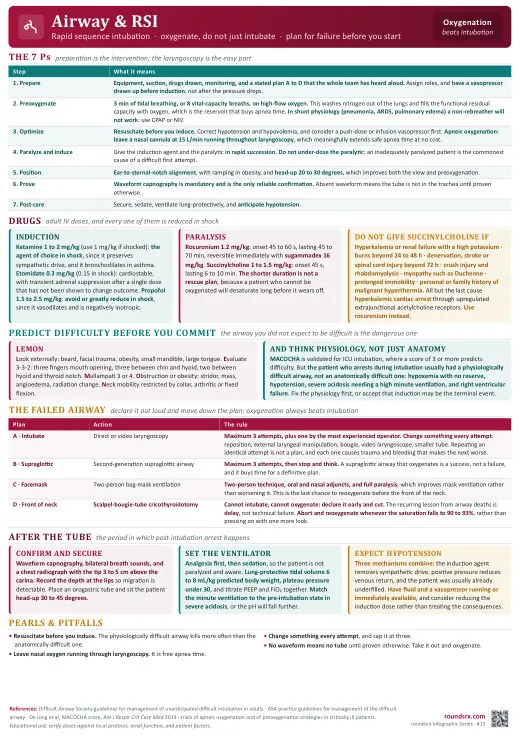
| # | Step | Details |
|---|---|---|
| 1 | Preparation | Equipment check (ETT, laryngoscope, bougie, LMA, suction, BVM), IV access, monitors, difficult airway plan |
| 2 | Pre-oxygenation | 3–5 min 100% O2 via NRB or HFNC. Goal: denitrogenation of FRC. Creates O2 reserve for apnea. |
| 3 | Pre-treatment | Optional. Fentanyl 1–2 mcg/kg for ICP concerns, lidocaine 1.5 mg/kg for reactive airways (controversial) |
| 4 | Paralysis with Induction | Push induction agent + paralytic simultaneously. Wait 45–60s for fasciculations to stop. |
| 5 | Protection & Positioning | Sniffing position (ear-to-sternal-notch alignment). Avoid cricoid pressure (Sellick) unless vomiting. |
| 6 | Placement | Direct or video laryngoscopy. Pass ETT through cords. Inflate cuff. Confirm with waveform ETCO2. |
| 7 | Post-intubation Management | Sedation + analgesia, initial vent settings, CXR, ABG at 30 min. Secure tube. |
- Pre-oxygenate 3–5min 100% O2, HFNC apneic oxygenation, HOB 20–30°
- Push induction + paralytic simultaneously → wait 45–60s → laryngoscopy
- Confirm with continuous waveform ETCO2
| Agent | Dose | Pros | Cons |
|---|---|---|---|
| Etomidate | 0.3mg/kg | Hemodynamically neutral | Adrenal suppression |
| Ketamine | 1–2mg/kg | Bronchodilator, maintains BP. Best for asthma/sepsis | Emergence reactions |
| Propofol | 1–2mg/kg | Fast onset | Drops BP, avoid in hypotension |
| Agent | Dose | Onset | Contraindications |
|---|---|---|---|
| Succinylcholine | 1–1.5mg/kg | 45s (fastest) | HyperK, burns >48h, crush, NMD, malignant hyperthermia |
| Rocuronium | 1.2mg/kg | 60s | Reversible with sugammadex |
- Bougie (first adjunct), video laryngoscopy, LMA rescue, cricothyrotomy last resort
| Step | Intervention | Details |
|---|---|---|
| 1st attempt fails | Reposition + Bougie | Optimize head position (ear-to-sternal-notch), use bougie as first-line adjunct through direct or video laryngoscopy |
| 2nd attempt fails | Video laryngoscopy | Switch to video if using direct. Different blade (hyperangulated). Limit to 3 total attempts. |
| Can oxygenate, can't intubate | Supraglottic airway (LMA/iGel) | Place LMA as rescue device. Can ventilate through it and even intubate through certain LMAs. |
| Can't intubate, can't oxygenate (CICO) | Surgical airway (cricothyrotomy) | Do NOT delay. Scalpel-bougie-tube technique. Vertical skin incision, horizontal through cricothyroid membrane. |
- LEMON airway assessment, equipment ready (ETT, laryngoscope, bougie, LMA, suction)
- Hemodynamics: optimize BEFORE intubation, push-dose vasopressors ready
- Pre-oxygenation: 3–5min NRB or HFNC, HOB elevated
| Letter | Assessment | Concerning Findings |
|---|---|---|
| L | Look externally | Facial trauma, large tongue, short neck, obesity, beard, cervical collar |
| E | Evaluate 3-3-2 rule | < 3 fingers mouth opening, < 3 fingers mentum to hyoid, < 2 fingers hyoid to thyroid notch |
| M | Mallampati | Class III (soft palate only) or IV (hard palate only) = difficult view |
| O | Obstruction / Obesity | Epiglottitis, peritonsillar abscess, angioedema, neck mass, BMI > 30 |
| N | Neck mobility | C-spine immobilization, ankylosing spondylitis, rheumatoid arthritis (C1-2 instability) |
| Parameter | Setting |
|---|---|
| TV | 6–8 mL/kg PBW (6 if ARDS) |
| RR | 14–16 (higher if met acidosis) |
| FiO2 | 100% → wean to SpO2 92–96% |
| PEEP | 5 cmH2O (higher if ARDS) |
- CXR for tube position (3–5cm above carina)
- Sedation: propofol or midazolam + fentanyl, target RASS -2 to 0
- HOB 30–45°, oral care q4h, DVT ppx, stress ulcer ppx
| Agent | Dose | Pros | Cons | Best For |
|---|---|---|---|---|
| Propofol | 5–50 mcg/kg/min | Fast on/off, daily awakening trials easy, anti-epileptic | Hypotension, propofol infusion syndrome (PRIS) if > 48h at high doses | Short-term sedation, neuro patients (exam needed) |
| Dexmedetomidine (Precedex) | 0.2–1.5 mcg/kg/h | No respiratory depression, patients are arousable, less delirium | Bradycardia, hypotension, expensive. Not deep enough for some patients. | Awake-sedation, extubation readiness, delirium-prone |
| Midazolam (Versed) | 1–5 mg/h | Anxiolysis, anti-epileptic | Accumulation in renal/hepatic failure, worst delirium profile, prolonged sedation | Refractory agitation, seizures. Avoid as first-line. |
| Fentanyl | 25–200 mcg/h | Potent analgesia, hemodynamically neutral | Chest wall rigidity at high doses, accumulation | Analgesia-first strategy, combine with sedative |
| Drug | Class | Dose | Pearl |
|---|---|---|---|
| Etomidate | Induction | 0.3mg/kg | Hemodynamically neutral |
| Ketamine | Induction | 1–2mg/kg | Best for asthma/sepsis |
| Propofol | Induction | 1–2mg/kg | Drops BP. Avoid in shock |
| Succinylcholine | Depolarizing NMB | 1–1.5mg/kg | Fastest (45s). CI in hyperK/burns/NMD |
| Rocuronium | Non-depolarizing NMB | 1.2mg/kg | Reversible with sugammadex 16mg/kg |
| Agent | Dose | Onset | Duration | Best Used For | Pros | Cons | Contraindications |
|---|---|---|---|---|---|---|---|
| Etomidate | 0.3 mg/kg IV | 15–45s | 3–12 min | Default for hemodynamically stable patients. Specifically: head injury / elevated ICP (cerebroprotective), cardiac patients (BP-neutral), borderline hypotension where propofol would crash them. Most commonly used RSI agent in US EDs. | Hemodynamically neutral, cerebro-protective (lowers ICP, maintains CPP) | Adrenal suppression (single dose clinically insignificant per Jabre, 2009), myoclonus, no analgesic properties | Relative: sepsis/adrenal insufficiency (some avoid, data equivocal) |
| Ketamine | 1–2 mg/kg IV | 45–60s | 10–20 min | Asthma / status asthmaticus (bronchodilator). Septic shock or any hypotensive patient (sympathomimetic, maintains BP). Trauma / hemorrhagic shock. Awake / delayed-sequence intubation (preserves respiratory drive). Pediatric airway. Increasingly the default ED induction agent for unstable patients. | Bronchodilator, sympathomimetic (maintains BP), analgesic, does not suppress respirations | Emergence reactions (give midazolam), hypersalivation (give glycopyrrolate), increases HR | Relative: severe uncontrolled HTN. Old concern about raising ICP is largely debunked. |
| Propofol | 1–2 mg/kg IV | 15–30s | 5–10 min | Status epilepticus (anti-epileptic) requiring intubation. Stable elective intubation (OR setting). Neurosurgical patients with stable BP (lowers ICP, smooth induction). Patients on chronic opioids / sedatives who tolerate higher doses. Avoid in any hemodynamically unstable patient. | Fastest onset, anti-epileptic, lowers ICP, smooth induction | Significant hypotension (drops MAP 20–30%), myocardial depression, apnea, pain on injection | Avoid in hemodynamic instability, shock, hypovolemia, egg/soy allergy (controversial) |
| Midazolam (Versed) ALTERNATIVE | 0.1–0.3 mg/kg IV | 2–5 min | 30–80 min | When etomidate, ketamine, and propofol are unavailable. Useful in seizing patient requiring intubation (also treats the seizure). Sometimes added in low dose to reduce ketamine emergence reactions. | Anxiolytic, anti-epileptic, amnestic, reversible with flumazenil | Slow onset (2–5 min, too slow for true RSI), variable hypotension, prolonged duration in elderly / liver disease | Avoid in airway compromise from sedative buildup; reverse cautiously in chronic benzo users (precipitates withdrawal seizures). |
| Feature | Succinylcholine | Rocuronium |
|---|---|---|
| Class | Depolarizing NMB | Non-depolarizing NMB |
| RSI dose | 1–1.5 mg/kg IV | 1.2 mg/kg IV (RSI dose) |
| Onset | 45 seconds (fastest) | 60 seconds at RSI dose |
| Duration | 6–10 minutes (ultra-short) | 45–70 minutes |
| Reversal | None (metabolized by pseudocholinesterase) | Sugammadex (Bridion) 16 mg/kg for immediate reversal |
| Contraindications | Hyperkalemia, burns > 48h, crush injuries, denervation injuries, NMD, malignant hyperthermia (personal or family hx), prolonged immobility | Very few. True allergy only. |
| Side effects | Fasciculations, hyperkalemia (+0.5 mEq/L), bradycardia (especially repeat doses or pediatrics), masseter spasm, malignant hyperthermia | Minimal. No hyperkalemia. No fasciculations. |
| Advantage | Ultra-short duration (returns spontaneous breathing faster if you cannot intubate) | Reversible with sugammadex, safer profile, fewer contraindications |
| Best Used For | Brief / anticipated easy airway when you want fast spontaneous breathing recovery if intubation fails. Useful when sugammadex unavailable. Historically the default but losing ground to rocuronium. | Default in modern practice. Hyperkalemia risk patients (CKD, ESRD, dialysis), burns > 48h, crush / denervation injuries, NMD (Guillain-Barré, ALS, MS, MD), prolonged immobility, MH personal/family history, prolonged paralysis needed (e.g., transport, OR), unknown patient history. Sugammadex availability makes it nearly universal first choice. |
- Asthmatic / wheezing patient → ketamine (bronchodilator, sympathomimetic) + rocuronium (no histamine release, unlike succinylcholine).
- Septic shock / hypotension → ketamine (sympathomimetic, maintains BP) + rocuronium (no risk of hyperK in coexisting AKI / renal failure).
- Head injury / elevated ICP → etomidate (cerebroprotective, lowers ICP, BP-neutral) + rocuronium (avoids succinylcholine fasciculations that transiently raise ICP).
- Status epilepticus → propofol (anti-epileptic, lowers ICP) or midazolam (anti-epileptic, amnestic, reversible with flumazenil) + rocuronium (doesn't mask ongoing seizure activity needing EEG; succinylcholine can trigger MH-like rigidity in some seizure patients).
- Hyperkalemia (CKD/ESRD, crush, burns > 48h) → any induction + rocuronium (no K⁺ shift). NEVER succinylcholine (raises K⁺ ~0.5 mEq/L; can be much higher in upregulated extrajunctional receptor states → fatal hyperK arrest).
- Stable elective intubation → propofol (smooth induction, fast recovery, anti-emetic) + rocuronium (sugammadex-reversible) or succinylcholine (ultra-short duration if you anticipate quick extubation).
- Anticipated difficult airway / awake intubation → ketamine alone (dissociative anesthesia, preserves respiratory drive and airway reflexes). Avoid paralytic until the tube is in and confirmed.
Patient: 34-year-old male with epilepsy, brought in with ongoing seizures for 25 minutes. Failed IV lorazepam 4 mg x 2 and levetiracetam loading dose. Still seizing. SpO2 88%, GCS 3.
Decision to intubate: Refractory status epilepticus, failure to protect airway, hypoxemia despite supplemental O2.
RSI approach:
- Pre-oxygenate with BVM (patient cannot cooperate due to seizures)
- Induction: Propofol 1.5 mg/kg, serves dual purpose as both induction agent AND anti-epileptic. Hemodynamics acceptable (BP 142/88)
- Paralytic: Rocuronium 1.2 mg/kg, preferred over succinylcholine because (1) already hyperkalemic risk from prolonged seizures, (2) longer duration is acceptable since patient will need ongoing sedation
- Post-intubation: Continue propofol drip for both sedation and seizure suppression. Continuous EEG monitoring.
Teaching point: Propofol is ideal when seizure control is needed alongside intubation. Avoid succinylcholine in status epilepticus due to rhabdomyolysis-induced hyperkalemia risk.
Patient: 68-year-old female with pneumonia, septic shock on norepinephrine 15 mcg/min. BP 84/52 despite 3L crystalloid. SpO2 91% on 15L NRB. RR 34, using accessory muscles. GCS 14.
Decision to intubate: Respiratory failure with impending arrest, failing despite maximal oxygen.
RSI approach:
- Pre-oxygenate with HFNC at 60L/min (continue during apneic period via nasal cannula at 15L)
- Push-dose phenylephrine 100 mcg IV ready at bedside BEFORE induction
- Give 500 mL NS bolus during pre-oxygenation
- Induction: Ketamine 1.5 mg/kg, sympathomimetic, maintains BP. Do NOT use propofol (will cause cardiovascular collapse)
- Paralytic: Rocuronium 1.2 mg/kg
- Post-intubation: Immediately increase norepinephrine to compensate for loss of sympathetic drive from sedation. Start fentanyl + propofol at LOW dose for sedation.
Teaching point: The most dangerous part of intubating a septic patient is the hemodynamic collapse that follows induction. Have vasopressors drawn up, fluids running, and choose ketamine. Anticipate BP drop and treat preemptively.
Patient: 56-year-old male with ESRD (missed last 2 dialysis sessions), presents with severe dyspnea, bilateral crackles, SpO2 82% on NRB. K+ 7.2. ECG shows peaked T-waves and widened QRS. GCS 15 but tiring rapidly.
Decision to intubate: Severe pulmonary edema with respiratory failure, cannot tolerate BiPAP due to volume overload.
RSI approach:
- Pre-intubation: Give calcium gluconate 3g IV for cardiac membrane stabilization, insulin 10 units + D50 for K+ shifting
- Pre-oxygenate with BiPAP or HFNC if tolerated
- Induction: Etomidate 0.3 mg/kg, hemodynamically neutral (patient is volume overloaded but may drop BP with positive pressure ventilation)
- Paralytic: Rocuronium 1.2 mg/kg, NEVER succinylcholine in hyperkalemia (raises K+ by 0.5–1.0 mEq/L → can cause fatal cardiac arrest at K+ 7.2)
- Post-intubation: Emergent nephrology consult for dialysis. Low tidal volumes, high PEEP for pulmonary edema.
Teaching point: Succinylcholine is absolutely contraindicated in hyperkalemia. At K+ 7.2 with ECG changes, even a 0.5 mEq/L rise can trigger VFib. Rocuronium is the only paralytic choice. Treat the hyperkalemia before and during intubation.
| Parameter | Target |
|---|---|
| ETCO2 | Continuous. 35–45 mmHg. Loss = dislodged tube |
| SpO2 | 92–96% (88–92% COPD) |
| Plateau pressure | <30 cmH2O |
| ABG | 30min post-intubation |
| CXR | Immediately post-intubation |