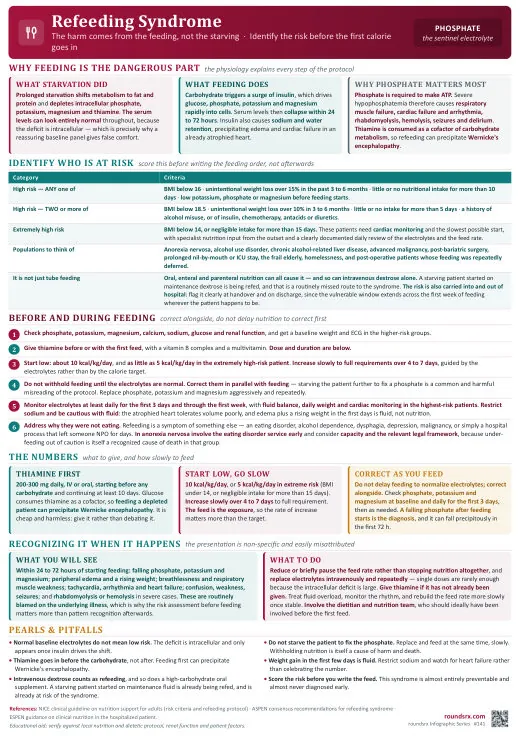
Refeeding Syndrome
- Starvation phase: Body switches from carb to fat and protein metabolism. Insulin drops. Intracellular K⁺, Mg²⁺, and PO₄³⁻ stores are depleted, but serum levels remain deceptively normal because the kidney conserves them.
- Refeeding (carb load): Glucose intake triggers an insulin surge. Insulin drives glucose, K⁺, Mg²⁺, and especially phosphate into cells (phos is consumed making ATP for glycolysis and protein synthesis).
- Result: Severe extracellular hypoK, hypoMg, and hypoPhos within 24-72 hours of starting feeds. Plus thiamine is consumed in glucose metabolism → risk of Wernicke encephalopathy if not pre-loaded.
- Plus: Insulin promotes Na⁺ and water retention → fluid overload, CHF, peripheral edema (worsened by thiamine deficiency cardiomyopathy).
| Major (any 1) | Minor (any 2) |
|---|---|
| BMI < 16 kg/m² | BMI < 18.5 kg/m² |
| Unintentional weight loss > 15% in 3-6 months | Unintentional weight loss > 10% in 3-6 months |
| Little or no nutritional intake > 10 days | Little or no intake > 5 days |
| Low pre-feeding serum K⁺, Mg²⁺, or PO₄³⁻ | History of alcohol abuse, drug use (insulin, chemo, antacids, diuretics) |
- Chronic alcoholism with poor PO intake (also at risk for Wernicke independently)
- Anorexia nervosa (the textbook case; BMI often < 15)
- Prolonged NPO in hospitalized patients (post-op, ICU, dysphagic stroke, intubated > 5-7 days)
- Post-bariatric surgery patients restarting nutrition after complications
- Oncology patients with cachexia restarting feeds, especially after chemo or surgery
- Elderly with poor oral intake from depression, dementia, or social isolation
- TPN initiation in any malnourished patient (highest risk per kcal delivered)
- Refugees, hunger strikers, malabsorption (short bowel, IBD, chronic pancreatitis)
- BMP (Na, K, Cl, HCO₃, BUN, Cr, glucose)
- Magnesium and phosphate (often missing from default panels, must order separately)
- Calcium (ionized if hypoalbuminemic)
- LFTs, albumin, prealbumin (nutritional baseline)
- CBC (anemia of malnutrition, baseline)
- ECG if K⁺ < 3.0 or Mg < 1.5 (arrhythmia risk)
- Thiamine level (rarely available real-time; replace empirically)
- Vitamin D, B12, folate, zinc, copper in chronic malnutrition
Replace electrolytes to these thresholds before starting any nutrition (PO, EN, or TPN). Do not begin feeds until all three are met.
| Electrolyte | Minimum target before feeding | Repletion if low |
|---|---|---|
| Phosphate | ≥ 2.0 mg/dL (0.65 mmol/L) | K-phos or Na-phos 0.16-0.32 mmol/kg IV over 6 h, OR Neutra-Phos 1-2 packets PO TID |
| Potassium | ≥ 3.5 mEq/L | KCl 10-40 mEq IV/PO; recheck in 4-6 h |
| Magnesium | ≥ 1.6 mEq/L (~2.0 mg/dL) | MgSO₄ 1-2 g IV q6-8h; oral mag oxide for mild cases |
| Parameter | Frequency | Action threshold |
|---|---|---|
| Phos, K, Mg | BID for first 3 days, then daily through day 7 | Phos < 1.5 = pause/slow feeds + IV phos. K < 3.0 or Mg < 1.5 = hold feeds, replete |
| BMP, Ca | Daily | Watch for AKI, hyperglycemia, hypocalcemia |
| Daily weight, I/O | Daily | > 1 kg/day gain = fluid retention, slow feeds |
| ECG / telemetry | Continuous if BMI < 14 or severe electrolyte derangement | QTc prolongation, arrhythmia → full electrolyte recheck |
| Glucose | q6h initially | > 180 = hyperglycemia from insulin resistance; consider sliding scale |
| Step | Action | Notes |
|---|---|---|
| 1. Identify risk | Apply NICE criteria. Document risk level in note. | Every malnourished patient. Don't skip if intake has been < 50% for > 5 days. |
| 2. Thiamine FIRST | 200-300 mg IV/PO daily × 10 days. Give BEFORE any glucose or feeds. | If at risk for Wernicke (alcoholic, AMS, ophthalmoplegia): 500 mg IV TID × 3 days then 250 mg daily. Plus B-complex multivitamin daily. |
| 3. Replete electrolytes | Reach phos ≥ 2.0, K ≥ 3.5, Mg ≥ 1.6 BEFORE starting feeds. | Even if "normal," empirically supplement K, Mg, phos in highest-risk patients. |
| 4. Start LOW | Day 1-2: 5-10 kcal/kg/day (sometimes 5 kcal/kg if BMI < 14 or no intake > 15 days). | Use full IBW, not actual weight. Limit carbs to 40-50% of calories initially. |
| 5. Advance slowly | Increase by 5 kcal/kg/day if labs stable. Reach goal (25-30 kcal/kg/day) by day 5-7. | If phos drops > 0.5 mg/dL or K/Mg fall, pause advancement and replete. |
| 6. Fluid restrict | Limit IVF + feeds to 20-25 mL/kg/day initially. | Risk of CHF (thiamine deficiency cardiomyopathy + Na/water retention). Daily weights. |
| 7. Continue prophylaxis | Daily multivitamin + thiamine through at least day 10. | Magnesium and zinc help recovery. Continue PO supplementation after IV repletion. |
| Severity | Phos level | Treatment |
|---|---|---|
| Mild | 2.0-2.5 mg/dL | Oral: Neutra-Phos or PhosNak 1-2 packets TID. Recheck in 6 h. |
| Moderate | 1.0-2.0 mg/dL | K-phos or Na-phos 0.16-0.32 mmol/kg IV over 6 h. Use K-phos if K < 4.0, Na-phos if K ≥ 4.0. Recheck phos and Ca after infusion. |
| Severe | < 1.0 mg/dL OR symptomatic | K-phos 0.32-0.64 mmol/kg IV over 8-12 h. ICU monitoring. Telemetry. Pause or reduce feeds. Recheck phos, Ca, K q6h. Watch for hypocalcemia (phos binds Ca) and metastatic calcification. |
| Drug | Indication | Dose | Notes |
|---|---|---|---|
| Thiamine (Vitamin B1) | Prevent Wernicke + co-factor for glucose metabolism | 200-300 mg IV/PO daily × 10 days. If suspected Wernicke: 500 mg IV TID × 3 days then 250 mg daily × 5 days then 100 mg PO daily. | ALWAYS give before any glucose or feeds. Cheap and safe. |
| K-phos (potassium phosphate) | HypoPhos with K < 4.0 | 0.16-0.64 mmol/kg IV over 6-12 h depending on severity | Each 15 mmol delivers ~22 mEq K. Cap at 30 mmol per dose. Recheck phos, K, Ca after. |
| Na-phos (sodium phosphate) | HypoPhos with K ≥ 4.0 | Same dosing as K-phos | Use when K is normal or high. Each 15 mmol delivers ~20 mEq Na. |
| Neutra-Phos / PhosNak (oral) | Mild hypoPhos (2.0-2.5) | 1-2 packets PO TID with meals | Each packet = 8 mmol phos. GI side effects (diarrhea) common. |
| Magnesium sulfate | HypoMg < 1.6 | 1-2 g IV over 30-60 min q6-8h | Cap at 4-6 g/day. Monitor reflexes (loss of patellar reflex = Mg > 8). Reduce dose in CKD. |
| KCl (potassium chloride) | HypoK < 3.5 | 10-40 mEq IV/PO; max IV peripheral 10 mEq/h, central 20 mEq/h | Classic rule: each 10 mEq raises K ~0.1, but that is a best case. Real-world inpatient median is ~0.05 per 10 mEq, and ~0.03 on a loop diuretic, so recheck rather than trusting the arithmetic. Replete Mg first or K won't stay up. |
| Multivitamin (with B-complex) | Prevent micronutrient deficiencies | 1 tab/amp PO/IV daily × at least 10 days | Standard for any malnutrition refeed. |
Patient: 22F with anorexia nervosa, BMI 13.8 (75 lb), admitted for medical stabilization. Per family, intake has been minimal for 6 weeks. HR 42, BP 88/56, T 35.6 C. Labs: K 3.1, Mg 1.4, PO₄ 2.2, glucose 68, albumin 3.0, ECG with QTc 510.
Risk assessment: Major criteria met (BMI < 16 AND low pre-feed Mg AND minimal intake > 10 days). VERY HIGH RISK.
Plan:
- Telemetry, ICU-level monitoring for 48-72 h
- Thiamine 300 mg IV daily × 10 days BEFORE feeds
- Multivitamin, folate, B12 IV daily
- Replete: KCl 40 mEq IV (in divided doses), MgSO₄ 2 g IV q6h × 3 doses, Neutra-Phos 1 packet PO TID
- Recheck phos, K, Mg in 6 h. Once K ≥ 3.5, Mg ≥ 1.6, phos ≥ 2.0 → start nutrition
- Day 1: 5 kcal/kg/day (~25 kg actual = 125 kcal/day) via NG tube. Limit carbs.
- Daily weights, fluid restrict to 20 mL/kg/day. BID labs × 3 days.
- Advance by 5 kcal/kg/day if labs stable. Reach goal ~25-30 kcal/kg/day by day 5-7.
- Multidisciplinary: psychiatry, dietitian, social work, family meetings.
Teaching point: The lower the BMI and the longer the starvation, the slower the advancement. Eating disorder patients are the textbook refeeding case and the highest-mortality scenario. Cardiac arrest from hypoPhos is a real risk in the first week.
Patient: 58M with alcohol use disorder, admitted for cellulitis, NPO and on IV antibiotics × 5 days. Day 6, switched to general diet plus D5NS at 100 mL/h. Day 7, found confused with ataxia and horizontal nystagmus. Labs: phos 1.4, K 2.8, Mg 1.2, glucose 152.
Diagnosis: Refeeding syndrome WITH iatrogenic Wernicke encephalopathy (dextrose given without prior thiamine in a chronic alcoholic).
Plan:
- Stop dextrose-containing fluids. Switch to NS or LR.
- Thiamine 500 mg IV TID × 3 days, then 250 mg daily × 5 days, then 100 mg PO daily long-term
- K-phos 0.32 mmol/kg IV over 6 h, MgSO₄ 2 g IV q6h × 2, KCl 40 mEq IV total in divided doses
- Hold full feeds for 24 h while electrolytes correct, then restart at 5-10 kcal/kg/day with thiamine on board
- CIWA monitoring (alcohol withdrawal still possible)
- Repeat MRI brain if confusion persists (rule out other causes)
Teaching point: Always give thiamine BEFORE dextrose in any patient with possible alcoholism, eating disorder, or prolonged NPO. The "banana bag" exists for a reason. Wernicke triad (confusion, ataxia, ophthalmoplegia) is present in only ~10% of cases; treat empirically.
Patient: 64F, 8 days post-Whipple for pancreatic adenocarcinoma. Pre-op weight loss 14 kg over 4 months (15% of body weight). NG tube to suction since surgery. Surgical team starts TPN to advance to goal calories over 24 h.
Risk assessment: 1 major criterion (weight loss > 15%) + 2 minor (no intake > 5 days, malignancy/post-op). HIGH RISK.
What went wrong: TPN rate ramped to goal (~2000 kcal/day) in 24 h instead of titrated. Day 2: phos 0.6, K 2.4, Mg 1.0, new arrhythmias on tele.
Recovery plan:
- Stop TPN immediately. Telemetry, ICU transfer.
- K-phos 0.5 mmol/kg IV over 8-12 h (severe hypoPhos). Recheck phos, Ca, K q4-6h.
- MgSO₄ 4 g IV over 4 h, KCl 60 mEq total in divided IV doses
- Thiamine 200 mg IV daily, multivitamin daily
- After labs corrected (phos ≥ 2.0, K ≥ 3.5, Mg ≥ 1.6): restart TPN at 5-10 kcal/kg/day. Advance by 5 kcal/kg/day. Daily phos/K/Mg.
Teaching point: TPN is the highest-risk refeeding scenario because every calorie is delivered without GI absorption barriers. Always start at 5-10 kcal/kg/day and advance over 5-7 days. Surgery teams sometimes ramp to goal too fast; the medicine consultant should slow it down.
- Phos, K, Mg checked today? Any drop > 0.5 mg/dL in phos = pause advancement
- Daily weight: gain > 1 kg/day suggests fluid retention → restrict
- Thiamine and multivitamin given today?
- Caloric advancement: still 5 kcal/kg/day increase, not faster?
- Cardiac monitor: any new arrhythmias, QTc trending?
- Mental status: any new confusion, ataxia, ophthalmoplegia (Wernicke)?
- Edema, JVD, dyspnea (CHF / thiamine cardiomyopathy)?
- Discussion with dietitian about kcal target and macros?