Renal Transplant Medicine
Immunosuppression regimens, rejection types, infection timelines, and the critical rule: any transplant patient with rising creatinine is rejection until proven otherwise.
🔍 Overview
Immunosuppression
Standard regimen has three components:
- Induction: Basiliximab (IL-2 receptor antagonist, low immunologic risk) or Anti-thymocyte globulin (ATG) (high immunologic risk, repeat transplant, sensitized patients)
- Maintenance (triple therapy):
- Tacrolimus (Prograf), calcineurin inhibitor. Target trough varies by time post-transplant: 8-12 ng/mL (month 0-3), 6-10 ng/mL (month 3-12), 4-8 ng/mL (after year 1).
- Mycophenolate (CellCept), 1000 mg PO BID (or mycophenolic acid 720 mg BID). Antiproliferative agent.
- Prednisone, high dose post-op, taper to 5 mg/day by month 3-6. Some centers do steroid-free protocols.
Types of Rejection
- Hyperacute rejection: Minutes to hours. Preformed antibodies against donor ABO/HLA. Immediate graft thrombosis and loss. Prevented by crossmatch testing. Essentially eliminated by modern crossmatching.
- Acute cellular rejection (ACR): Weeks to months. T-cell mediated. Most common type. Responds well to pulse steroids (methylprednisolone 500 mg IV x 3 days) or ATG for steroid-resistant cases.
- Acute antibody-mediated rejection (AMR): B-cell/antibody mediated. Donor-specific antibodies (DSA). Treat with plasmapheresis + IVIG + rituximab. Harder to treat than ACR.
- Chronic rejection: Months to years. Progressive interstitial fibrosis and tubular atrophy (IF/TA). No effective treatment. Leads to slow graft loss.
Infection Timeline
- Month 0-1: Surgical site infections, UTI, donor-derived infections, CMV (especially D+/R-)
- Month 1-6: Opportunistic infections, CMV (most common), BK virus (nephropathy), PJP (all on prophylaxis during this window)
- Month 6+: Community-acquired infections, late CMV (after prophylaxis stopped), BK nephropathy, Listeria, Nocardia
🚨 Management
Rising Creatinine in a Transplant Patient
Any transplant patient with rising creatinine = rejection until proven otherwise. Get tacrolimus level STAT, UA, donor-specific antibodies, and call transplant nephrology. Do NOT just "watch the creatinine."
Differential for Rising Creatinine
- Rejection (cellular or antibody-mediated)
- Tacrolimus toxicity (check trough level, supratherapeutic)
- BK virus nephropathy (check BK PCR)
- Obstruction (ureteral stricture, lymphocele, renal US)
- Pre-renal (dehydration, NSAID use, ACE/ARB)
- Recurrent disease (FSGS, IgA, diabetic nephropathy)
- CNI nephrotoxicity (chronic tacrolimus injury)
Rejection Treatment
- Acute cellular rejection: Methylprednisolone 500 mg IV daily x 3 days. If steroid-resistant, ATG.
- Antibody-mediated rejection: Plasmapheresis (5-7 sessions) + IVIG 100 mg/kg after each session + Rituximab 375 mg/m2. Consider bortezomib (Velcade) for refractory cases.
- BK nephropathy: Reduce immunosuppression (lower tacrolimus target, decrease mycophenolate). No specific antiviral. Cidofovir and leflunomide have been tried.
Clinical Example: A 55-year-old man 6 months post-renal transplant presents with Cr rising from 1.4 to 2.3 over 2 weeks. He feels well. Tacrolimus trough 4.2 (subtherapeutic). BK PCR negative. UA bland. DSA panel shows new anti-HLA antibodies. Renal biopsy: C4d positive peritubular capillaritis. Diagnosis: acute antibody-mediated rejection. Initiate plasmapheresis + IVIG + rituximab.
🧪 Workup
Workup for Rising Creatinine
- Tacrolimus trough, STAT. Supratherapeutic = CNI toxicity. Subtherapeutic = possible rejection.
- UA + urine culture, UTI is common post-transplant
- BK virus PCR, screen monthly for first 6 months, then q3 months. >10,000 copies = BK viremia requiring immunosuppression reduction.
- CMV PCR, if symptomatic or at high-risk period
- Donor-specific antibodies (DSA), if AMR suspected
- Renal transplant ultrasound with Doppler, evaluate for hydronephrosis, perinephric collections (lymphocele, hematoma), vascular stenosis
- Transplant renal biopsy, gold standard for diagnosis. Banff classification. Indicated if creatinine rises >25% from baseline without clear cause.
Routine Surveillance Labs
- BMP, CBC, tacrolimus trough, LFTs, fasting glucose, lipid panel
- BK PCR monthly x 6 months, then q3 months x 2 years
- CMV PCR monthly if D+/R- (highest risk)
💊 Medications
Medications
| Drug | Class/Indication | Dose | Notes |
|---|---|---|---|
| Tacrolimus (Prograf) | CNI, maintenance | Varies; target trough 8-12 early, 4-8 late | Nephrotoxic, diabetogenic, tremor, hyperkalemia, hypomagnesemia. Many drug interactions (azoles increase levels, rifampin decreases). Check trough levels. |
| Mycophenolate (CellCept) | Antiproliferative, maintenance | 1000 mg PO BID | GI side effects (diarrhea, nausea). Bone marrow suppression (monitor CBC). Teratogenic. Reduce dose if BK viremia. |
| Prednisone | Corticosteroid, maintenance | Taper to 5 mg daily | Metabolic effects (hyperglycemia, osteoporosis, weight gain). Some centers do steroid withdrawal. |
| TMP-SMX (Bactrim) | PJP prophylaxis | 1 SS tab daily x 6-12 months | Also provides UTI prophylaxis and Toxoplasma, Nocardia, Listeria coverage. |
| Valganciclovir (Valcyte) | CMV prophylaxis | 900 mg PO daily x 3-6 months | For CMV D+/R- (highest risk) or D+/R+. Monitor CMV PCR. Can cause leukopenia. |
| Nystatin | Oral candida prophylaxis | 5 mL swish and swallow QID x 1-3 months | Prevent oral/esophageal candidiasis while on high-dose immunosuppression. |
🏥 Rounds
Pimp Questions
❓ What are the types of rejection and their timelines?
Hyperacute: minutes (preformed antibodies, graft loss). Acute cellular: weeks-months (T-cell mediated, responds to steroids). Acute antibody-mediated: weeks-months (B-cell/DSA, treat with plasmapheresis/IVIG/rituximab). Chronic: months-years (IF/TA, no effective treatment).
❓ What infections occur in each post-transplant time period?
Month 0-1: Surgical site, UTI, donor-derived, early CMV. Month 1-6: CMV (most common), BK virus, PJP, all on prophylaxis. After month 6: Community-acquired, late CMV, BK nephropathy, PTLD.
❓ What is the most important first step when a transplant patient has a rising creatinine?
Check tacrolimus trough level STAT. Supratherapeutic = CNI nephrotoxicity (reduce dose). Subtherapeutic = risk factor for rejection. Then: UA, BK PCR, DSA, renal US. If no clear cause, biopsy. Call transplant nephrology early.
Sample Presentation
Mr. Johnson is a 48-year-old man, 3 months post-deceased donor renal transplant for ESRD from IgA nephropathy. Presenting with creatinine rising from baseline 1.2 to 1.9 over 1 week. No symptoms. Tacrolimus trough: 5.1 (target 6-10, slightly low). BK PCR: negative. CMV PCR: negative. UA: bland. Renal US: no hydronephrosis, normal Doppler flows. DSA: negative. Given rising Cr without clear etiology and subtherapeutic tacrolimus, transplant nephrology recommended renal biopsy. Biopsy showed Banff 1A acute cellular rejection (tubulitis, interstitial inflammation). Started methylprednisolone 500 mg IV x 3 days. Tacrolimus dose increased to target trough 8-10.
Key Points: Rising creatinine in a transplant patient is rejection until proven otherwise. Subtherapeutic tacrolimus was the likely contributing factor. Biopsy is the gold standard. ACR responds well to pulse steroids. Increase maintenance immunosuppression and recheck creatinine in 48-72h.
Monitoring
- Tacrolimus trough, check 2-3x/week early, then weekly, then monthly. Target varies by time post-transplant.
- BMP weekly initially, creatinine trending, electrolytes (hyperK from tacrolimus, hypoMg)
- CBC weekly, leukopenia (mycophenolate, valganciclovir), anemia, thrombocytopenia
- BK virus PCR monthly x 6 months, then q3 months x 2 years
- CMV PCR monthly for high-risk (D+/R-) during and after prophylaxis
- Fasting glucose, post-transplant diabetes (tacrolimus + steroids)
- Lipid panel, dyslipidemia common (tacrolimus, sirolimus)
- Cancer screening, skin checks annually (SCC risk 65-250x increased), cervical screening, colon cancer per guidelines. PTLD surveillance (EBV PCR if EBV D+/R-).
📋 Summary
Summary
The Rule That Governs Everything
A rising creatinine in a transplant patient is rejection until proven otherwise. Get a STAT tacrolimus level, urinalysis, renal ultrasound with Dopplers and donor-specific antibodies, and call transplant nephrology. Do not simply watch the creatinine: rejection treated late is graft loss.
The Standard Regimen
Triple therapy: a calcineurin inhibitor (tacrolimus), an antiproliferative (mycophenolate) and a steroid (prednisone tapered to about 5 mg). Tacrolimus troughs run 8 to 12 early and 4 to 8 later. Never stop immunosuppression without transplant input, including through an admission for something unrelated; missed doses cause rejection within days.
Tacrolimus Interactions Are a Daily Hazard
Azole antifungals, macrolides and diltiazem raise the level toward nephrotoxicity; rifampin and antiepileptics drop it toward rejection. Check the level whenever a new drug is started or stopped, and expect tremor, hyperkalemia, hypomagnesemia, hypertension and new-onset diabetes as class effects.
Sort the Differential by Timing
Immediate: hyperacute rejection (preformed antibodies), vascular thrombosis, urinary obstruction. Days to weeks: acute cellular or antibody-mediated rejection, calcineurin inhibitor toxicity, delayed graft function. Months to years: BK virus nephropathy, recurrent primary disease, chronic allograft nephropathy. Prerenal and obstruction are common and reversible, so exclude them first with an ultrasound.
Two Kinds of Rejection, Two Treatments
Acute cellular rejection (T-cell mediated) → pulse methylprednisolone, with anti-thymocyte globulin for steroid-resistant disease. Antibody-mediated rejection → plasmapheresis plus IVIG, sometimes with rituximab. Only a biopsy distinguishes them, which is why the biopsy comes before the treatment whenever the patient can safely wait for it.
The Infection Timeline Is Diagnostic
First month: the usual surgical and nosocomial infections, wound, line, urinary, plus donor-derived. 1 to 6 months, the peak immunosuppression window: CMV, BK virus, PJP, Nocardia, Listeria and reactivated tuberculosis. Beyond 6 months: community-acquired infection, with late CMV and post-transplant lymphoproliferative disease. Knowing where the patient is on that timeline narrows the differential faster than any test.
Prophylaxis Is Not Optional
TMP-SMX single strength daily for 6 to 12 months covers PJP and also Toxoplasma, Nocardia, Listeria and urinary infection. Valganciclovir 900 mg daily for 3 to 6 months in CMV-mismatched recipients (donor positive, recipient negative is the highest risk group), with CMV PCR monitoring; it causes leukopenia, so watch the counts.
Long-Term Risks the Ward Team Forgets
Skin cancer, particularly squamous cell, is dramatically increased and needs annual dermatologic screening and sun protection. Cardiovascular disease is the leading cause of death with a functioning graft, and post-transplant diabetes, hypertension and dyslipidemia are largely drug-induced. Live vaccines are contraindicated, and inactivated vaccines should ideally be given before transplant.
📄 One Pager
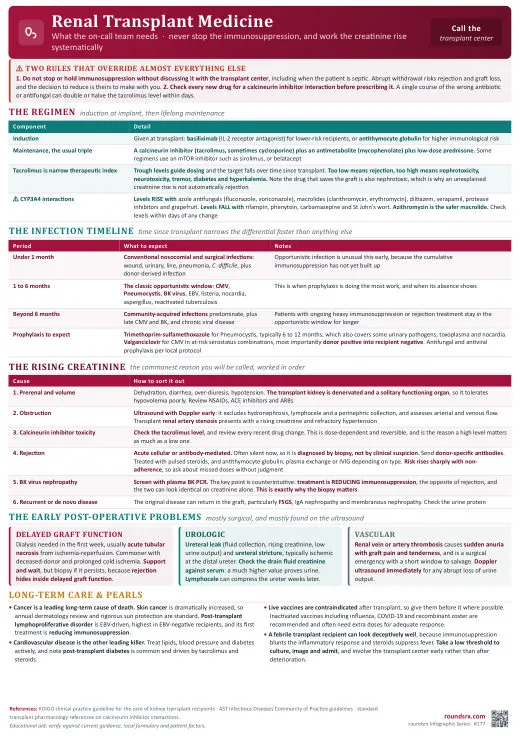
Text version
Nephrology · One Pager
Renal Transplant Medicine
Triple immunosuppression, four rejection types, a predictable infection timeline, and one rule that never bends: a rising creatinine is rejection until proven otherwise.
Immunosuppression: Role and Signature Toxicity
- Induction, basiliximab (IL-2 receptor antagonist) for low immunologic risk, or anti-thymocyte globulin (ATG) for high immunologic risk, repeat transplant, and sensitized patients
- Tacrolimus (Prograf), the calcineurin inhibitor backbone. Target trough moves with time post-transplant: 8 to 12 ng/mL months 0 to 3, 6 to 10 ng/mL months 3 to 12, 4 to 8 ng/mL after year 1, because rejection risk is highest early and toxicity risk accumulates later. Signature toxicity: nephrotoxic, diabetogenic, tremor, hyperkalemia, hypomagnesemia
- Mycophenolate (CellCept) 1000 mg PO BID (or mycophenolic acid 720 mg BID), the antiproliferative. Signature toxicity: GI upset (diarrhea, nausea), bone marrow suppression, teratogenic
- Prednisone, high dose post-op then tapered to 5 mg/day by month 3 to 6. Signature toxicity: hyperglycemia, osteoporosis, weight gain. Some centers use steroid-free protocols
- Drug interactions matter: azoles increase tacrolimus levels, rifampin decreases them, so any new antimicrobial means rechecking a trough
Rejection Types and How to Tell Them Apart
- Acute cellular rejection (ACR), weeks to months. T-cell mediated, the most common type. Biopsy shows tubulitis and interstitial inflammation (Banff). Responds well to pulse steroids
- Acute antibody-mediated rejection (AMR), weeks to months. B-cell and antibody mediated, driven by donor-specific antibodies (DSA). Biopsy shows C4d positive peritubular capillaritis. Harder to treat than ACR
- Hyperacute, minutes to hours. Preformed antibodies against donor ABO/HLA cause immediate graft thrombosis and loss. Essentially eliminated by modern crossmatch testing
- Chronic rejection, months to years. Progressive interstitial fibrosis and tubular atrophy (IF/TA). No effective treatment, leads to slow graft loss
- The distinguishing tests: DSA panel separates AMR from ACR serologically, and transplant biopsy is the gold standard (Banff classification) that settles it
Rising Creatinine: Step by Step
1
Treat it as rejection until proven otherwise. Do NOT just "watch the creatinine", and call transplant nephrology early
2
Tacrolimus trough STAT: supratherapeutic points to CNI nephrotoxicity (reduce dose), subtherapeutic is a risk factor for rejection. This single number splits the differential
3
Then UA and urine culture (UTI is common post-transplant), BK virus PCR, CMV PCR if symptomatic or in a high-risk window, and DSA if AMR is suspected
4
Renal transplant ultrasound with Doppler to look for hydronephrosis, perinephric collections (lymphocele, hematoma), and vascular stenosis, since obstruction is reversible and must not be missed
5
Biopsy if no clear cause, indicated when creatinine rises >25% from baseline without explanation. It is the gold standard and it decides ACR vs AMR vs BK vs CNI injury
6
Treat by diagnosis: ACR gets methylprednisolone 500 mg IV daily × 3 days (ATG if steroid-resistant). AMR gets plasmapheresis 5 to 7 sessions + IVIG 100 mg/kg after each session + rituximab 375 mg/m² (bortezomib for refractory). BK nephropathy gets immunosuppression reduced, not added
Infection Timeline
- Month 0 to 1: surgical site infections, UTI, donor-derived infections, CMV (especially D+/R-). This window is dominated by the operation itself
- Month 1 to 6: opportunistic infections, CMV (most common), BK virus (nephropathy), PJP. This is peak net immunosuppression, which is exactly why everyone is on prophylaxis during this window
- Month 6+: community-acquired infections, late CMV once prophylaxis stops, BK nephropathy, Listeria, Nocardia, and PTLD
- Prophylaxis: TMP-SMX 1 SS tab daily × 6 to 12 months for PJP, which also covers UTI, Toxoplasma, Nocardia, Listeria
- Valganciclovir 900 mg PO daily × 3 to 6 months for CMV D+/R- (highest risk) or D+/R+. Can cause leukopenia
- Nystatin 5 mL swish and swallow QID × 1 to 3 months to prevent oral and esophageal candidiasis while immunosuppression is highest
Monitoring
- Tacrolimus trough 2 to 3×/week early, then weekly, then monthly, because the target itself changes with time post-transplant
- BMP weekly initially: trend creatinine, and watch the tacrolimus electrolyte signature (hyperkalemia, hypomagnesemia)
- CBC weekly: leukopenia from mycophenolate and valganciclovir, plus anemia and thrombocytopenia
- BK PCR monthly × 6 months, then q3 months × 2 years. >10,000 copies means BK viremia requiring immunosuppression reduction, before it becomes nephropathy
- CMV PCR monthly for D+/R- during and after prophylaxis, since late CMV appears once prophylaxis stops
- Fasting glucose for post-transplant diabetes (tacrolimus plus steroids), and a lipid panel since dyslipidemia is common on tacrolimus and sirolimus
- Cancer screening: annual skin checks (SCC risk increased 65 to 250×), cervical screening, colon cancer per guidelines, EBV PCR for PTLD surveillance if EBV D+/R-
Pitfalls
- "Watching" a rising creatinine in a transplant patient. Every day of untreated rejection is graft you do not get back
- Assuming a normal tacrolimus level excludes a problem. A subtherapeutic trough is itself a rejection risk factor, and a normal level does not exclude AMR
- Escalating immunosuppression for BK nephropathy. The treatment is to reduce it (lower tacrolimus target, decrease mycophenolate), since there is no specific antiviral
- Forgetting the reversible causes: obstruction, dehydration, NSAIDs, and ACE/ARB all raise creatinine and none need a biopsy
- Starting an azole or rifampin without rechecking a trough. Azoles push tacrolimus up into toxicity, rifampin drops it toward rejection
- Missing recurrent native disease (FSGS, IgA, diabetic nephropathy) as the cause of graft dysfunction
Escalate / Call Transplant Nephrology When
- Any rise in creatinine, immediately and in parallel with the workup, not after it
- Creatinine up >25% from baseline with no clear cause: this is the biopsy threshold
- New DSA detected: AMR is on the table and needs plasmapheresis, IVIG, and rituximab, which is not a floor-level decision
- ACR that does not respond to pulse steroids: steroid-resistant rejection needs ATG
- BK PCR >10,000 copies: immunosuppression reduction has to be balanced against rejection risk by the transplant team
Carry These Numbers
- Tacrolimus targets: 8 to 12 (month 0 to 3), 6 to 10 (month 3 to 12), 4 to 8 (after year 1) ng/mL
- ACR: methylprednisolone 500 mg IV daily × 3 days, ATG if steroid-resistant
- AMR: plasmapheresis × 5 to 7 + IVIG 100 mg/kg after each session + rituximab 375 mg/m²
- BK viremia threshold: >10,000 copies triggers immunosuppression reduction
- Biopsy trigger: creatinine >25% above baseline without a clear cause
Related Topics
Acid-Base DisordersCalciphylaxis (Calcific Uremic Arteriolopathy)Chronic Kidney Disease (CKD)Contrast-Induced NephropathyDialysis IndicationsHypernatremia