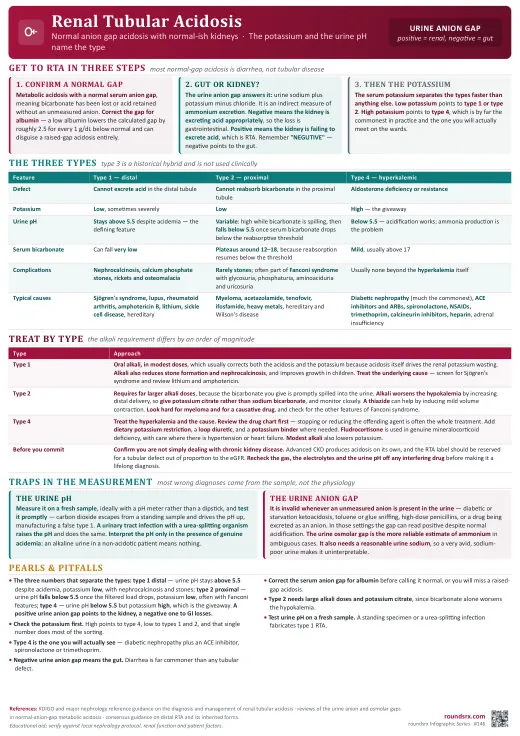
Renal Tubular Acidosis
| Feature | Type 1 (Distal) | Type 2 (Proximal) | Type 4 (Hypoaldo) |
|---|---|---|---|
| Defect | Cannot secrete H⁺ in collecting duct | Cannot reabsorb HCO₃⁻ in proximal tubule | ↓ Aldosterone effect → ↓ H⁺/K⁺ secretion |
| Serum K⁺ | ↓ Hypokalemia | ↓ Hypokalemia | ↑ Hyperkalemia |
| Urine pH | > 5.5 (cannot acidify) | < 5.5 (can acidify once bicarb threshold exceeded) | < 5.5 |
| Serum HCO₃⁻ | Can be very low (< 10) | Usually 12–20 (self-limited) | Usually > 15 (mild) |
| Associations | Sjögren, SLE, nephrocalcinosis, kidney stones | Fanconi syndrome, multiple myeloma, carbonic anhydrase inhibitors | Diabetes (#1), ACEi/ARBs, K-sparing diuretics, adrenal insufficiency |
| Treatment | Oral NaHCO₃ 1–2 mEq/kg/day | Oral NaHCO₃ (high doses needed) + thiazide | Fludrocortisone (Florinef), low-K diet, loop diuretics |
- Features: Type 2 RTA + glycosuria (normal blood glucose) + aminoaciduria + phosphaturia (hypophosphatemia/rickets) + uricosuria
- Causes: Multiple myeloma (light chains), tenofovir, cisplatin, Wilson disease, lead poisoning
- Key clue: Glucose in urine with NORMAL serum glucose = proximal tubular dysfunction, not diabetes
| Step | Question | Answer | Interpretation |
|---|---|---|---|
| 1 | Is the anion gap normal? | AG <=12 | Confirmed NAGMA. Proceed |
| 2 | Urine anion gap? | Negative (UCl > UNa + UK) | GI loss (diarrhea). Stop here |
| 3 | Urine anion gap? | Positive (UCl < UNa + UK) | RTA. Proceed to classify |
| 4 | Serum K+? | Hyperkalemia (>5.0) | Type 4 RTA. Check aldosterone/renin, medications |
| 5 | Serum K+? | Hypokalemia (<3.5) | Type 1 or Type 2. Check urine pH |
| 6 | Urine pH? | >5.5 | Type 1 (Distal). Check for stones, autoimmune |
| 7 | Urine pH? | <5.5 | Type 2 (Proximal). Check for Fanconi, myeloma |
- Type 1 (Distal): Oral sodium bicarbonate or sodium citrate 1–2 mEq/kg/day. Potassium supplementation (KCl). Relatively easy to correct -low doses suffice.
- Type 2 (Proximal): Oral sodium bicarbonate -but requires HIGH doses (10–15 mEq/kg/day) because bicarb is wasted in urine. Add thiazide diuretic (induces mild volume contraction → increases proximal reabsorption). K⁺ supplementation often needed.
- Type 4: Treat hyperkalemia first. Fludrocortisone (Florinef) 0.1 mg daily if hypoaldosteronism. Low-potassium diet. Furosemide (Lasix) (increases K⁺ excretion). Discontinue offending drugs (ACEi, K-sparing diuretics, TMP-SMX).
| Feature | Type 1 (Distal) | Type 2 (Proximal) | Type 4 (Hypoaldo) |
|---|---|---|---|
| Bicarb dose | Low (1-2 mEq/kg/day) | High (10-15 mEq/kg/day) | Usually not needed |
| Why? | Distal tubule cannot secrete H+, but proximal is intact so bicarb is retained | Proximal tubule wastes bicarb above lowered threshold, requiring massive replacement | Acidosis is mild (HCO3 usually >15) |
| K+ management | KCl supplementation (bicarb worsens hypoK) | KCl supplementation (bicarb worsens hypoK) | RESTRICT K+. Treat hyperK first |
| Unique therapy | Potassium citrate (prevents stones + corrects acidosis) | Add thiazide (volume contraction enhances proximal reabsorption) | Fludrocortisone 0.1 mg daily. Loop diuretics for K+ excretion |
| Stop offending drugs | Amphotericin B, lithium, toluene | Carbonic anhydrase inhibitors (acetazolamide), tenofovir, cisplatin | ACEi/ARBs, K-sparing diuretics, TMP-SMX, NSAIDs, heparin |
- ABG/VBG -non-anion gap metabolic acidosis (NAGMA)
- BMP -serum HCO₃⁻, K⁺, anion gap
- Urine pH -key differentiator (> 5.5 in Type 1)
- Urine anion gap -(Na⁺ + K⁺) - Cl⁻. Positive = RTA (renal cause). Negative = GI HCO₃⁻ loss (diarrhea).
- Serum aldosterone, renin (if Type 4 suspected)
- Urine electrolytes
- Step 1: Confirm NAGMA (normal anion gap metabolic acidosis)
- Step 2: Calculate urine anion gap → Positive = RTA, Negative = GI loss (diarrhea)
- Step 3: Check serum K⁺ → Hyperkalemia = Type 4, Hypokalemia = Type 1 or 2
- Step 4: Check urine pH → >5.5 = Type 1 (cannot acidify), <5.5 = Type 2
- Step 5: Look for associations → Stones/Sjögren = Type 1, Fanconi/myeloma = Type 2, DM/ACEi = Type 4
| Drug | Dose | Type |
|---|---|---|
| Sodium Bicarbonate | 1–2 mEq/kg/day (Type 1); 10–15 mEq/kg/day (Type 2) | Types 1 & 2 |
| Potassium Citrate | 20–40 mEq BID-TID | Type 1 -corrects acidosis AND prevents stones |
| Fludrocortisone (Florinef) | 0.1 mg PO daily | Type 4 -mineralocorticoid replacement |
| Furosemide (Lasix) | 20–40 mg PO daily | Type 4 -enhances K⁺ excretion |
| Hydrochlorothiazide (Microzide) | 12.5–25 mg daily | Type 2 -volume contraction increases proximal HCO₃⁻ reabsorption |
Patient: 32F with Sjögren syndrome, fatigue, muscle weakness. BMP: K 2.8, HCO₃ 12, AG 10 (normal). Urine pH 6.2.
Diagnosis: Type 1 (Distal) RTA.
Key findings:
- Cannot acidify urine below 5.5, urine pH 6.2 confirms distal defect
- Hypokalemia (K 2.8), classic for Type 1
- Sjögren syndrome, autoimmune cause of Type 1 RTA
Treatment: NaHCO₃ 1–2 mEq/kg/day + KCl supplementation. Monitor for nephrocalcinosis.
Patient: 65M with type 2 diabetes on lisinopril. BMP: K 6.1, HCO₃ 18, AG 10. Urine pH 5.0.
Diagnosis: Type 4 RTA.
Key findings:
- Hyperkalemia (K 6.1), hallmark of Type 4
- Diabetic nephropathy → hyporeninemic hypoaldosteronism
- ACEi (lisinopril) worsens by further reducing aldosterone
- Can acidify urine (pH 5.0), distinguishes from Type 1
Treatment: Stop lisinopril, low-K diet, fludrocortisone if persistent hyperkalemia.
Patient: 8-year-old with failure to thrive, rickets, glycosuria with normal blood glucose, aminoaciduria.
Diagnosis: Fanconi syndrome → Type 2 (Proximal) RTA.
Key findings:
- Everything leaking through proximal tubule: glucose, amino acids, phosphate, bicarbonate, uric acid
- Glycosuria with normal serum glucose, pathognomonic for proximal tubular dysfunction
- Rickets, from phosphate wasting (hypophosphatemia)
- Failure to thrive, chronic acidosis impairs growth in children
Workup: Evaluate for underlying cause, in children, cystinosis is the most common cause. In adults, consider multiple myeloma (light chains), tenofovir, cisplatin.