Rhabdomyolysis
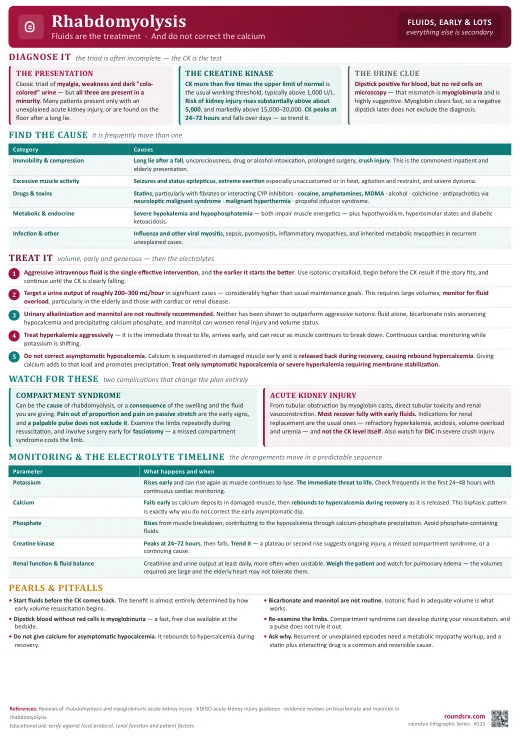
- Trauma/crush injury -earthquakes, prolonged immobilization, surgery
- Immobilization -found down (overdose, stroke, fall), prolonged surgery
- Drugs of abuse -cocaine, amphetamines, MDMA, PCP, synthetic cannabinoids
- Medications -statins (especially + fibrates or CYP3A4 inhibitors), daptomycin, colchicine, antipsychotics (NMS)
- Seizures -prolonged/status epilepticus
- Extreme exertion -marathon, military training, CrossFit (especially in heat)
- NMS / Serotonin syndrome -see NMS vs Serotonin Syndrome
- Heat stroke -see Heat Stroke
- Metabolic -hypokalemia, hypophosphatemia, hypothyroidism, DKA
- Infections -influenza, HIV, Legionella, group A strep
| Priority | Intervention | Details |
|---|---|---|
| 1. Aggressive IV fluids | NS or LR at 200–300 mL/hr | Target UOP 200–300 mL/hr (much higher than standard resuscitation). Goal: dilute myoglobin and prevent tubular precipitation. Most patients need 6–10 L in first 24h. Foley catheter mandatory for strict I&Os. |
| 2. Treat hyperkalemia | Calcium gluconate, insulin + D50, kayexalate/patiromer | Check K⁺ q4–6h. If K⁺ > 6.0 or ECG changes → calcium gluconate 1g IV for cardiac membrane stabilization → insulin 10 units + D50 for K⁺ shift → kayexalate or patiromer for removal. See Hyperkalemia. |
| 3. Bicarb (controversial) | Sodium bicarbonate 150 mEq in 1L D5W | Goal: urine pH > 6.5 to keep myoglobin soluble. Controversial -theoretical benefit but no strong RCT evidence. May worsen hypocalcemia (alkalosis binds ionized Ca). Consider if urine pH < 6.5. |
| 4. Compartment check | Measure compartment pressures | If limb injury involved or tense/swollen extremity. Pressure > 30 mmHg or within 30 mmHg of diastolic → emergent fasciotomy. Ortho/surgery consult. |
| 5. Dialysis (if needed) | Continuous RRT (CRRT) preferred | Indications: refractory hyperkalemia, volume overload, severe acidosis, uremia. Standard HD does NOT clear myoglobin (too large). CRRT may have theoretical benefit. |
- CK (creatine kinase) -diagnostic. Serial q6–12h until trending down. Peak usually at 24–72h. CK > 5,000 = significant rhabdo risk for AKI.
- BMP -K⁺ (hyperK!), Ca²⁺ (hypoCa), PO₄ (hyperPhos), Cr/BUN (AKI), bicarb (metabolic acidosis)
- Urinalysis -dipstick positive for blood but NO RBCs on microscopy = myoglobinuria. This is a classic boards question. The heme pigment on the dipstick cross-reacts with myoglobin.
- LDH -elevated (nonspecific muscle injury marker)
- Uric acid -often elevated (cell lysis)
- Coags (PT/INR, aPTT, fibrinogen) -DIC risk with severe rhabdo
- Lactate -tissue hypoperfusion marker
- Urine myoglobin -can confirm but not widely available and clears quickly. UA dipstick is adequate.
- Toxicology screen -if etiology unclear (cocaine, amphetamines)
- ECG -hyperkalemia changes (peaked T-waves, wide QRS)
Why it matters: A patient with AST 400 / ALT 250 / AST > ALT after a found-down event or seizure does not need a hepatitis B/C panel. Check CK first. Wasted serology workup delays the only thing that helps the kidneys, aggressive hydration to UOP 200–300 mL/hr.
Red flags that argue for true hepatic injury (look elsewhere if any are present): AST/ALT in the thousands without matching CK, ↑ INR, ↑ bilirubin out of proportion to CK, encephalopathy, or AST/ALT not tracking CK on serial labs (real liver injury usually means ischemic hepatitis from shock, drug-induced injury, or alcoholic hepatitis).
Myoglobin → kidney → urine (causes AKI, not jaundice). Filtered freely by the glomerulus (~17 kDa, small enough to pass). In acidic urine it precipitates as ferrihemate casts → tubular obstruction + oxidative injury to tubular epithelium + renal vasoconstriction → acute tubular necrosis. This is why rhabdo presents with tea-colored urine and AKI, the myoglobin gets excreted in urine before it can be metabolized to anything else.
Hemoglobin → spleen → bilirubin (causes jaundice when pathologic). Senescent RBCs are phagocytosed by splenic macrophages. Heme oxygenase converts heme to biliverdin; biliverdin reductase converts biliverdin to unconjugated bilirubin, which then travels to the liver for conjugation and biliary excretion. This pathway accounts for ~80% of daily bilirubin production.
Why the distinction matters: Myoglobin technically can yield trace bilirubin via the same heme-oxygenase pathway (the chemistry is identical), but clinically it doesn't produce jaundice because it's excreted in urine first. If a rhabdo patient is jaundiced, look elsewhere, hemolysis (free hemoglobin overwhelming haptoglobin → bilirubin surge), ischemic hepatitis from shock (AST in the thousands, ↑ LDH, ↑ INR), or drug-induced hepatic injury. Don't blame the myoglobin.
| Drug | Dose | Route | Role |
|---|---|---|---|
| Normal Saline or LR | 200–300 mL/hr | IV | FIRST-LINE -aggressive volume resuscitation to target UOP 200–300 mL/hr. LR may be preferred (less hyperchloremic acidosis) but avoid if K⁺ > 6.0 (contains 4 mEq/L K⁺). |
| Sodium bicarbonate | 150 mEq in 1L D5W | IV infusion | Urine alkalinization (target pH > 6.5). Controversial -no RCT evidence of benefit. Consider if urine pH < 6.5. |
| Calcium gluconate | 1–2 g IV over 10 min | IV | ONLY for hyperkalemia with ECG changes. Do NOT give for asymptomatic hypocalcemia. |
| Insulin (regular) + D50 | 10 units IV + 25g D50 | IV | K⁺ shifting for hyperkalemia. Onset 15–30 min, lasts 4–6h. |
| Kayexalate / Patiromer | Kayexalate 30g PO; Patiromer 8.4g PO | PO | K⁺ removal (delayed onset). Patiromer preferred (fewer GI side effects). |
| Parameter | Frequency | Target / Action |
|---|---|---|
| Urine output | Hourly (Foley required) | Target 200–300 mL/hr. If not meeting target, increase IV rate. If oliguric despite adequate fluids → nephrology consult. |
| CK (creatine kinase) | q6–12h | Trend to peak and decline. Stop aggressive IVF when CK trending down and < 5,000. |
| BMP (K⁺, Ca, PO₄, Cr) | q6h initially | K⁺ is the most dangerous -check frequently. Cr trend for AKI progression. |
| Urine pH | q6h if giving bicarb | Target > 6.5 if alkalinizing urine. |
| Compartment checks | q2–4h if limb involved | Tense, painful, swollen limb → measure pressures → fasciotomy if > 30 mmHg. |
| Vitals | q4h floor, q1–2h ICU | Watch for fluid overload with aggressive resuscitation. |
Patient: 34M found unresponsive on floor for unknown duration. PMH opioid use disorder. GCS 10 on arrival. Dark brown urine noted on Foley insertion.
Key findings: CK 85,000 IU/L. K+ 6.2. Cr 3.1 (baseline unknown). UA: dipstick positive for blood, no RBCs on microscopy (myoglobinuria). R gluteal compartment firm and tender.
Management:
- Aggressive IV crystalloid (NS or LR) 200-300 mL/hr targeting UOP 200-300 mL/hr
- Treat hyperkalemia: calcium gluconate 3g IV (ECG changes present), insulin 10 units + D50, kayexalate
- Do NOT give calcium for hypocalcemia (will worsen muscle injury), only for hyperK with ECG changes
- Monitor CK, K+, Cr, phosphorus q4-6h
- Orthopedic surgery consult for compartment pressure measurement
Teaching point: Immobilization ("found down") is one of the most common causes of rhabdomyolysis. The three killers are hyperkalemia (check K+ q4-6h), AKI (myoglobin tubular necrosis), and compartment syndrome. Dipstick positive for blood with no RBCs on microscopy is the classic myoglobinuria finding.
Patient: 68F, PMH hyperlipidemia, CKD stage 3. Started simvastatin 80 mg 3 weeks ago (recently added clarithromycin for pneumonia). Presents with diffuse myalgias, weakness, tea-colored urine.
Key findings: CK 22,000. Cr 2.8 (baseline 1.6). K+ 5.4. Phosphorus 6.1. Simvastatin + clarithromycin = CYP3A4 drug interaction causing toxic statin levels.
Management:
- Stop simvastatin AND clarithromycin immediately
- IV fluids 200-300 mL/hr (adjust for CKD, monitor for volume overload)
- Target UOP 200-300 mL/hr
- Avoid calcium for asymptomatic hypocalcemia
- When recovered: switch to rosuvastatin or pravastatin (not CYP3A4 metabolized)
Teaching point: Statins metabolized by CYP3A4 (simvastatin, atorvastatin, lovastatin) have dangerous interactions with CYP3A4 inhibitors (macrolides, azole antifungals, protease inhibitors). Rosuvastatin and pravastatin are safer alternatives because they are not CYP3A4 substrates.
Patient: 25M after crush injury to R leg (motor vehicle accident). CK 120,000. R anterior leg tense, exquisitely painful with passive stretch of toes. Distal pulses present.
Key findings: Compartment pressure measurement: 38 mmHg (normal < 10). Delta pressure (diastolic BP - compartment pressure) = 22 mmHg (< 30 = concerning). Classic 5 P's: pain out of proportion, pain with passive stretch, pressure, paresthesias (late), pulselessness (very late).
Management:
- Emergent fasciotomy, this is a surgical emergency
- Do NOT wait for all 5 P's, pulselessness means irreversible damage has occurred
- Continue aggressive IV fluids for rhabdomyolysis
- Monitor for reperfusion injury after fasciotomy (may worsen hyperkalemia transiently)
- Serial CK and K+ monitoring post-fasciotomy
Teaching point: Compartment syndrome is a clinical/manometric diagnosis. Delta pressure (diastolic BP - compartment pressure) < 30 mmHg is an indication for emergent fasciotomy. Pulses may be preserved even with critical compartment pressures, do not rely on distal pulses to rule out compartment syndrome.