Sarcoidosis
Sarcoidosis is a systemic granulomatous disease of unknown etiology characterized by non-caseating granulomas in affected organs. The lungs are involved in ~90% of cases. Other commonly affected organs: skin (erythema nodosum, lupus pernio), eyes (anterior uveitis), liver (granulomatous hepatitis), heart (conduction abnormalities, cardiomyopathy), and nervous system (cranial nerve palsies, especially CN VII). Epidemiology: peaks at age 25-35, higher incidence and more severe disease in African Americans and Scandinavians.
A specific acute presentation with an excellent prognosis (>90% spontaneous resolution): bilateral hilar lymphadenopathy + erythema nodosum + polyarthralgia + fever. So characteristic that biopsy is often NOT required for diagnosis. More common in young women.
- Stage 0 -Normal CXR
- Stage I -Bilateral hilar lymphadenopathy (BHL) alone. ~60-80% spontaneous remission.
- Stage II -BHL + pulmonary infiltrates. ~50-60% remission.
- Stage III -Pulmonary infiltrates WITHOUT lymphadenopathy. ~30% remission.
- Stage IV -Pulmonary fibrosis. Irreversible. Poor prognosis.
Many patients need NO treatment -sarcoidosis is self-resolving in a large proportion of cases, especially Stage I and Lofgren syndrome. Observation alone is appropriate for asymptomatic patients with stable disease.
- Progressive pulmonary disease -worsening PFTs, increasing infiltrates
- Cardiac involvement -heart block, cardiomyopathy, ventricular arrhythmias
- Neurological involvement -cranial nerve palsies, CNS mass lesions, seizures
- Hypercalcemia -from granulomatous production of 1,25-dihydroxyvitamin D
- Disfiguring skin disease -lupus pernio
- Significant eye disease -posterior uveitis, optic neuritis refractory to topical therapy
- Renal involvement -nephrocalcinosis, nephrolithiasis from hypercalciuria
Prednisone 20-40 mg daily x 4-6 weeks, then slow taper over 6-12 months. Total treatment duration typically 12+ months. Relapse rate is high (~30-50%) when steroids are tapered. NSAIDs can be used for mild arthralgia and erythema nodosum.
Consider when: unable to taper below prednisone 10 mg/day, steroid side effects, or relapse on taper.
- Methotrexate (Trexall) -most commonly used steroid-sparing agent. 10-15 mg weekly. Supplement with folic acid.
- Azathioprine (Imuran) -alternative to MTX. 50-200 mg daily. Check TPMT before starting.
- Mycophenolate (CellCept) -500-1500 mg BID. Used for refractory disease.
Infliximab (Remicade) -anti-TNF-alpha. Reserved for severe disease failing conventional therapy. Evidence strongest for lupus pernio and neurosarcoidosis.
- CXR -Scadding staging (I-IV). Bilateral hilar lymphadenopathy is classic.
- CT chest -better characterization of parenchymal disease, lymphadenopathy pattern
- PFTs -restrictive pattern (decreased FVC, decreased DLCO). Obstructive pattern also possible with endobronchial involvement.
- ACE level -elevated in ~60% but NOT diagnostic. Neither sensitive nor specific (see alert below).
- Calcium -check serum calcium (hypercalcemia from granulomatous 1,25-vitamin D production)
- 24-hour urine calcium -hypercalciuria may be present even with normal serum calcium
- CBC, BMP, LFTs -baseline; elevated alk phos suggests hepatic granulomas
- ECG -screen for heart block (PR prolongation, bundle branch block). If abnormal, consider cardiac MRI or PET.
- Ophthalmology exam -screen for uveitis (anterior > posterior), even if asymptomatic
- Biopsy of accessible tissue -lung (transbronchial), skin, lymph node. REQUIRED for definitive diagnosis.
| Drug | Dose | Route | Notes |
|---|---|---|---|
| Prednisone 1ST LINE | 20-40 mg daily x 4-6 wk, then taper over 6-12 months | PO | Start at higher dose for severe organ involvement (cardiac, neuro). Monitor glucose, BP, bone density. |
| Methotrexate (Trexall) | 10-15 mg weekly | PO/SQ | Most common steroid-sparing agent. Add folic acid 1 mg daily. Monitor LFTs, CBC q4-8 weeks. Avoid in pregnancy (teratogenic). Vorselaars, Chest 2013 |
| Azathioprine (Imuran) | 50-200 mg daily | PO | Check TPMT before starting (homozygous deficiency = fatal myelosuppression). Monitor CBC regularly. |
| Mycophenolate (CellCept) | 500-1500 mg BID | PO | Alternative steroid-sparing. GI side effects common. Monitor CBC. |
| Infliximab (Remicade) | 3-5 mg/kg IV at weeks 0, 2, 6, then q4-8 weeks | IV | For refractory disease. Screen for TB before starting (anti-TNF reactivates latent TB). Baughman, AJRCCM 2006 |
| Hydroxychloroquine | 200-400 mg daily | PO | Useful for skin sarcoidosis, hypercalcemia, and fatigue. Annual eye exams for retinal toxicity. |
Patient: 34-year-old African American woman with 3 months of dry cough, dyspnea, and painful shin nodules. Blurry vision OS.
Key findings: CXR: bilateral hilar LAD + reticular opacities (Stage II). PFTs: FVC 65%, DLCO 58%. Calcium 11.2. Ophthalmology: anterior uveitis. Biopsy: non-caseating granulomas, AFB/fungal negative.
Management:
- Prednisone 40 mg daily × 4-6 weeks, then taper over 6-12 months
- Topical steroids for uveitis (ophthalmology comanagement)
- Methotrexate as steroid-sparing agent for prolonged therapy
- ECG screening for cardiac sarcoidosis
Teaching point: Not all sarcoidosis needs treatment. Indications: progressive pulmonary disease, hypercalcemia, cardiac involvement, neurosarcoidosis, sight-threatening uveitis.
Patient: 28-year-old Scandinavian woman with acute bilateral ankle pain, fever, and tender erythematous shin nodules × 1 week.
Key findings: CXR: bilateral hilar LAD (Stage I). Classic triad: BHL + erythema nodosum + polyarthralgia. ESR elevated. Calcium normal.
Management:
- Biopsy NOT required, Lofgren syndrome is clinically diagnostic
- > 90% spontaneous resolution within 2 years
- NSAIDs for symptoms. Low-dose prednisone only if refractory.
- Follow-up CXR in 3-6 months to confirm resolution
Teaching point: Lofgren syndrome has the best prognosis in sarcoidosis. Recognize the triad. Rarely needs immunosuppression.
Patient: 42-year-old man with known pulmonary sarcoidosis presenting with palpitations and near-syncope. ECG: new complete heart block.
Key findings: Cardiac MRI: late gadolinium enhancement in basal septum. LVEF 40% (was 55%). FDG-PET: active myocardial inflammation. No CAD on angiography.
Management:
- Temporary pacing wire; evaluate for permanent pacemaker/ICD
- Prednisone 40-60 mg daily for active cardiac sarcoidosis
- Steroid-sparing agent (methotrexate or mycophenolate)
- ICD if LVEF ≤ 35% or sustained VT
- Guideline-directed HF therapy
Teaching point: Cardiac sarcoidosis is a leading cause of death. Screen ALL sarcoidosis patients with ECG. New AV block or unexplained cardiomyopathy → cardiac MRI or FDG-PET.
Ms. Davis is a 34-year-old African American woman presenting with 3 months of dry cough, progressive dyspnea on exertion, and bilateral ankle swelling. She also notes painful red bumps on her shins and bilateral ankle pain. CXR shows bilateral hilar lymphadenopathy with diffuse reticular opacities (Stage II). PFTs: FVC 65% predicted, DLCO 58% predicted. Labs: calcium 11.2, ACE level 85 (elevated), LFTs mildly elevated. Ophtho exam: anterior uveitis OS. Transbronchial biopsy: non-caseating granulomas. AFB and fungal stains negative.
- PFTs -repeat every 3-6 months while on treatment. FVC and DLCO most useful for tracking disease activity.
- CXR or CT chest -every 6-12 months depending on disease severity.
- Serum calcium and 24h urine calcium -monitor for hypercalcemia/hypercalciuria, especially when tapering steroids.
- Ophthalmology -annual screening even if asymptomatic. More frequent if active uveitis.
- ECG -annual. Low threshold for cardiac MRI or PET if new symptoms (palpitations, syncope, dyspnea).
- LFTs -monitor for hepatic sarcoidosis and drug toxicity (MTX, azathioprine).
- CBC -for steroid-sparing drug monitoring (MTX, azathioprine, mycophenolate).
- Bone density (DEXA) -if on prolonged steroids (>3 months prednisone >= 5 mg/day).
- ACE level -some clinicians follow trends, but NOT useful for diagnosis or as sole marker of disease activity.
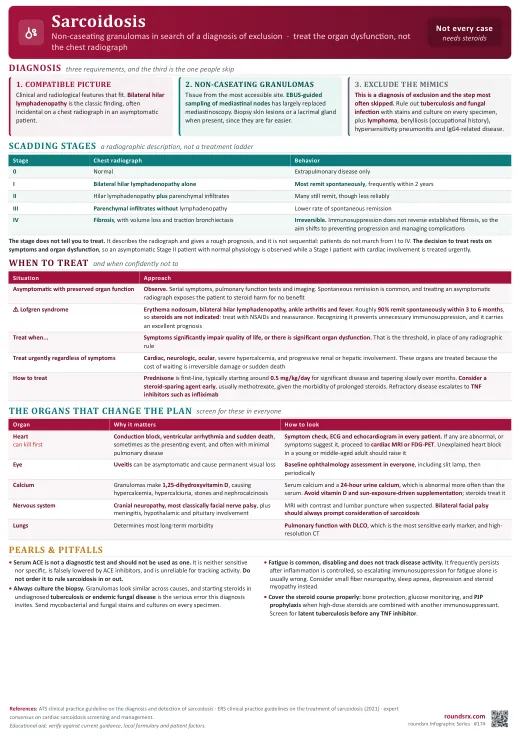
Text version
- Diagnosis requires two things: tissue biopsy showing non-caseating granulomas plus exclusion of other causes (TB, fungal infection, lymphoma, berylliosis). Biopsy accessible tissue: lung (transbronchial), skin, or lymph node.
- Stage 0: normal CXR.
- Stage I: bilateral hilar lymphadenopathy (BHL) alone. ~60–80% spontaneous remission, which is why observation is a legitimate plan, not neglect.
- Stage II: BHL + pulmonary infiltrates. ~50–60% remission.
- Stage III: pulmonary infiltrates without lymphadenopathy. ~30% remission.
- Stage IV: pulmonary fibrosis. Irreversible, poor prognosis, and the reason you follow PFTs rather than waiting for symptoms.
- Lofgren syndrome: BHL + erythema nodosum + polyarthralgia + fever. > 90% spontaneous resolution, so characteristic that biopsy is often not required. More common in young women.
- Epidemiology that raises suspicion: peaks at age 25–35, higher incidence and more severe disease in African Americans and Scandinavians.
- Many patients need no treatment at all. Sarcoidosis self-resolves in a large proportion of cases, especially Stage I and Lofgren syndrome. Observation alone is appropriate for the asymptomatic patient with stable disease, and steroids carry real harm over 12+ months.
- Progressive pulmonary disease (worsening PFTs, increasing infiltrates): treat, because the endpoint of untreated progression is Stage IV fibrosis, which is irreversible.
- Cardiac involvement (heart block, cardiomyopathy, ventricular arrhythmias): treat. Cardiac involvement is a leading cause of death in sarcoidosis.
- Neurologic involvement (cranial nerve palsies, CNS mass lesions, seizures): treat.
- Hypercalcemia from granulomatous 1,25-dihydroxyvitamin D production: treat.
- Significant eye disease (posterior uveitis, optic neuritis refractory to topical therapy): treat systemically.
- Renal involvement (nephrocalcinosis, nephrolithiasis from hypercalciuria): treat.
- Disfiguring skin disease (lupus pernio): treat.
- PFTs q3–6 months on treatment. FVC and DLCO are the most useful markers of disease activity and are what tell you whether you are preventing Stage IV fibrosis.
- CXR or CT chest q6–12 months, interval set by disease severity.
- Serum calcium and 24h urine calcium, especially while tapering steroids, since steroid withdrawal can unmask recurrent granulomatous vitamin D activation.
- Ophthalmology annually even if asymptomatic, more often with active uveitis, because sight-threatening disease can be silent.
- ECG annually, with a low threshold for cardiac MRI or FDG-PET on any new palpitations, syncope, or dyspnea.
- LFTs for both hepatic sarcoidosis and drug toxicity (MTX, azathioprine); CBC q4–8 weeks on MTX and for azathioprine or mycophenolate monitoring.
- DEXA if on prolonged steroids (> 3 months of prednisone ≥ 5 mg/day), because the treatment course is measured in years.
- Using ACE level to diagnose. Sensitivity only ~60% and poor specificity. ACE inhibitors lower it (false negative), diabetes, hyperthyroidism, and other granulomatous diseases raise it (false positive). Never a sole diagnostic criterion.
- Following ACE as a disease-activity marker. Some clinicians trend it, but it is not reliable enough to drive treatment decisions; use PFTs and organ-specific markers.
- Treating everyone. Stage I and Lofgren syndrome mostly resolve without immunosuppression, and 12+ months of steroids is not a benign exposure.
- Skipping the ECG. Cardiac sarcoidosis is a leading cause of death and AV block is often the first sign; screen all patients.
- Skipping the eye exam in someone with no eye complaints, when uveitis is frequently asymptomatic early.
- Missing hypercalciuria by checking only serum calcium, when the 24-hour urine can be abnormal with a normal serum level.
- Calling it sarcoid without excluding the mimics: TB, fungal infection, lymphoma, and berylliosis all produce granulomas or hilar adenopathy.
- New AV block, palpitations, syncope, or unexplained cardiomyopathy: cardiac MRI (late gadolinium enhancement) or FDG-PET. Consider temporary pacing and evaluation for permanent pacemaker or ICD; ICD if LVEF ≤ 35% or sustained VT. Prednisone 40–60 mg daily for active cardiac sarcoidosis, plus guideline-directed HF therapy.
- Cranial nerve palsy, CNS mass lesion, or seizure: neurosarcoidosis, treat rather than observe, and infliximab has the strongest evidence in refractory disease.
- Cannot taper below prednisone 10 mg/day, steroid toxicity, or relapse on taper: add methotrexate (or azathioprine, mycophenolate).
- Severe disease failing conventional therapy: infliximab, with evidence strongest for lupus pernio and neurosarcoidosis. Screen for TB first, since anti-TNF reactivates latent TB.
- Posterior uveitis or optic neuritis refractory to topical therapy: systemic therapy with ophthalmology comanagement.
- Vorselaars, Chest 2013: methotrexate versus azathioprine as second-line therapy, the basis for methotrexate being the usual first steroid-sparing choice.
- Baughman, AJRCCM 2006: infliximab in chronic sarcoidosis with pulmonary involvement, supporting anti-TNF for refractory disease.
- Why hypercalcemia happens: activated macrophages in sarcoid granulomas express 1-alpha-hydroxylase, converting 25-hydroxyvitamin D to 1,25-dihydroxyvitamin D. This extra-renal production is not regulated by PTH, so intestinal calcium absorption rises and PTH is appropriately suppressed, unlike primary hyperparathyroidism. Corticosteroids work by suppressing macrophage activity.